Ahrefs Content Strategy: A Step-by-Step Framework for 2026
Ahrefs is one of the most powerful SEO toolkits available, but owning a subscription doesn't automatically translate into results. What separates sites that grow from those that stall is a clear ahrefs content strategy, a repeatable process for finding the right keywords, mapping content to search intent, and publishing consistently enough to build topical authority over time.
This guide breaks down a step-by-step framework you can follow in 2026 to turn Ahrefs data into a content plan that actually moves the needle. You'll learn how to prioritize keywords, structure topic clusters, analyze competitors, and build a publishing cadence that compounds. We'll also show where tools like RankYak fit in, specifically, how you can automate the execution side (daily content creation, optimization, and publishing) so the strategy you build inside Ahrefs doesn't die in a spreadsheet.
Whether you're a solo founder, a small marketing team, or an agency managing multiple sites, this framework gives you a practical path from raw keyword data to ranked content. Let's get into it.
What an Ahrefs-style content strategy is
An Ahrefs-style content strategy is a data-driven system built around three pillars: finding topics people actually search for, mapping those topics to business goals, and publishing in a way that builds topical authority over time. It's not about writing whatever feels relevant. It's about using search data to make deliberate decisions on what to create, when to create it, and why.
The core principles
At its foundation, this approach prioritizes search demand and business value above all else. The Ahrefs team has popularized a specific method: target keywords with real search volume, filter by keyword difficulty you can realistically compete for, and assign a business potential score to each topic based on how naturally your product fits into the content. A topic like "how to find broken backlinks" scores high for Ahrefs because their tool solves that problem directly. A topic about "best fonts for websites" scores near zero.
This business potential filter is what separates a strategy that drives revenue from one that only drives traffic.
Ahrefs uses a simple 0-3 scoring scale that you can apply to your own niche:
- 3: Your product is the direct solution to the problem the article addresses
- 2: Your product is mentioned but isn't the central focus
- 1: The connection between the topic and your product is loose
- 0: No meaningful connection exists
How it differs from generic content planning
Most content calendars start with brainstorming sessions and end with publishing articles that have no connection to a measurable outcome. An Ahrefs-style approach does the opposite. You start with keyword research data, work backward to identify which topics can rank, and then map each piece of content to a stage in your audience's buying journey. Every article has a job: attract traffic, build trust, or convert readers.
This framework also bakes in competitive analysis from the start. Before you write anything, you check what's already ranking, assess the quality of top results, and run a keyword gap analysis to identify gaps you can fill. You're not writing into a void. You're making a calculated bet that your content can outrank what's sitting on page one.
Step 1. Set goals and define your audience
Before you open Ahrefs and start pulling keyword data, you need to know two things: what you want your content to achieve and who you're writing for, so it helps to have the basics of keyword research for beginners clear first. Skipping this step is the most common reason an ahrefs content strategy falls apart. You end up with a list of keywords that attracts traffic from the wrong people, or content that ranks but never converts.
Define what success looks like
Every content goal should connect to a business outcome, not a vanity metric. Traffic numbers mean nothing if none of those readers ever buy, sign up, or return. Set goals that tie directly to revenue or pipeline: organic leads per month, trial signups from blog content, or pages ranking in the top five for your target keywords.
Use your goals as a filter. If a keyword can't move one of your metrics, it probably doesn't belong in your content plan.
Profile your audience
Your audience profile shapes every keyword and content decision you make downstream. Before you search anything, write down who your ideal reader is, what problem they're trying to solve, and where they sit in the buying process. Use a simple template like this:
| Attribute | Example |
|---|---|
| Role | Founder, content marketer |
| Core problem | Not enough organic traffic |
| Buying stage | Evaluating solutions |
| Search behavior | "How to" and "best tool for" queries |
Step 2. Build a keyword and topic map in Ahrefs
The keyword research phase is where your ahrefs content strategy gets its raw material. You're not just looking for individual keywords here. You're building a topic map: a structured view of everything your audience searches for, organized by theme and intent.
Start with seed keywords
Open Keywords Explorer, Ahrefs' keyword explorer tool, and type in three to five broad terms that describe your core product or service. For a project management tool, that might be "project management," "task tracking," and "team collaboration." These seeds pull back thousands of related queries you can filter down.
Filter by a Keyword Difficulty (KD) score below 30 if your site is new, or below 50 if you have an established domain with solid backlinks.
Export the filtered list and delete any keyword that doesn't match your audience profile from Step 1. You'll end up with a shorter, sharper list of terms worth targeting.
Group topics into clusters
Once you have your keyword list, group related terms into topic clusters. Each cluster centers on one broad "pillar" topic and connects to several supporting subtopics, the same shape as a topical map of pillars and supporting articles. Use this table structure to organize your map:
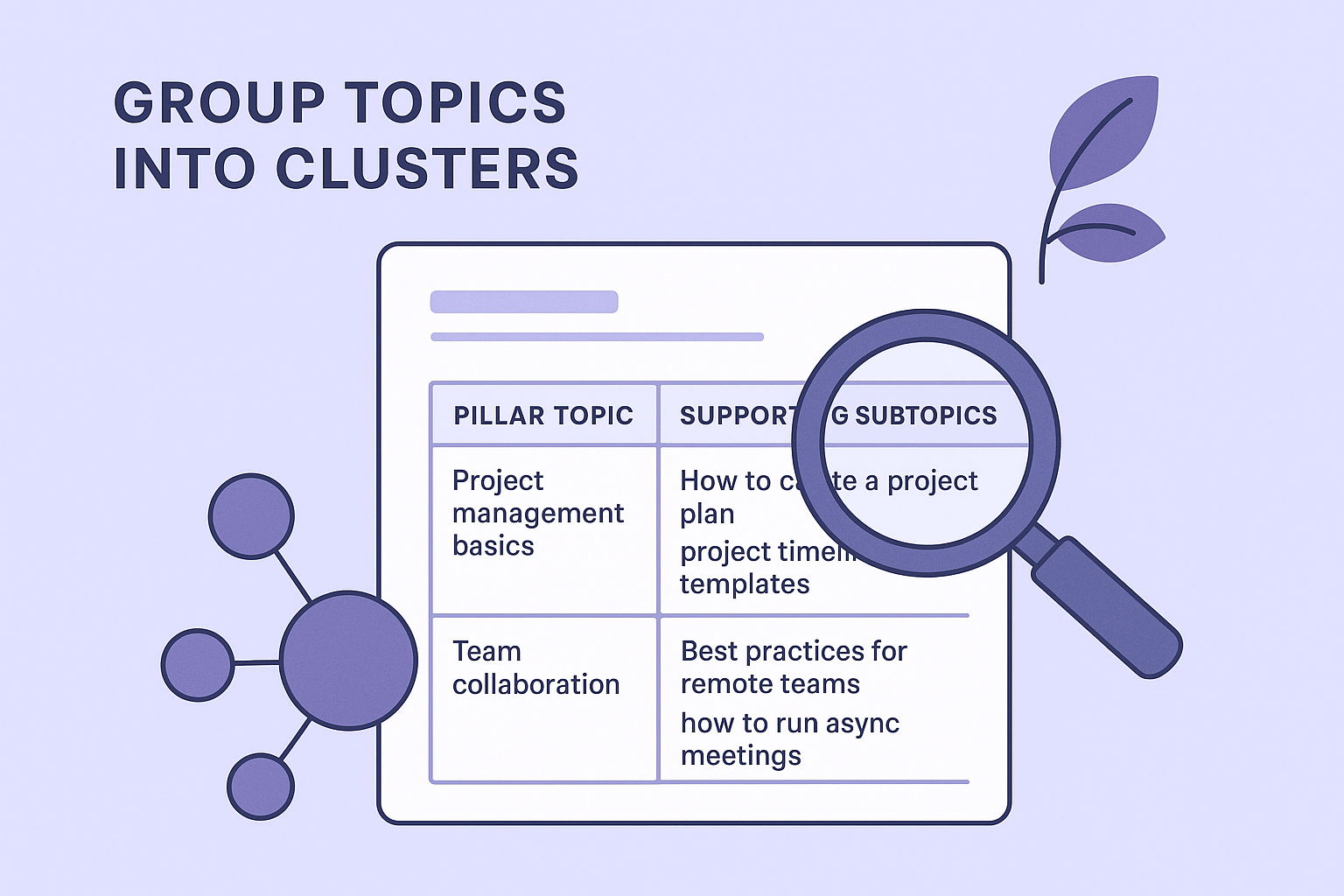
| Pillar Topic | Supporting Subtopics |
|---|---|
| Project management basics | How to create a project plan, project timeline templates |
| Team collaboration | Best practices for remote teams, how to run async meetings |
This structure signals to search engines that your site has depth on a subject, which compounds your authority in that topic area over time.
Step 3. Prioritize topics by business potential
Once you have your topic map, you need to decide what to write first. Picking topics by gut feeling or search volume alone is the most common mistake content teams make. In an ahrefs content strategy, you rank every topic by business potential before you commit any resources to writing.
Score each topic before you write
Apply the 0-3 business potential scale to every topic in your cluster map. This takes about 20 minutes and protects you from producing content that ranks but never generates a single qualified lead. Work through your list, assign each topic a score, then sort descending.

Start with your 3-scored topics. These convert at a higher rate because your product is the direct answer to the reader's problem.
| Topic | Monthly Volume | KD | Business Score |
|---|---|---|---|
| How to audit backlinks | 2,400 | 28 | 3 |
| Best project management tools | 5,000 | 45 | 2 |
| What is a Gantt chart | 8,000 | 35 | 1 |
Balance reach and relevance
High-volume topics with a low business score pull traffic that never converts. Aim to keep roughly 60% of your publishing slots on topics scored 2 or 3.
Reserve the remaining 40% for informational content that builds topical authority within your cluster. These lower-scored pieces support your pillar pages by capturing top-of-funnel readers who later discover your product through related articles.
Step 4. Create, publish, and update content
Once your priority list is set, execution becomes the bottleneck. Most teams do solid keyword research and then slow to a trickle when it's time to actually publish. Your ahrefs content strategy only works if you ship content consistently and keep it current as search results shift.
Build a publishing schedule you can keep
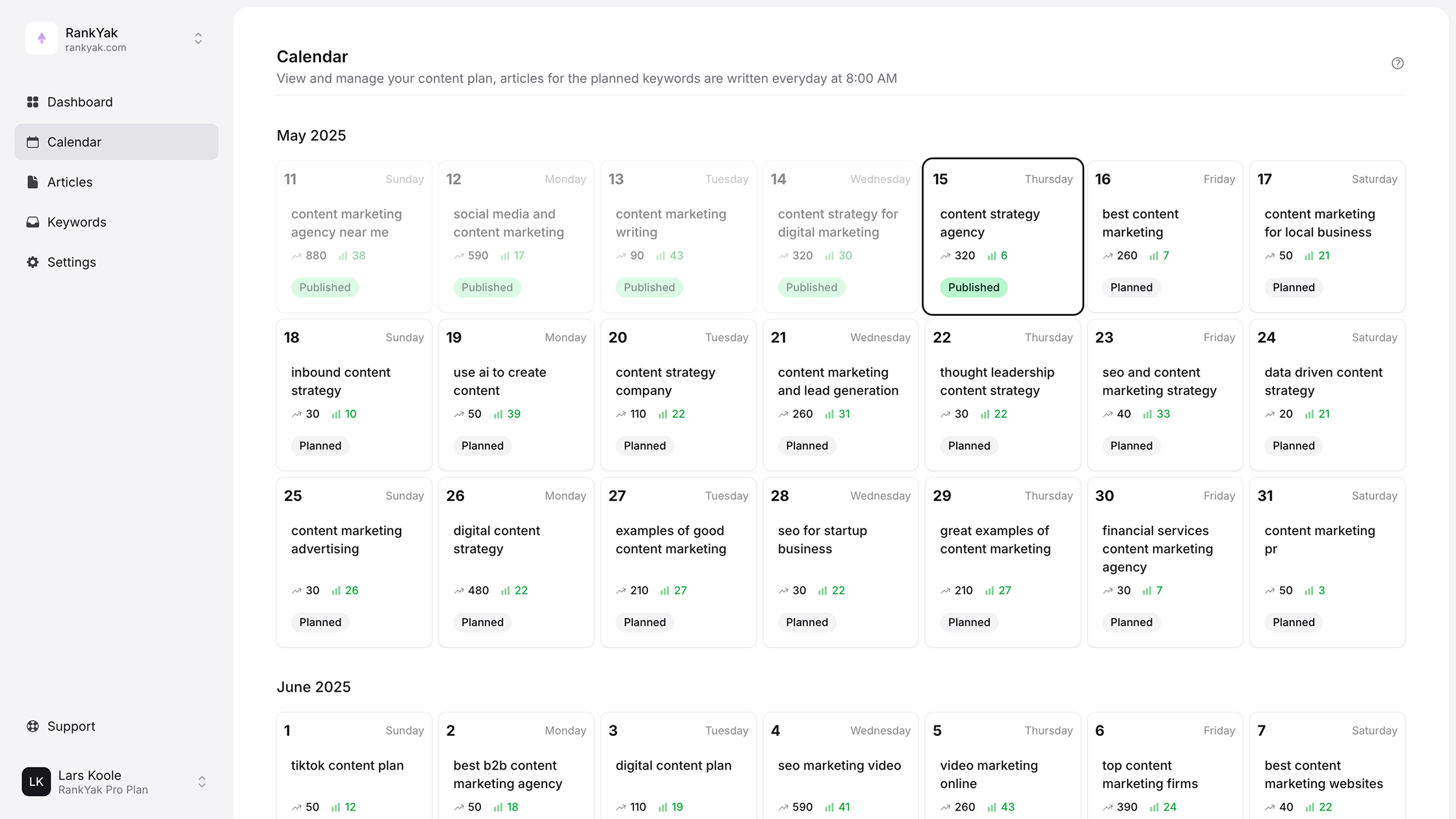
Consistency beats volume every time. Set a realistic cadence based on your actual capacity, whether that's one article per week or one per day. Use a simple planned publishing calendar to track status across each piece:
| Article Title | Target Keyword | Publish Date | Status |
|---|---|---|---|
| How to audit backlinks | backlink audit | Week 1 | In progress |
| Best project management tools | PM tools list | Week 2 | Scheduled |
Refresh content on a set cycle
Published content is not finished content. Search results change, competitors update their pages, and Google rewards freshness on competitive topics. Set a calendar reminder to review every published article every six months. Check if rankings dropped on pages stuck below page one, update outdated data, and add new sections where search intent has shifted.
A 20-minute refresh on a page that dropped from position 3 to position 11 often costs less than writing a brand new article from scratch.
Prioritize updates on your highest business potential topics first. These pages drive the most direct revenue impact, so keeping them current protects your most valuable organic assets.
What to do next
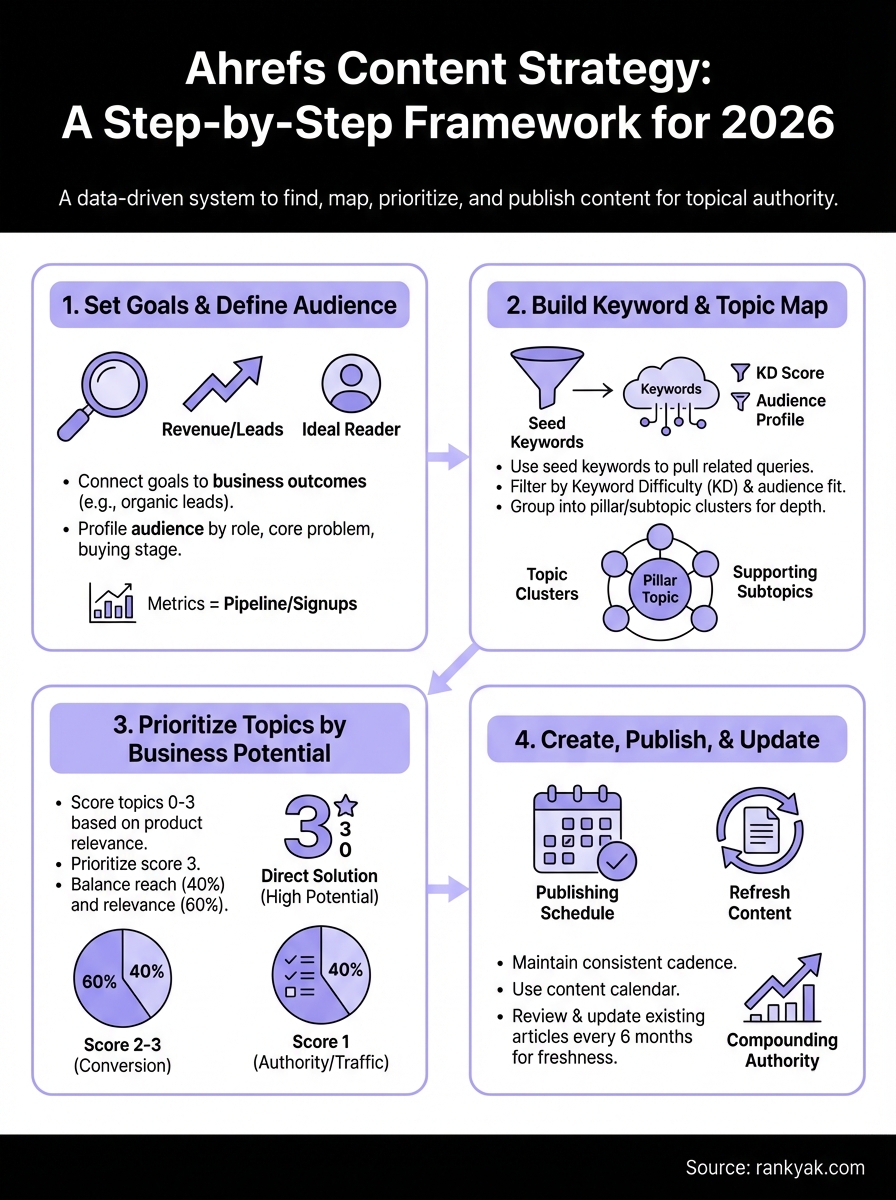
You now have a complete ahrefs content strategy framework: set goals, build a keyword map, score topics by business potential, and publish on a schedule you can realistically maintain. The hard part isn't understanding the process. It's keeping execution moving week after week without letting the content calendar go quiet for months.
Start with one action today. Open Ahrefs Keywords Explorer, enter three to five seed keywords from your niche, and export the filtered list. Score the top 20 topics using the 0-3 business potential scale from Step 3. That single session gives you a prioritized publishing list you can act on immediately without second-guessing what to write next.
Consistent publishing is where most content strategies fall apart. If daily content creation feels like too much to manage on your own, you can let RankYak run your content on autopilot, from keyword selection and article writing to direct publishing to your CMS, keeping your strategy active without the daily grind.
Allan de Wit is a co-founder of RankYak and has worked in SEO since 2015: inside agencies, alongside them, for clients directly, and in-house on the products being ranked. He came to it as a software engineer building for marketers, which is why the platform is built the way it is. He went on to start companies of his own, two of which were acquired. At RankYak he sets the product direction and owns the features, the quality bar, the design, and the UX.