8 B2B Content Marketing Examples That Actually Drive Leads
Most B2B companies publish blog posts, send emails, and post on LinkedIn, yet only a fraction of that effort turns into actual pipeline. The difference between content that fills a calendar and content that fills a CRM often comes down to a documented B2B content marketing strategy, not volume. Studying real b2b content marketing examples can show you exactly where that gap is, and how to close it.
We built RankYak to help businesses automate the SEO side of content marketing, from keyword research to publishing. But even the best automation needs a strong strategic foundation. That's why we pulled together eight campaigns from B2B brands that aren't just producing content for the sake of it, they're generating measurable leads with every piece they ship, alongside our wider roundup of content marketing examples worth copying.
Below, you'll find examples spanning blog series, newsletters, podcasts, social campaigns, and more. Each one breaks down what worked, why it worked, and how you can apply the same thinking to your own marketing. Let's get into it.
1. RankYak
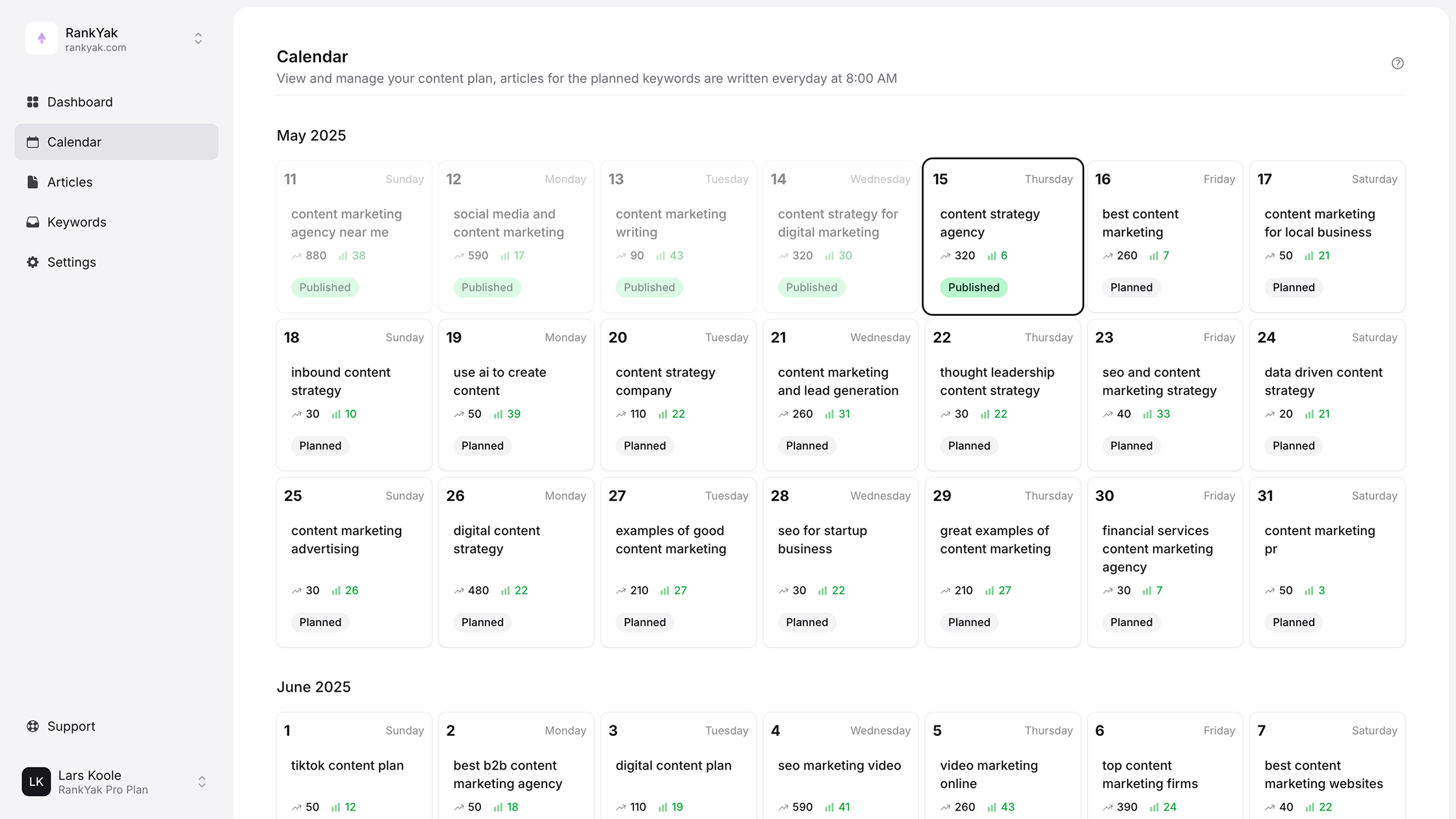
RankYak is an SEO automation platform that publishes one fully optimized article every day to your website, handling everything from keyword research to content creation to CMS publishing. Instead of manually piecing together a content strategy, you connect your site and RankYak builds the entire roadmap for you.
What the content engine produces
Every article RankYak generates is up to 5,000 words, structured around search intent, competitor research, and Google's helpful content guidelines. The platform identifies high-potential keywords for your niche, writes articles with internal linking and topic clusters built in, schedules them on a rolling content plan, and adapts to your brand voice so the content doesn't read like generic AI output. It also supports over 40 languages, making it a strong fit for businesses targeting international markets or multilingual audiences.
Why it drives leads
Among the b2b content marketing examples in this list, RankYak's approach stands out because it solves a fundamental problem: most B2B teams can't publish consistently enough to build real authority. Consistent publishing is one of the most reliable ways to compound organic traffic over time. RankYak removes that bottleneck entirely. By publishing daily, your site builds topical authority faster, which means more pages ranking in Google and AI chat platforms like ChatGPT and Perplexity.
Consistency in publishing is not a nice-to-have; it is the single biggest predictor of long-term organic growth.
How to replicate the approach
You can apply this model without a tool by setting a realistic publishing cadence, mapping your content to keyword clusters scored by volume and difficulty, and optimizing each piece for search intent rather than raw keyword density. The challenge is that doing this manually at scale requires a dedicated team and significant budget. If you are a small business or solo operator, a platform that automates the research and writing pipeline lets you focus on distribution and conversion instead of production.
Pricing
What the platform costs is straightforward, with plans that include keyword discovery, daily article creation, automatic publishing, backlink exchange, and multi-site management. There is a 3-day free trial you can cancel anytime, with no questions asked and no contracts required.
2. CB Insights newsletter
CB Insights built one of the most recognized B2B newsletters in the tech space by doing something most companies avoid: writing with a strong editorial voice instead of a bland corporate tone. The newsletter covers venture capital, startup trends, and market data, and it reaches over a million subscribers consistently.
What the content looks like
Each edition mixes proprietary research and data visualizations with sharp, opinionated commentary. The format stays consistent, the tone stays direct, and the content teaches readers something they cannot find anywhere else. CB Insights owns its data, which means every newsletter delivers exclusive analysis that no competitor can replicate.
Why it drives leads
The newsletter keeps CB Insights top of mind with decision-makers and investors who rely on it weekly. When those readers need a deeper research platform, CB Insights is the obvious choice. This is one of the strongest b2b content marketing examples of building pipeline through trust rather than direct promotion.
A newsletter that consistently teaches your audience something valuable converts readers into buyers over time without a single hard sell.
How to replicate the approach
Pick one topic your business has unique data or a distinct perspective on, then publish on a fixed schedule. Resist the urge to make every edition a product pitch, because the value of the content is what keeps subscribers coming back.
Key metrics to track
Track open rate, click-through rate, and subscriber growth week over week to identify which topics resonate most and where to focus next.
3. Gong Labs
Gong Labs is the research and insights arm of Gong, a revenue intelligence platform. The team mines millions of real sales calls and customer interactions from Gong's platform to publish data-driven findings about what actually works in sales conversations.
What the content looks like
Each Gong Labs post centers on a specific, testable claim backed by call data. Topics like "what top sales reps say in the first 60 seconds" or "how deal velocity changes with specific phrases" turn raw behavioral data into actionable guidance that sales teams can apply immediately.
Why it drives leads
Gong Labs stands out among b2b content marketing examples because the content is impossible to replicate without Gong's proprietary data. Every piece builds credibility and authority with the exact buyers Gong wants to reach: sales leaders and revenue teams who care deeply about improving their numbers.
When your content is built on data only your company can produce, you own a content category no competitor can enter.
How to replicate the approach
Dig into your own product data or customer behavior to find patterns worth publishing. You do not need millions of data points to start. Even a sample of 50 to 100 customer interactions can surface insights specific enough to build a research-led content series around.
Key metrics to track
Focus on organic traffic to each post and direct demo requests attributed to the content, using analytics tools that prove content ROI. Also monitor social shares from sales professionals, since this audience tends to amplify strong data publicly.
4. HubSpot blog and topic clusters
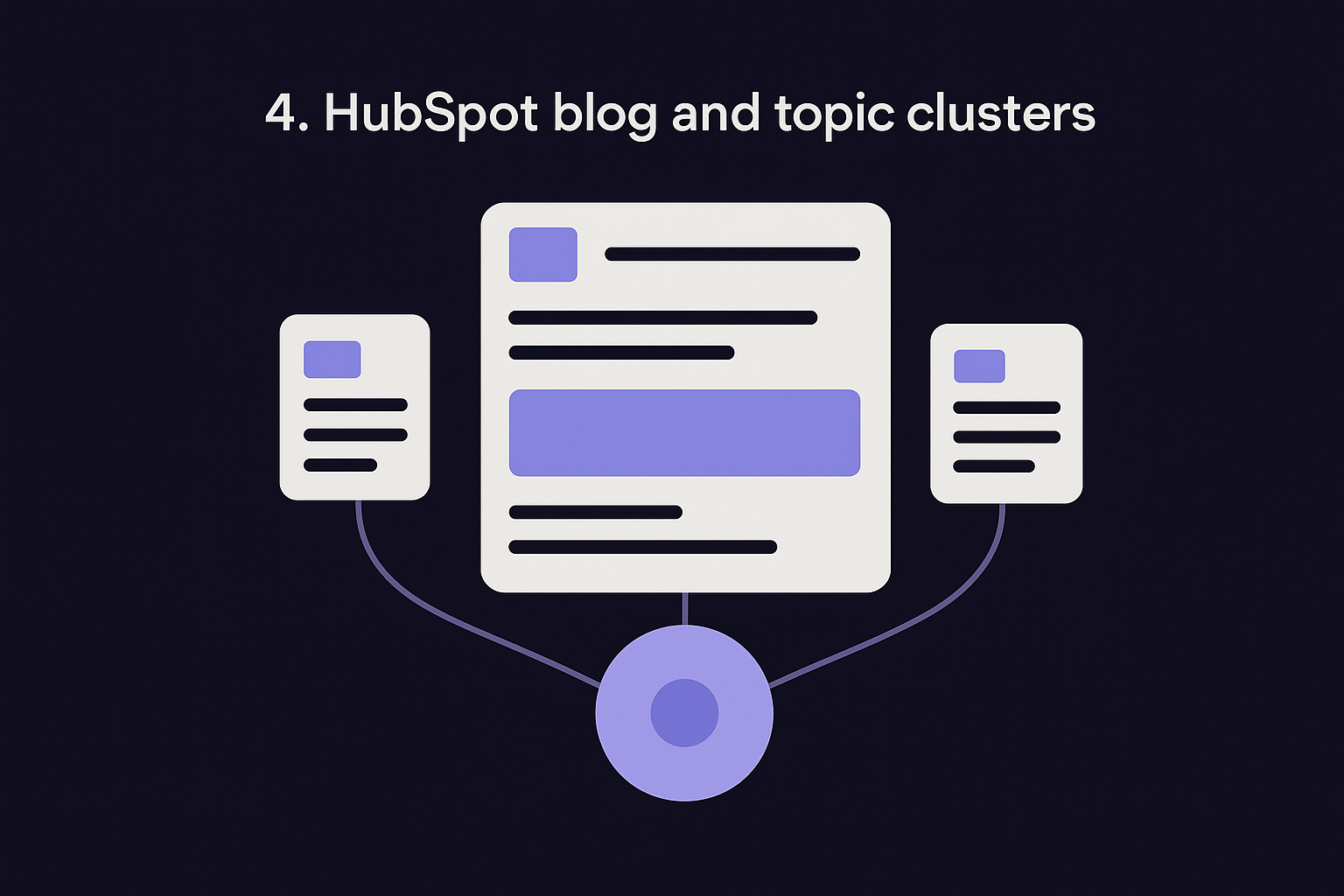
HubSpot popularized the topic cluster model for B2B content, organizing their blog around pillar pages and supporting articles that link back to a central resource. The result is a content architecture that dominates search rankings across entire subject areas, not just individual keywords.
What the content looks like
HubSpot's blog covers marketing, sales, and customer service with each topic area anchored by a long-form pillar page. Dozens of shorter supporting posts link back to that pillar, signaling to Google that HubSpot owns the subject. This structure gives readers a clear path from a specific question to deeper, more comprehensive resources.
Why it drives leads
Among b2b content marketing examples, HubSpot's model works because it captures buyers at every stage of their research process. A reader looking up a basic definition eventually lands on a free tool or template, and that conversion point feeds directly into HubSpot's product funnel.
Organizing your content into clusters rather than isolated posts builds search authority across an entire topic, not just a single page.
How to replicate the approach
Start with one pillar topic your business can own completely, look at how other clusters are structured, then map out 10 to 15 supporting questions buyers ask around that topic. Write a dedicated post for each, link them all back to the pillar, and update the pillar regularly as supporting content grows.
Key metrics to track
Monitor organic traffic to the pillar page, internal link click-through rates, and the number of supporting posts ranking on page one for their target keywords.
5. Semrush Academy and educational content
Semrush built a free learning platform called Semrush Academy that teaches SEO, PPC, content marketing, and social media through structured courses and certification programs. Rather than gating everything behind a paywall, Semrush gives away genuinely useful training to anyone who creates a free account, which means the content serves as both a lead generator and a retention tool simultaneously.
What the content looks like
Semrush Academy offers dozens of courses and certification exams across digital marketing disciplines. Each course is video-based, broken into modules, and ends with a certificate learners can share on LinkedIn. The content is not promotional; it teaches concepts and tactics that work regardless of which tools a learner chooses to use.
Why it drives leads
This is one of the most effective b2b content marketing examples of using education to create product-qualified leads. Students who complete a course on SEO or keyword research already understand the problem space deeply, which means they convert at a much higher rate than cold traffic arriving from a standard blog post.
Educational content that teaches buyers how to solve a problem positions your product as the natural next step without a single hard sell.
How to replicate the approach
Build a free mini-course or webinar series around a skill your buyers need to develop. Keep it genuinely useful without turning every lesson into a product demo.
Key metrics to track
Track course completion rates, free account sign-ups driven by academy traffic, and the conversion rate from academy users to paid subscribers.
6. LinkedIn B2B Institute research
LinkedIn's B2B Institute is the platform's internal think tank, dedicated to publishing independent research on the science of B2B marketing and brand building. Unlike most platform-sponsored content, the B2B Institute funds academic research and partners with universities to produce findings marketers can cite and apply.
What the content looks like
Each B2B Institute report centers on long-form research, white papers, and short-form summaries focused on topics like mental availability, category entry points, and long-term brand investment. The writing is accessible without dumbing down the findings, and each report comes with downloadable PDFs and visual summaries that are easy to share with your leadership team.
Why it drives leads
This is one of the more unconventional b2b content marketing examples on this list because the content does not promote LinkedIn's advertising products directly. Instead, it builds the case for B2B brand investment in ways that naturally favor the channels LinkedIn owns.
Publishing research that your target buyers genuinely want to cite in their own strategy documents builds authority faster than any promotional content ever will.
How to replicate the approach
Commission or conduct original research in your category, even if it starts small, and publish it as a standalone report with a clear point of view. Position your company as the source, not just the publisher.
Key metrics to track
Monitor report downloads and backlinks earned, then track the number of times your research gets cited in industry publications or strategy documents from potential buyers.
7. Wistia social content and brand voice
Wistia is a video hosting platform for businesses, and the company uses social content and a deliberately playful brand voice to stand out in a market crowded with corporate-sounding competitors. Rather than presenting itself as another B2B software vendor, Wistia leans into humor, behind-the-scenes content, and personality-driven storytelling across LinkedIn, YouTube, and the other channels worth distributing on.
What the content looks like
Wistia publishes short-form video content, case studies, and production guides that teach marketers how to create better video. The tone is conversational and sometimes self-deprecating, which makes content feel more like advice from a peer than a pitch from a vendor. Each piece reinforces Wistia's identity as a company that genuinely cares about video craft, not just software sales.
Why it drives leads
This is one of the more distinctive b2b content marketing examples on this list because Wistia proves that B2B brands do not have to sound stiff to earn buyer trust. A consistent and recognizable brand voice builds loyalty over time, reduces customer acquisition costs, and generates word-of-mouth referrals from satisfied users.
When your brand voice is distinctive enough that readers recognize it without seeing your logo, you have built something competitors cannot copy.
How to replicate the approach
Define two or three core personality traits for your brand before writing a single piece of content. Then apply those traits consistently across every channel and content format you publish.
Key metrics to track
Track social engagement rates, direct traffic growth, and referral traffic from social platforms to measure whether your brand voice is actually resonating with your target audience over time.
8. Mailchimp Presents original series
Mailchimp launched Mailchimp Presents, a collection of original documentary films, podcasts, and short series centered on small business owners and entrepreneurs. The content does not pitch email marketing tools; it tells the stories of people building companies, navigating challenges, and finding creative ways to grow.
What the content looks like
Each production is professionally filmed or recorded, with real founders as the subjects and Mailchimp taking a hands-off editorial role. The series spans formats including long-form documentaries, episodic audio, and short video features, all hosted on a dedicated content hub that functions more like a streaming platform than a marketing page.
Why it drives leads
Among the b2b content marketing examples in this list, Mailchimp Presents stands out because it builds an emotional connection that product-focused content rarely achieves. Viewers identify with the entrepreneurs on screen, and Mailchimp becomes associated with business ambition and resilience rather than just a software subscription.
When your content makes buyers feel something, they remember your brand long before they're ready to buy.
How to replicate the approach
Choose a format your audience already consumes, such as a short documentary or an interview series, and make your customers the heroes. Keep your product in the background, because the story does the selling.
Key metrics to track
Monitor video completion rates, branded search volume growth, and new account sign-ups from viewers who discover Mailchimp through the series content.
What to do next
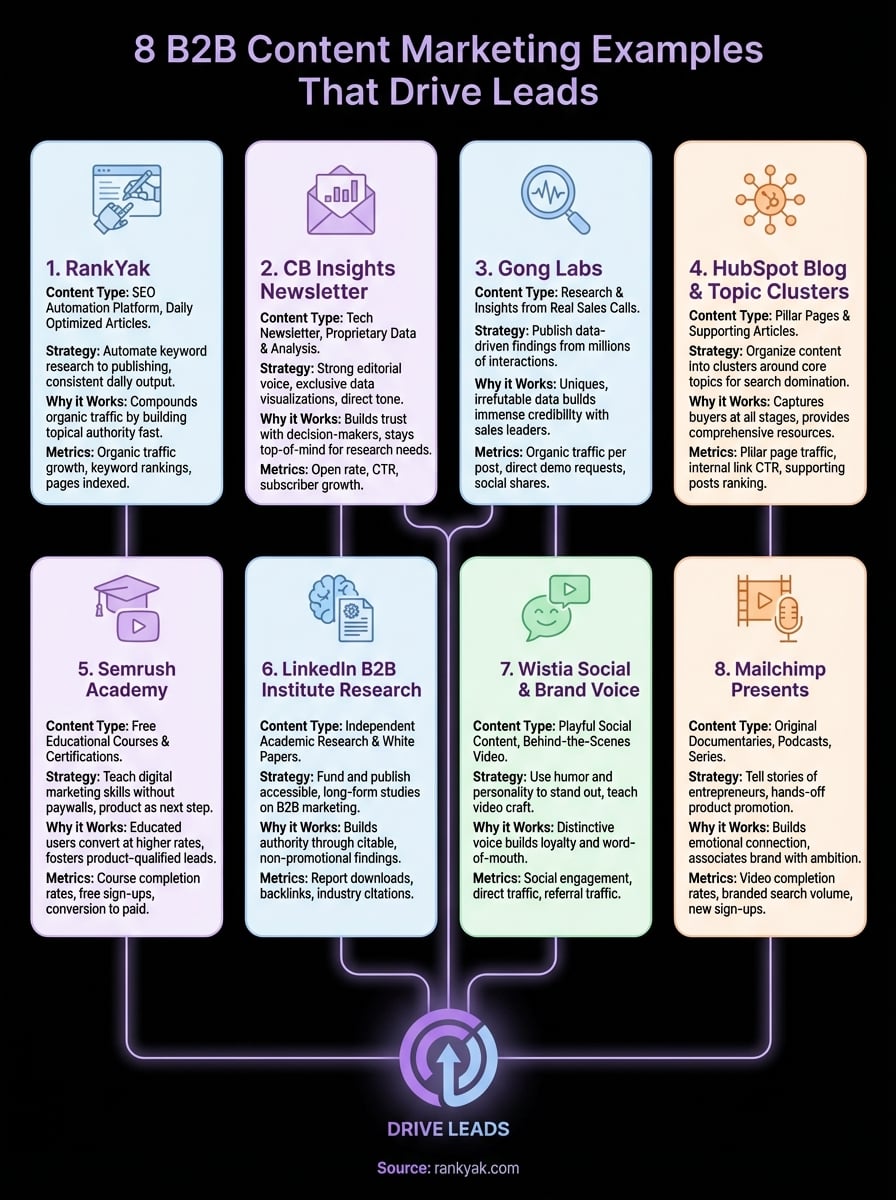
Every b2b content marketing examples in this list follows a consistent pattern: pick a format your audience actually uses, publish on a reliable schedule, and let the content do the selling. You do not need a massive team or a six-figure budget to start. You need a clear topic focus, a consistent publishing cadence, and the discipline to keep going long enough for the content to compound.
Start by picking one format from this list that fits your current resources, whether that is a data-driven blog series, a focused newsletter, or an educational resource. Build the process before you scale the output.
If organic search is part of your growth plan, consistent daily publishing is the fastest way to build topical authority and rank on Google and AI platforms. Let RankYak research, write, and publish an article a day on a free 3-day trial, and see how much ground you can cover when the whole pipeline runs on autopilot.
Allan de Wit is a co-founder of RankYak and has worked in SEO since 2015: inside agencies, alongside them, for clients directly, and in-house on the products being ranked. He came to it as a software engineer building for marketers, which is why the platform is built the way it is. He went on to start companies of his own, two of which were acquired. At RankYak he sets the product direction and owns the features, the quality bar, the design, and the UX.