16 Best Content Marketing Platform Options for 2026 Compared
Picking the best content marketing platform can feel like comparing apples to seventeen slightly different apples. Every tool promises better rankings, smoother workflows, and more traffic, but the features, pricing, and actual results vary wildly. Making the wrong choice means wasted budget and months of lost momentum.
That's exactly why we put this comparison together. At RankYak, we automate SEO content from keyword research to publishing, so we know firsthand what matters in a content marketing stack, and where most tools fall short. We've evaluated each platform on this list based on core functionality, ease of use, integrations, and real value for teams that need results without burning through resources.
Whether you're a solo founder trying to scale organic traffic or a marketing team managing multiple brands, this guide breaks down 16 content marketing platforms worth considering in 2026. You'll find a clear look at what each one does best, where it struggles, and who it's built for, so you can skip the guesswork and pick the right tool for your specific goals.
1. RankYak
RankYak is the best content marketing platform for teams that want to automate their entire SEO content pipeline without juggling multiple tools. It handles keyword research, article creation, and publishing in one place, cutting out the manual work that slows most content teams down.
What it is and how it works
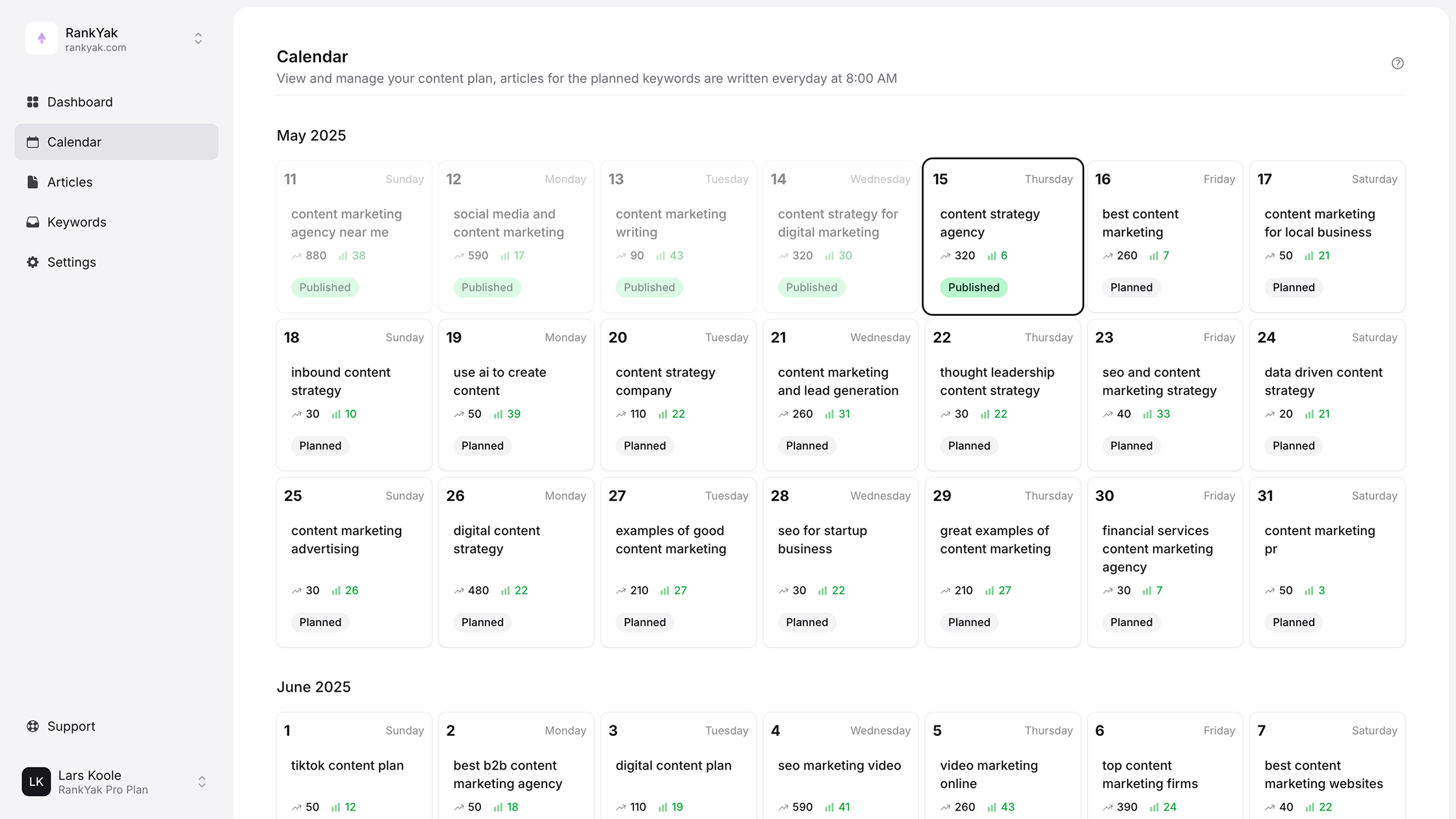
The platform connects to your website, analyzes your niche, and builds a daily content roadmap around high-potential keywords. Each day, it writes and publishes one fully SEO-optimized article up to 5,000 words, complete with a featured image. It integrates directly with WordPress, Shopify, Webflow, and Wix, so content goes live without any manual uploading.
If your goal is consistent organic growth without spending hours each week on content tasks, RankYak handles the full cycle automatically.
Best fit and ideal team size
This tool works best for solo founders, small business owners, and lean marketing teams that need to publish consistently but can't justify the cost of an agency or a dedicated SEO hire. It also suits agencies managing multiple client sites, since each site runs its own subscription, content plan, and keyword targets under one account.
Standout features for content marketers
Each article goes through deep competitor analysis and search intent research before it's written, so the output aligns with what Google actually rewards. The platform also supports 40+ languages and adapts to your brand voice. Internal linking, topic clusters, citations, and a backlink exchange network are all built in automatically.
- Automated keyword discovery based on your niche
- Daily article generation up to 5,000 words with featured images
- Direct publishing to major CMS platforms
- Built-in backlink exchange network
- Google Search Console integration
Drawbacks to know before you buy
One thing to note is that RankYak is built around long-form SEO articles, so if you need social media scheduling, email campaigns, or short-form content, you'll need a separate tool for that. The platform also produces one article per day per site, which supports steady, compounding growth but won't work for teams that need to launch a site with a large content library overnight.
Pricing and plan notes
RankYak offers a single all-inclusive plan at $99 per month, covering every feature including daily article creation, automatic publishing, backlink exchange, and multi-site management. You can start with a 3-day free trial and cancel anytime, no questions asked.
2. HubSpot Marketing Hub
HubSpot Marketing Hub is a well-established all-in-one marketing platform that combines content management, email marketing, social media, and CRM data into a single workspace. If you're evaluating the best content marketing platform for a team that needs to manage the full marketing funnel, HubSpot is one of the most recognized options on the market.
What it is and how it works
HubSpot connects your blog, landing pages, email campaigns, and social posts to a central CRM so you can track how content influences leads and revenue. You build and publish content through its drag-and-drop editor, then use built-in analytics to see what drives conversions across the buyer journey.
This CRM-to-content connection is where HubSpot genuinely separates itself from standalone content tools.
Best fit and ideal team size
HubSpot works best for mid-size to enterprise marketing teams that need tight alignment between content and sales data. Solo operators and small teams often find the platform's depth more than they need.
Standout features for content marketers
- SEO recommendations built into the content editor
- Contact-level analytics tied to content engagement
- Email, social, and blog management in one dashboard
- Native A/B testing for landing pages and emails
Drawbacks to know before you buy
The platform's pricing scales steeply as your contact list grows, which surprises many buyers after the free tier. You also need time to configure the CRM properly before the content tools deliver their full value.
Pricing and plan notes
HubSpot offers a free plan with limited features. Paid tiers start at $20 per month for Starter and climb significantly for Professional and Enterprise plans.
3. Contently
Contently is a content marketing platform built around connecting brands with a network of vetted freelance writers, editors, and strategists. If your team needs high-quality editorial content at scale, Contently gives you the infrastructure to manage the entire production process in one place.
What it is and how it works
The platform combines a talent marketplace with workflow management tools, so you can assign briefs, review drafts, and approve content without bouncing between email threads and spreadsheets. Contently also includes a content strategy layer with analytics that shows how each piece performs against your business goals.
For brands that depend on quality editorial output, having writers, editors, and approval workflows in one platform removes a significant coordination burden.
Best fit and ideal team size
Contently fits mid-size to enterprise marketing teams that produce a high volume of editorial content and need a structured system for managing freelance contributors. Solo operators or small teams with tight budgets will find it harder to justify the cost.
Standout features for content marketers
- Freelancer talent network with pre-vetted writers across industries
- Built-in content strategy and performance analytics
- Workflow tools for assignments, revisions, and approvals
- Brand safety compliance features for regulated industries
Drawbacks to know before you buy
Contently is not the best content marketing platform for teams that want automation or self-serve content creation. The model still relies on human writers and manual editorial cycles, which means turnaround times and output volume depend heavily on freelancer availability.
Pricing and plan notes
Contently does not publish pricing publicly. Plans are custom-quoted based on content volume, team size, and the scope of freelancer talent you need access to.
4. Semrush
Semrush is a comprehensive SEO and content marketing suite that covers keyword research, competitor analysis, site auditing, and content optimization. Teams that treat search visibility as a core channel will find it one of the most data-rich tools available in this category.

What it is and how it works
Semrush pulls data from its large proprietary database to show you keyword opportunities, track rankings, audit your site for technical issues, and analyze what your competitors rank for. The Content Marketing Toolkit inside Semrush helps you plan, write, and optimize articles using real search data at each stage, largely through its SEO Writing Assistant.
If your content strategy depends heavily on outpacing competitors in organic search, Semrush gives you a clear map of where the gaps are.
Best fit and ideal team size
This platform suits marketing teams and SEO professionals who need detailed data to guide their content decisions. Freelancers and solo founders can use it, but many of the advanced features pay off more at medium to larger team sizes where multiple campaigns run simultaneously.
Standout features for content marketers
- Keyword Magic Tool with deep search volume and intent data
- Content audit and topic cluster planning tools
- Competitor gap analysis showing keywords rivals rank for that you don't
- Position tracking with daily ranking updates
Drawbacks to know before you buy
Semrush is a research and optimization tool, not an execution platform. You still need to write and publish content yourself or pair it with another tool. The platform can also feel overwhelming early on because of the sheer number of reports available.
Pricing and plan notes
Semrush plans start at $139.95 per month for Pro, with Guru at $249.95 and Business at $499.95. A limited free account is available.
5. Ahrefs
Ahrefs is a well-respected SEO toolset that content marketers rely on for keyword research, backlink analysis, and content gap discovery. It gives you a clear, data-driven picture of what's working in your niche and what it will take to compete for specific keywords.
What it is and how it works
The platform pulls from a continuously updated index of backlinks, keywords, and ranking data to help you understand the competitive landscape before you write a single word. You can use Site Explorer to analyze any domain, Keywords Explorer to find search opportunities, and Content Explorer to discover high-performing content by topic.
Knowing exactly why a competitor ranks before you start writing saves you from producing content that has no realistic path to the first page.
Best fit and ideal team size
Ahrefs fits SEO-focused marketers and content strategists who make data the foundation of every publishing decision. It works at most team sizes, though the full value shows up most clearly when you're managing multiple campaigns or tracking dozens of target keywords.
Standout features for content marketers
- Site Audit tool that identifies technical issues affecting content performance
- Keyword Explorer with difficulty scores and traffic potential estimates
- Content gap analysis comparing your rankings against competitors
- Rank Tracker with regular position updates across search engines
Drawbacks to know before you buy
Compared with an automated content platform, Ahrefs is a research platform, not a writing or publishing tool. You still need to produce and distribute content manually or pair it with a separate platform. New users also typically need a few weeks to get comfortable with the full feature set.
Pricing and plan notes
Ahrefs plans start at $129 per month for Lite, with Standard at $249, Advanced at $449, and Enterprise pricing available on request. No free plan is offered, though a limited free account with restricted access exists.
6. BuzzSumo
BuzzSumo is a content research and discovery platform that helps you understand what content performs best in any niche before you invest time creating it. If you're evaluating the best content marketing platform for research-driven strategy, BuzzSumo fills a specific but valuable role.
What it is and how it works
BuzzSumo scans the web for content performance data, showing you which articles, videos, and posts get the most shares, backlinks, and engagement across social platforms. You can search by topic, competitor domain, or keyword to see what's resonating with real audiences right now.
If you spend time creating content without researching what already works, you're guessing instead of building on proven demand.
Best fit and ideal team size
BuzzSumo works best for content strategists and social media teams that need audience insight when they plan content marketing for the months ahead. It fits small to mid-size teams particularly well, especially those that publish frequently and need to stay current on trending topics in their space.
Standout features for content marketers
- Content discovery showing top-performing articles by topic or domain
- Influencer identification for outreach campaigns
- Trending topic alerts to catch emerging content opportunities early
- Competitor content analysis to benchmark your own performance
Drawbacks to know before you buy
BuzzSumo is a research tool, not a publishing platform. You'll still need separate tools to write, optimize, and publish your content once you've gathered insights. The platform also skews toward social engagement metrics, which don't always map directly to organic search performance.
Pricing and plan notes
BuzzSumo plans start at $199 per month for the Content Creation tier, rising to $299 and $499 at higher levels. A free trial is available before you commit.
7. CoSchedule
CoSchedule is a content marketing platform centered on editorial calendar management and marketing project coordination. It brings your blog posts, social campaigns, and marketing tasks into one shared calendar so your team can see exactly what's in progress and what's scheduled to publish.
What it is and how it works
CoSchedule connects your content calendar with task management, letting you assign work, set deadlines, and track progress without leaving the platform. It integrates with WordPress, social media networks, and email tools so you can coordinate publishing across multiple channels from a single view.
When your team works from a shared calendar instead of scattered spreadsheets, fewer things fall through the cracks.
Best fit and ideal team size
This platform suits small to mid-size marketing teams that struggle to keep content production organized across multiple channels. Solo operators can use it, but the collaboration and approval workflow features deliver the most value when multiple people contribute to your content pipeline.
Standout features for content marketers
- Marketing calendar syncing tasks, social posts, and blog content in one view
- ReQueue feature that automatically reschedules evergreen content on social channels
- Task templates for repeatable content workflows
- Integration with WordPress and major social platforms
Drawbacks to know before you buy
CoSchedule focuses on organization and scheduling rather than content creation or SEO optimization. If you're looking for the best content marketing platform that writes and publishes content automatically, you'll need to pair it with a separate tool for actual content production.
Pricing and plan notes
CoSchedule offers a free calendar plan with limited features. The Marketing Suite starts at $29 per user per month, with higher tiers available for larger teams needing advanced workflow tools.
8. StoryChief
StoryChief is a content marketing and distribution platform that lets you write a piece of content once and push it to multiple channels simultaneously. It covers blog publishing, social media distribution, email newsletters, and team collaboration from a single workspace.

What it is and how it works
StoryChief connects your content editor directly to your publishing destinations, so when you finish an article, you can distribute it to your website, social profiles, and email list without switching between tools. It also includes an SEO scoring layer that checks readability and keyword usage as you write.
Writing once and distributing everywhere removes a significant chunk of manual work from your weekly content routine.
Best fit and ideal team size
This platform fits small to mid-size marketing teams that publish content across several channels but want to manage everything from one place. Freelancers and content agencies handling multiple clients also find it useful because of the multi-workspace support.
Standout features for content marketers
- Multi-channel distribution to blogs, social media, and newsletters in one click
- Team collaboration with role-based approvals and feedback tools
- Built-in SEO and readability checks inside the editor
- Content calendar for planning and tracking scheduled posts
Drawbacks to know before you buy
StoryChief handles distribution well, but it is not the best content marketing platform for automated content creation. You still write every piece manually, and the SEO guidance stays fairly surface-level compared to dedicated research tools.
Pricing and plan notes
StoryChief plans start at $40 per month for solo users, with team and agency plans available at higher price points. A free trial is offered before you commit.
9. ContentStudio
ContentStudio is a content marketing and social media management platform that combines content discovery, scheduling, and publishing into one dashboard. If you're searching for the best content marketing platform to manage both blog content and social channels without switching between multiple apps, it covers a lot of ground in one place.
What it is and how it works
ContentStudio pulls in trending content from across the web using topic feeds you configure, so you can stay current on what your audience cares about and find ideas worth creating around. From there, you can plan, schedule, and publish to your blog, social profiles, and RSS feeds directly from the platform.
Having content discovery and publishing in the same tool keeps your workflow tight and your editorial calendar moving.
Best fit and ideal team size
This platform suits small business owners and social media managers who need to run content across multiple channels without a large team behind them. Agencies managing several client accounts also find value in the multi-workspace setup that keeps client content separate and organized.
Standout features for content marketers
- Content discovery feeds filtered by topic, keyword, or competitor domain
- Social media scheduling across multiple platforms from one calendar
- Automation recipes that republish evergreen content on a set schedule
- Analytics dashboard tracking engagement across channels
Drawbacks to know before you buy
ContentStudio leans heavily toward social media and curation workflows, which means its blogging and SEO optimization features are fairly basic. Teams that need deep keyword research or automated long-form article creation will need to pair it with a dedicated SEO tool.
Pricing and plan notes
ContentStudio plans start at $25 per month for the Starter tier, with Professional at $49 and Agency plans available at higher price points. A free trial is available before you commit.
10. Hootsuite
Hootsuite is one of the most widely recognized social media management platforms available, and many marketers treat it as a content hub for scheduling and monitoring everything happening across their social channels, one piece of a wider content production workflow.
What it is and how it works
Hootsuite lets you connect multiple social media accounts and manage them from a single dashboard. You schedule posts in advance, monitor mentions and conversations, and review engagement data across platforms like Instagram, LinkedIn, X, and Facebook, all without logging into each one separately.
If you run active social channels across several platforms, managing them from one dashboard saves a meaningful amount of time each week.
Best fit and ideal team size
Hootsuite suits social media managers and marketing teams that prioritize consistent social presence over organic search. It works across team sizes, though its collaboration and approval features deliver the most value when multiple people post on behalf of one brand.
Standout features for content marketers
- Bulk scheduling to queue weeks of social content in one session
- Streams dashboard for monitoring brand mentions and competitor activity in real time
- Analytics reports covering reach, engagement, and follower growth
- Integration with Canva for creating post visuals inside the platform
Drawbacks to know before you buy
Hootsuite is not the best content marketing platform for teams focused on SEO or long-form content. It does not help you create or optimize articles, and its content tools stay firmly in the social media lane.
Pricing and plan notes
Hootsuite's Professional plan starts at $99 per month for one user and ten social accounts. Team and Enterprise plans are available at higher price points, and a limited free trial lets you test the platform before committing.
11. Buffer
Buffer is a straightforward social media scheduling tool that lets you plan and publish posts across major platforms without the complexity of enterprise-level marketing suites. It's one of the cleaner options available if your primary goal is keeping social channels active and consistent.
What it is and how it works
Buffer connects to your social media accounts and gives you a simple queue-based system for scheduling posts, one of the lighter tools for planning and scheduling content. You add content to your queue, set your preferred posting times, and Buffer handles the rest. The platform also includes basic analytics so you can see which posts drive the most engagement over time.
Keeping your social queue full in advance means you're not scrambling to post something every day.
Best fit and ideal team size
Buffer works well for solo creators, freelancers, and small business owners who need a no-fuss way to maintain a social presence without spending hours each week on manual posting. Larger teams with complex approval workflows may find its collaboration features too limited for their needs.
Standout features for content marketers
- Queue-based scheduling across Instagram, LinkedIn, X, Facebook, and Pinterest
- Start Page feature for building a simple link-in-bio landing page
- Clean analytics dashboard showing reach and engagement per post
- Browser extension for adding content to your queue while browsing
Drawbacks to know before you buy
Buffer is not the best content marketing platform for SEO-driven growth. It does not help you research keywords, write articles, or optimize content for search, so you'll need separate tools if organic traffic is a priority.
Pricing and plan notes
Buffer offers a free plan covering up to three social channels. Paid plans start at $6 per month per channel, making it one of the more affordable scheduling tools available.
12. Mailchimp
Mailchimp started as an email marketing tool but has expanded into a broader platform covering landing pages, social ads, and basic content creation workflows. It remains one of the most widely used tools for small businesses that want to keep email campaigns and other marketing activities under one roof.
What it is and how it works
The platform gives you a drag-and-drop email editor, audience segmentation tools, and automated campaign sequences that trigger based on subscriber behavior. You can also build landing pages and signup forms directly inside Mailchimp, making it easier to capture leads and connect them to ongoing email workflows without a separate tool.
For small businesses running email as their primary content channel, Mailchimp keeps the setup simple and the learning curve short.
Best fit and ideal team size
This platform fits solo operators and small marketing teams that treat email as their core content distribution channel. Larger teams needing advanced CRM capabilities or multi-channel orchestration tend to outgrow it fairly quickly.
Standout features for content marketers
- Audience segmentation based on behavior, location, and purchase history
- Pre-built automation workflows for welcome sequences and re-engagement campaigns
- Basic landing page builder included in paid plans
- A/B testing for subject lines and email content
Drawbacks to know before you buy
Mailchimp is not the best content marketing platform for SEO-driven growth. It focuses almost entirely on email and paid social channels, so you'll need separate tools if building organic search traffic is part of your strategy.
Pricing and plan notes
A free plan covers up to 500 contacts. Paid plans start at $13 per month for Essentials, with Standard and Premium tiers available as your list size and feature needs grow.
13. Sprout Social
Sprout Social is a social media management and analytics platform that helps marketing teams plan, publish, and measure content across major social channels. It goes deeper on reporting and team collaboration than most tools in this category, which makes it a strong option for brands that treat social content as a core business function.
What it is and how it works
The platform gives you a unified inbox, publishing calendar, and analytics dashboard in one workspace. You schedule posts, respond to comments and messages, and track performance metrics without switching between individual social apps.
When your whole team works from the same inbox and calendar, communication gaps and missed responses become much less common.
Best fit and ideal team size
This platform fits mid-size to enterprise marketing teams that need structured workflows, approval processes, and detailed reporting to justify their social media investment. Smaller teams can use it, but the pricing makes it harder to justify for solo operators or startups with limited budgets.
Standout features for content marketers
- Smart Inbox aggregating messages and mentions across all connected platforms
- Detailed analytics reports covering reach, engagement, and audience growth
- Publishing calendar with team approval workflows built in
- Social listening tools for tracking brand mentions and industry conversations
Drawbacks to know before you buy
Sprout Social is not the best content marketing platform for SEO or long-form content. It focuses exclusively on social media workflows, so it helps to understand how social media marketing differs from content marketing before you decide it's enough on its own.
Pricing and plan notes
Plans start at $249 per month for the Standard tier, covering one user with five social profiles. Higher tiers are available, and a 30-day free trial gives you time to evaluate the platform before committing.
14. Uberflip
Uberflip is a content experience platform focused on organizing and personalizing existing content assets so buyers encounter the right piece of content at the right moment in their journey. It sits on the content distribution and personalization end of the spectrum rather than the creation side.

What it is and how it works
The platform takes your existing content library, including blog posts, videos, whitepapers, and case studies, and organizes everything into personalized content streams or hubs tailored to specific audiences, accounts, or campaigns. Marketers use it to surface relevant content for prospects moving through the sales funnel rather than pointing them to a generic resources page.
When buyers find content that matches exactly where they are in the purchase process, they stay engaged longer and convert at higher rates.
Best fit and ideal team size
This tool is built for mid-size to enterprise B2B marketing teams that already own a substantial content library and need a smarter way to activate it across campaigns. Smaller teams with limited content inventories won't get much value from a personalization layer with nothing to personalize yet.
Standout features for content marketers
- Account-based marketing (ABM) content hubs tailored to specific target accounts
- Content stream builder for organizing assets by topic, persona, or campaign
- Integration with major marketing automation platforms like Marketo and HubSpot
Drawbacks to know before you buy
Uberflip is not the best content marketing platform for teams that need to create content from scratch. It delivers value only after you've already built a significant library of assets worth organizing and personalizing.
Pricing and plan notes
Pricing is not published publicly on the Uberflip website. You'll need to contact their sales team directly for a custom quote based on your content volume and team requirements.
15. PathFactory
PathFactory is a B2B content intelligence platform that focuses on tracking how buyers engage with content and using that data to serve the next most relevant asset automatically. It sits in the content experience and buyer enablement category rather than the content creation space.
What it is and how it works
PathFactory tracks individual content consumption behavior across your library and uses that data to build personalized content tracks for each visitor. Instead of landing on a single page and leaving, buyers move through a curated sequence of assets that match their interests and stage in the purchase process.
When a buyer spends more time with content that directly addresses their problem, they arrive at sales conversations much better informed.
Best fit and ideal team size
This platform is built for enterprise teams with a mature B2B content marketing strategy, running account-based marketing programs on a deep, established content library. Smaller teams without a large asset inventory won't extract enough value to justify the investment.
Standout features for content marketers
- Content track builder that sequences assets based on buyer behavior and intent signals
- Real-time content engagement analytics showing which assets drive pipeline progression
- Integration with major CRM and marketing automation platforms
- Binge-worthy content experience that keeps buyers moving through your funnel
Drawbacks to know before you buy
PathFactory is not the best content marketing platform for teams that need to create or publish content. It adds value only after you've built a substantial library of existing assets worth personalizing and sequencing for target accounts.
Pricing and plan notes
PathFactory does not list pricing publicly. You need to contact their sales team for a custom quote based on your content volume, team size, and integration requirements.
16. Acrolinx
Acrolinx is a content governance and language quality platform built to help large organizations maintain consistent tone, terminology, and style across every piece of content their teams produce. It functions as a writing guidance layer rather than a creation or publishing tool.
What it is and how it works
Acrolinx plugs into the tools your writers already use, including Microsoft Word, content management systems, and web editors, and provides real-time guidance as they type. It checks each piece of content against your brand's custom style guide, flags terminology violations, and scores the writing on clarity and consistency.
If your organization publishes thousands of documents across multiple teams, a single off-brand phrase or inconsistent term can appear in hundreds of places before anyone catches it.
Best fit and ideal team size
This platform is built for large enterprise organizations with distributed writing teams that need to enforce brand standards at scale. It fits companies in regulated industries like finance, healthcare, and technology where precise language is not optional.
Standout features for content marketers
- Custom terminology management that enforces approved words and flags prohibited ones
- Real-time writing guidance inside the tools your team already uses
- Consistency scoring across large-scale content libraries
- Support for multiple languages with localization-aware style rules
Drawbacks to know before you buy
Acrolinx is not the best content marketing platform for teams that need to create, publish, or distribute content. It adds value only after your writers are already producing content, functioning strictly as a quality control layer on top of your existing workflow.
Pricing and plan notes
Acrolinx does not publish pricing publicly. You need to contact their sales team directly for a custom quote based on your team size and integration requirements.
Next Steps
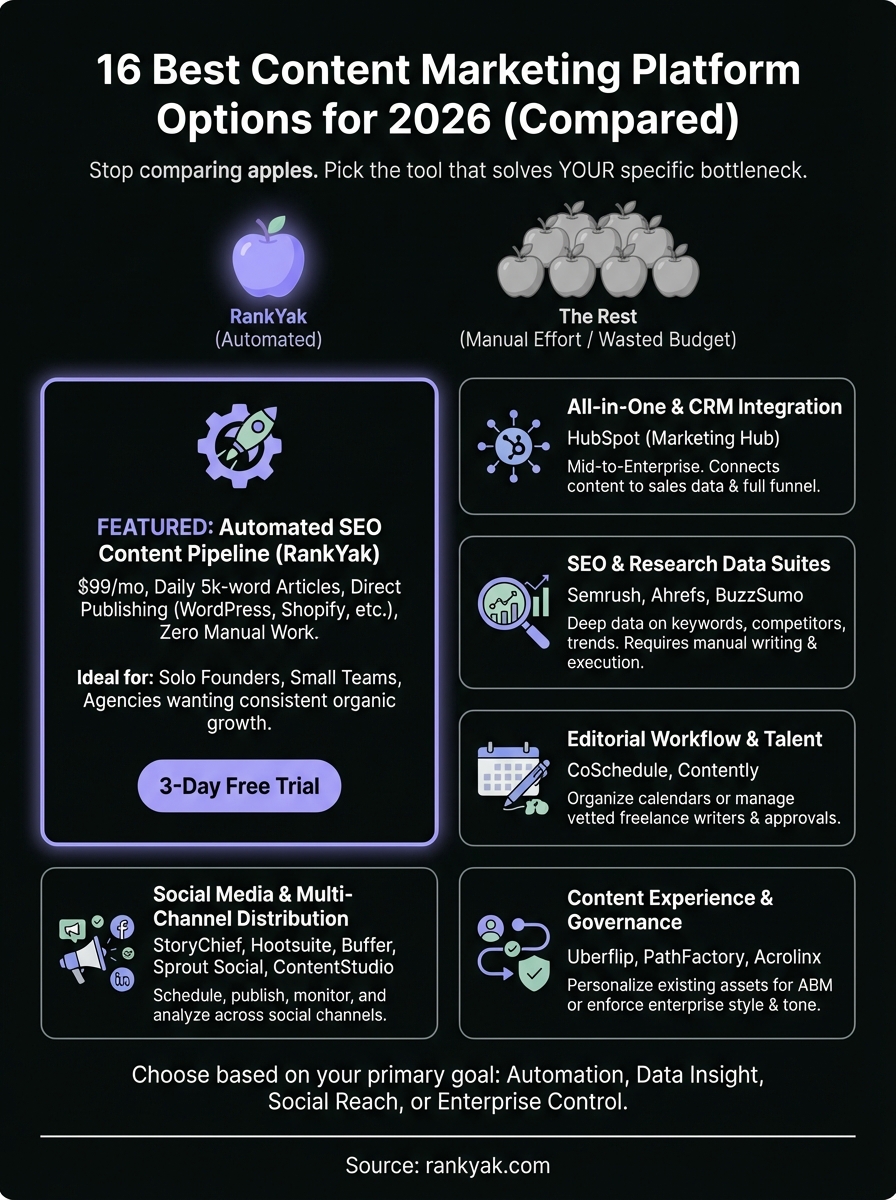
Each platform on this list solves a different problem, so the best content marketing platform for your business depends on what's actually slowing you down right now. If you need social scheduling, Buffer or Hootsuite covers that well. If you need enterprise content governance at scale, Acrolinx fits. But if your core priority is consistent organic traffic from search, most of these tools still require significant manual effort to get results, even after you've paid for them.
RankYak handles the full content cycle automatically, from keyword research and article creation to publishing directly on your site, every single day. You don't need a large team, an expensive agency, or five separate tool subscriptions to keep your site growing in organic search. Start building your content pipeline today with a free trial, and see what RankYak costs across its plans before you commit, then cancel anytime if it's not the right fit.
Allan de Wit is a co-founder of RankYak and has worked in SEO since 2015: inside agencies, alongside them, for clients directly, and in-house on the products being ranked. He came to it as a software engineer building for marketers, which is why the platform is built the way it is. He went on to start companies of his own, two of which were acquired. At RankYak he sets the product direction and owns the features, the quality bar, the design, and the UX.