
Promotional Video Marketing: Benefits, Strategy & Examples

Video accounts for over 80% of all consumer internet traffic, and brands that ignore it are leaving money on the table. Promotional video marketing, the practice of using video content to showcase products, services, or brand stories with the goal of driving specific business outcomes, has moved from "nice to have" to non-negotiable for companies serious about growth.
But here's the thing: a great video means nothing if nobody sees it. That's where search visibility and content strategy come in. At RankYak, we automate the SEO side of content marketing so businesses can focus on high-impact initiatives like video. When your written content consistently ranks and drives organic traffic, your promotional videos have a built-in audience ready to watch.
This guide breaks down what promotional video marketing actually is, why it works, the types of videos worth producing, and how to build a strategy that gets results. Whether you're planning your first campaign or looking to sharpen an existing one, you'll walk away with clear, actionable steps to make video a real growth channel, not just another content checkbox.
What promotional video marketing is and how it works
At its core, promotional video marketing uses video content to move a specific audience toward a specific action, whether that's purchasing a product, signing up for a service, or simply becoming aware your brand exists. Unlike entertainment-first content, every promotional video has a business objective built in from the start: raise awareness, generate leads, drive conversions, or build loyalty. The format, length, tone, and distribution channel all flow from that objective.
The core components of a promotional video
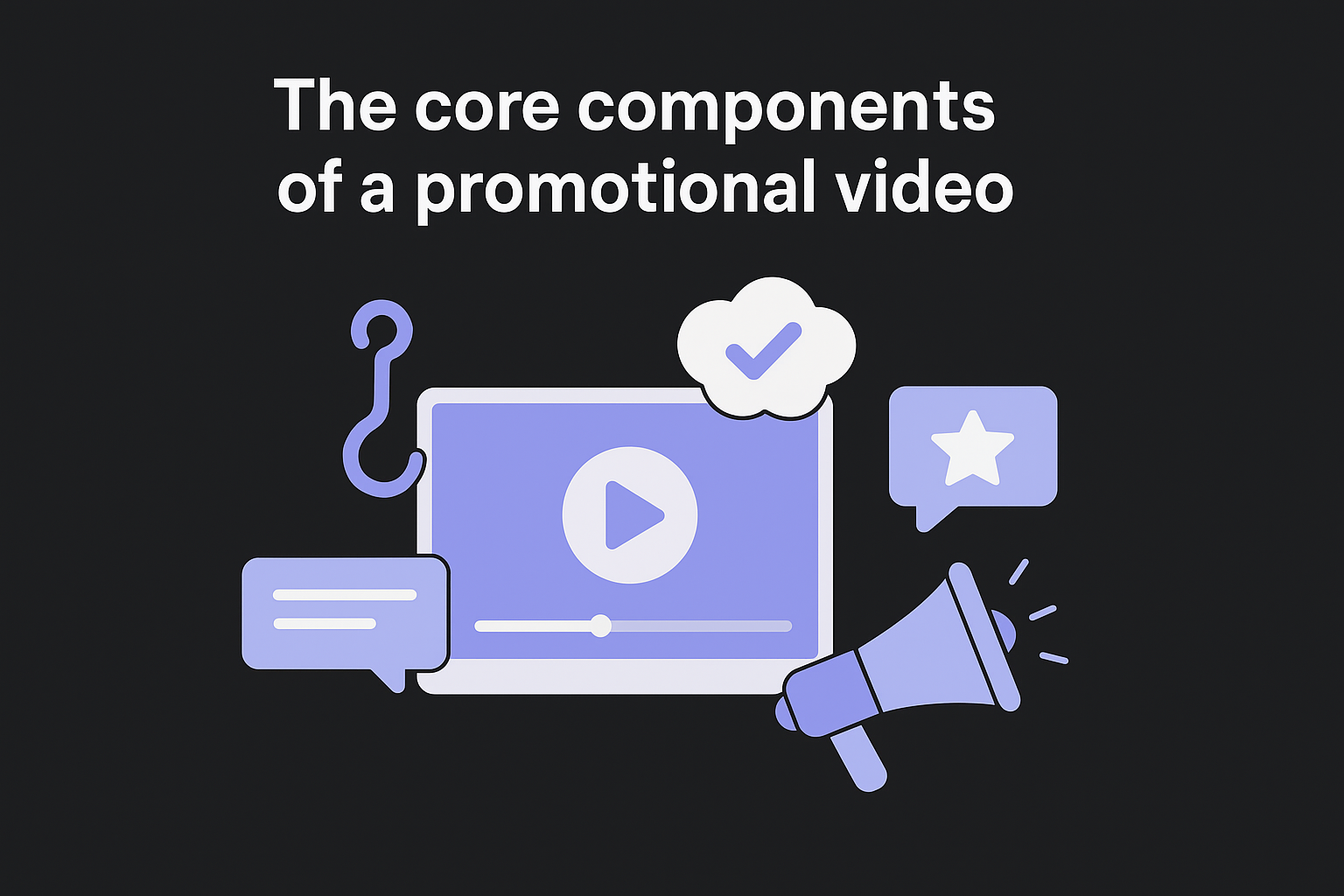
Every effective promotional video shares a few building blocks regardless of its format or budget. Understanding these components helps you make deliberate creative decisions instead of guessing and hoping something sticks.
A promotional video without a clear call to action is just content. With one, it becomes a sales asset.
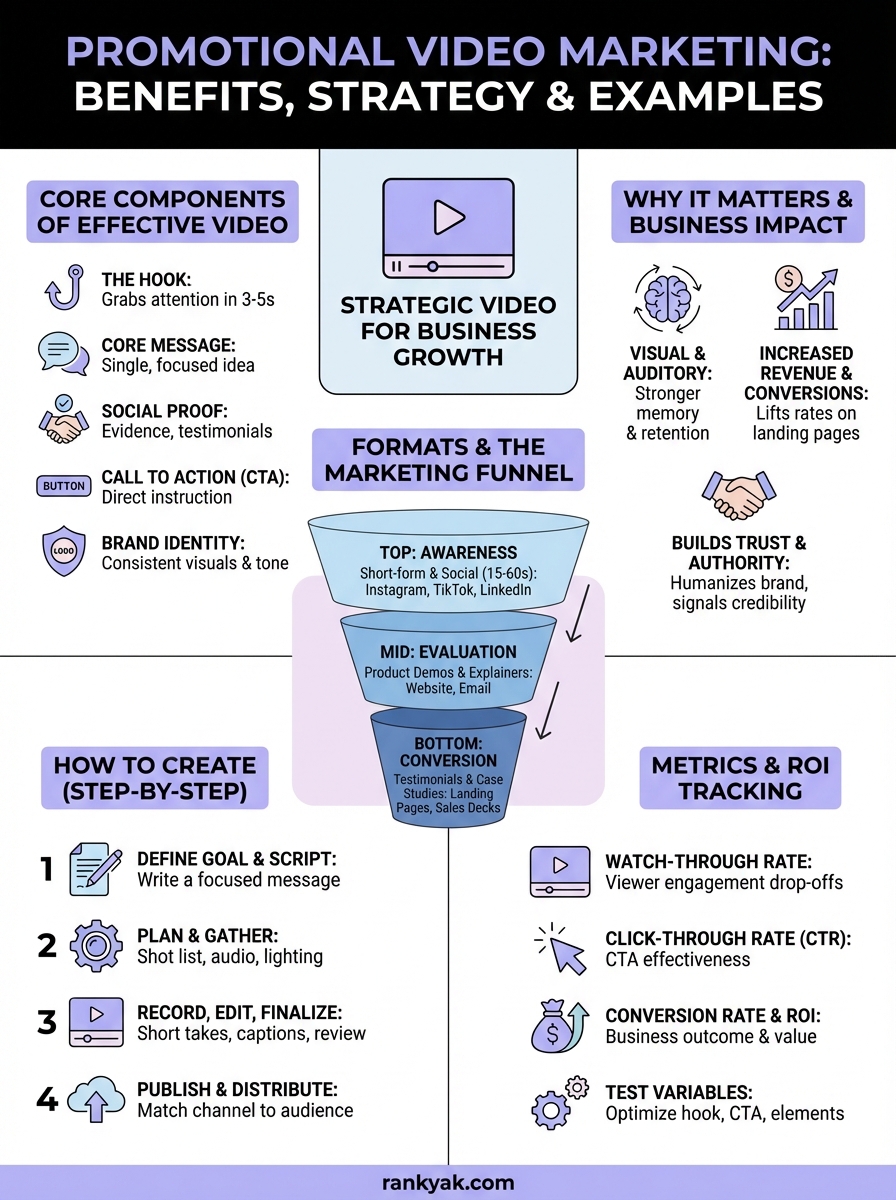
- The hook: The first 3-5 seconds determine whether your viewer stays or scrolls. Your hook should immediately signal relevance to your target audience.
- The core message: One focused idea communicated clearly. Trying to say three things at once usually means communicating nothing well.
- Social proof or evidence: Testimonials, data, or live demonstrations give viewers a concrete reason to believe your claim.
- The call to action (CTA): A direct, specific instruction: "Start your free trial," "Watch the full demo," or "Shop now." Vague CTAs produce vague results.
- Brand identity: Consistent visuals, tone, and voice so viewers connect the video back to your business, not just a piece of content they happened to watch.
How the promotional cycle actually works
A promotional video does not operate in isolation. It fits inside a broader marketing funnel where different videos serve different stages. At the top of the funnel, short awareness videos introduce your brand to cold audiences who have never heard of you. In the middle, explainer or demo videos address specific objections and help prospects evaluate your offer. At the bottom, testimonial and case study videos push warm leads toward a final decision.
Matching the video type to the funnel stage is what separates campaigns that convert from campaigns that just accumulate views. A 15-second social clip built for cold audiences on Instagram will almost never work as a bottom-funnel email to someone already comparing you against a competitor. Each stage requires a different message and a different distribution approach, and conflating them wastes both your budget and your audience's attention.
Why video works the way it does
The reason video outperforms text and static images in most contexts comes down to how people process information. Visual and auditory stimuli together create stronger memory encoding than either channel alone, which means viewers retain your message longer and associate it more strongly with your brand. Research from Google consistently shows that consumers who watch a brand's video are significantly more likely to visit that brand's website afterward.
Beyond memory, video compresses complex ideas into digestible formats. You can explain a product feature in 60 seconds that would take five paragraphs to cover in writing, and your viewer will leave with a clearer mental picture than if they had read the equivalent text. That efficiency is exactly why businesses that invest seriously in promotional video marketing consistently outpace competitors that rely on text and images alone.
Why promotional video marketing matters for businesses
Businesses invest in video because it produces measurable results at every stage of the customer journey. Promotional video marketing is not a format chasing attention; it is a distribution method that changes how quickly prospects understand your offer and how often they act on it. The evidence is consistent: video drives higher engagement, better recall, and stronger purchase intent than static alternatives across most industries and audience types.
The revenue and conversion impact
When a prospect lands on a product page that includes a video, conversion rates consistently climb. Landing pages with video can see conversion lifts of 80% or more compared to pages without, according to research referenced by Google's Think with Google. That result is not a coincidence. Video removes friction by answering common objections in real time, showing the product in context, and giving viewers a concrete sense of what they are buying before they commit.
A single well-placed product video on a landing page can do more conversion work than a dozen paragraphs of copy.
For businesses selling complex products or services, video shortens the sales cycle by pre-educating prospects. When someone arrives at a sales call having already watched your demo, they come with fewer questions and more confidence, meaning your team closes faster with less effort spent on basic education.
Trust and brand authority
Consumers buy from businesses they recognize and trust. Consistent video presence builds both. When your brand appears in video search results, social feeds, and email campaigns with a clear and professional visual identity, it signals credibility. Prospects who encounter your brand multiple times through video develop familiarity that written content alone rarely builds at the same pace.
Beyond recognition, video humanizes your business in a way that static text cannot replicate. Seeing a real face, hearing a real voice, or watching an honest customer testimonial creates a sense of connection that accelerates trust. In markets where multiple competitors offer similar products at similar price points, that trust advantage often determines who earns the sale. Your video presence becomes a differentiator that compounds over time as your library grows.
Goals, audiences, and messaging that convert
The biggest mistake businesses make with promotional video marketing is starting with production before answering three foundational questions: What do you want viewers to do? Who exactly are you talking to? And what message will move them to act? Skipping this work produces videos that look polished but underperform because they were built without a clear strategic foundation.
Define your goal before anything else
Every promotional video needs one primary goal, not two or three. Your goal determines everything that follows: the video length, the call to action, the platform you publish on, and how you measure success. Common goals include driving product page visits, generating email signups, increasing free trial activations, or building brand awareness among a cold audience. Pick one and build toward it deliberately.
A video optimized for awareness and a video optimized for conversions look completely different, even if they promote the same product.
Know exactly who you're talking to
Audience specificity directly affects message effectiveness. A video aimed at "everyone" resonates with no one. Before you write a script or plan a shot, define your target viewer by their specific situation: what problem they have right now, what they have already tried, and what objection stands between them and taking action. The more precisely you define this person, the sharper your message becomes and the more your video feels personally relevant to the people watching it.
A useful exercise is to write a one-sentence description of your viewer before scripting anything: "This video is for a small business owner who runs paid ads but has never tried organic content." That level of specificity forces every creative decision to stay focused on one person rather than drifting toward vague generalities.
Write messaging that earns the action
Strong video messaging follows a simple structure: acknowledge the viewer's problem, demonstrate your solution in concrete terms, and give a single clear next step. Avoid abstract claims like "best in class." Instead, use specific proof points: a measurable outcome, a customer result, or a live product demonstration. Specificity builds credibility, and credibility is what converts skeptical viewers into paying customers.
Promotional video formats and real-world examples
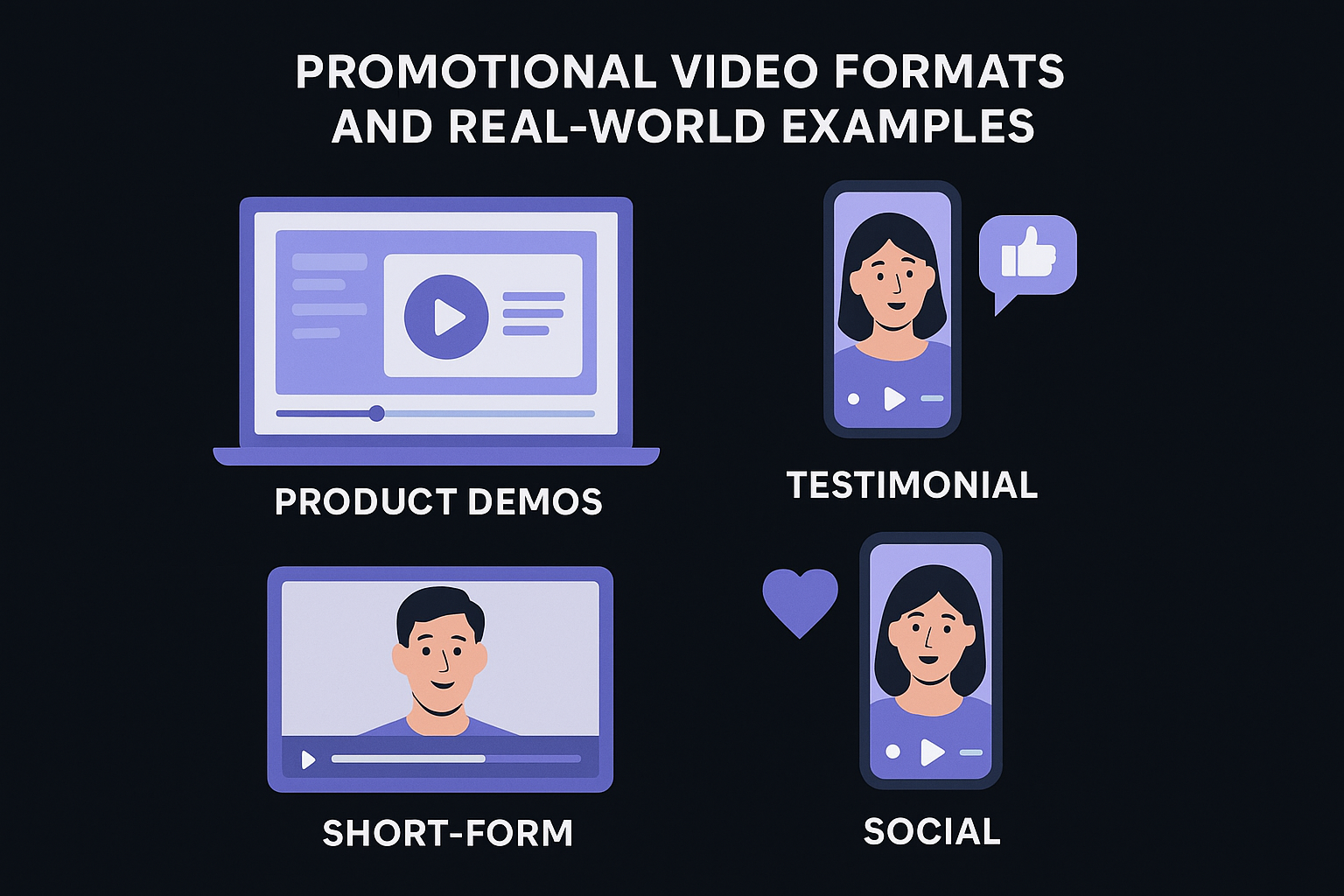
Not all videos serve the same purpose, and choosing the right format for your goal is one of the most practical decisions you make in promotional video marketing. Each format excels at a specific stage of the buyer journey, and using the wrong one for the wrong moment wastes your budget and your viewer's attention.
Product demos and explainer videos
Product demo videos show your product or service in action, making them ideal for mid-funnel audiences who already know they have a problem and are evaluating solutions. A software company, for example, might record a screen-capture walkthrough that shows exactly how a user completes a key task in under two minutes. Explainer videos take a slightly different angle: they break down a concept or problem before introducing your product as the answer. Both formats perform well in these placements:
- Embedded on product and pricing pages
- Included in onboarding email sequences
- Linked from search ads that target high-intent keywords
The clearer your demo, the fewer objections your sales team has to handle later.
Testimonial and case study videos
Customer testimonial videos feature real users describing a specific outcome they achieved with your product. The key word is specific: "We cut our onboarding time by 40%" outperforms "This product changed everything" in every measurable way. Case study videos go one step further and walk viewers through the full story: the challenge, the approach, and the quantified result. Both formats build trust with bottom-funnel prospects who are close to a decision and need external validation before committing.
These videos perform especially well on landing pages and sales decks where the viewer already knows your brand and just needs confirmation they are making the right call.
Short-form and social videos
Short-form videos running between 15 and 60 seconds are built for cold audiences scrolling quickly through social feeds. Their job is not to explain everything; their job is to generate enough curiosity or recognition that the viewer takes a next step, whether that's clicking through to your site or saving the video to return to later. A second, slightly longer version of the same concept, between 60 and 90 seconds, can run as a mid-funnel retargeting asset aimed at viewers who have already visited your website or engaged with your brand content.
How to create a promotional video step by step
Promotional video marketing works best when you follow a repeatable process rather than improvising. Most underperforming videos fail at the planning stage, not the production stage. The steps below keep your effort focused and your output consistent, whether you're working with a professional crew or recording on a smartphone in your office.
Define your goal and write your script first
Before you open any editing software, lock down your single goal and write a script that serves it directly. Your script does not need to be long; a 60-second video requires roughly 150 words of spoken content. Keep the structure tight: hook, core message, CTA, done. Read the script aloud and time it before you film anything, because written sentences often sound unnatural when spoken and discovering that on set wastes time.
The script is the foundation of everything. A weak script produces a weak video regardless of how good your camera is.
Plan your shots and gather your equipment
Once your script is final, map each line to a visual with a simple shot list. You do not need a formal storyboard; a plain document noting what the camera should show at each moment works fine. When assembling your gear, prioritize in this order:
- Audio first: A decent external microphone matters more than camera quality. Poor audio kills viewer retention faster than imperfect visuals.
- Lighting second: Natural light or an inexpensive softbox solves most problems without a full studio.
- Camera last: A modern smartphone shoots acceptable footage for most formats.
Record, edit, and finalize before publishing
Record in short takes rather than long uninterrupted runs, which makes editing significantly faster. During editing, trim aggressively and cut any moment where pacing slows or the message drifts. Add captions to every video before publishing, since a large share of viewers watch without sound, particularly on social platforms. Export in the format your target platform recommends, and do a final review on both desktop and mobile before you push anything live. A video that looks polished on a laptop but clips incorrectly on a phone loses impact with the majority of your audience before they hear a single word.
Distribution channels and promotion strategy
Producing a great video is only half the work. Where and how you distribute it determines whether your promotional video marketing investment actually reaches the people who need to see it. Your distribution plan should be built at the same time as your video concept, not added as an afterthought once the file is ready to upload.
Match your channel to your audience
Different platforms attract different viewers at different stages of the buying journey, and spreading your video across every platform equally is rarely the right call. Focus your energy on the channels where your specific audience already spends time, then optimize your video specs and messaging for those platforms rather than uploading a single generic file everywhere.
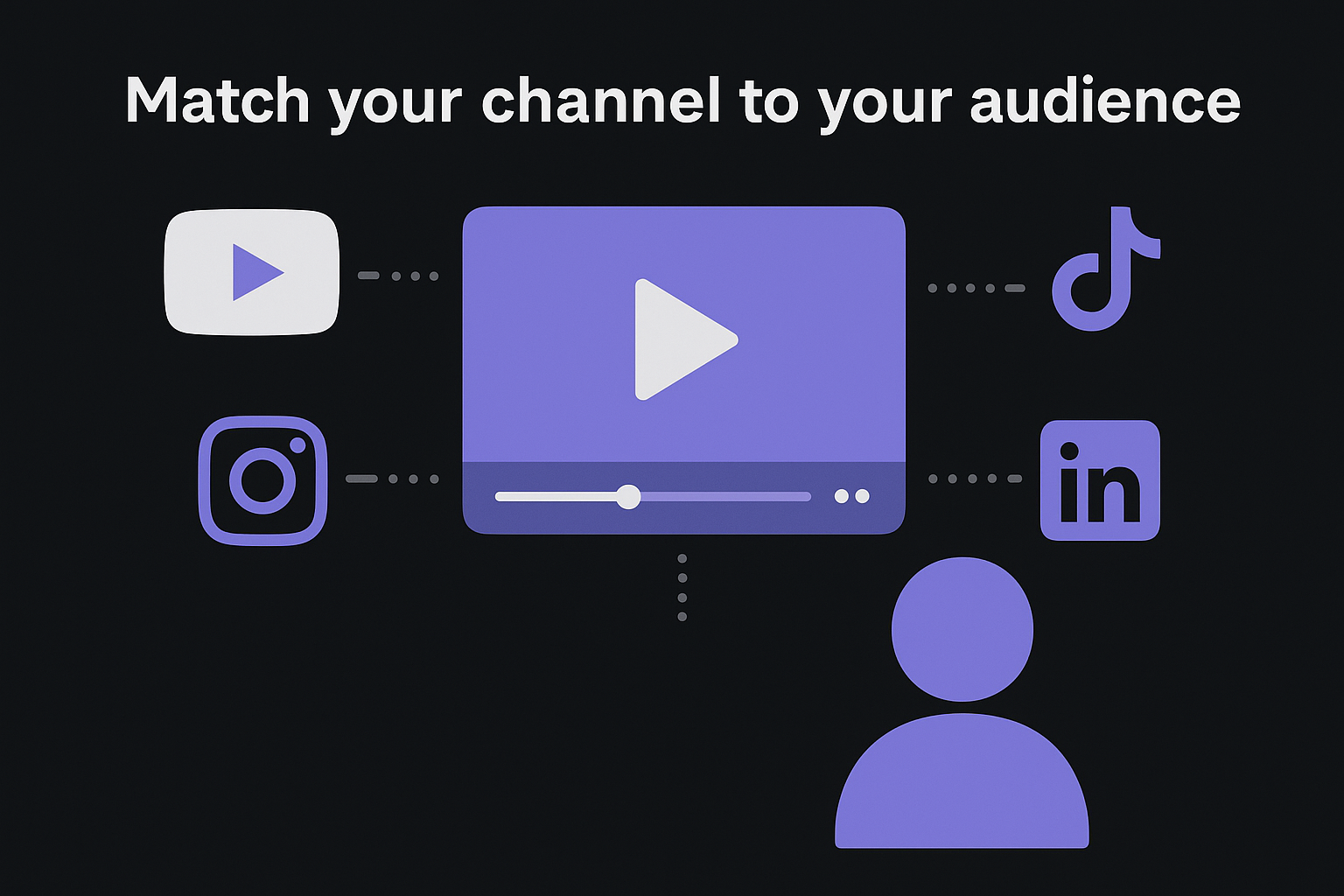
Here is a straightforward breakdown of how common channels align with funnel stages:
| Channel | Best funnel stage | Ideal video length |
|---|---|---|
| YouTube | Awareness and mid-funnel | 2-10 minutes |
| Instagram Reels / TikTok | Cold awareness | 15-60 seconds |
| B2B awareness and mid-funnel | 30-90 seconds | |
| Website landing pages | Mid to bottom funnel | 60-120 seconds |
| Email campaigns | Bottom funnel | 30-90 seconds |
Putting a long demo video on a cold social audience is the fastest way to waste your production budget.
Paid promotion and organic reach
Paid distribution gives you immediate reach with a targeted audience, while organic distribution builds momentum over time. For most businesses, the strongest strategy combines both: run paid ads to a cold audience to generate initial awareness, then rely on organic placement (search results, email lists, website embeds) to continue nurturing those viewers as they move down the funnel.
When you run paid video ads, start with a small test budget across two or three audience segments before scaling spend. Different audience definitions often produce dramatically different results for the same video, and finding that signal early saves significant money. On the organic side, embed your videos directly into relevant blog posts and landing pages rather than just linking out to them. Embedded videos keep visitors on your site longer, which signals engagement to search engines and increases the chance that a visitor converts before they leave.
Metrics, testing, and ROI tracking
Running promotional video marketing without tracking performance is the same as driving without a speedometer. You might be moving, but you have no idea whether you are going fast enough or in the right direction. Connecting your video metrics to your actual business goals is what separates teams that improve over time from teams that repeat the same mistakes with better cameras.
Metrics that actually tell you something
View count is the most visible metric, but it tells you almost nothing about whether your video is working. The numbers that matter are tied directly to behavior: watch-through rate (the percentage of viewers who reach the end), click-through rate on your CTA, and downstream conversions. A video with 500 views and a 12% conversion rate outperforms one with 10,000 views and a 0.3% conversion rate every time.
The goal is not views. The goal is the action that follows the view.
Track these core metrics for every video you publish:
- Watch-through rate: Tells you where viewers disengage so you can fix pacing or cut weak sections
- Click-through rate: Measures how effectively your CTA moves viewers to the next step
- Conversion rate: Tracks the percentage of viewers who complete your target action
- Cost per result (for paid): Divides your total ad spend by the number of conversions generated
Running tests that improve your results
Testing one variable at a time is the only way to learn what actually drives better performance. If you change your hook, your thumbnail, and your CTA in the same version, you cannot identify which change moved the needle. Pick one element per test, run both versions to audiences of similar size, and give each at least one to two weeks before drawing conclusions.
The most valuable tests for most businesses focus on the first five seconds of the video and the CTA phrasing. These two elements have the largest effect on watch-through rate and click-through rate respectively, meaning small improvements to them produce outsized results across your entire video library.
Calculating the actual ROI
ROI for video is straightforward once you connect your video platform data to your sales data. Take the revenue generated from tracked conversions, subtract your total production and distribution costs, then divide by those costs. Even rough attribution through UTM parameters on video links gives you enough signal to compare video performance against other marketing channels and justify your next investment.
Wrap up and what to do next
Promotional video marketing works when you build it on three things: a clear goal, a defined audience, and a distribution plan that matches the right video to the right channel. Every section of this guide connects back to that framework, from writing a focused script to tracking the metrics that actually reflect business outcomes rather than vanity numbers. Skip any of those steps and your production budget goes further than your results.
Your next move is straightforward. Pick one video format that fits your current funnel gap, whether that is a short social clip for cold audiences or a demo video for prospects already on your pricing page, and build it using the process outlined here. Once your video is live and driving traffic, you need written content that ranks and captures that audience consistently. RankYak automates your SEO content so both channels work together and compound over time.

Get Google and ChatGPT traffic on autopilot.
Start today and generate your first article within 15 minutes.
SEO revenue calculator
How much revenue is your website leaving on the table?
Take a quick quiz and see exactly how much organic revenue you're missing out on, along with personalized tips to fix it.
-
4 questions, under 1 minute
-
See traffic and revenue potential
-
No email required
Free · takes 1 minute · no signup needed
Question 1 of 4
Question 2 of 4
Question 3 of 4
Question 4 of 4
Your SEO growth potential
Extra visitors / month
after 6-12 months of consistent publishing
Revenue potential / year
at your niche's avg. conversion rate
Articles needed (12 mo)
to reach this traffic level
ROI with RankYak
on the Professional plan ($129/mo)
To hit that number, you'd need to:
- Build a topical authority strategy for your niche
- Research keywords & map out a full topical cluster
- Write, edit & publish an article every single day
- Build backlinks to the articles you publish
RankYak handles all of this automatically, every day.
* Estimates based on industry averages. Results vary by niche, competition, and domain authority. Most SEO results become visible after 3-6 months of consistent publishing.