
10 Best B2B Marketing Automation Platforms Compared (2026)

Choosing the right b2b marketing automation platforms can mean the difference between a sales pipeline that fills itself and one that requires constant manual effort. But with dozens of tools competing for your budget, each promising better leads, smarter workflows, and higher ROI, picking the wrong one wastes both money and momentum.
Most B2B teams need more than just email sequences. They need platforms that handle lead scoring, CRM syncing, multi-channel campaigns, and analytics under one roof. The challenge is that every platform packages these features differently, and pricing models vary wildly depending on contacts, users, or feature tiers. That's exactly why a side-by-side comparison matters before you commit.
At RankYak, we help businesses drive organic traffic on autopilot through automated SEO content, the kind of content that feeds the top of your marketing funnel. But even the best inbound traffic needs nurturing, which is where marketing automation picks up the baton. We built this guide because our users regularly ask which platforms pair well with a strong organic content engine.
Below, you'll find 10 of the best B2B marketing automation platforms for 2026, compared across features, pricing, ideal use cases, and real limitations. Whether you're a lean startup choosing your first tool or an established team ready to switch, this breakdown gives you the details you actually need to make a confident decision.
1. RankYak
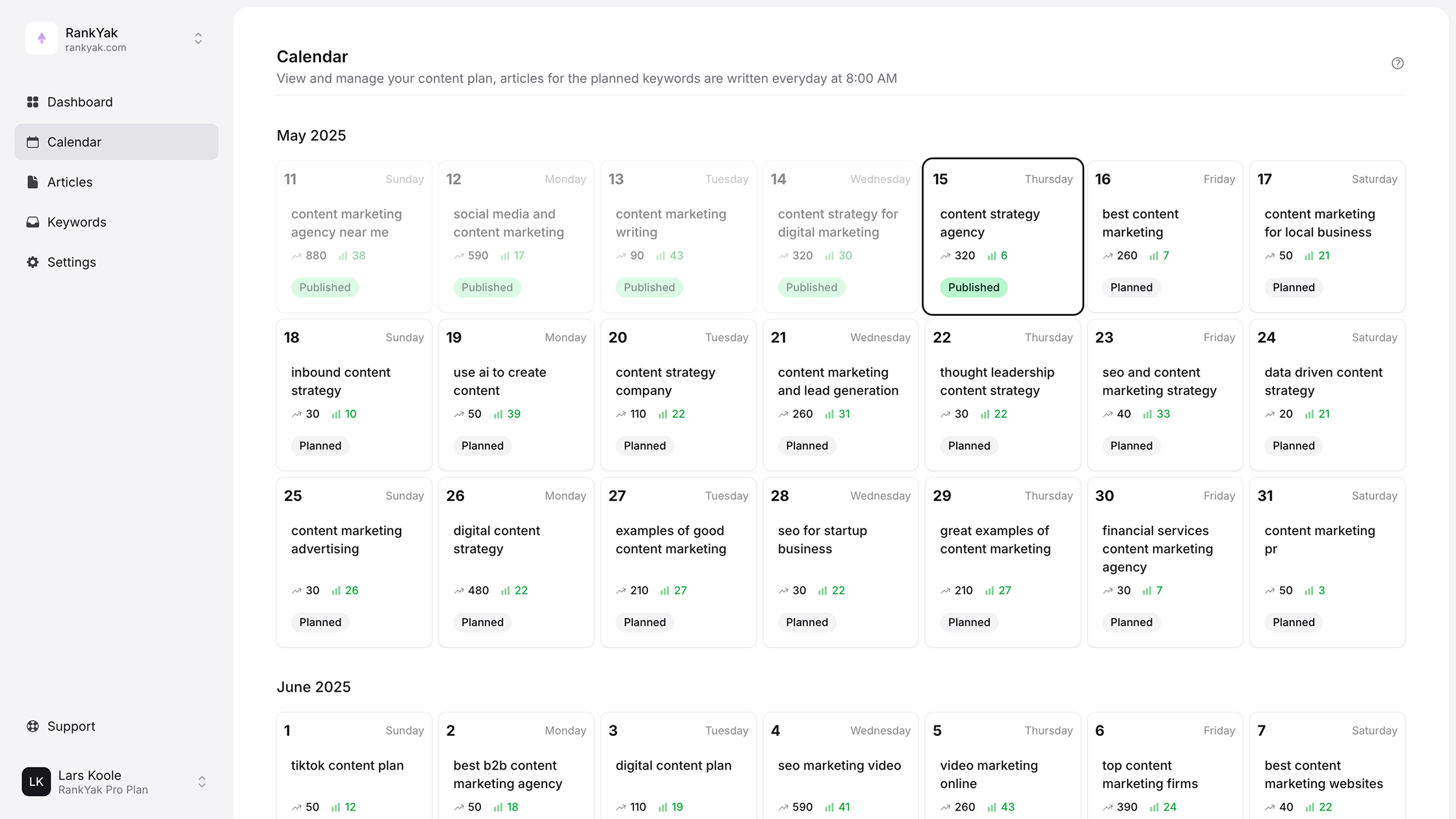
RankYak is an SEO content automation platform that handles keyword research, article writing, and publishing on a daily basis. While it doesn't replace traditional b2b marketing automation platforms focused on email workflows or CRM syncing, it fills a critical gap that most marketing stacks leave wide open: the consistent, scalable creation of organic content that brings qualified prospects to your site before they ever enter a nurture sequence.
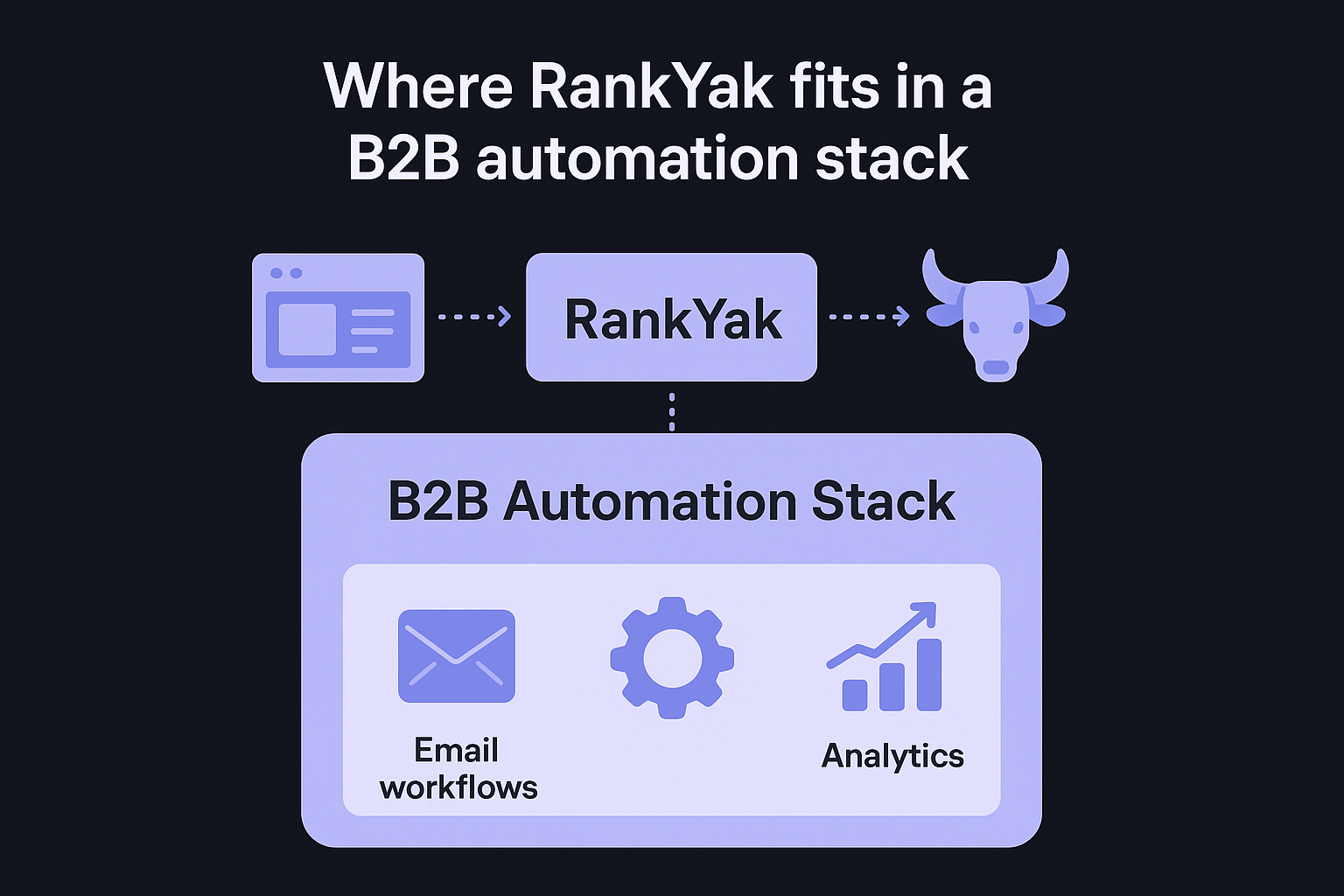
Where RankYak fits in a B2B automation stack
Most B2B marketing teams invest heavily in tools that activate and convert leads but underinvest in the top-of-funnel content that generates those leads in the first place. RankYak solves that problem by automating the entire SEO content lifecycle, from discovering high-potential keywords in your niche to writing fully optimized articles and publishing them directly to your CMS every day.
RankYak produces up to 5,000-word SEO-optimized articles daily and publishes them automatically to WordPress, Shopify, Webflow, Wix, and other platforms without requiring you to lift a finger.
The platform uses your website and niche to build a daily content roadmap, deciding which keywords to target based on search intent, competitor research, and Google's helpful content guidelines. It also builds internal linking structures and topic clusters, which means your site grows authority over time rather than producing disconnected posts. For B2B teams running lead gen through organic search, this kind of systematic content output feeds every other tool in the stack with a steady stream of warm, search-qualified visitors.
Each article includes facts, citations, and brand voice adaptation, so the output reads like your team wrote it, not like a generic AI template. RankYak also supports 40+ languages and integrates with Google Search Console, making it a practical choice for B2B companies targeting multiple markets or looking to track real ranking performance.
Best for
RankYak works best for B2B businesses that rely on organic search as a primary acquisition channel but lack the time or budget to produce consistent long-form content. If your team spends more time chasing leads than building the content that attracts them, RankYak handles that work automatically.
It also fits well for agencies and consultants managing multiple client websites. The multi-site management feature lets you run separate keyword strategies, content plans, and publishing schedules for each client under one account, without juggling multiple subscriptions or tools.
- Small to mid-sized B2B companies with limited content teams
- SaaS businesses targeting informational and commercial search queries
- Marketing agencies scaling content for multiple clients
- Entrepreneurs building site authority without hiring writers
Pricing
RankYak offers one straightforward plan at $99 per month, which includes all features: keyword discovery, daily article generation, automatic publishing, backlink exchange, multi-site management, and all integrations. There are no contact-based pricing tiers or feature paywalls.
You can start a 3-day free trial with no commitment required and cancel anytime, no questions asked. For B2B teams used to enterprise software contracts that lock you in for a year, this pricing model removes most of the risk from testing whether automated SEO content fits your growth strategy.
2. HubSpot Marketing Hub
HubSpot Marketing Hub is one of the most widely used B2B marketing automation platforms on the market, and for good reason. It combines email marketing, lead scoring, landing pages, ad management, and reporting inside a single interface, and it connects directly to HubSpot's CRM so your marketing and sales teams work from the same data.
What it automates
HubSpot automates the full lead nurturing lifecycle. You can build multi-step email workflows triggered by form submissions, page visits, deal stages, or contact properties, without writing a single line of code. The platform also automates lead scoring, contact segmentation, internal notifications to sales reps, and social media posting.
HubSpot's workflow builder is visual and drag-and-drop, which means your marketing team can build and adjust automation without depending on developers.
Beyond email, HubSpot handles ad retargeting automation across Google and Meta, syncs contact data in real time with its native CRM, and provides revenue attribution reporting that ties specific campaigns to closed deals. For B2B teams that need tight alignment between marketing activity and pipeline results, these integrations remove a lot of manual reporting work.
Best for
HubSpot Marketing Hub works best for mid-sized B2B companies that want an all-in-one platform covering marketing, CRM, and sales tools under one vendor. If your team is already using HubSpot's CRM or Sales Hub, adding Marketing Hub makes the data connection seamless.
- Growing B2B teams that need scalable email and workflow automation
- Companies that want native CRM and marketing alignment without third-party connectors
- Teams running inbound marketing strategies across content, email, and paid ads
- Businesses that need detailed multi-touch attribution reporting
Pricing
HubSpot Marketing Hub pricing starts at $800 per month for the Professional tier, which covers most automation features. The Enterprise tier runs $3,600 per month and unlocks advanced features like custom behavioral events and sandboxes. Pricing scales with the number of marketing contacts in your account, so costs can climb quickly as your list grows. A free tier with basic tools is available, but it lacks the automation capabilities most B2B teams actually need.
3. Salesforce Marketing Cloud Account Engagement
Salesforce Marketing Cloud Account Engagement, formerly known as Pardot, is a B2B-focused automation platform built specifically for longer sales cycles and complex buying committees. It sits inside the Salesforce ecosystem, which means it connects directly to Salesforce CRM and gives your marketing and sales teams a shared view of every prospect interaction from first click to closed deal.
What it automates
Account Engagement automates lead nurturing, lead scoring, and prospect grading based on behaviors like email opens, form fills, and page visits. You can build multi-step drip campaigns triggered by specific actions, and the platform adjusts scoring automatically as prospects move through the funnel. This matters in B2B contexts where purchase decisions involve multiple stakeholders and weeks or months of evaluation.
The direct Salesforce CRM sync means your sales reps see a prospect's full engagement history, including which emails they opened and which pages they visited, before making contact.
Beyond email, the platform handles dynamic content personalization, landing page creation, and ROI reporting that ties campaigns directly to revenue in Salesforce. For teams running account-based marketing strategies, the ability to track engagement at the account level rather than just the contact level is a practical advantage that many b2b marketing automation platforms don't offer out of the box.
Best for
Account Engagement works best for mid-to-large B2B companies already running on Salesforce CRM that need tight alignment between marketing automation and their sales pipeline. If your organization manages complex, multi-touch sales cycles with defined stages in Salesforce, this platform eliminates the data gaps that typically exist between marketing activity and sales follow-up.
- Enterprise B2B teams running account-based marketing programs
- Companies that require deep Salesforce CRM integration
- Organizations with dedicated marketing operations staff to manage the platform
- Businesses with high-value deals and longer sales cycles
Pricing
Salesforce Marketing Cloud Account Engagement starts at $1,250 per month for the Growth tier, which covers up to 10,000 contacts. The Plus tier runs $2,500 per month, and the Advanced tier reaches $4,000 per month. Pricing scales with contact volume, and most B2B teams will need at least the Plus tier to access the full automation and analytics features the platform is known for.
4. Adobe Marketo Engage
Adobe Marketo Engage is a mature, enterprise-grade platform that has been a core option among b2b marketing automation platforms for over a decade. Since Adobe acquired Marketo in 2018, the platform has deepened its integrations with Adobe's broader Experience Cloud, giving marketing teams access to advanced analytics, content personalization, and cross-channel campaign management within a single ecosystem.
What it automates
Marketo Engage automates multi-channel campaign execution across email, web, mobile, social, and paid advertising from a centralized interface. You can build sophisticated nurture tracks triggered by behavioral signals like content downloads, webinar attendance, or product page visits, and the platform scores leads automatically based on the rules you define.
Marketo's engagement programs let you build "smart campaigns" that respond dynamically to prospect behavior, ensuring the right message reaches the right contact at the right stage of the buying cycle.
Beyond lead nurturing, the platform handles account-based marketing workflows, allowing your team to coordinate outreach across multiple stakeholders within a target account. Marketo also integrates with Salesforce and Microsoft Dynamics, so sales reps receive real-time lead alerts and a full engagement history without switching tools.
Best for
Marketo Engage works best for mid-to-large B2B enterprises that run complex, multi-touch campaigns and need detailed control over every step of the automation logic. If your marketing team has dedicated operations staff and manages large contact databases across multiple programs, Marketo gives you the flexibility and depth to build exactly what you need.
- Enterprise marketing teams with dedicated Marketo administrators
- B2B companies running both demand generation and account-based marketing programs simultaneously
- Organizations already using Adobe Experience Cloud products
- Businesses that need advanced revenue attribution reporting tied to specific campaigns
Pricing
Adobe does not publish standard pricing for Marketo Engage publicly. Plans are custom-quoted based on your database size, feature requirements, and contract length. Industry estimates place the starting price around $895 per month for smaller implementations, with enterprise contracts commonly running several thousand dollars per month. Contact Adobe's sales team directly for an accurate quote based on your specific contact volume and use case.
5. ActiveCampaign
ActiveCampaign is a mid-market automation platform that combines email marketing, CRM, and sales automation in one tool. Unlike enterprise-focused alternatives, it targets small to mid-sized B2B teams that need powerful automation without the complexity or cost that comes with platforms like Marketo or Salesforce.
What it automates
ActiveCampaign automates email sequences, lead scoring, contact segmentation, and deal pipeline updates based on contact behavior and custom triggers. You can build multi-step automations visually, connecting actions like form submissions, link clicks, or site visits to specific follow-up messages or internal tasks without writing any code.
ActiveCampaign's site tracking feature monitors which pages a contact visits on your website and triggers automations based on that behavior, giving your sales team relevant context before they reach out.
The platform also handles SMS messaging, in-app notifications, and Facebook Custom Audiences as part of its automation workflows, which lets you coordinate outreach across multiple channels from a single automation builder. For B2B teams managing multiple touch points across a longer sales cycle, this multi-channel capability reduces the number of separate tools you need to run a complete nurture strategy.
Best for
ActiveCampaign works best for small to mid-sized B2B companies that need more automation depth than basic email tools offer but aren't ready for the complexity or cost of enterprise-grade b2b marketing automation platforms. If you want a practical combination of email automation and a lightweight CRM without hiring a dedicated platform administrator, ActiveCampaign covers that ground well.
- SMBs and growing startups that need scalable automation without enterprise pricing
- Teams that want built-in CRM and email automation in one interface
- B2B companies running multi-channel nurture across email, SMS, and ads
- Businesses that want detailed automation reporting without custom configuration
Pricing
ActiveCampaign's pricing starts at $15 per month for the Starter plan, though most B2B teams will need the Plus plan at $49 per month or the Pro plan at $79 per month to access the full automation and CRM features. All plans scale based on the number of contacts in your account, so costs increase as your database grows.
6. Oracle Eloqua
Oracle Eloqua is an enterprise-level marketing automation platform built for large B2B organizations running complex, multi-channel campaigns at scale. It sits within the Oracle Marketing Cloud and targets companies that need deep integration with enterprise tech stacks, including Oracle CRM, ERP systems, and third-party data sources. If your team manages large databases and requires precise campaign control across multiple business units, Eloqua is built for that environment.
What it automates
Eloqua automates lead management, email campaigns, campaign orchestration, and contact segmentation based on behavioral and demographic data. You can build multi-step campaign canvases that route contacts through different paths depending on how they interact with your emails, landing pages, or web content, with each step adjusting based on real-time signal.
Eloqua's Campaign Canvas gives your team a visual, drag-and-drop interface to map out complex, branching campaign logic without writing custom code.
The platform also handles lead scoring and lead routing automatically, passing qualified prospects to your sales team through CRM integrations when they hit defined thresholds. For B2B companies dealing with long sales cycles and large buying committees, this level of automation precision is difficult to replicate with lighter b2b marketing automation platforms.
Best for
Eloqua works best for large enterprise B2B organizations with dedicated marketing operations teams and complex technical environments. If your company runs multiple campaigns across multiple product lines or regions simultaneously, Eloqua's campaign management structure handles that scale without breaking down.
- Enterprise B2B teams managing high contact volumes across multiple segments
- Organizations that need tight integration with Oracle CRM or other enterprise systems
- Companies with dedicated marketing operations staff to configure and manage the platform
- Businesses running global campaigns that require granular regional control
Pricing
Oracle does not publish standard pricing for Eloqua publicly. Contracts are custom-quoted based on your database size, the number of users, and which feature modules you require. Industry estimates place entry-level Eloqua implementations at several thousand dollars per month, with large enterprise contracts running significantly higher. Contact Oracle's sales team directly for a quote based on your organization's specific requirements.
7. 6sense
6sense is an AI-powered account-based marketing platform that focuses on intent data and pipeline intelligence. Unlike most b2b marketing automation platforms that activate leads you already know about, 6sense identifies anonymous buying behavior across the web and helps your team prioritize the accounts most likely to convert before they ever fill out a form or request a demo.

What it automates
6sense automates account prioritization, audience segmentation, and multi-channel campaign activation based on intent signals collected from billions of web interactions. The platform uses AI to analyze which accounts are in an active buying cycle and routes that intelligence directly to your sales and marketing teams, so your outreach targets the right companies at the right moment rather than burning effort on accounts that aren't ready.
6sense's predictive AI assigns each account a buying stage score, giving your sales reps clear, data-driven signals on when to engage instead of relying on timing guesswork.
Beyond prioritization, the platform automates ad campaign delivery across display, social, and programmatic channels, targeting buying committee members at in-market accounts without requiring your team to manually build new audiences for every campaign. This saves significant time when your target account list includes hundreds of companies across multiple industries.
Best for
6sense works best for mid-to-large B2B companies running account-based marketing programs that need real intent data to focus their pipeline activities. If your sales team spends time chasing accounts that aren't in an active buying cycle, 6sense shifts that dynamic by surfacing the ones that actually are, which makes every outreach interaction more relevant.
- Enterprise and mid-market B2B teams building or scaling ABM programs
- Sales and marketing teams that need shared, data-driven account prioritization
- Companies targeting defined verticals or named account lists
- Organizations looking to reduce wasted ad spend on out-of-market accounts
Pricing
6sense does not publish standard pricing publicly. All plans are custom-quoted based on your target account list size, feature requirements, and contract terms. A free tier with limited intent data is available, but most teams will need a paid plan to access full AI-driven prioritization, campaign automation, and CRM integrations. Reach out to 6sense directly for a quote that matches your team's scope.
8. Customer.io
Customer.io is a behavioral messaging platform that focuses on event-driven automation rather than traditional broadcast email. It targets product-led B2B companies that need to send highly personalized messages based on what users actually do inside their product or on their website, rather than relying on static contact lists or basic demographic segmentation.
What it automates
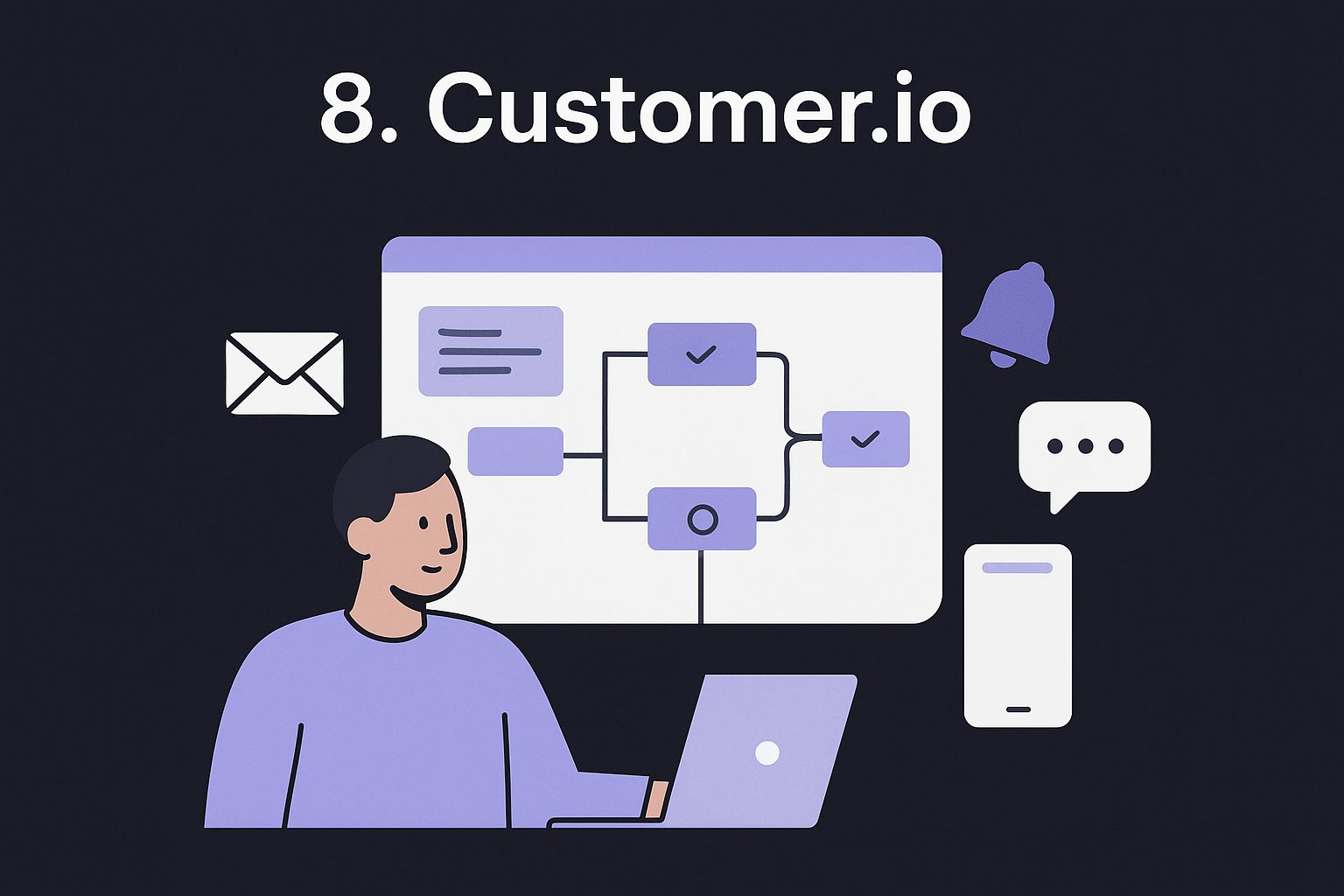
Customer.io automates email, SMS, push notifications, in-app messages, and Slack notifications based on real-time events you define. When a user completes an action, like activating a feature, reaching a usage milestone, or going inactive for a set period, the platform triggers the right message automatically without requiring manual follow-up.
Customer.io's visual workflow builder lets your team map out complex, multi-branch messaging logic based on event data, making it easier to personalize outreach at scale without writing custom backend code.
Beyond core messaging, the platform handles audience segmentation and A/B testing natively, so you can split-test message variations and refine your automation based on real performance data. For B2B SaaS companies managing free trials or onboarding sequences, this event-based approach covers use cases that traditional b2b marketing automation platforms handle less precisely.
Best for
Customer.io works best for B2B SaaS and product-led companies that need to automate messaging based on in-product behavior rather than just email engagement metrics. If your business depends on user activation and retention as key growth levers, Customer.io's event-driven model fits that workflow more naturally than most standard marketing automation tools.
- B2B SaaS teams managing onboarding and activation sequences
- Companies running product-led growth models
- Marketing and product teams that share ownership of the user lifecycle
- Businesses that need multi-channel automation beyond email alone
Pricing
Customer.io's pricing starts at $100 per month for the Essentials plan, which covers up to 5,000 contacts. The Premium plan starts at $1,000 per month and adds advanced features like frequency capping, custom objects, and priority support. Enterprise pricing is available for larger organizations with higher contact volumes or more complex technical requirements.
9. Brevo
Brevo, formerly known as Sendinblue, is a multi-channel marketing platform that combines email automation, SMS, CRM, and transactional messaging in one tool. It targets small to mid-sized B2B companies that need a cost-effective alternative to the pricier options among b2b marketing automation platforms without giving up the core workflow automation features a growing team relies on.
What it automates
Brevo automates email workflows, contact segmentation, and SMS campaigns based on behavioral triggers like form submissions, email engagement, and website activity. You can build multi-step automation sequences visually, setting conditions that move contacts through different paths depending on how they interact with your messages or landing pages.
Brevo also handles transactional email automation, making it practical for B2B SaaS companies that need to automate both marketing sequences and product-triggered notifications like trial expiration alerts or account confirmations inside one platform.
The platform includes a built-in CRM and contact scoring feature, so your sales team can track deal stages and follow-up priorities based on engagement data without connecting a separate tool.
Best for
Brevo works best for small B2B businesses and startups that need solid email and SMS automation at a price point that doesn't strain a limited marketing budget. If your team is stepping up from a basic email tool and wants automation workflows, a lightweight CRM and multi-channel messaging in one place, Brevo covers that ground without requiring significant technical setup.
- SMBs and early-stage B2B companies looking for an affordable all-in-one option
- Teams that need both marketing automation and transactional email in one platform
- Businesses running email and SMS campaigns simultaneously
- Companies that want a built-in CRM without paying for a separate tool
Pricing
Brevo offers a free plan that includes up to 300 emails per day with no contact limit, which makes it unusually accessible compared to most marketing automation tools. Paid plans scale based on your email volume and feature needs, with the Business tier unlocking automation workflows, A/B testing, and advanced reporting.
- Free: up to 300 emails per day, unlimited contacts
- Starter: starts at $9 per month, removes the daily sending cap
- Business: starts at $18 per month, adds full marketing automation and A/B testing
- Enterprise: custom pricing for larger contact volumes and dedicated support
10. Mailchimp
Mailchimp started as an email marketing tool for small businesses and has expanded over the years to include automation workflows, landing pages, basic CRM functionality, and audience segmentation. While it sits at the lighter end of b2b marketing automation platforms, it remains a practical choice for B2B teams that need straightforward automation without a steep learning curve or a high monthly bill.
What it automates
Mailchimp automates email sequences, contact tagging, and audience segmentation based on engagement behavior like email opens, clicks, and purchase activity. You can set up multi-step customer journeys visually using its Journey Builder, which triggers follow-up messages based on predefined actions or time delays without requiring technical setup.
Mailchimp's predictive segmentation feature uses AI to identify your most likely buyers, helping you focus campaign spend on the contacts showing the highest engagement signals.
Beyond email, the platform handles retargeting ad automation across Google and Facebook, connecting your contact list directly to ad audiences so your campaigns stay aligned with your email outreach. For B2B teams managing smaller lists and simpler sales cycles, this combination of email automation and basic paid ad integration covers a solid portion of a standard nurture strategy without requiring multiple tools.
Best for
Mailchimp works best for small B2B businesses and early-stage startups that need accessible automation without the complexity or cost of enterprise-grade platforms. If your team is running basic nurture sequences and wants a familiar, low-maintenance tool that handles email and segmentation reliably, Mailchimp fits that profile well.
- Small B2B teams running straightforward email nurture sequences
- Early-stage businesses building their first automated marketing workflows
- Companies that need basic CRM and email automation in a single, easy-to-use interface
- Teams with limited marketing budgets that need a free or low-cost starting point
Pricing
Mailchimp offers a free plan for up to 500 contacts with basic email features included. Paid plans start at $13 per month for the Essentials plan and scale up to $20 per month for the Standard plan, which unlocks the full Journey Builder and advanced segmentation tools. Premium pricing is available for larger contact databases and priority support.
Next Steps
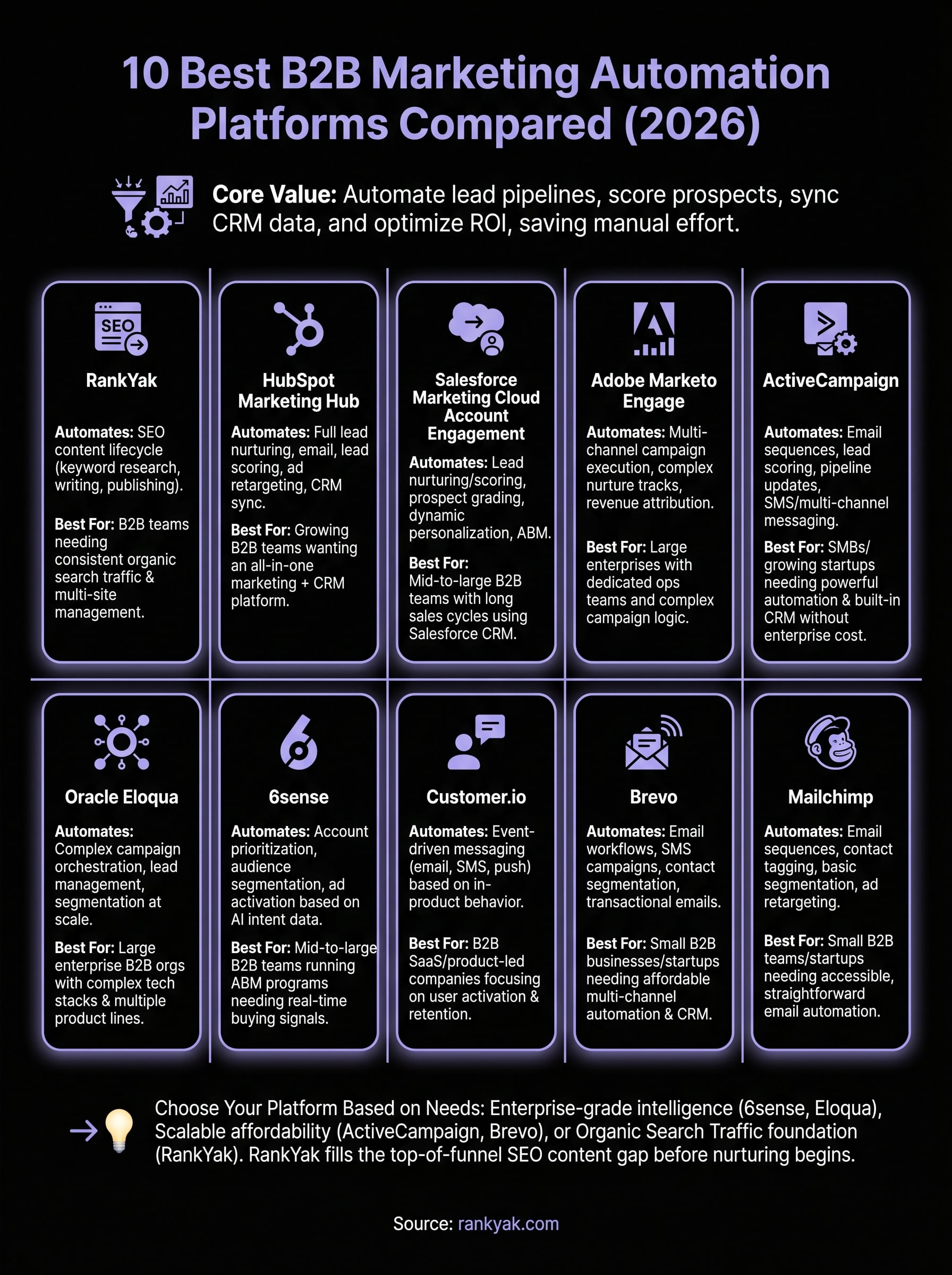
Every platform on this list solves a different piece of the B2B marketing problem, so your best choice depends on where your biggest bottleneck sits right now. If you need enterprise-grade pipeline intelligence, 6sense or Eloqua fits. If you need affordable automation that scales, ActiveCampaign or Brevo makes more sense. And if your sales cycle depends on organic search traffic, none of these b2b marketing automation platforms can help if qualified visitors aren't reaching your site in the first place.
That's where RankYak fills the gap. Before a lead enters any nurture sequence, it has to find you through search. RankYak automates the daily content output that makes that happen, from keyword research to publishing, without requiring a full content team. If you want to see how it works with your own website, start your free 3-day trial of RankYak and let the platform build your first content plan automatically.

Get Google and ChatGPT traffic on autopilot.
Start today and generate your first article within 15 minutes.
SEO revenue calculator
How much revenue is your website leaving on the table?
Take a quick quiz and see exactly how much organic revenue you're missing out on, along with personalized tips to fix it.
-
4 questions, under 1 minute
-
See traffic and revenue potential
-
No email required
Free · takes 1 minute · no signup needed
Question 1 of 4
Question 2 of 4
Question 3 of 4
Question 4 of 4
Your SEO growth potential
Extra visitors / month
after 6-12 months of consistent publishing
Revenue potential / year
at your niche's avg. conversion rate
Articles needed (12 mo)
to reach this traffic level
ROI with RankYak
at $99/mo ($1,188/year)
To hit that number, you'd need to:
- Build a topical authority strategy for your niche
- Research keywords & map out a full topical cluster
- Write, edit & publish an article every single day
- Build backlinks to the articles you publish
RankYak handles all of this automatically, every day.
* Estimates based on industry averages. Results vary by niche, competition, and domain authority. Most SEO results become visible after 3-6 months of consistent publishing.