Guest Posting For Backlinks: How To Earn Quality Links
Backlinks remain one of the strongest ranking signals Google uses to determine where your pages show up in search results, and it helps to understand why backlinks matter this much for SEO. But building backlinks that actually work? That's where most businesses hit a wall. Cold outreach goes unanswered, link schemes get penalized, and buying links is a fast track to a Google manual action. Guest posting for backlinks stands out as one of the few link building approaches for beginners that's both effective and sustainable, you provide genuine value to another site's audience, and in return, you earn a contextual link back to your own domain.
The catch is that guest posting takes real effort. You need to find the right sites, pitch topics that actually get accepted, write content worth publishing, and do it all consistently enough to move the needle. For small teams and solo operators, that's a tall order, especially when you're already juggling keyword research, on-site optimization, and your own content calendar.
That's exactly the kind of problem RankYak was built to solve. While RankYak automates your daily content creation, keyword targeting, and even builds links through its automated backlink exchange network, guest posting gives you an additional lever to pull for off-site authority. The two approaches complement each other well: automated on-site content keeps your publishing consistent, and strategic guest posts build the external trust signals that push those pages higher, which is the heart of any off-page SEO tactic list.
This guide breaks down how to earn quality backlinks through guest posting, from identifying high-value target sites and crafting pitches that get replies, to writing guest articles that editors actually want to publish. Whether you've never pitched a guest post or you're looking to tighten up a process that's gone stale, you'll walk away with a clear, repeatable system you can start using this week.
What guest posting for backlinks means in 2026
Guest posting for backlinks has changed more in the past few years than in the decade before that. Google's systems are smarter, site editors are pickier, and the low-effort tactics that once worked (mass-submitting spun articles to any site with a "write for us" page) now hurt more than they help. In 2026, a guest post backlink earns its value through editorial relevance and genuine audience fit, not just from the act of placing a link on an external domain. If you treat guest posting as a link placement transaction, you'll get diminishing returns fast.
The sites that rank best today consistently earn links that sit inside content a real editor chose to publish for a real audience.
How Google treats guest post links today
Google has publicly stated for years that links built primarily to manipulate PageRank violate its spam policies, which is why white hat link building techniques are the only ones worth your time. That doesn't mean guest posting is off the table; it means the intent and quality behind the guest post determine whether the link helps or hurts your site. When your guest post provides real value to readers on a relevant site, Google treats that link as a legitimate editorial signal. When a site publishes anything from anyone just to collect placement fees, Google devalues those links or ignores them entirely.
Practically, you need to treat every guest post as a piece of content your byline is permanently attached to. Your reputation travels with every link you place, and a well-placed article on a niche site with an engaged readership does more for your domain authority than ten links from generic blogs that accept every submission they receive.
What makes a guest post link actually count
Not all backlinks from guest posts carry the same weight. Several factors determine whether a link moves your rankings or just sits there doing nothing for your domain.
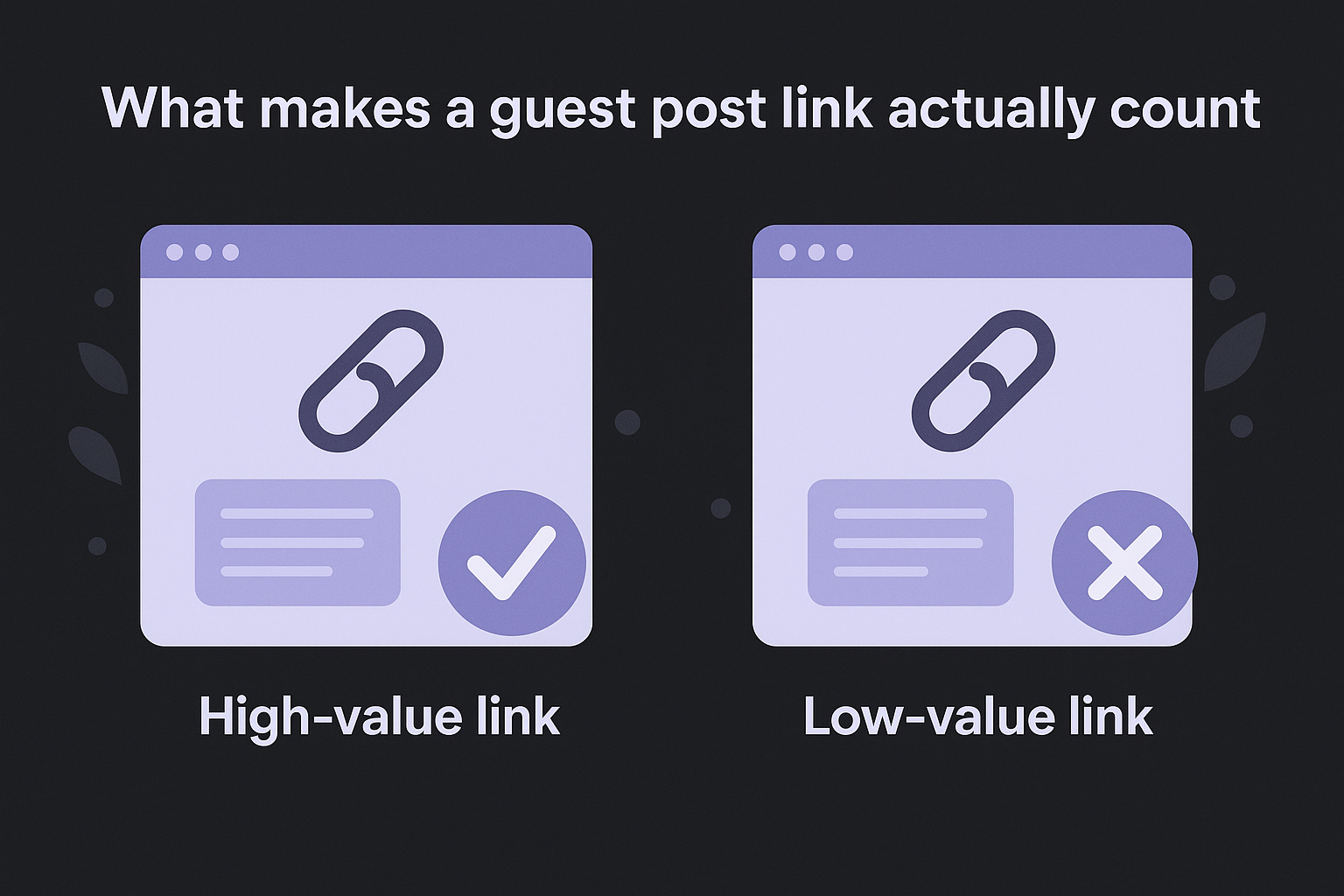
Topical relevance is the biggest factor. A link to your project management SaaS from a software productivity blog carries real context. The same link from a cooking website does not. Google's systems read the surrounding content and the overall topic of the linking domain before assigning authority, so publishing on loosely related sites wastes the effort you put into pitching and writing.
Link placement inside the body copy of an article outperforms footer links, sidebar mentions, or links buried in an author bio. Contextual links, those surrounded by related text that reinforces the anchor phrase, pass more signal because they're clearly part of the editorial content rather than a placed advertisement. Author bio links still carry brand recognition value, but if your goal is ranking, you want at least one in-content link per post.
Here's a quick comparison of what separates a high-value guest post link from a low-value one:
| Factor | High-value link | Low-value link |
|---|---|---|
| Site relevance | Closely related niche | Unrelated or generic domain |
| Placement | Inside body copy | Author bio or footer only |
| Editorial process | Human editor reviewed | Auto-accepted submissions |
| Audience | Engaged, real readership | Thin traffic, low engagement |
| Domain standing | Established, trusted site | New or previously penalized site |
Understanding these distinctions before you build your prospect list saves you from spending weeks on outreach that produces links Google either ignores or counts against you.
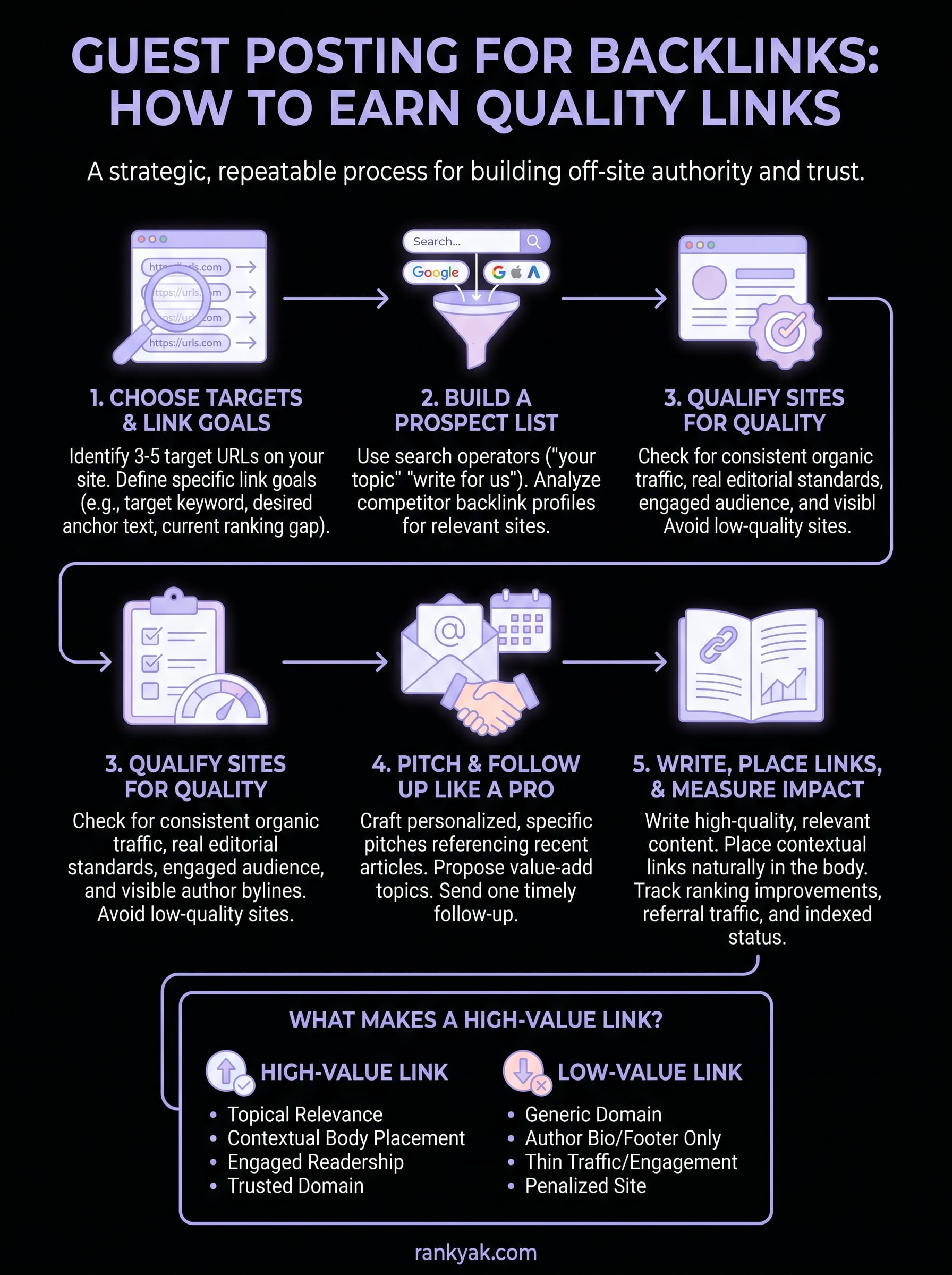
Step 1. Choose targets and link goals
Before you build a single prospect list, you need to know what you're trying to accomplish with each link you earn. Guest posting for backlinks without a clear goal wastes time, leaving you chasing placements that look impressive on paper but do nothing for the pages that actually need ranking signals. Start by listing the three to five URLs on your site that need the most external authority, whether those are product pages, pillar posts, or landing pages stuck below the first page of results.
Define your link goal for each target page
Each page you want to promote through guest posting should have a specific goal attached to it. A product page targeting a commercial keyword needs links with anchor text that reinforces the topic and intent. A blog post targeting an informational keyword benefits from links that broaden topical authority and pull in referral traffic from curious readers. Write down the page URL, the target keyword, the current ranking position, and the type of anchor text you plan to use before you contact a single editor.
Here's a simple planning template to fill in before you start outreach:
| Page URL | Target keyword | Current ranking | Goal anchor text |
|---|---|---|---|
| /your-page | main keyword phrase | Position 22 | exact or partial match |
| /another-page | secondary keyword | Not ranking | branded or natural phrase |
Setting a clear link goal before you search for prospects keeps your outreach focused and stops you from accepting every placement opportunity that lands in your inbox.
Prioritize pages by ranking gap
Once you have your list of target pages, sort them by ranking gap, meaning how close each page sits to the first page of results for its primary keyword. Pages sitting between positions 11 and 30 typically see the biggest lift from a handful of quality backlinks. Pages sitting outside position 50 usually need on-site content improvements first, so it pays to find and fix the pages stuck below page one before pushing them through guest posting alone. Concentrate your guest posting energy on the pages closest to page one and work outward from there.
Step 2. Build a prospect list
Your prospect list is the raw material every outreach campaign runs on. Without a solid, targeted list, you'll spend most of your time pitching sites that either won't respond or won't help your rankings. Build this list before you write a single pitch, and treat it as a living document you add to and filter over time.
Find sites through search operators
Google's search operators give you a fast way to surface sites that actively accept guest contributions in your niche. Pair a topically relevant term with standard signals that indicate a publication accepts outside writers, and you'll surface dozens of prospects in a few minutes. Try these search strings and swap out "your topic" for your actual niche:
"your topic" "write for us""your topic" "guest post guidelines""your topic" "submit a post""your topic" "contributor guidelines""your topic" intitle:"write for us"
Running five or six variations of these search strings typically uncovers more prospects than most teams can realistically contact in a single month.
Copy every promising URL into a spreadsheet with columns for site name, URL, contact email, estimated traffic, and outreach status. Keeping your list organized from the start prevents the disorganization that kills most outreach campaigns before they gain any real traction.
Use your competitors' backlink profiles
Sites that have already published a guest post from one of your competitors are pre-qualified prospects: they accept guest contributions, they cover your niche, and they've proven they'll link out to content like yours. Pull your top three competitors through any of the tools built for backlink research and outreach, filter for links from editorial content, and add any relevant site to your spreadsheet.
For each competitor, look specifically for links that point to blog posts or resource pages rather than homepages, since those placements typically come from genuine guest posting for backlinks rather than directories or press mentions. This step alone can generate thirty to fifty realistic prospects in under an hour. Between search operator queries and competitor research, you'll have a large enough list to run a meaningful outreach campaign without spinning your wheels on cold prospecting from scratch.
Step 3. Qualify sites for quality and fit
A long prospect list means nothing if every site on it is low-quality or misaligned with your niche. Before writing a single pitch, run each prospect through a short qualification process to confirm the site is worth targeting. This step protects your time and keeps your guest posting for backlinks campaign focused on placements that will actually move your rankings.
Check domain authority and traffic signals
The first thing to verify is whether a site has real organic traffic and an established backlink profile of its own. A site that earns no organic traffic passes almost no authority through the links it publishes, regardless of its domain rating score. Use any backlink or traffic estimation tool to check whether the site shows consistent visits over the past twelve months. Avoid sites with sudden traffic spikes followed by steep drops, as these usually indicate a penalized or manipulated domain.
A site's traffic trend matters more than its domain rating. A site with steady, growing traffic on a lower domain score will typically outperform a high-rated site in sharp decline.
Here's a quick qualification checklist to run through for every prospect:
- Organic traffic: consistent monthly visits, not trending sharply downward
- Backlink profile: links come from real editorial sites, not link farms
- Content recency: new articles published within the past 30 to 60 days
- Topical focus: majority of content stays within your niche
- Visible author bylines: real contributor names, not anonymous posts
Evaluate editorial standards and audience fit
Beyond metrics, read five to ten recent articles on the site before adding it to your confirmed outreach list. Check whether the site publishes thorough, well-researched content or thin posts that exist purely to collect guest submissions. A site with an engaged comment section or regular reader responses signals a real audience, which means your guest post will earn referral traffic alongside the backlink.
Look at each site's existing guest posts specifically and check whether contributor links appear inside the body content or get pushed entirely into an author bio. If the site consistently buries all external links in bio boxes, you may get brand visibility but limited ranking benefit from the placement.
Step 4. Pitch and follow up like a pro
Your prospect list is ready and every site on it has passed your quality filters. Now you need to write a pitch that gets a reply. Most outreach fails not because the topic is wrong but because the email reads like a template blast sent to a hundred editors at once, a pattern even paid outreach providers struggle to escape. Editors spot a copy-paste pitch in two seconds and delete it just as fast. A strong pitch is short, specific, and personal enough to show you actually read the site before contacting them.
Write a pitch that gets opened
Your subject line determines whether an editor opens your email at all. Avoid vague subject lines like "Guest Post Inquiry" and instead reference the site or a specific article directly. Keep the body under 150 words: introduce yourself in one sentence, reference a piece they've already published, propose two or three topic ideas, and explain why each topic serves their audience. Here's a pitch template you can adapt:
Subject: Guest post idea for [Site Name], [Topic Area]

Hi [Editor's name],

I've been reading [Site Name] for a while, and your recent piece on
[specific article title] stood out to me.

I write about [your niche] and think your audience would get value
from one of these topics:

1. [Topic idea 1]
2. [Topic idea 2]
3. [Topic idea 3]

I can deliver a fully researched, 1,000+ word draft within a week.
Happy to share previous bylines if that helps.

[Your name]
Personalizing just two or three details in your pitch dramatically improves reply rates compared to sending the same generic message to every editor on your list.
Follow up without being annoying
Most editors miss emails rather than ignore them. A single follow-up sent five to seven days after your original pitch recovers a large portion of non-replies without damaging the relationship. Keep your follow-up to two sentences: reference the original email and ask whether they had a chance to review your ideas.
Running guest posting for backlinks at any real volume, in-house or through providers that place guest posts for you, requires tracking every outreach thread in your prospect spreadsheet. Log the date of your first email, the follow-up date, and the reply status so nothing slips through and you never accidentally contact the same editor twice.
Step 5. Write, place links, and measure impact
You've secured a confirmed placement. Now you need to deliver an article that the editor publishes without sending back for a full rewrite, and then track whether the link actually moves your target page's rankings. Completing this step well is what separates a one-time placement from a long-term relationship with an editor who invites you back.
Write content the editor won't rewrite
The same rules that apply to writing SEO articles that rank apply here: your guest post should match the site's existing tone, structure, and depth as closely as possible. Read three published pieces from that site and note the average word count, whether they use subheadings, and how they open each article. Mirror that format in your draft. Editors receive a constant stream of generic submissions, and a piece that fits their style immediately signals a professional contributor worth working with again.
Use this checklist before submitting any guest post draft:
- Matches the site's average word count and section structure
- Includes at least one in-content link to your target page with a relevant anchor phrase
- Links to two or three external sources that are not your own domain
- Opens with a clear statement of what the reader will learn
- Contains no promotional language about your product or service
Place your links with intention
Every link you include in the guest post body should feel natural to a reader, not inserted to satisfy a quota. Place your primary link in a sentence where the surrounding text directly relates to your target page's topic. If your anchor text is "content automation for SEO," the sentence around it should give that phrase full context so both the editor and Google can read it as editorial rather than advertorial.
Track what your guest posts actually do
Guest posting for backlinks only compounds in value if you measure each placement's effect on the pages you're promoting. After each post goes live, log the placement in a tracking sheet and check your target page's ranking position weekly for the next 60 days.
Even a single high-quality placement on a relevant, well-trafficked site can shift a page from position 14 to the first page within four to six weeks.
| Metric to track | Tool to use | Check frequency |
|---|---|---|
| Target page ranking position | Google Search Console | Weekly |
| Referring domain count | Any backlink checker | Monthly |
| Referral traffic from placement | Google Analytics | Monthly |
| Indexed status of guest post | Google Search (site: query) | Within 7 days of publication |
Final thoughts
Guest posting for backlinks works when you treat it as a system rather than a one-off tactic. Every step in this guide builds on the previous one: your link goals sharpen your prospect list, your prospect list informs your pitch, and your pitch gets you into publications that actually move your rankings. The businesses that see real results from guest posting are the ones that run the process consistently month after month, not the ones that send a handful of pitches and wait.
The biggest bottleneck for most teams is time, specifically the daily content output your own site needs while you're also doing outreach. RankYak handles your on-site publishing on autopilot, generating a fully optimized article every day so your blog keeps growing while you focus on guest placements. If you want to stop choosing between your own content and link building, let RankYak publish for you every day with a free trial and run both without the tradeoff.
Allan de Wit is a co-founder of RankYak and has worked in SEO since 2015: inside agencies, alongside them, for clients directly, and in-house on the products being ranked. He came to it as a software engineer building for marketers, which is why the platform is built the way it is. He went on to start companies of his own, two of which were acquired. At RankYak he sets the product direction and owns the features, the quality bar, the design, and the UX.