Long Tail Keyword Examples: 75 High-Intent Queries To Copy

Most businesses chase the same handful of broad, hyper-competitive keywords, and wonder why they're stuck on page three. Meanwhile, the sites actually pulling in consistent organic traffic are targeting long tail keyword examples that most competitors completely ignore. These longer, more specific search queries may get fewer individual searches, but they convert better and are far easier to rank for.
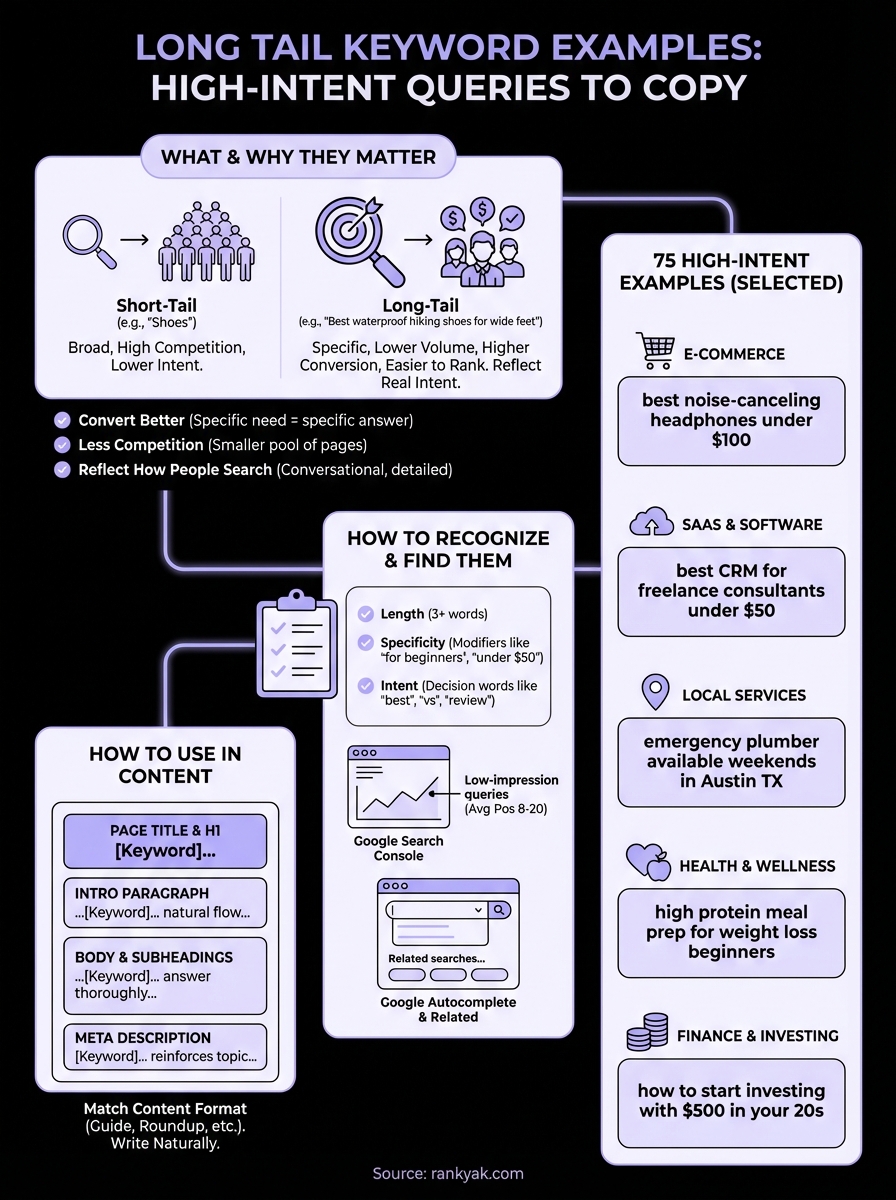
A long-tail keyword isn't just a longer phrase. It's a reflection of real search intent, someone who knows what they want and is closer to taking action. "Shoes" is a short-tail keyword. "Best waterproof hiking shoes for wide feet" is a long-tail keyword with a buyer behind it, and the difference between long tail and short tail keywords shapes how you use each one. Understanding the difference, and knowing how to spot these queries in your niche, is what separates SEO strategies that actually drive revenue from ones that just burn time.
This article gives you 75 concrete long-tail keyword examples across multiple industries and intent types, queries you can adapt and use right away. You'll see exactly what makes each one effective, how to categorize them by search intent using the different types of keywords in SEO, and how to start building content around them. It's the kind of targeted keyword work that RankYak automates daily for its users, identifying high-potential long-tail opportunities and turning them into optimized, published articles, but whether you use a tool or do it manually, grasping these patterns will sharpen every piece of content you create.
Why long-tail keywords matter
Most people treat keyword research as a numbers game, chasing high search volume at all costs. That thinking keeps most sites stuck. Long-tail keywords flip the equation: instead of fighting for a fraction of one percent of clicks from a massive keyword pool, you target specific queries where you can actually win. The payoff shows up in your rankings, your traffic, and your conversion rates.
They convert better than broad keywords
When someone types a very specific query, they already know what they want. A visitor who finds your page through "best CRM software for freelance consultants" is far more likely to sign up, buy, or book than someone who landed after searching "CRM." Specificity signals real purchase intent, and intent drives action.
The closer a keyword matches what a buyer is thinking, the shorter the path from landing on your page to taking action.
Think about long tail keyword examples from e-commerce: "organic dog food for senior dogs with kidney disease" or "lightweight running shoes for flat feet under $100." Each phrase describes a real person with a real problem. Your content that answers this query earns trust fast because it speaks directly to that need, not to an anonymous crowd.
They face less competition
Broad keywords attract massive competition. Ranking for "project management" means competing against billion-dollar software brands with dedicated SEO teams and years of domain authority. Ranking for "project management templates for construction teams" puts you in a much smaller, more winnable pool of pages. A smaller pool means faster ranking, and faster ranking means traffic sooner.
Businesses that build their SEO strategy around targeted, lower-competition queries accumulate wins faster than those swinging at the same head terms as everyone else. Over time, ranking for dozens or hundreds of specific terms adds up to significant organic traffic, traffic you own without paying for every click. This same principle applies to paid search: long-tail keywords in PPC campaigns typically cost less per click and deliver higher quality scores, making them valuable across both organic and paid channels.
They reflect how people actually search
People do not type like robots. When someone opens Google or an AI chat interface, they write conversational, detailed queries that match the way they think about a problem. Google's own research into how search works confirms that a massive share of all searches each day are queries that have never been searched before.
This pattern is even more pronounced in AI search platforms like ChatGPT, Gemini, and Perplexity, where users type full questions and detailed prompts rather than fragmented keywords. Long tail search keywords are the native language of these platforms, making them critical for visibility in both traditional and AI-powered search.
That reality means there is a nearly unlimited supply of long-tail opportunities in almost every niche. By understanding the patterns behind how people search, you can get ahead of demand rather than react to it. Your content becomes the answer before competitors even realize the question exists.
How to recognize a long-tail keyword
Not every long phrase qualifies as a long-tail keyword, and not every short phrase is automatically a head term. Recognizing the pattern takes a bit of practice, and a proper long tail keyword analysis makes the markers obvious once you know what to look for. The key signals are length, specificity, and the intent hiding inside the query. Looking at any long tail keyword search example closely reveals these same markers every time.
Look for three or more words with a clear modifier
Most long-tail keywords contain three to six words, and almost always include at least one modifier that narrows the search. A modifier can be a location ("in Chicago"), a qualifier ("for beginners"), a price point ("under $50"), a use case ("for small businesses"), or a feature ("with free shipping"). When you see a keyword phrase that answers an implicit question, such as "who," "what," "where," or "how much," you're likely looking at a strong long-tail keyword example.
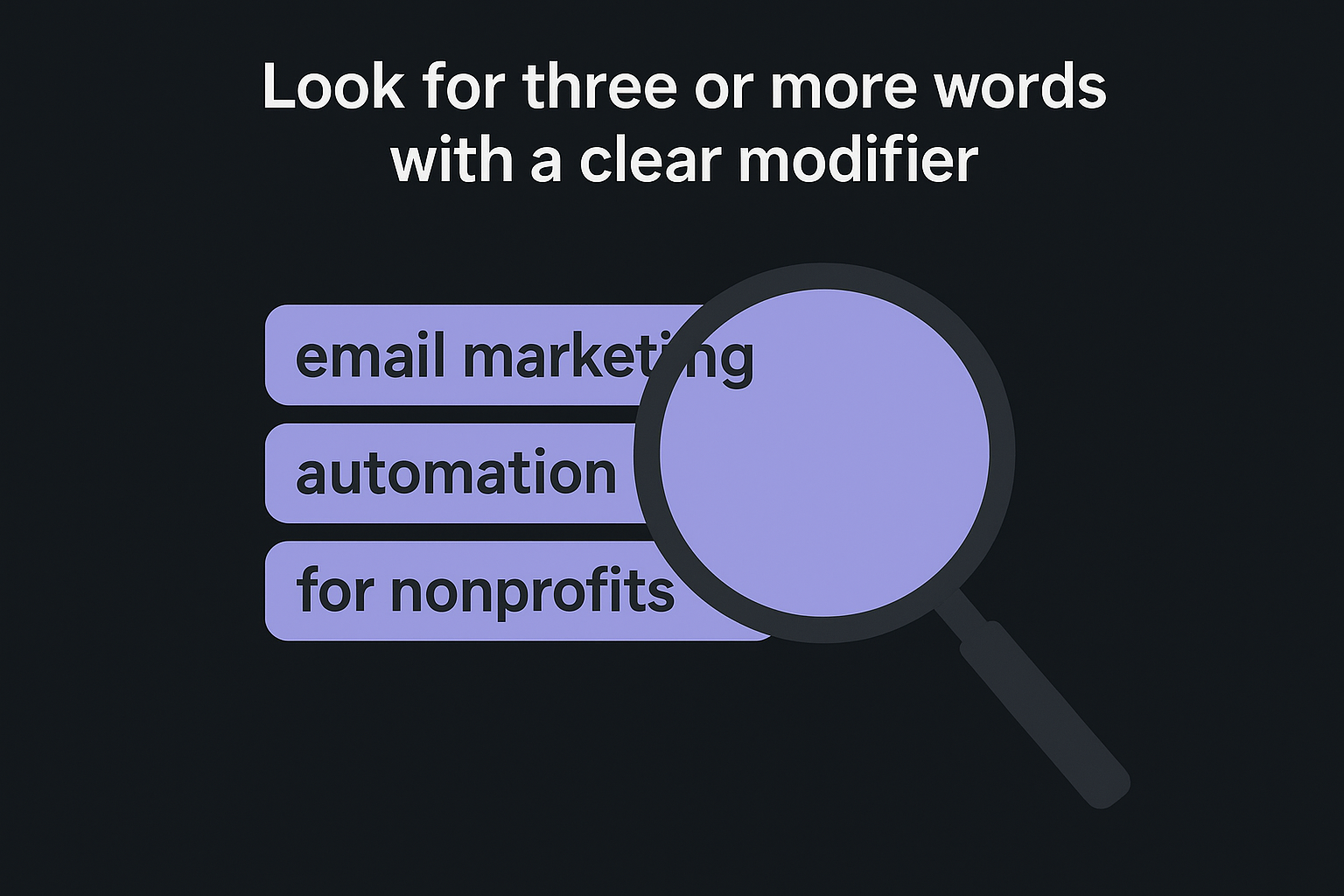
The modifier is the signal. It tells you a real person is filtering out irrelevant results and looking for exactly the right answer.
Compare "email marketing" to "email marketing automation for nonprofits." The second phrase carries a specific audience (nonprofits) and a specific need (automation). That specificity is the fingerprint of a long-tail keyword.
Check whether the query reflects a decision-stage mindset
Long-tail keywords often appear at the bottom of the buying funnel, where someone is evaluating options or ready to act. Phrases that include words like "best," "vs," "review," "how to choose," or "alternatives to" point to someone who is actively deciding. These queries deserve content that answers their specific concern directly, not a broad overview that forces them to keep searching.
Shorter keywords like "CRM software" suggest early-stage curiosity. "Best CRM software for small real estate teams" signals a person comparing options with a specific context in mind. That difference in intent shapes everything, from the content you write to the conversion rate you can expect.
How to find long-tail keywords for your niche
Finding long tail keywords for your specific niche does not require expensive tools or advanced technical skills. Your best sources are already built into the platforms your audience uses, and learning to read those signals will surface more keyword opportunities than you can realistically create content for.
Start with your own search console data
Google Search Console shows you the exact queries people use to find your site, including low-impression phrases that your pages are already ranking for without you even targeting them. Filter your queries by impressions below 100 to reveal a hidden layer of long-tail traffic you are not yet optimizing.
Look specifically for queries where your average position sits between 8 and 20. These are keywords where your content already has traction but needs a dedicated, well-optimized page to push it into the top five. That list alone can fill months of content planning.
Use Google's autocomplete and related searches
Type a broad keyword into Google and watch the autocomplete suggestions drop down. Each suggestion represents a real query pattern that enough people have searched for Google to surface it. These are not guesses; they are signals pulled directly from actual search behavior.

Autocomplete is Google handing you a research shortlist for free. Use it.
Scroll to the bottom of the search results page and check the "Related searches" section. This section shows you how Google clusters similar queries together, which reveals how real users think about a topic and what variations they search before making a decision. Combine these two sources with a close read of the questions appearing in the "People also ask" box, and you will build a niche keyword list grounded entirely in real demand, not guesswork.
How to use long-tail keywords in content
Finding long tail keyword examples is only half the job. Placing them correctly inside your content is what turns a keyword list into actual rankings. The way you structure, title, and write around a long-tail keyword signals to Google whether your page truly answers the query or just mentions it in passing.
Match the content format to the query type
Before you write a single word, check what Google already ranks at the top for your target keyword. If the top results are step-by-step guides, your page needs to walk through a process. If they are product roundups or comparison articles, your content should evaluate options. Google's results show you the format that already satisfies user intent, and ignoring that signal means writing content that ranks lower no matter how carefully you handle the rest of your content optimization in SEO.
Matching format to intent is not about copying competitors. It is about understanding what kind of answer the person behind the query actually needs.
When someone searches a query like "how to write a subject line for a cold email to recruiters," they want a practical walkthrough, not a definition of subject lines. Tailoring your content format to the specific query type is what makes each individual page useful rather than generic.
Place keywords where they carry the most weight
Your long-tail keyword should appear in your page title and H1 heading as close to the front as possible. Include it once in the opening paragraph, once in a subheading if it fits naturally, and a handful of times throughout the body without forcing it. Search engines also read your meta description, so including the keyword there reinforces what the page is about before someone even clicks.
Avoid stuffing the same phrase repeatedly, and check the phrase frequency on your page if you are unsure. Google rewards natural language and semantic relevance, which means writing naturally about the topic will pull in related terms automatically. Focus on answering the question thoroughly, and keyword placement will follow without extra effort. Once your content is live, track your long-tail keyword rankings in Google Search Console or a rank tracking tool so you can measure progress and identify pages that need further optimization.
75 long-tail keyword examples to copy
The fastest way to internalize what makes a strong long-tail keyword is to see a large set of them side by side. The 75 long tail keyword examples below are organized by industry and sorted by intent type so you can see exactly how specificity, audience, and context combine to create queries worth targeting. Adapt any of these directly to your niche by swapping the product, location, or audience detail.
Organized by industry and intent
Each category below covers a different industry vertical, and each keyword reflects a real decision-stage or problem-aware mindset. Notice how every phrase names a specific audience, use case, price range, or situation. That combination is what makes each one easier to rank for and more likely to convert than a broad head term.
The closer a keyword mirrors a real person's specific situation, the more likely your content will be the one they click.
| Industry | Long-Tail Keyword Example |
|---|---|
| E-commerce | best noise-canceling headphones under $100 |
| organic baby formula for sensitive stomachs | |
| lightweight running shoes for flat feet women | |
| affordable standing desk for small home office | |
| waterproof hiking boots for wide feet men | |
| non-toxic cookware set for induction stove | |
| wireless earbuds for small ears with long battery | |
| best robot vacuum for pet hair on hardwood | |
| foldable electric bike for commuting under 500 | |
| reusable water bottle that fits cup holder | |
| bamboo sheets for hot sleepers queen size | |
| cast iron skillet preseasoned for beginners | |
| portable blender for protein shakes travel | |
| ergonomic chair for back pain under $300 | |
| adjustable dumbbells for small apartment workout | |
| SaaS and Software | best CRM for freelance consultants under $50 |
| project management software for remote construction teams | |
| email automation tool for nonprofit organizations | |
| affordable accounting software for self-employed | |
| time tracking app for freelancers with invoicing | |
| HR software for small businesses without IT | |
| video conferencing tool with virtual background free | |
| best password manager for small business teams | |
| social media scheduler for multiple Instagram accounts | |
| document signing software that integrates with Google Drive | |
| customer support software for e-commerce stores | |
| invoicing app for contractors with recurring billing | |
| cloud storage for photographers large files | |
| SEO tool for bloggers on a budget | |
| landing page builder without coding for coaches | |
| Local Services | emergency plumber available weekends in Austin TX |
| affordable family dentist accepting Medicaid near me | |
| licensed electrician for home panel upgrade Denver | |
| pet grooming for anxious dogs in Seattle | |
| HVAC repair same day service Phoenix | |
| moving company that handles antiques Boston | |
| commercial kitchen cleaning service Chicago area | |
| personal trainer specializing in seniors Portland | |
| tax preparer for small business owners Miami | |
| immigration attorney free consultation New York | |
| dog trainer for reactive dogs Los Angeles | |
| wedding photographer with film style San Francisco | |
| roof repair after storm damage Nashville | |
| auto detailing mobile service near me | |
| fence installation company for wood privacy fence | |
| Health and Wellness | high protein meal prep for weight loss beginners |
| yoga for lower back pain over 50 | |
| best supplements for women over 40 energy | |
| low-impact cardio workout for bad knees | |
| gluten-free meal plan for athletes | |
| intermittent fasting schedule for night shift workers | |
| how to reduce cortisol levels naturally | |
| resistance band workout for postpartum women | |
| sleep routine tips for people with anxiety | |
| anti-inflammatory breakfast ideas for arthritis | |
| strength training for beginners at home no equipment | |
| mental health apps for teens with depression | |
| keto snacks with less than 5 carbs | |
| how long does it take to build muscle women | |
| meditation techniques for people who cannot sit still | |
| Finance and Investing | how to start investing with $500 in your 20s |
| best high-yield savings account no minimum balance | |
| how to pay off student loans on a teacher salary | |
| budgeting strategies for irregular freelance income | |
| Roth IRA vs 401k for self-employed | |
| how to build credit with no credit history | |
| cheapest way to send money internationally | |
| term life insurance for stay-at-home parents | |
| how to negotiate salary at first job | |
| passive income ideas that actually work in 2026 | |
| index funds for beginners with small amounts | |
| how to save for a house while renting | |
| financial advisor cost for middle-class families | |
| tax deductions for remote workers home office | |
| emergency fund calculator for single income household |
Next steps
You now have 75 ready-to-use long tail keyword examples, a clear framework for recognizing them, and a process for finding more in any niche. The next move is straightforward: pick five to ten keywords from the table above that closely match your audience and start mapping each one to a dedicated piece of content. Do not try to target all of them at once. Consistent, focused execution beats a scattered publishing sprint every time.
If building and maintaining that content pipeline manually feels like too much to manage alongside everything else running your business demands, you do not have to do it alone. RankYak automates the entire process, from automatic long-tail keyword discovery in your niche to writing fully optimized articles and publishing them to your site daily. You get the organic traffic benefits without the hours spent on research, writing, and scheduling. Start your free trial and let the system do the heavy lifting.