UGC Content Marketing: Strategy, Benefits, And Examples

Your customers are already talking about your brand, posting photos, leaving reviews, sharing stories. The question is whether you're putting that content to work. UGC content marketing turns authentic customer-created material into one of your most powerful growth channels, and brands that figure this out consistently outperform competitors who rely solely on polished, in-house content.
The appeal is straightforward: people trust other people more than they trust brands. A genuine customer photo or an unscripted video review carries weight that no amount of ad spend can replicate. But collecting UGC is only half the equation. You also need a strategy that integrates user-generated content into your broader marketing efforts, including your SEO and content pipeline, so it actually drives measurable results.
That's where things get interesting. At RankYak, we help businesses build consistent, SEO-optimized content engines on autopilot. Pairing that kind of structured content strategy with authentic UGC amplifies your brand's reach across both Google and AI-driven search platforms.
This guide breaks down everything you need to know about UGC content marketing: what it is, why it works, how to build a strategy around it, and real examples from brands doing it well.
What UGC content marketing is and is not
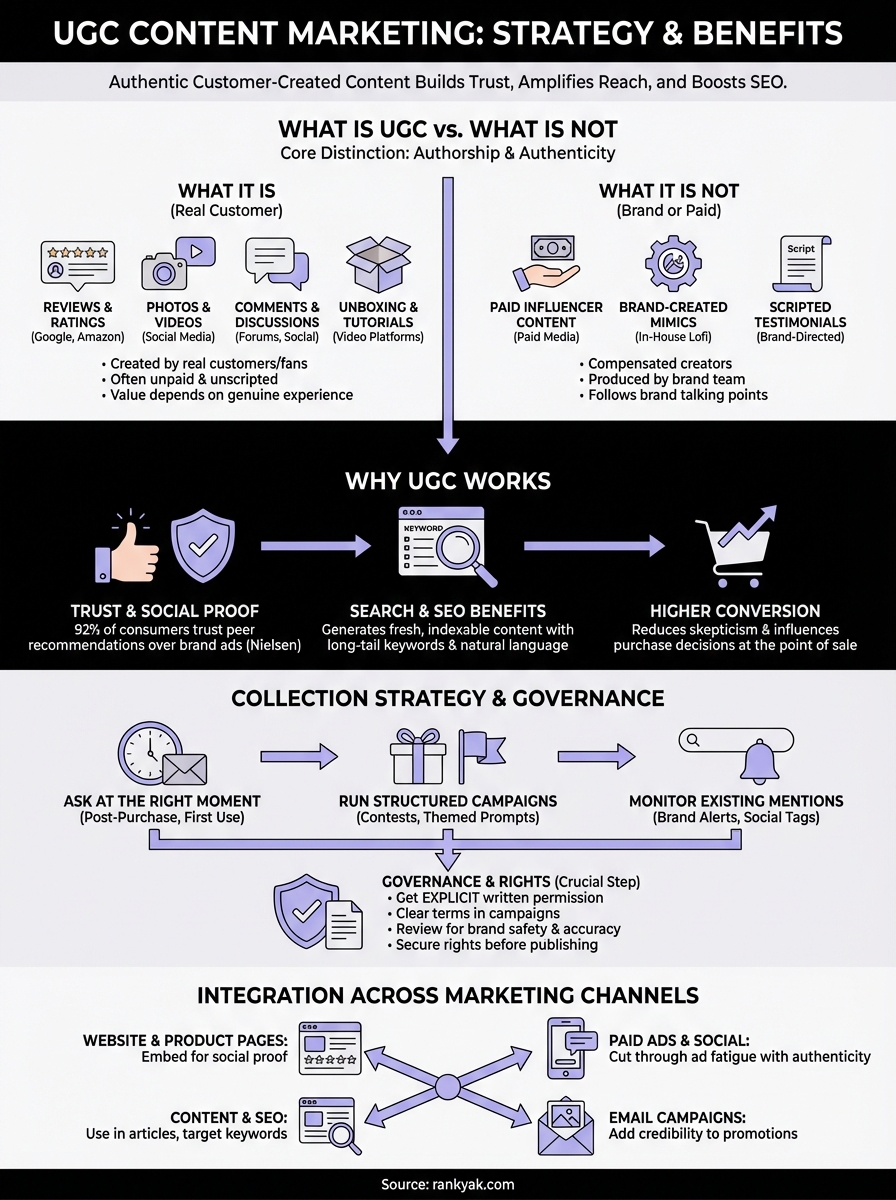
UGC content marketing is the practice of collecting, curating, and distributing content that your actual customers or users created, rather than content your marketing team produced in-house. The core distinction is authorship: the content originates from real people who interact with your product or service, not from your brand. Understanding this boundary matters because the value of UGC depends entirely on its authenticity, and that authenticity collapses the moment you misrepresent what you are publishing.
What qualifies as UGC
User-generated content covers a wide range of formats. The common thread across all of them is that a real customer, fan, or user created the content, often without direct compensation from your brand. Here are the main forms it takes:
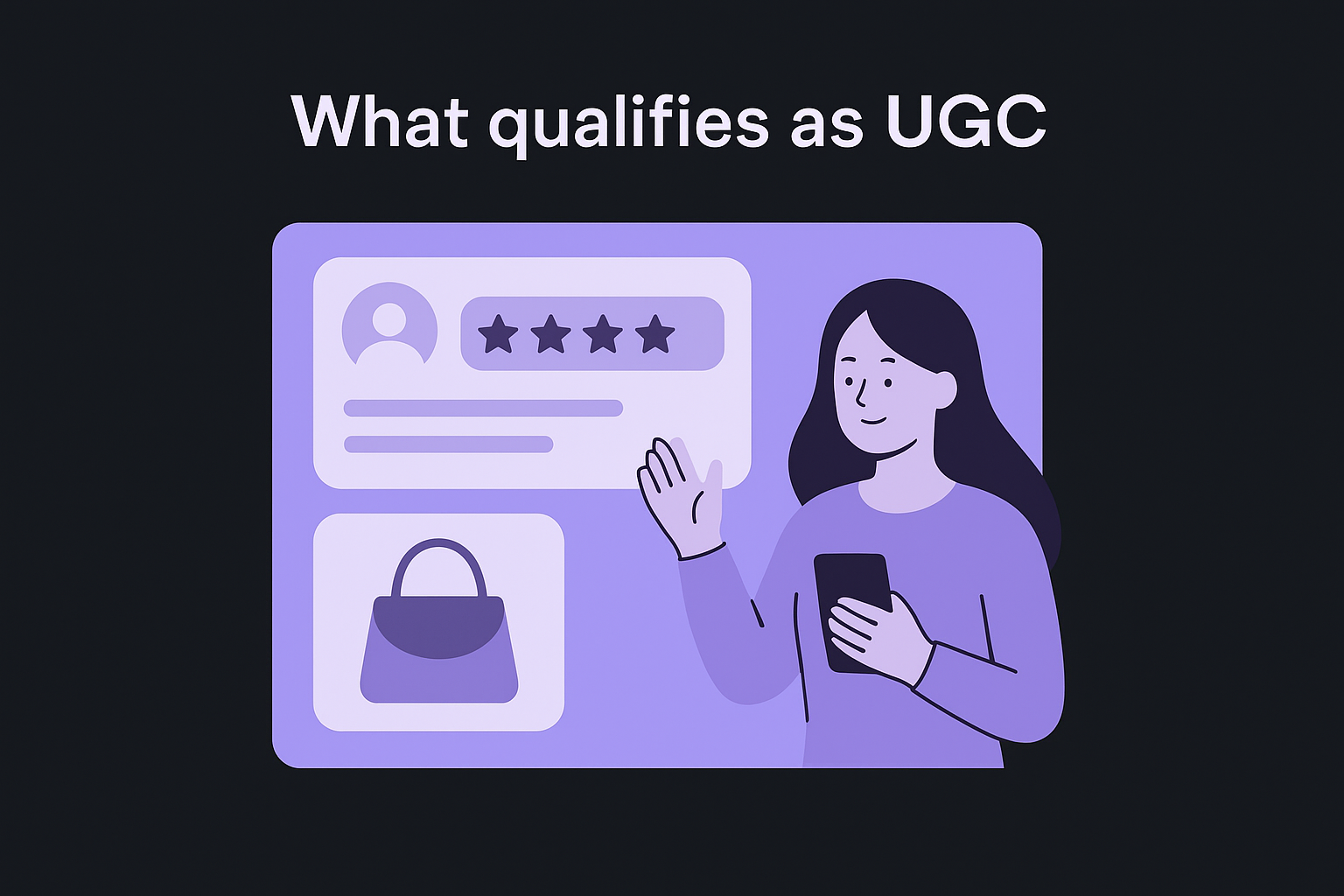
- Reviews and ratings on platforms like Google, Amazon, or Yelp
- Photos and videos customers post on social platforms featuring your product
- Blog posts or written accounts where someone documents their experience with your brand
- Comments, forum threads, and community posts discussing your product or service
- Unboxing videos and tutorials that customers record after purchasing
Each format carries different weight depending on your industry and audience. A software company might draw most of its value from forum discussions and written reviews. A consumer goods brand might get stronger results from customer photos and short videos. The format matters less than one core fact: a real person chose to document their genuine experience with your product, either spontaneously or in response to a direct, honest invitation from your brand.
The authenticity of UGC is its entire value proposition. Once your audience suspects the content is manufactured or deceptively incentivized, the trust it was supposed to build disappears immediately.
What UGC is not
Many brands get confused here, and that confusion leads to wasted resources and legal exposure. Influencer-created content your brand paid for is not UGC, even if it looks casual and unscripted. That content is paid media. The creator was compensated to produce and distribute it, which places it in a different category both legally and in terms of how audiences perceive it.
Similarly, content your own team creates to mimic the look of organic customer content is not user-generated content. Some marketing teams produce lo-fi videos or rough-looking photos designed to resemble genuine customer clips. That can be a useful creative approach, but it is still brand content, and presenting it as something else misleads your audience.
Another point worth clarifying: not every positive brand mention automatically qualifies as usable UGC for your campaigns. A customer posting about your product is technically user-generated content, but a solid ugc content marketing strategy requires explicit permission to repurpose that content in your marketing materials. Scraping mentions and republishing them without rights creates legal risk and damages the relationship with the customers whose content you are using.
Finally, do not conflate UGC with scripted testimonials. If you ask a customer to record a specific message and hand them talking points, that content is a testimonial or case study, not organic UGC. Both types are useful marketing assets, but they function differently. Testimonials involve direct editorial input from your brand. UGC, by definition, reflects what the customer chose to say and show on their own terms.
Keeping these categories separate protects your brand's credibility and ensures the content you distribute actually carries the authentic weight that makes UGC effective in the first place.
Why UGC works for brands
The reason ugc content marketing delivers results comes down to a simple behavioral reality: consumers trust strangers who have nothing to gain more than they trust brands that want to sell them something. That dynamic has always existed, but the internet made it scalable. Your potential customers now have access to thousands of unfiltered opinions before they ever interact with your brand directly, and that research happens before they reach your website, your ads, or your sales team.
Trust that paid content cannot replicate
When a real customer shares a photo, writes a detailed review, or records an honest video walkthrough of your product, they are offering social proof that no advertising budget can manufacture. According to research published by Nielsen, 92% of consumers trust organic, peer recommendations over direct brand communications. That trust gap is not a small one, and it directly affects conversion rates.
Customers who encounter authentic peer content during their decision process convert at significantly higher rates than those who only see brand-produced material.
Your paid content has a job: it builds awareness and frames your brand positioning. UGC does something different. It answers the skeptical questions your audience asks when no brand representative is in the room. Does this product actually work the way the company claims? What does it look like in a real home, on a real person, in a real workflow? UGC answers those questions in a voice your audience trusts instinctively.
Search and SEO benefits
Beyond the trust factor, UGC generates a steady stream of fresh, indexable content tied to your brand. Customer reviews, forum discussions, and social posts all contribute to your broader content footprint online. When customers write detailed reviews or create posts that describe their experience, they naturally use long-tail keywords and specific phrases that your marketing team might never think to target.
Search engines reward content that reflects genuine user experience and topical relevance. Every substantive customer review that mentions your product in specific, authentic terms adds another signal to your brand's overall authority. You do not produce this content, but your brand benefits from every piece of it that ranks or surfaces in search results. That compounds over time: the more real customers document their experiences, the wider your reach grows across organic and AI-driven search platforms without proportional increases in your content budget.
Types of UGC and where it comes from
Not all UGC looks the same, and the sources vary widely depending on your industry and audience. Mapping the different types before you build your ugc content marketing strategy helps you focus collection efforts on formats that actually drive results for your specific goals.
Customer reviews and ratings
Reviews are the most common and often the most impactful form of UGC for brand credibility. When customers post detailed feedback on platforms like Google Business Profile or Amazon, that content surfaces directly in search results and influences purchase decisions at the exact moment someone is evaluating your product. A single detailed review mentioning specific use cases can rank for long-tail queries that your own content never targeted.
Reviews carry particular weight in categories like health, finance, and software, where buyers actively seek third-party validation before committing.
The main platforms where review-based UGC concentrates:
- Google Business Profile
- Amazon product pages
- Industry-specific review sites your customers already use
Visual content: photos and videos
Customer photos and videos give your audience proof that your product performs in real-world conditions, not just in controlled studio shoots. Short-form video walkthroughs, unboxing clips, before-and-after photos, and lifestyle shots all fall into this category. Customers upload this type of content across multiple surfaces, including social feeds, retail product pages, and community groups.

Common formats worth tracking and collecting:
- Before-and-after photos showing a product's effect
- Unboxing or first-use videos recorded at the time of purchase
- Lifestyle images showing your product in a real environment
Written posts and community discussions
Long-form written UGC tends to deliver the strongest search value over time. A customer documenting six months with your product, or a community thread where multiple people compare your brand to alternatives, creates dense, specific content that mirrors exactly what real buyers search for. These posts appear on blogs, Reddit, niche forums, and question-and-answer sites, and search engines index them independently of anything you publish yourself.
Social mentions and comments extend the written UGC category further. A brief tag in a post or a detailed caption explaining why someone recommends your product both contribute to a distributed network of authentic signals across platforms. Comments on your own brand content matter here too, particularly when real customers answer questions in threads that other potential buyers actively read through before making a decision.
How to collect UGC consistently
Collecting UGC at scale requires a systematic approach, not just hoping customers post on their own. Most brands that build strong ugc content marketing programs do one thing differently: they remove the friction between a customer's experience and their ability to share it. You do not need a massive audience or a viral campaign to generate consistent UGC. You need a repeatable process that makes sharing easy and natural at multiple points in the customer journey.
Ask at the right moment
Timing your ask is the single biggest factor in whether customers follow through. The window right after a purchase, delivery, or first successful use of your product is when enthusiasm peaks. Reaching customers in that window, through a post-purchase email, an in-app prompt, or a follow-up message, dramatically increases the response rate compared to generic requests sent weeks later.
The easier you make the sharing process, the more UGC you collect. A direct link to a review platform or a specific prompt reduces the steps between intent and action.
Keep your request specific. Asking someone to "share their experience" produces vague results. Asking them to post a photo showing how they use your product or describe one concrete outcome they noticed gives customers a clear direction that makes the resulting content far more useful for your brand.
Run structured campaigns
Campaigns give customers a reason to create content beyond basic brand loyalty. A time-limited photo challenge, a community contest, or a themed prompt tied to a product launch focuses customer creativity around the content types you actually need. You set the parameters, and customers produce within them.
Structure these campaigns with clear instructions:
- Define the format: photo, short video, or written review
- Specify the platform: where you want the content posted
- Communicate the incentive: recognition, feature placement, or a tangible reward
Monitor existing mentions
Many customers already post about your brand without any prompt from you. Setting up monitoring across relevant platforms means you capture this organic content before it disappears or goes unnoticed. Google Alerts for your brand name, regular checks on platform-specific tags, and direct inbox monitoring all contribute to a consistent collection flow.
Build a simple tagging system to organize what you find by content type, product, and permission status. That organization makes it far easier to deploy UGC quickly when you need it, rather than scrambling to locate the right piece at the right time.
How to use UGC across your marketing
Collecting UGC means nothing if the content sits unused in a folder. The real leverage in ugc content marketing comes from deploying what you collect across multiple channels simultaneously, so each piece of authentic customer content works harder than a single placement allows. The goal is integration: weaving real customer voices into your existing marketing infrastructure rather than treating UGC as a separate channel.
On your website and product pages
Your product pages are where buying decisions happen, and authentic customer content placed at that decision point directly affects conversion. Embedding customer photos alongside your professional product shots shows visitors what your product looks like in real conditions. Adding a curated review section with specific, detailed feedback reduces the skepticism buyers carry into any purchase decision.

The closer UGC appears to the moment of conversion, the more directly it influences the outcome.
Beyond product pages, a dedicated UGC gallery or community section on your site gives returning customers a reason to engage and gives new visitors social proof that accumulates over time. Each new piece of customer content added to your site also contributes fresh material that search engines can index, extending your brand's organic footprint without additional writing from your team.
In your content and SEO strategy
Customer language is one of the most underused SEO assets you already own. Real customers describe your product using the exact phrases and questions that other potential buyers type into search engines, and those phrases often differ significantly from the polished language your marketing team defaults to. Mining your reviews and community posts for recurring terms and topics gives you a direct line to high-intent, low-competition keyword opportunities your competitors may overlook.
Published customer quotes, case study excerpts, and curated review content also strengthen the topical depth of your existing articles and landing pages. Weaving specific, attributed customer statements into your content signals genuine experience and authority to both readers and search engines.
In paid ads and email campaigns
Customer photos and short video clips consistently outperform polished brand-produced creative in paid social formats. Audiences have developed strong instincts for identifying manufactured content, and authentic visuals cut through ad fatigue in a way that studio-quality imagery often cannot.
Email campaigns benefit from the same principle. Including a real customer photo or a brief quoted review in a promotional email adds a layer of credibility to an otherwise promotional message. Segment your use of UGC by product category and customer lifecycle stage so the content you surface in each email is genuinely relevant to the recipient.
Governance, rights, and brand safety
Running a ugc content marketing program without clear governance creates real legal and reputational exposure. The fact that a customer posted something publicly does not give your brand the right to redistribute that content in your marketing materials. You need a structured approach to rights, permissions, and content standards before you scale any UGC collection or distribution effort.
Get explicit permission before you publish
Every piece of customer content you plan to use in your marketing requires clear, documented permission from the person who created it. A simple like or comment reply does not constitute consent. Best practice is to obtain written permission, either through a direct message exchange where the customer explicitly agrees, or through a formal release tied to your campaign entry terms.
Verbal or implied consent creates legal ambiguity. Always get something written, even if it is a brief direct message confirmation.
When you run structured campaigns, build permission language directly into your submission process. A short terms statement on your campaign entry form that explains how you plan to use submitted content protects both you and the customer. Keep records of every permission you collect, organized by content type and platform, so you can demonstrate consent if a question arises later.
- Include clear terms in every campaign submission form
- Save screenshots or exports of direct message permissions
- Note the date, platform, and scope of each rights grant
- Never assume that resharing a public post counts as permission
Handle sensitive content and brand safety risks
Not every piece of customer content belongs in your marketing, even if you have technical permission to use it. Reviewing UGC for accuracy, appropriateness, and alignment with your brand standards before publishing protects your reputation and prevents you from amplifying misleading claims. A customer photo that includes a competitor product in the background, a review that contains unverified health claims, or a video that shows unsafe use of your product all create problems you want to catch before publication.
Build a basic content review checklist into your UGC workflow so nothing moves from collection to deployment without a human check. That review should confirm that the content is accurate, that it does not expose your brand to legal risk, and that it reflects the experience you actually want to associate with your brand. Scaling UGC collection without this step is the fastest way to turn an authentic marketing asset into a liability.
Next steps
A solid ugc content marketing strategy gives you a compounding advantage that paid content cannot replicate. Real customers build trust, expand your organic reach, and produce language that mirrors exactly what your next buyer is searching for. The brands that win with UGC are not the ones with the biggest budgets. They are the ones with consistent systems for collecting, managing, and deploying authentic content across every touchpoint in the customer journey.
Start by auditing what you already have. Pull your existing reviews, tag customer photos, and identify the platforms where your customers are already talking. Then build one repeatable collection process, test it, and expand from there. Pair that UGC foundation with a structured content strategy so every piece of authentic customer material supports your broader SEO goals. If you want a content engine that handles the SEO side on autopilot, start your free trial with RankYak today.