12 Content Distribution Channels To Grow Reach In 2026
Creating great content means nothing if nobody sees it. You can publish the most useful, well-researched article on your site, but without a plan to get it in front of the right people, it sits there collecting dust. That's where content distribution channels come in, they're the pathways that carry your work from your website to the audiences who actually need it, so it helps to understand what content distribution actually means before you pick any of them.
The challenge? There are more distribution options than ever, and not all of them deserve your time or budget. Some channels give you full control over how and when your content appears. Others rely on third parties to amplify your reach. A few require you to pay for every click. Knowing which channels fit your goals, and how to build a distribution strategy that uses them together, is what separates a content strategy that drives traffic from one that burns resources with little to show for it.
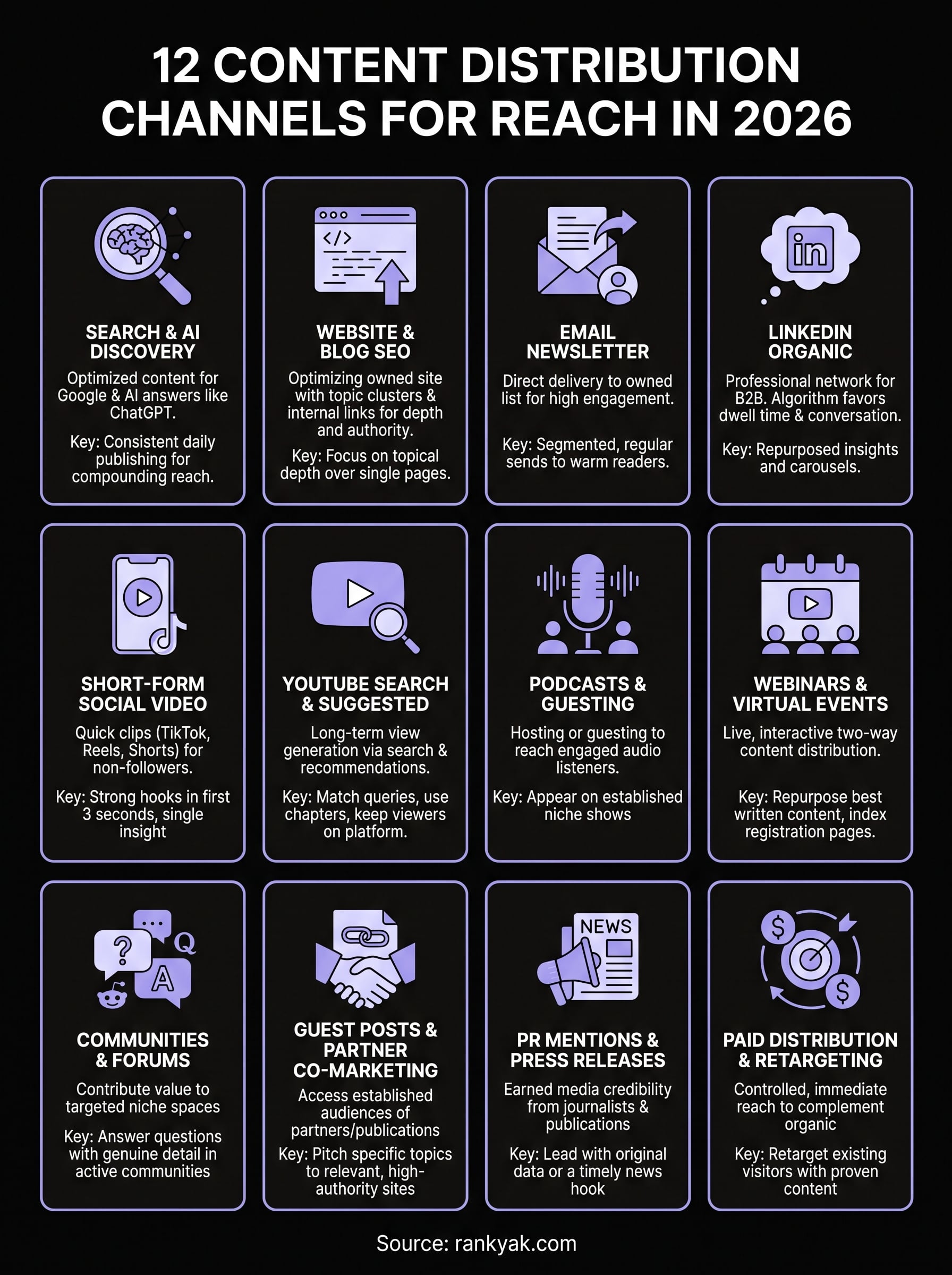
This guide breaks down 12 content distribution channels across owned, earned, and paid media, with practical guidance on when each one makes sense. And since distribution works best when you're publishing consistently, we'll also touch on how tools like RankYak can keep your content pipeline full so you always have something worth distributing. Let's get into the channels that matter most heading into the second half of 2026.
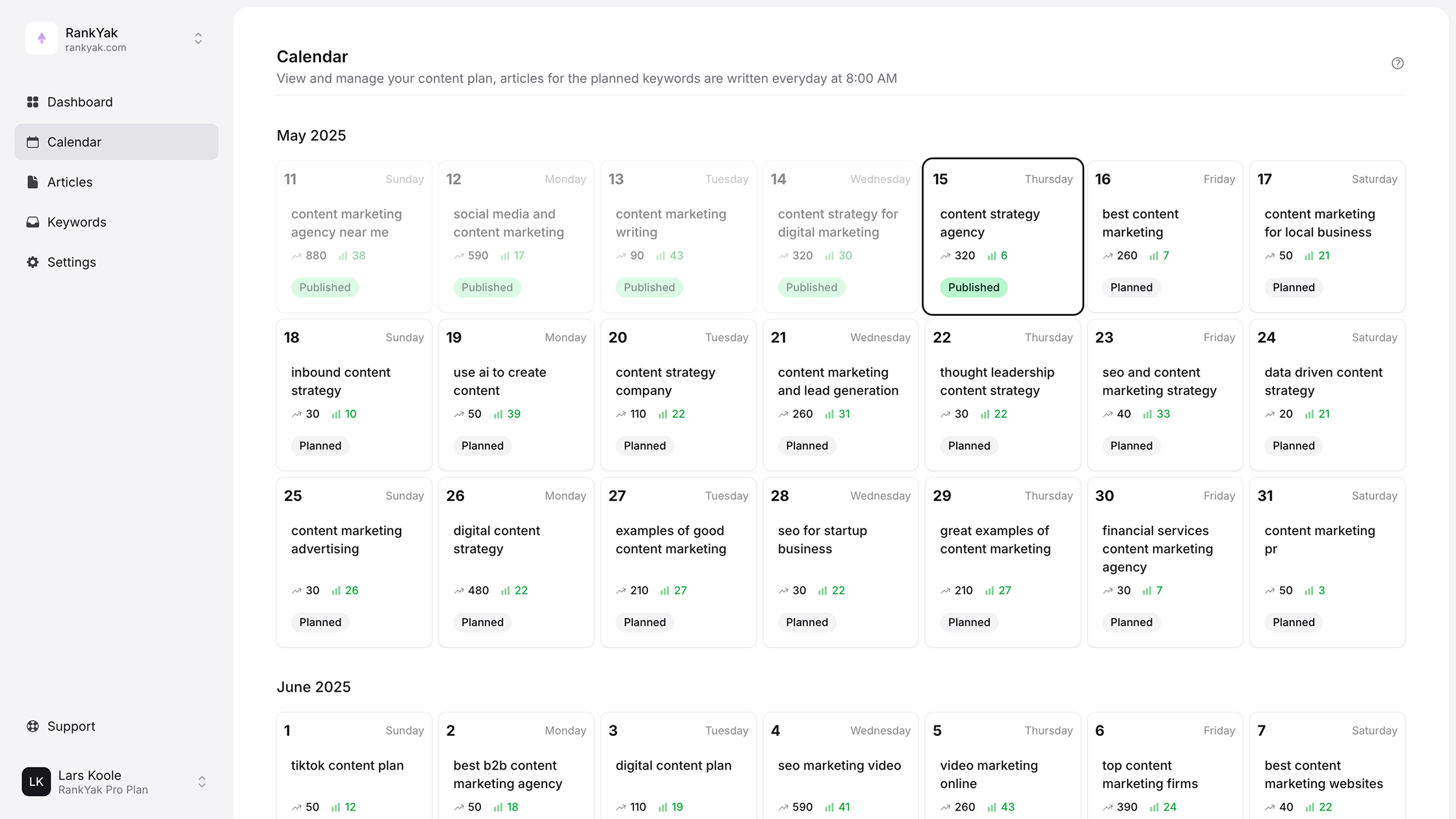
1. Search and AI discovery with RankYak
Of all the content distribution channels available today, organic search and AI discovery represent the highest-leverage starting point, especially if you want reach that compounds over time rather than stopping the moment you stop paying.
What this channel is
Search and AI discovery covers two overlapping surfaces: traditional Google search results, and AI platforms like ChatGPT, Perplexity, and Gemini that pull answers from indexed content on the web. When someone types a question into Google or asks an AI assistant something in your niche, well-optimized content on your site can show up as the answer. RankYak is built specifically to put you on both surfaces by automating the research, writing, and publishing steps that most businesses skip due to time constraints.
How it drives reach in 2026
Google still processes billions of queries every day, and AI chat platforms are now routing a significant share of informational searches to cited sources. Content that ranks on Google also feeds AI answers, which means a single well-written article can generate traffic from multiple discovery points simultaneously. Consistent publishing is the key variable, and that's exactly where most teams fall short without a rolling content plan in place.
Publishing one optimized article per day, even a short one, builds compounding authority far faster than publishing ten articles in a single sprint and then going quiet for weeks.
How to use it well
Start by feeding RankYak your website URL. It handles automatic keyword discovery in your niche, then generates a daily content roadmap so you know what to publish and when. Every article it produces is structured around search intent, competitor research, and E-E-A-T signals, so you get researched, ready-to-publish articles built to rank rather than just fill space. Connect your CMS through the supported publishing integrations (WordPress, Shopify, Webflow, and others are all covered) and articles publish directly without you touching them.
Costs and effort
RankYak runs at $99 per month for one site, and the plan details cover everything from keyword discovery to publishing. There's a 3-day free trial with no commitment required. Ongoing effort on your end is minimal once the integration is set up.
Metrics to track
Watch organic impressions and clicks in Google Search Console, keyword ranking positions over time, and referral traffic from AI platforms where trackable. Month-over-month growth in non-branded clicks is your clearest signal that the channel is working.
2. Website and blog SEO
Your website is the foundation of all your content distribution channels. Without it pulling its weight in organic search, every other channel ends up doing more work to compensate.
What this channel is
Website and blog SEO means optimizing the pages you already own so they rank higher in Google and other search engines. This covers the on-page SEO essentials like title tags, headings, meta descriptions, internal links, and content structure, as well as technical factors like site speed and mobile usability.
How it drives reach in 2026
Google's ranking systems increasingly reward depth and topical authority over single high-performing pages. Sites that cover a topic thoroughly through interconnected content clusters consistently outperform those with isolated articles.
Building internal links between related posts signals relevance to Google and keeps readers on your site longer, both of which improve your overall rankings.
How to use it well
Focus on a pillar and cluster structure: create a strong pillar page around a broad subject, then link it to more specific supporting articles. Once you set up Google Search Console, use it to find pages already getting impressions but sitting in positions 8 to 20, those are the quickest wins to optimize with better headings, updated content, and stronger internal links.
Costs and effort
Blog SEO is mostly a time investment. Basic tools like Google Search Console are free. Paid tools can help you research keywords faster, but you can build solid momentum without them if you publish consistently and optimize each piece before it goes live.
Metrics to track
Track organic click-through rate, average position, and page-level organic traffic over 60 to 90 day windows. Ranking improvements rarely happen overnight, so give optimized pages enough time before drawing conclusions.
3. Email newsletter and lifecycle email
Email remains one of the most direct content distribution channels available because you own the list and control exactly when your audience sees your content, with no algorithm deciding whether your message gets through.
What this channel is
An email newsletter delivers curated content, articles, or updates directly to subscribers on a regular schedule. Lifecycle email refers to automated sequences triggered by specific reader actions, like signing up, downloading a resource, or going inactive for a set period.
How it drives reach in 2026
Your email list gives you direct access to warm readers who already expressed interest in what you publish. Open rates for niche newsletters regularly outperform social media engagement, making email one of the more reliable channels as organic reach on social platforms keeps declining.
An engaged email list of 1,000 subscribers often delivers more consistent traffic than a social following 10 times that size.
How to use it well
Send a weekly or biweekly newsletter that links back to your latest articles or content pieces. Segment your list based on reader interests or behavior to increase relevance, and test subject lines regularly to improve open rates over time.
Costs and effort
Most email platforms offer free tiers up to a few hundred or thousand subscribers, which is enough to start building momentum. Writing and scheduling each send takes one to two hours per week once you build a reusable template.
Metrics to track
Focus on open rate, click-to-open rate, and traffic driven to your site from each email, the same way you would read any other content engagement metrics. Watch your unsubscribe rate too, because a rising number there signals your content or send frequency needs adjustment.
4. LinkedIn organic distribution
LinkedIn sits in a different category from most social platforms because its organic reach is still generous compared to Facebook or Instagram, and its audience is predominantly professional and business-focused, which makes it one of the more effective content distribution channels for B2B brands and service businesses.
What this channel is
Organic distribution on LinkedIn means sharing content, whether posts, articles, documents, or carousels, directly on your LinkedIn profile or company page without paying for promotion. When your connections engage with what you post, LinkedIn pushes it to their networks, extending your reach well beyond your immediate followers.
How it drives reach in 2026
LinkedIn's algorithm continues to favor dwell time and saves over raw likes. Posts that make people stop, read, and save get shown to significantly larger audiences than those that collect a handful of quick reactions and nothing else.
A single post that sparks genuine conversation in the comments can reach five to ten times more people than one that gets passive scroll-by engagement.
How to use it well
Repurpose your best-performing blog content into LinkedIn posts by pulling out a strong insight or counterintuitive finding and framing it as a concise standalone point. Use document posts or carousels to present data or step-by-step frameworks, since these formats consistently outperform plain text links in the feed.
Costs and effort
LinkedIn organic requires no ad spend. The primary investment is time: expect to spend 30 to 60 minutes per post when you factor in writing, formatting, and responding to early comments, which signals to the algorithm that your post is worth amplifying.
Metrics to track
Watch impressions, engagement rate, and profile visits after each post. Track whether LinkedIn referral traffic in your site analytics grows into a consistent source over a 60 to 90 day window.
5. Short-form social video
Short-form video has moved from a trend to a core part of how content travels across the internet. For brands willing to show up on camera or create visually engaging clips, it's one of the fastest content distribution channels for building recognition with cold audiences.
What this channel is
Short-form social video covers content under three minutes distributed on platforms like TikTok, Instagram Reels, and YouTube Shorts. Unlike long-form video, these clips are designed for rapid consumption in a vertical feed, where viewers decide within the first two seconds whether to keep watching.
How it drives reach in 2026
All three platforms still push short-form video to non-followers by default, making it one of the few remaining channels where you can reach people who have never heard of your brand without spending on ads. The algorithm rewards watch-through rate and shares above all other signals.
A 45-second clip that gets watched to the end by 60% of viewers will reach a larger audience than a polished three-minute video that most people abandon after 15 seconds.
How to use it well
Pull a single strong insight from your existing blog content and build a short clip around it. You don't need production equipment to start: a phone, decent lighting, and a clear point are enough. Hooks in the first three seconds determine whether someone keeps watching, so lead with the most interesting or surprising element of your content.
Costs and effort
Short-form video requires more time per piece than written content, but repurposing existing material cuts production time significantly. Expect 30 to 90 minutes per clip when starting out.
Metrics to track
Track average watch percentage, shares, and profile visits after each clip. Watch whether video traffic converts into site visits or email subscribers, which signals that your content is reaching the right audience.
6. YouTube search and suggested videos
YouTube is the second-largest search engine in the world, and it operates as one of the most durable content distribution channels available to creators and brands. Unlike social platforms where content disappears from feeds within hours, a well-optimized YouTube video can generate views for years.
What this channel is
YouTube search and suggested videos refers to two distinct discovery mechanisms on the platform. Search works like Google: viewers type a query and YouTube surfaces relevant videos. Suggested videos appear in the sidebar and autoplay queue, driven by watch history and viewer behavior patterns.
How it drives reach in 2026
YouTube's algorithm has shifted heavily toward keeping viewers on the platform longer, which means it actively surfaces videos that hold attention and generate follow-up views. Videos that rank in search also feed into AI answer features, broadening their reach beyond the platform itself.
A single evergreen tutorial that answers a specific question can accumulate more cumulative views over two years than a viral short that spikes and disappears in a week.
How to use it well
Match your video topics to specific search queries rather than broad subjects, which starts with finding the queries people actually search. Use your target keyword in the title, description, and spoken content within the first 30 seconds. Chapters and timestamps improve both viewer experience and search indexing, so add them to every video over five minutes.
Costs and effort
Starting out requires only a phone and basic editing software. Time investment runs two to four hours per video when you factor in filming, editing, and uploading with a complete description.
Metrics to track
Focus on click-through rate from impressions, average view duration, and subscriber growth per video. Track whether YouTube referral traffic in your site analytics trends upward over a 90-day period.
7. Podcasts and podcast guesting
Podcasts have grown into one of the more accessible audio-based content distribution channels available, and they work in two distinct ways: hosting your own show and appearing as a guest on shows your target audience already listens to.
What this channel is
Podcast distribution means putting long-form audio content in front of listeners who prefer consuming information while commuting, exercising, or working. Podcast guesting flips the model: instead of building your own audience from scratch, you borrow access to someone else's existing listeners for a single episode.
How it drives reach in 2026
Podcast listeners tend to be highly engaged and loyal, which makes them more likely to act on a recommendation than a passive social media scroller. Many podcast apps now include searchable transcripts, which means your episode content can surface through search in ways that weren't possible a few years ago.
Appearing on three to five established podcasts in your niche often delivers more qualified leads than months of building a brand-new show from zero.
How to use it well
Identify podcasts your target audience already subscribes to and pitch yourself as a guest with a specific, useful angle tied to your expertise. When hosting your own show, repurpose each episode into blog posts, social clips, and email content to extend its reach across multiple channels.
Costs and effort
Guesting costs nothing but your time. Hosting your own podcast requires basic recording equipment and an audio hosting platform, which typically runs $15 to $25 per month.
Metrics to track
Track listener downloads per episode, referral traffic from podcast show notes links, and new email subscribers attributed to each appearance.
8. Webinars and virtual events
Webinars and virtual events give you a way to distribute content live, creating a two-way experience that pre-recorded material simply cannot replicate. They work as both a direct channel to your existing audience and a discovery mechanism for new prospects when you co-host with a partner, which is why they show up in most B2B content marketing best practices.
What this channel is
Webinars and virtual events are live or recorded online sessions where you present educational content, host panel discussions, or walk audiences through a specific topic in real time. Unlike passive content distribution channels, webinars invite active participation through Q&A, polls, and chat, which builds a stronger connection between you and your audience.
How it drives reach in 2026
Registration pages for webinars are indexable by search engines, giving you an additional organic touchpoint before the event even happens. Many platforms now automatically generate on-demand recordings, meaning a single live session can keep generating views for months after the original air date.
A webinar that draws 200 live attendees can reach thousands more once the recording gets distributed through email, social, and your blog.
How to use it well
Repurpose your best-performing written content into a structured webinar format where you expand on the key points with examples and live discussion. After the session, clip the recording into short highlight videos for social distribution and embed the full replay on a dedicated landing page to capture search traffic.
Costs and effort
Most webinar platforms start around $50 to $100 per month. Preparation typically runs three to five hours per event including slide creation, promotion, and follow-up email setup.
Metrics to track
Track registration-to-attendance rate, on-demand replay views, and leads generated from each event. Monitor how many attendees click through to your site or sign up for your email list within 48 hours of the session.
9. Communities and forums
Online communities and forums belong in a different category from most content distribution channels because they require you to contribute value before you can expect any return. When you do it right, though, the reach you get is remarkably targeted.
What this channel is
Communities and forums include spaces like Reddit, Quora, niche Slack groups, Discord servers, and industry-specific forums where people gather around shared interests or professional topics. These platforms exist for peer-to-peer discussion, and the audiences in them are often more knowledgeable and engaged than the average social media follower.
How it drives reach in 2026
Reddit threads and Quora answers appear regularly in Google search results, meaning a well-written response you post today can generate clicks for months. AI platforms also pull from community discussions when forming answers, which gives your contributions an additional discovery surface beyond the forums themselves.
A single detailed answer in a high-traffic Quora thread or subreddit can send more qualified traffic to your site than a week of standard social posting.
How to use it well
Focus on two or three communities where your target audience is already active rather than spreading yourself thin. Answer questions with genuine detail, then link to a relevant article only when it adds direct value to the thread. Dropping links without contributing to the conversation first gets you flagged quickly.
Costs and effort
Participating in communities costs nothing except time. Budget 30 to 45 minutes per week to find relevant threads and write substantive responses.
Metrics to track
Track referral traffic from specific subreddits or Quora threads and watch whether those visitors convert into email subscribers or trial signups.
10. Guest posts and partner co-marketing
Guest posts and partner co-marketing are two of the most underused content distribution channels for businesses that want to grow reach. You get direct access to readers who already trust the publication or brand you're working with, without waiting months for your own audience to build.
What this channel is
Guest posting means contributing an article to another website or publication in your niche, usually in exchange for an author bio and a link back to your site, which is how guest posting earns quality links. Partner co-marketing goes a step further: two complementary brands create and distribute content together, splitting the audience exposure between them.
How it drives reach in 2026
Guest posts on established sites carry real weight in search because the backlinks they generate pass authority to your domain, one of several off-page tactics that build authority. Co-marketing campaigns, whether joint webinars, shared guides, or newsletter swaps, give both partners access to audiences they couldn't easily reach alone.
A single guest post on a high-authority site in your niche can drive more referral traffic in one month than six months of solo publishing.
How to use it well
Focus on sites and partners whose audiences match your target reader, not just those with high domain authority scores. Pitch specific, well-scoped topics rather than vague ideas. Make sure both brands bring roughly equivalent audience size to the co-marketing exchange to keep it worthwhile for both sides.
Costs and effort
Guest posting costs no money but takes two to four hours of writing per piece plus outreach time. Basic co-marketing campaigns like newsletter swaps take four to six hours to coordinate.
Metrics to track
Track referral traffic from each placement and whether those visitors convert into subscribers or trial signups. Monitor domain authority changes in your SEO tools over a 90-day period to assess the backlink impact.
11. PR mentions and press release distribution
PR and press coverage belong to the earned media side of your content distribution channels mix. When a journalist or publication mentions your brand, they're essentially vouching for your credibility to their own audience, which is something no amount of paid placement can replicate cleanly.
What this channel is
PR mentions happen when journalists, bloggers, or media outlets reference your brand, data, or expertise in their own coverage. Press release distribution means proactively pushing a structured announcement through a wire service or direct media outreach so reporters can pick it up and cover it.
How it drives reach in 2026
Coverage in major publications generates high-authority backlinks that strengthen your domain's search presence over time, which is the whole point of digital PR link building. AI platforms also surface brand mentions from credible outlets when forming answers, so earned media citations now carry weight beyond traditional SEO.
One mention in a respected industry publication can generate more trust signals and referral traffic than dozens of self-published pieces combined.
How to use it well
Lead with original data or a clear news hook rather than generic company announcements. Journalists ignore self-promotional pitches, but they respond to proprietary research, unusual statistics, or a timely angle tied to something already in the news cycle. Use HARO-style query services to find reporters who are actively looking for expert sources in your niche.
Costs and effort
Wire services like PR Newswire charge $300 to $800 per release. Direct media outreach costs nothing but requires several hours of research and personalized pitching per campaign.
Metrics to track
Track referral traffic from media placements, new backlinks acquired, and branded search volume in Google Search Console after each coverage wave.
12. Paid distribution and retargeting
Paid distribution gives you a way to control exactly who sees your content, when they see it, and how often. It works best as a complement to your organic content distribution channels, not a replacement for them.
What this channel is
Paid distribution covers any channel where you pay to put content in front of a defined audience. This includes promoted social posts, paid search ads, content discovery networks, and retargeting campaigns that follow visitors who already engaged with your site or social profiles.
How it drives reach in 2026
Paid channels give you immediate, measurable reach that organic methods take months to build. Retargeting is particularly valuable because you're serving content to people who already showed interest, which means conversion rates run significantly higher than cold traffic campaigns.
Retargeting a visitor who read your blog post but never signed up can cost 10 times less per conversion than acquiring a completely cold lead through display advertising.
How to use it well
Start by retargeting existing site visitors with your highest-performing content before spending on cold audiences. Use paid social on LinkedIn or Meta to amplify content that already performs well organically, since proven organic engagement signals tell you the creative will hold up at scale.
Costs and effort
Budgets vary widely, but $300 to $500 per month is enough to test retargeting campaigns meaningfully. Expect two to three hours of setup time and one hour per week to monitor performance and adjust bids.
Metrics to track
Track cost per click, conversion rate, and return on ad spend by campaign. Compare your cost per acquired subscriber or trial signup against other channels to see where paid fits in your overall mix, alongside the other KPIs that measure content marketing success.
Wrap it up and pick your next two channels
You now have a clear picture of 12 content distribution channels that can grow your reach heading into the second half of 2026. The worst move you can make is trying to activate all of them at once. Instead, pick two channels that align with where your audience already spends time and where you can realistically show up with consistency. Master those before adding more.
Start with the foundation: search and organic discovery should be on every list because it builds compounding returns that no other channel matches over time. Add one channel from earned or social media that fits your format strengths, whether that's LinkedIn, podcast guesting, or short-form video. Then give it 90 days of consistent effort before judging the results.
If you want search and AI discovery running on autopilot while you focus on the other channels, let RankYak handle your daily publishing and see how fast a consistent cadence changes your traffic.
Allan de Wit is a co-founder of RankYak and has worked in SEO since 2015: inside agencies, alongside them, for clients directly, and in-house on the products being ranked. He came to it as a software engineer building for marketers, which is why the platform is built the way it is. He went on to start companies of his own, two of which were acquired. At RankYak he sets the product direction and owns the features, the quality bar, the design, and the UX.