How to Build a Content Strategy for Small Business
Most small business owners know they need a content strategy for small business growth, but they're stuck writing blog posts whenever they find a spare hour and hoping something sticks. That's not a strategy, it's a guessing game, and it wastes the little time and budget you have.
This guide skips the theory you'd get from a marketing textbook and gives you a step-by-step process built for teams without a dedicated content department. You'll learn how to pick topics your customers actually search for, set a realistic publishing schedule, and structure content so it supports your business goals instead of just filling a calendar. Every step assumes you're working with limited hours, not a full agency budget.
By the end, you'll have a clear content plan you can execute this week, from keyword selection to measuring what's actually driving traffic and leads. We'll also cover where automation tools like RankYak fit in, so you can keep publishing consistently once your strategy is set, without burning out trying to write everything yourself.
Why small businesses need a focused content strategy
Small businesses waste more money on random blog posts than on almost any other marketing activity, because a post written without research rarely targets a keyword anyone searches for. Scattered content feels productive since you're publishing something, but if it doesn't match what your customers type into Google, it just sits there collecting zero traffic. A focused content strategy flips that: you pick topics tied to actual search demand and business goals, then execute consistently instead of sporadically.
The cost of random publishing
Without a plan, you end up chasing whatever topic feels urgent that week, which means your content never builds on itself. Search engines reward sites that demonstrate depth on a subject over time, something Google's own guidance on helpful content confirms when it describes rewarding sites with a clear focus and expertise. Random posts also make it nearly impossible to measure results, because you're not tracking progress toward a defined goal, just publishing and hoping.
A content strategy turns guesswork into a repeatable system that compounds instead of resetting every month.
What a focused strategy actually changes
Moving from random posts to a real strategy changes three things immediately: what you write about, how often you publish, and how you judge success. The table below shows the difference in practice.
| Approach | Topic selection | Publishing cadence | Success measure |
|---|---|---|---|
| Random content | Whatever feels timely | Whenever there's time | Vague, "more traffic" |
| Focused strategy | Keyword and intent research | Fixed schedule (weekly/daily) | Rankings, leads, revenue tied to specific pages |
Running a small business already means juggling sales, operations, and customer service, so content can't demand hours of daily attention. That's exactly why a focused strategy matters more for small teams than large ones: you don't have the headcount to recover from wasted effort. Every article needs to earn its place by targeting a keyword your customers actually use and supporting a goal you can point to, whether that's newsletter signups, demo requests, or direct sales. Once you accept that constraint, the next question becomes practical: who are you writing for, and what do you want them to do after they read it?
Step 1. Define your audience and goals
Every effective content strategy for small business owners starts with a clear picture of who reads the content and why. Skip this step and you'll write articles that sound good to you but never match what your actual customers search for or need answered before they buy, which is why a practical keyword research workflow comes right after you define your audience.
Nail down who you're writing for
Grab your customer data, whether that's CRM notes, support tickets, or sales call recordings, and pull out the exact phrases people use to describe their problems. Build a simple audience profile that answers:
- What job, role, or life situation brings them to your business?
- What question or frustration triggers their search?
- What stops them from buying today (price, trust, lack of information)?
You don't need a 20-page persona document. Three or four bullet points per audience segment is enough to guide topic selection later.
Set goals you can actually measure
Vague goals like "get more traffic" don't tell you which articles are working. Tie each piece of content to a specific action: newsletter signup, quote request, demo booking, or direct purchase. Pick one primary metric per content pillar so you're not drowning in vanity numbers.
If you can't name the action you want a reader to take, you're not ready to write the article yet.
Once your audience and goals are defined, every keyword and headline decision downstream gets faster, because you're filtering ideas against a fixed target instead of guessing.
Step 2. Choose your content pillars and formats
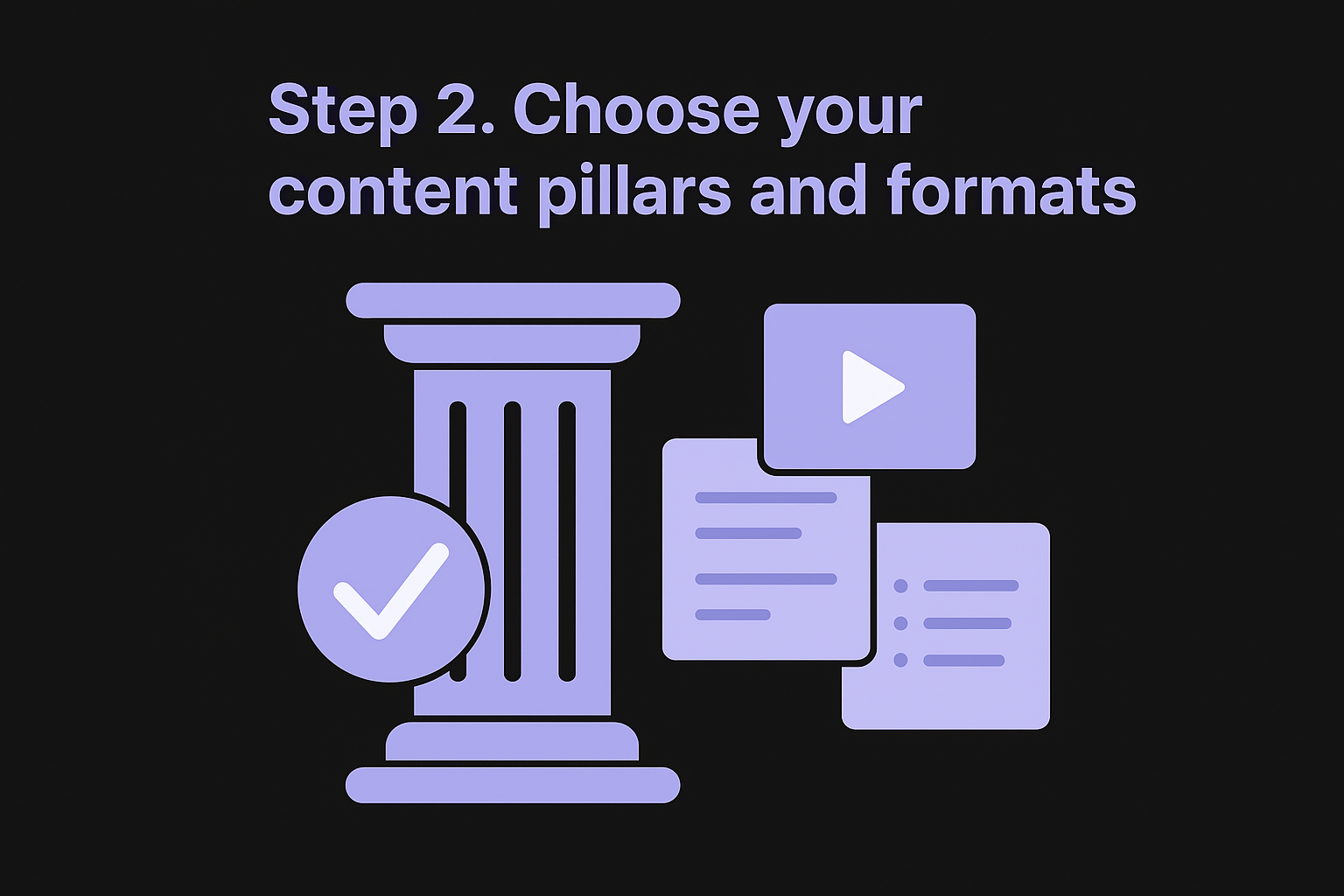
Once you know your audience and goals, pick three to five content pillars, broad topics that map directly to what you sell and what customers ask before buying, following a content pillar framework with examples. A landscaping company might choose lawn care, hardscaping, and seasonal maintenance. Every article you publish should fall under one of these pillars, which keeps your site from turning into a random collection of unrelated posts.
Pick pillars tied to revenue, not curiosity
Choose pillars based on what actually drives inquiries or sales, not whatever topic seems interesting to write about. Ask yourself: which three or four subjects come up most in sales calls or support tickets? Those are your pillars. Each one should be broad enough to support 15 to 30 articles over a year, but specific enough that a reader immediately understands your expertise.
Content pillars work because they give search engines and readers a reason to see you as the authority on a specific set of problems.
Match format to search intent
Not every topic deserves a blog post. Some searches want a comparison table, others want a step-by-step guide or a short answer. Match the format to intent before you write:
| Search intent | Best format |
|---|---|
| "How do I..." | Step-by-step guide |
| "X vs Y" | Comparison article |
| "Best [product] for..." | Roundup or buyer's guide |
| "What is..." | Definition or explainer post |
Running a real content strategy for small business growth means committing to this structure instead of switching formats randomly, since consistency is what lets readers and search engines recognize your site's focus over time, and the same logic drives broader SEO for small business wins.
Step 3. Build a realistic content calendar
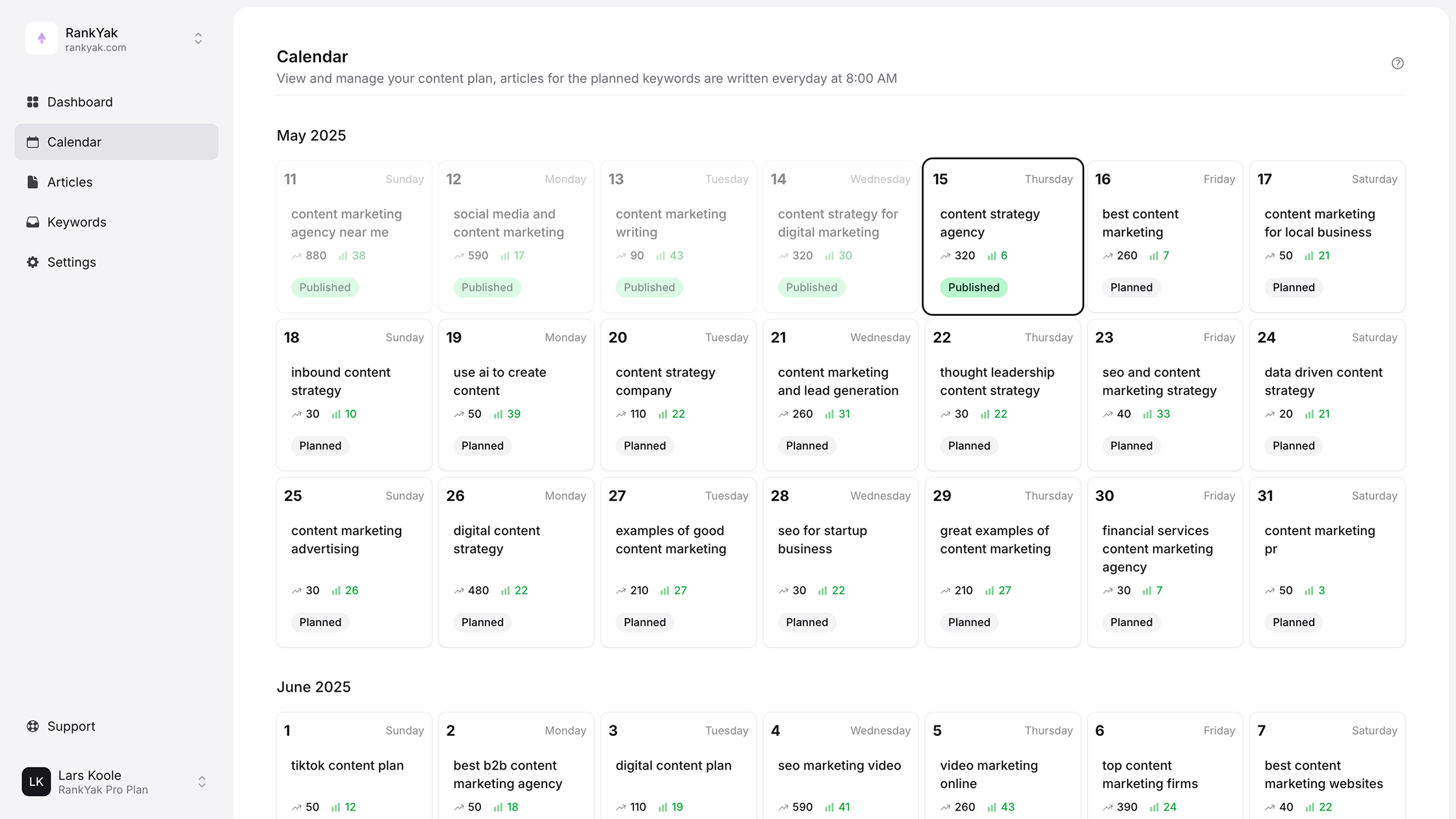
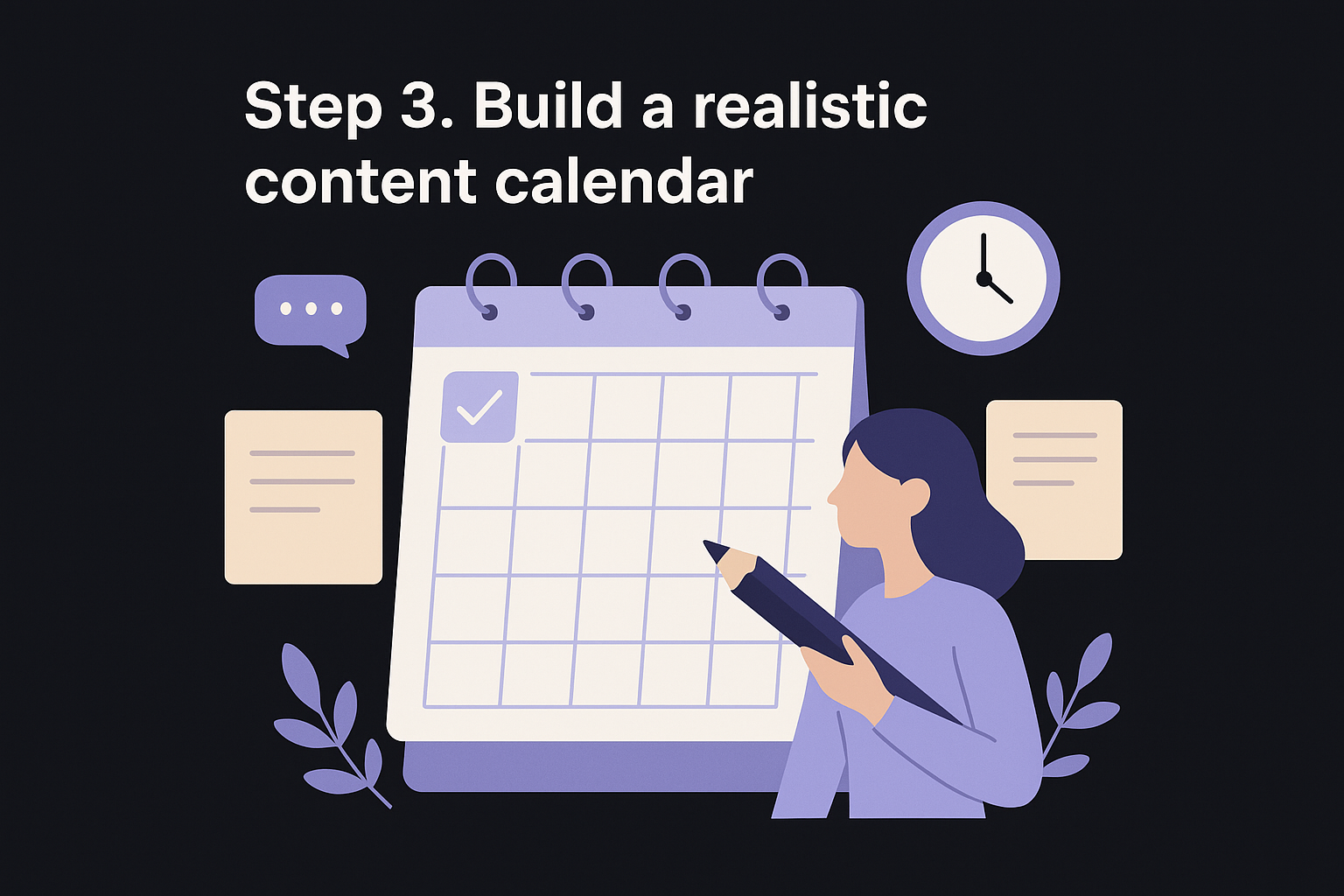
Now that you have pillars and formats, turn them into a schedule you'll actually keep. Realistic scheduling beats ambitious scheduling every time, because a content calendar that keeps you consistent does far more for your rankings than one you abandon after three weeks. Pick a cadence based on the hours you truly have each week, not the cadence a marketing blog recommends.
Pick a cadence you can sustain
Be honest about capacity before you commit to a number. A workable starting point looks like this:
- One article per week if you're writing solo alongside running the business
- Two to three per week if you have a part-time writer or use automation for drafts
- Daily only if publishing is fully automated end to end
A calendar you can keep for six months beats an aggressive plan you abandon after three weeks.
Map pillars to weeks
Rotate through your pillars so no single topic dominates and readers see breadth across your site. A simple monthly rotation might look like this:
| Week | Pillar | Format |
|---|---|---|
| 1 | Pillar A | Step-by-step guide |
| 2 | Pillar B | Comparison article |
| 3 | Pillar C | Buyer's guide |
| 4 | Pillar A | Explainer post |
Spreadsheets work fine for tracking this; you don't need project management software. List the target keyword, pillar, format, and publish date for each article at least a month ahead, so you're never staring at a blank page wondering what to write next. Tools like RankYak automate this entire step by deciding which keyword you publish on which date, which removes the scheduling guesswork entirely.
Step 4. Publish, promote, and measure results
Publishing is where most small business content plans quietly die, because writing an article feels like the finish line when it's actually the starting point. Once a post goes live, you still need to push it to the right audience and track whether it moves your goals, or you're just adding pages nobody reads.
Publish on a fixed schedule
Stick to the calendar you built in Step 3, even when a specific article isn't perfect. A published article ranking imperfectly beats a flawless draft sitting in your drafts folder. Set a recurring day and time for publishing, whether that's every Tuesday morning or the first business day of the week, so it becomes routine instead of a decision you make from scratch each time.
Promote through channels you already own
Don't rely on search traffic alone to discover new content. Build a simple content distribution plan that shares every article through your email list, social accounts, and any partner or customer touchpoints you already have. A quick checklist keeps this consistent:
- Send a link in your next newsletter
- Post an excerpt on your main social channel
- Add internal links from older, related articles
An article nobody sees can't rank, convert, or build authority, no matter how well it's written.
Track results against your goals
Check Google Search Console monthly for impressions and clicks on new pages, and compare those numbers against the specific action you defined in Step 1, focusing on the content marketing KPIs that matter. Tools like RankYak connect directly to Search Console, so you can see which published articles are actually driving traffic without pulling reports manually.
Making your content strategy stick
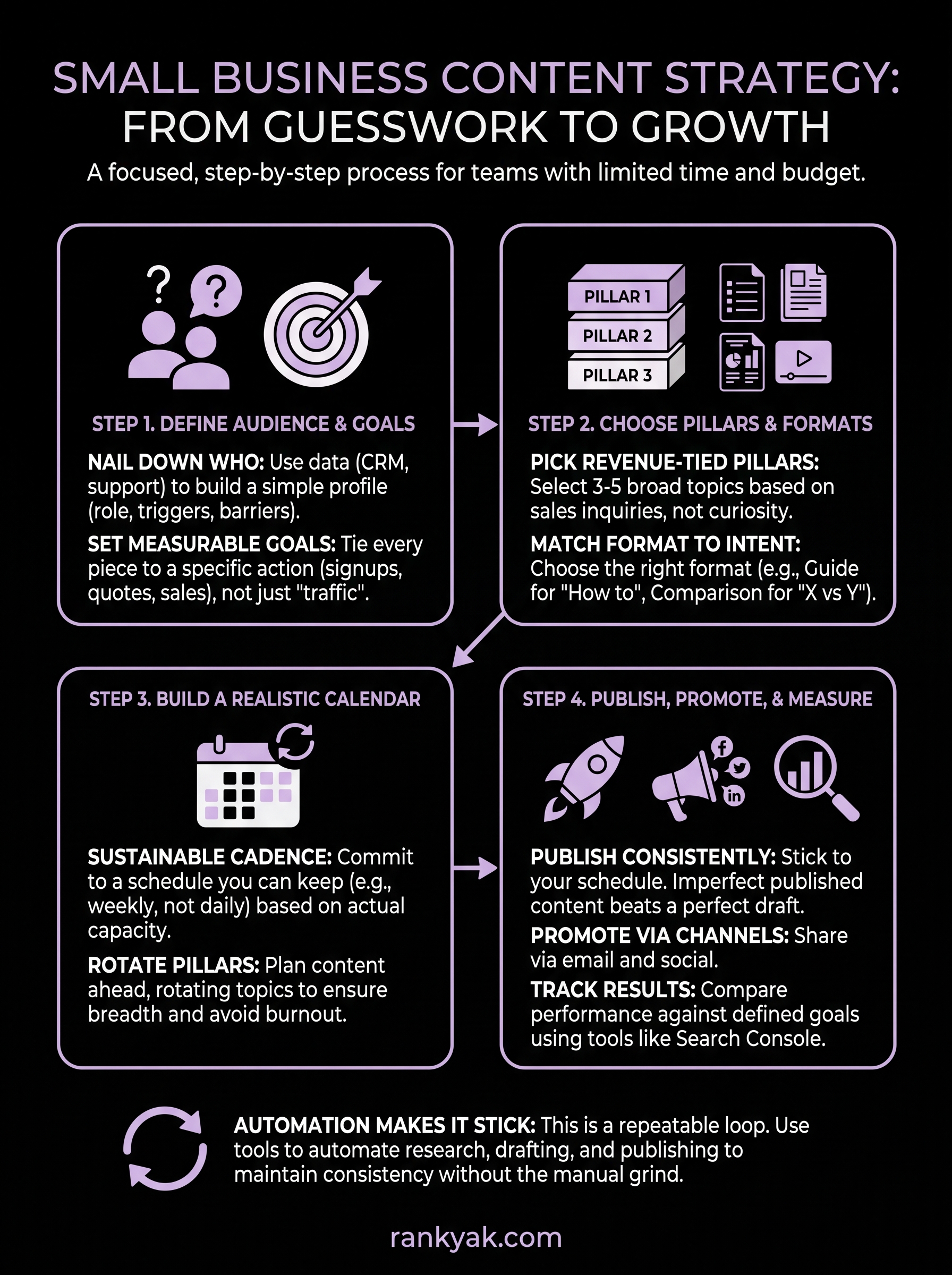
A content strategy for small business growth only works if you keep running it after the initial burst of motivation fades. The four steps here, defining your audience, picking pillars, building a calendar, and measuring results, aren't a one-time project. They're a loop you repeat every month, refining topics as you learn which articles actually bring in leads.
Most small teams don't fail because their strategy was wrong. They fail because writing, publishing, and tracking every article by hand eats the time they were supposed to save. That's the gap automation is built to close, handling keyword research, drafting, and publishing so your calendar never goes empty.
If you'd rather stop writing everything yourself and let a system keep your pillars publishing on schedule, see how RankYak researches, writes, and publishes an article every day and watch your plan turn into published articles without the manual grind.
Allan de Wit is a co-founder of RankYak and has worked in SEO since 2015: inside agencies, alongside them, for clients directly, and in-house on the products being ranked. He came to it as a software engineer building for marketers, which is why the platform is built the way it is. He went on to start companies of his own, two of which were acquired. At RankYak he sets the product direction and owns the features, the quality bar, the design, and the UX.