Long Tail Keyword Analysis: What It Is and How to Do It
You already know your niche's obvious keywords are packed with competitors. That's exactly why long tail keyword analysis matters: it helps you find the specific, lower-competition phrases your actual customers type into Google when they're close to taking action, not just browsing.
Long tail keywords are the longer, more specific search phrases, usually three or more words, that carry less search volume individually but add up to a huge share of total search traffic. Analyzing them means digging past the surface-level keyword list to understand search intent, phrase variations, and how competitors are (or aren't) targeting them. Done right, this analysis tells you exactly what to write about next and how to structure it so it actually ranks.
In this article, you'll learn how long tail keywords differ from short tail ones, why they're often easier to rank for, and a practical process for finding and evaluating them. We'll cover the research tools worth using, how to judge intent and competition, and how to turn your findings into a content plan you can execute consistently.
Why long-tail keyword analysis matters for SEO
Most site owners chase the same handful of broad terms because they look impressive in search volume tools. That's a mistake. Long tail keyword analysis shifts your focus to the thousands of specific phrases that, combined, often account for the majority of organic search traffic. Google itself has noted that a huge share of daily searches are ones it has never seen before in that exact form, which means the fight for generic terms is only one small piece of the opportunity.
Lower competition, faster wins
Ranking for "running shoes" means competing against Nike, Adidas, and every major retailer with a decade of backlinks. Ranking for "best running shoes for flat feet marathon training" puts you up against a much smaller field, often just a few blog posts and forum threads. New or mid-sized sites can realistically land on page one for these phrases within weeks rather than years, once they know how to spot the low-competition ones. That speed matters if you're trying to prove ROI on content investment early.
Long tail keywords let you win searches today instead of waiting years to outrank giants for generic terms.
Higher intent, better conversion rates
Someone searching "CRM software" could be a student writing a paper, a competitor doing research, or a buyer three months from purchase. Someone searching "CRM software for solo real estate agents under $50 a month" has already narrowed their problem, their budget, and often their timeline. That specificity signals intent, and intent-matched content converts at noticeably higher rates because you're answering the exact question the reader brought to Google.
The traffic math adds up
A single long tail phrase might only pull 40 searches a month, which feels small next to a head term's 10,000. But most niches have hundreds or thousands of these variations, and a content plan built around dozens of them compounds fast.

| Keyword type | Example | Monthly volume | Competition | Typical conversion |
|---|---|---|---|---|
| Short-tail | "project management software" | 40,000 | Very high | Low |
| Mid-tail | "project management software for teams" | 2,500 | High | Medium |
| Long-tail | "project management software for remote construction teams" | 90 | Low | High |
It builds topical authority
Covering long tail variations around a core topic also signals to Google that your site has depth, not just a handful of thin pages chasing volume. This ties directly into how Google's helpful content guidance frames quality: content that provides a substantial, comprehensive treatment of a topic tends to earn more trust than pages that skim the surface. Publishing consistently around long tail clusters, rather than one-off posts, is how you build that depth without guessing at what to write next.
How to do long-tail keyword analysis step by step
Good long-tail keyword analysis follows a repeatable process, not a random scroll through a keyword tool. Below is the sequence I use whenever I'm mapping out a new content plan for a site.
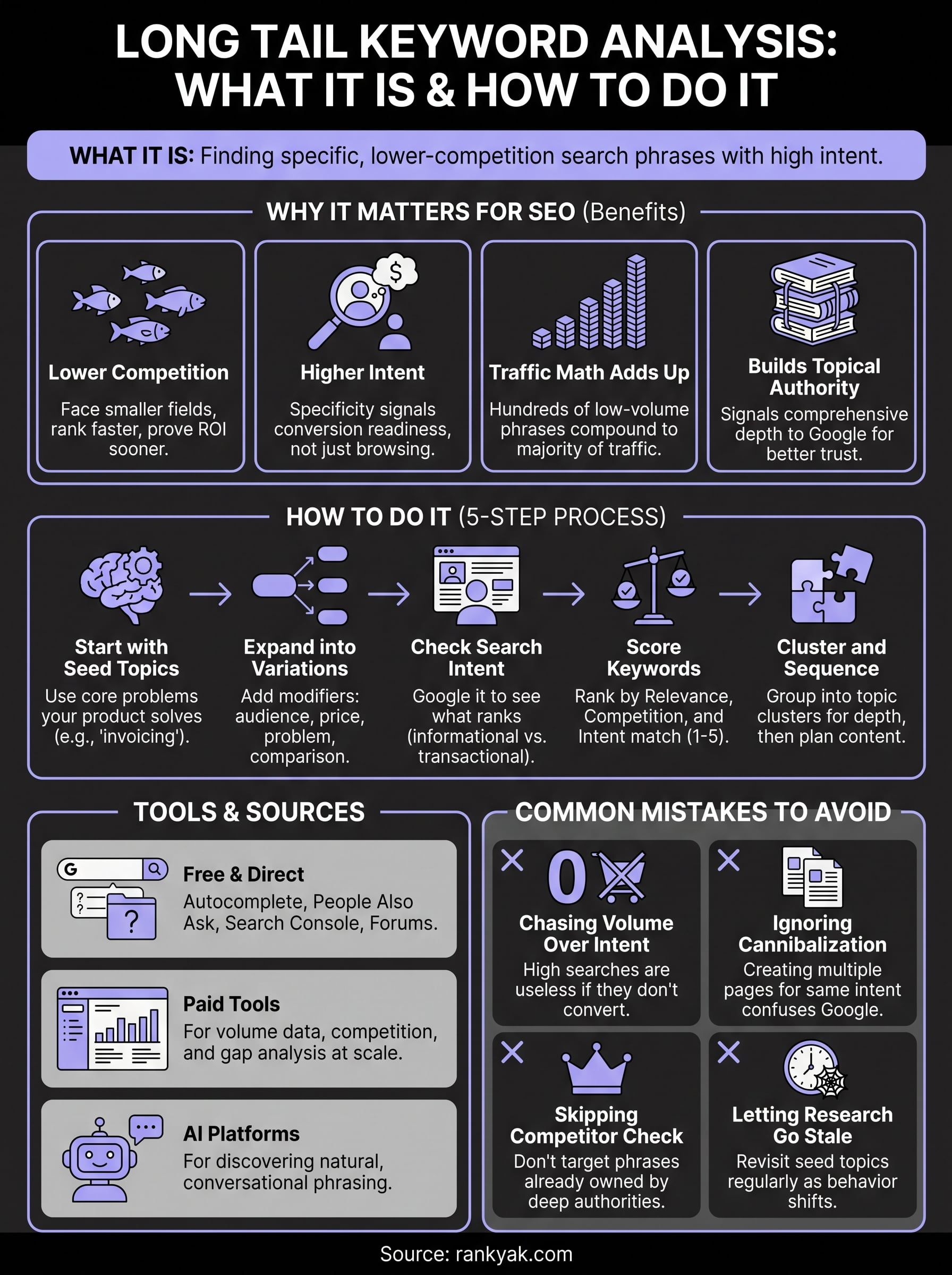
Start with seed topics from your actual business
Begin with the core problems your product or service solves, not generic industry terms. If you sell accounting software for freelancers, your seeds might be "invoicing," "tax deductions," or "quarterly payments." These seeds feed every later step, so grounding them in real customer language rather than internal jargon saves you from chasing phrases nobody actually searches.
Expand each seed into long tail variations
Take each seed and layer on modifiers: audience ("for freelance photographers"), price ("under $20 a month"), problem ("that syncs with PayPal"), and comparison ("vs QuickBooks"), which is one of the fastest tactics for uncovering long tail variations. This is where volume drops but relevance climbs.
Check search intent for every phrase
Google the phrase yourself and look at what's already ranking. If the results are all product pages, the intent is transactional. If they're guides and listicles, it's informational. Matching this intent signal to your content format is non-negotiable; a blog post won't outrank a pricing page for a buying-intent query.
Score keywords on a simple matrix
Rather than obsessing over exact volume numbers, rank each candidate on three factors:
- Relevance to your product or service (1-5)
- Competition based on who currently ranks (1-5, lower is better)
- Intent match with a page type you can realistically produce (1-5)
Add the scores and prioritize anything landing 12 or higher.
Cluster and sequence
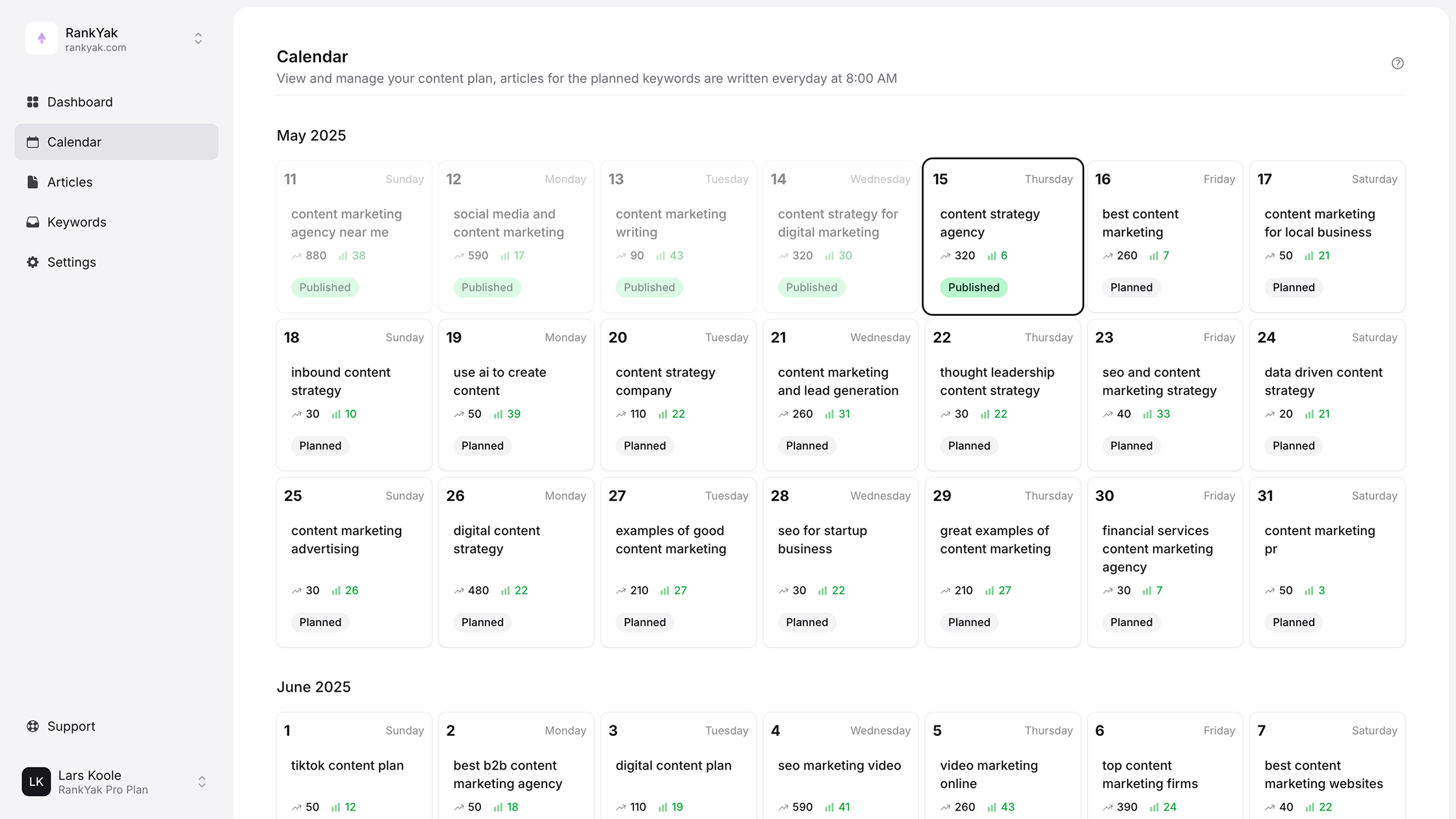
Group related long tail phrases into topic clusters instead of treating each as a standalone article, which a free tool for clustering a keyword list can do in one pass. This clustering step is what separates scattered posts from a plan that builds topical authority over months, and it's exactly the kind of sequencing decision an automated content plan, like the one RankYak generates daily, is built to handle for you.
Tools and sources for uncovering long-tail keywords
You don't need a dozen subscriptions to do solid long tail keyword analysis. A handful of free and paid long tail keyword tools will surface more phrases than you can write about in a year. The trick is knowing which source fits which stage of research.
Free sources hiding in plain sight
Google's own autocomplete and "People also ask" boxes are the fastest way to see real phrasing. Type your seed term, note every autocomplete suggestion, then scroll to the bottom of the results page for "related searches." Google Search Console is even better if your site already has traffic, since it shows the exact queries people used to find you, including long tail variations you never targeted on purpose. Reddit and niche forums round this out by showing the raw language customers use when nobody's optimizing for SEO.
Paid tools worth the cost
When you need volume and competition data at scale, a paid tool saves hours of manual digging.
| Tool type | Best for | What to look for |
|---|---|---|
| Keyword research suites | Volume and difficulty scores | Long tail filters, "questions" view |
| Competitor gap tools | Finding phrases rivals rank for that you don't | Keyword overlap reports |
| Rank trackers | Monitoring how new pages perform | Position history by keyword |
The best keyword source is usually the one closest to your actual customers, not the flashiest tool on the market.
AI chat platforms as an emerging source
Since buyers increasingly ask ChatGPT and Perplexity full questions instead of typing fragments into Google, testing your seed topics directly in those tools reveals conversational long tail phrases worth targeting. This matters because Google's helpful content guidance rewards content that answers real questions thoroughly, and AI platforms tend to surface those exact questions before search volume tools catch up. RankYak's automatic keyword discovery and clustering pulls from these same signals, so you're not stitching together five tools by hand.
Long-tail keyword examples across industries
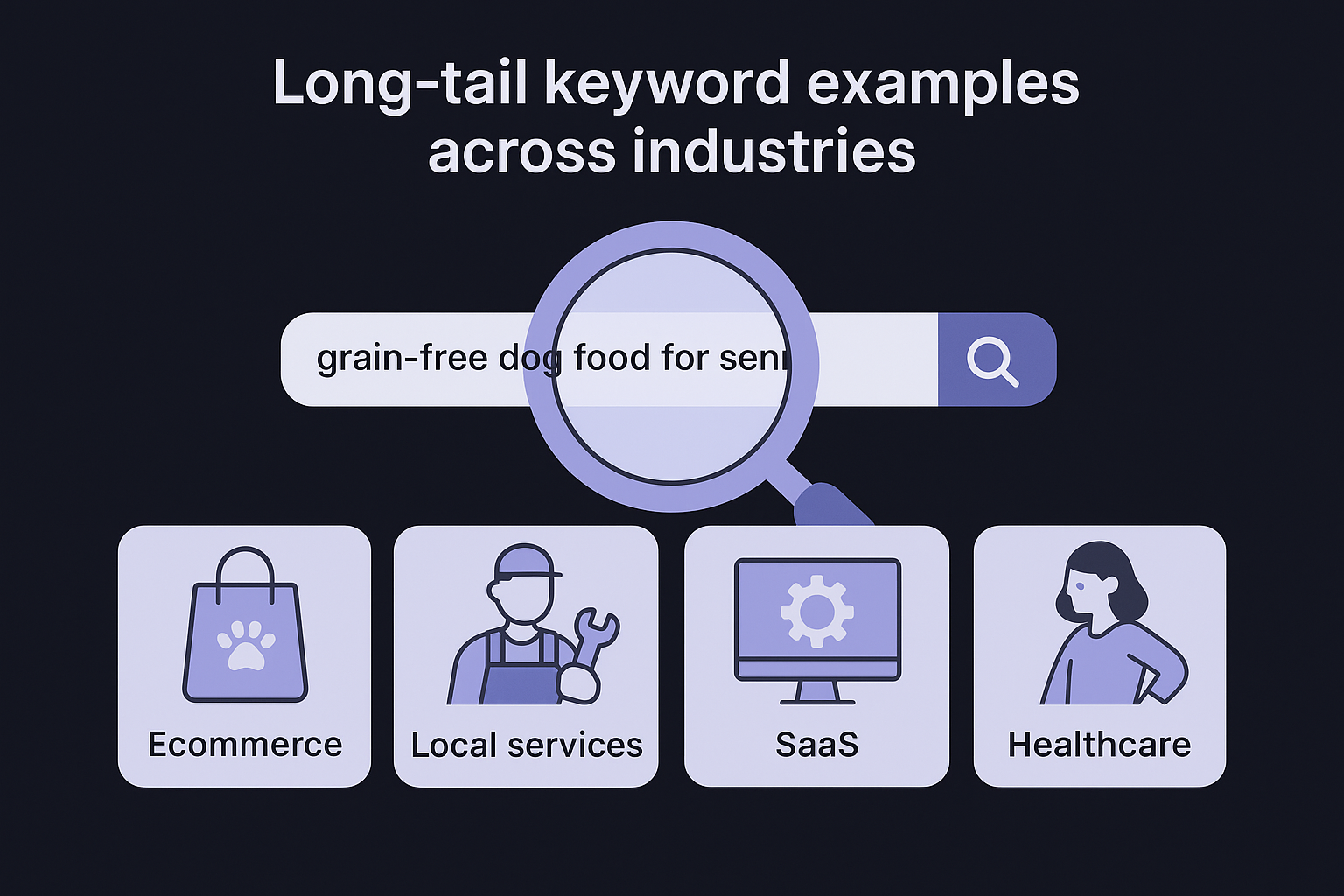
Seeing long tail keyword analysis applied across different industries makes the concept click faster than any definition. Below are real patterns you'll find in ecommerce, local services, SaaS, and healthcare content, along with the head term each one branches from, and you can borrow more high-intent query examples from there.
Ecommerce and retail
An online pet store chasing "dog food" is fighting Chewy and Amazon on page one. That same store ranks easily for "grain-free dog food for senior dogs with allergies," a phrase with real buyer intent and almost no direct competition. Product-specific modifiers like size, material, or use case turn a flooded category into a winnable niche.
Local service businesses
A plumber targeting "plumber" nationally is wasting effort. A plumber targeting "emergency plumber for burst pipe in [city name]" captures someone who needs help right now and is ready to call. Geographic specificity combined with urgency is one of the highest-converting long tail patterns in local SEO.
The industry changes, but the pattern stays the same: add a use case, a location, or a constraint, and the head term becomes a long tail winner.
SaaS and B2B tools
Software buyers rarely search just "invoicing software." They search "invoicing software for freelance consultants that integrates with Stripe." That level of detail tells you exactly which feature to highlight in your headline.
| Industry | Head term | Long tail example |
|---|---|---|
| Ecommerce | dog food | grain-free dog food for senior dogs with allergies |
| Local service | plumber | emergency plumber for burst pipe in Denver |
| SaaS | invoicing software | invoicing software for freelancers that syncs with Stripe |
| Healthcare | physical therapy | physical therapy for lower back pain after pregnancy |
Healthcare content follows the same logic. "Physical therapy for lower back pain after pregnancy" answers a specific, urgent question that "physical therapy" alone never could.
Common long-tail keyword analysis mistakes to avoid
Even experienced marketers stumble on the same handful of errors when they run long tail keyword analysis. Knowing these traps in advance saves you from building a content plan on shaky data.
Chasing volume instead of intent
Picking a phrase because a tool shows 200 searches a month, without checking what those searchers actually want, wastes a writing slot. A phrase with 30 searches and clear buying intent almost always outperforms one with 300 searches and mixed intent. Volume without intent is a vanity metric, not a strategy.
A high search volume means nothing if the searcher isn't looking for what you're offering.
Ignoring keyword cannibalization
Writing five separate articles around near-identical long tail variations, like "best CRM for freelancers" and "top CRM software for freelancers," splits your ranking signals instead of strengthening one page, which is the cannibalization trap to avoid. Google can't decide which page to rank, so both underperform. Consolidate overlapping phrases into one thorough article instead.
Treating every long tail phrase as equally valuable
Not every low-competition phrase deserves a full article. Some are too niche to move revenue, others don't match anything your business actually sells. Skipping the relevance check from your scoring matrix leads to a content calendar full of pages that rank for nobody who'd ever buy from you.
Skipping the competitor check
Assuming a phrase is easy just because it looks obscure is risky. Sometimes a single, deeply authoritative page already owns that space, and you'd be better off targeting an adjacent variation. Always glance at who's ranking before committing writing time.
Letting research go stale
Search behavior shifts as new products, regulations, or trends emerge, and a keyword list built a year ago misses phrases people ask today, especially in AI chat platforms where phrasing evolves fast. Revisit your seed list quarterly rather than treating it as a one-time exercise.
A quick pre-publish checklist
- Confirm intent matches your planned content format
- Check for overlapping articles already targeting a similar phrase
- Verify the phrase connects to something you actually sell or offer
- Glance at current top-ranking pages for that exact phrase
- Re-check seed topics every few months for new phrasing
Turning long-tail insights into content that ranks
Finding great long tail phrases is only half the job. The real payoff comes from consistent execution: turning each cluster into a published article before your competitors notice the gap. That means seed topics, intent checks, scoring, and clustering all feeding into a content calendar you actually stick to, week after week, not a spreadsheet that goes stale after one burst of research.
Most site owners lose momentum right here, not because the analysis is hard, but because writing and publishing daily takes more hours than a busy team has. That's the gap automation closes. If you'd rather skip the manual grind and let a system handle keyword discovery, drafting, and publishing on a daily schedule, see how RankYak turns long tail keywords into published articles every day. Running an agency with multiple client sites? The same engine scales across accounts without multiplying your workload.
Lars Koole is a co-founder of RankYak and has worked in SEO since 2021, on the side where a strategy has to become a live page: inside agencies, alongside them, for clients directly, and in-house on the products being ranked. He is a software engineer by trade, which is how that page gets built. Before RankYak he founded companies of his own, two of which were acquired. At RankYak he owns the engineering and everything AI, and works out the solution and the implementation of each new feature.