Keyword Gap Analysis: How To Find Competitors' Best Keywords
Your competitors are ranking for keywords you haven't even considered yet. That's not a guess, it's almost always the reality. Keyword gap analysis is the process of comparing your keyword profile against your competitors' to uncover exactly where they're winning traffic that you're missing. It's one of the most direct ways to find ranking opportunities without starting from scratch.
Instead of brainstorming keywords in a vacuum, you analyze the keywords your competitors rank for to reverse-engineer what's already working for businesses in your space. You find the gaps, prioritize the best ones, and build content around them. Simple concept, but the execution matters. Done right, it can reshape your entire content strategy. Done poorly, you end up chasing irrelevant terms that waste time and budget.
This guide walks you through the full process, what keyword gap analysis actually involves, how to run one step by step, which tools make it easier, and how to turn your findings into content that ranks. If you're using a platform like RankYak to automate your SEO content pipeline, gap analysis gives you the strategic input to make sure every article targets a keyword worth going after, and automated keyword discovery scored by volume and difficulty carries that input through to the plan.
What keyword gap analysis is and what it reveals
Keyword gap analysis compares your site's keyword rankings against one or more competitors to surface terms they rank for that you don't. The "gap" is the space between where they appear in search results and where you're absent entirely. This isn't about chasing every possible keyword in existence. It's about identifying the specific terms already driving traffic to sites in your niche, so you can build a smarter content plan grounded in real, proven demand rather than guesswork.
The three types of keyword gaps worth knowing
Not every gap looks the same, and not every gap requires the same response. When you run a keyword gap analysis, you typically surface three distinct categories of opportunity:
- Missing keywords: Terms your competitors rank for in the top 100 but you don't appear for at all. These are your biggest blind spots.
- Weak keywords: Terms where both you and a competitor rank, but they sit significantly higher. Your page exists, but it isn't competitive yet.
- Untapped keywords: Terms where two or more competitors rank but your site has zero presence, which usually signals strong topic-level demand in your niche.
Knowing which type of gap you're looking at changes how you respond. A missing keyword almost always means you need a new piece of content built around that topic from scratch. A weak keyword likely needs a targeted update to an existing page, stronger internal linking, or a more focused on-page approach. Treating all gaps as identical is where most people go wrong, creating brand-new pages when a well-executed refresh would have moved the needle faster and with less effort.
The highest-value gaps are often untapped keywords where two or more competitors rank in the top 10, but your site has no page targeting the topic at all.
What the data reveals beyond a list of keywords
Running gap analysis does more than produce a spreadsheet of terms to chase. It exposes where your content strategy has structural blind spots and maps out what your target audience is actively searching for, based on real competitor performance instead of your assumptions about what might be relevant.
The data also surfaces topic clusters you haven't built out yet. You might find that a competitor has 14 articles tightly grouped around a sub-topic you've only written about once. That cluster is likely responsible for a significant share of their organic traffic, and it signals a content architecture gap, not just a keyword gap. Fixing it requires a coordinated set of pages, laid out as a topical map of pillars and supporting articles, not a single article.
Gap analysis also removes guesswork from your editorial calendar. Instead of targeting keywords because they feel relevant or seem logical, you're working from terms that real competitors have already validated through actual search rankings. You're using performance data to guide your content investments, which cuts wasted effort and points you directly toward topics with a demonstrated audience. For anyone running an automated content pipeline, this kind of strategic input is what separates a plan that compounds over time from one that produces content with no clear direction.
Step 1. Choose the right competitors to compare
The competitors you pick for your keyword gap analysis determine whether the results are useful or misleading. Choosing sites that are too large or operate in a different niche means you'll surface keywords that are either out of reach or completely irrelevant to your audience. You want search competitors, which are sites competing for the same keywords in Google, not necessarily your direct business rivals. A local accounting firm and a national tax software company may serve similar customers but compete in entirely different search spaces.
Identify your search competitors, not just your business rivals
Your business competitors are the companies you lose deals to. Your search competitors are the sites showing up on page one for terms your ideal customers are actually searching. These two groups overlap sometimes, but not always. To find your search competitors, take three to five of your most important target keywords and run each one in Google. Note which domains appear consistently across the results. Any site showing up in at least two or three of those searches is a strong candidate for your comparison list.
Build a shortlist of three to five sites
More competitors sounds like more data, but it creates noise. Three to five well-chosen sites give you enough variation to spot real patterns without overwhelming your analysis. Aim for a mix: one or two direct competitors at roughly your authority level, and one or two slightly stronger sites already ranking for terms you want to target. Avoid adding sites with massive domain authority or entirely different business models.
Comparing your site to a competitor with ten times your domain authority will surface keywords you can't realistically rank for in the near term, skewing your entire priority list.
Use this shortlist template before you run any tool:
| Competitor | Business overlap | Search overlap | Authority level |
|---|---|---|---|
| Site A | High | High | Similar |
| Site B | Medium | High | Slightly stronger |
| Site C | Low | High | Similar |
Filling this in first keeps your comparison grounded and makes the next steps significantly faster.
Step 2. Find keyword gaps with tools and manual checks
Once you have your competitor shortlist, you need actual data to work with. Most keyword gap analyses start with a dedicated SEO tool because manually crawling search results for hundreds of terms is not practical at scale. The tool pulls ranking data across thousands of keywords for your site and your competitors at the same time. From there, a manual check validates the most promising results before you build content around them.
Use an SEO tool to pull the comparison data
Tools like Semrush, Ahrefs, and Moz each offer a keyword gap or content gap feature built for this exact purpose, and it helps to compare the keyword analysis tools available before you commit to one. You enter your domain alongside two to four competitor domains, and the tool surfaces keywords where they rank but you don't. When you run the report, filter for keywords where competitors rank in positions 1 through 20 first. Those are terms with proven ranking traction rather than buried results that may not drive any meaningful traffic. Export the data and structure it using the template below, or group the exported keyword list into clusters, before moving on.

Focus on competitor keywords ranking in positions 1 through 10 for your first round. Those terms carry the clearest proof of real search demand.
Use this export template to organize what you pull:
| Column | What to capture |
|---|---|
| Keyword | The exact term or phrase |
| Competitor position | Where they rank for this term |
| Monthly search volume | Average monthly searches |
| Keyword difficulty | Tool-assigned difficulty score |
| Your current ranking | Your position or "not ranking" |
Cross-check with manual Google searches
Your tool data gives you a strong starting list, but manual checks catch context that raw data misses. Take your top 10 to 15 gap keywords and search each one in Google yourself. Look at the format and type of pages ranking, whether those are listicles, product pages, comparison guides, or in-depth how-tos. This tells you what search intent actually looks like for that term, which directly shapes how you structure the page you build.
Checking manually also helps you spot featured snippets and SERP features like People Also Ask boxes, image carousels, or local packs. If a keyword triggers a featured snippet, you know the exact format Google is rewarding for that query, and you can structure your content to target it directly. This extra step adds maybe 20 minutes to your process but removes a significant amount of uncertainty from your content decisions.
Step 3. Filter and prioritize keywords by impact
The gap data from your tool gives you a raw list that's too long to act on as-is. A solid keyword gap analysis produces dozens or even hundreds of terms, but not all of them deserve a spot on your content plan. You need to filter this list down to the keywords most likely to move your organic traffic and do it systematically rather than by gut feel.
Score each keyword using three filters
Three data points tell you almost everything you need to know about whether a keyword belongs on your priority list: search volume, keyword difficulty, and business relevance. Search volume confirms real demand exists. Keyword difficulty tells you how hard it'll be to rank, and a free keyword difficulty checker gives you that number quickly. Business relevance confirms the term actually connects to what you sell or do. A keyword that scores well on all three is worth targeting immediately. One that scores well on only one is usually noise.
Keywords with moderate difficulty scores between 20 and 40, clear business relevance, and monthly search volumes above 300 tend to deliver the best return on content investment for most small to medium-sized sites.
Run each keyword through this scoring template before adding it to your content plan:
| Keyword | Monthly volume | Difficulty score | Business relevance (1-3) | Priority tier |
|---|---|---|---|---|
| Example term | 800 | 28 | 3 | High |
| Example term | 4,200 | 72 | 2 | Low |
| Example term | 450 | 35 | 3 | High |
Separate quick wins from longer-term targets
Not every high-value keyword belongs in your immediate content queue. Quick wins are terms where you already have a relevant page sitting between positions 11 and 30, the kind of page stuck just below page one that an audit surfaces for you. A targeted update to that existing page can push it onto page one faster than building something new from scratch. Longer-term targets are fresh topics where a competitor dominates but you have no page at all, meaning you need a full content build and time for the page to gain traction.
Splitting your filtered list into these two buckets gives you a realistic execution order with clear reasoning behind each decision. Your quick wins go first because they produce results faster, and your longer-term targets fill out the months ahead with steady, compounding growth.
Step 4. Turn gaps into pages, updates, and a plan
A filtered, prioritized keyword list only has value when it connects directly to action. The final step of your keyword gap analysis is converting that list into a concrete content plan with clear assignments, whether that means building a new page, refreshing an existing one, or scheduling both across the next 30 days. Without this step, your gap data sits in a spreadsheet and nothing changes.
Map each gap to an action type
Every keyword on your priority list falls into one of two buckets: new content or existing content update. New content means you build a page targeting that keyword from scratch, usually starting from a writer-ready content brief. An update means you already have a relevant page, but it needs stronger optimization, better structure, or additional depth to compete with the ranking competitors you found in your analysis. Assigning each keyword to one of these buckets before you start writing removes confusion about what work actually needs to happen.
Use this assignment template to map your top gaps:
| Keyword | Action type | Existing page (if any) | Target publish date |
|---|---|---|---|
| Example keyword A | New page | None | Week 1 |
| Example keyword B | Update existing | /blog/related-topic | Week 2 |
| Example keyword C | New page | None | Week 3 |
| Example keyword D | Update existing | /services/topic | Week 4 |
Build your 30-day content calendar
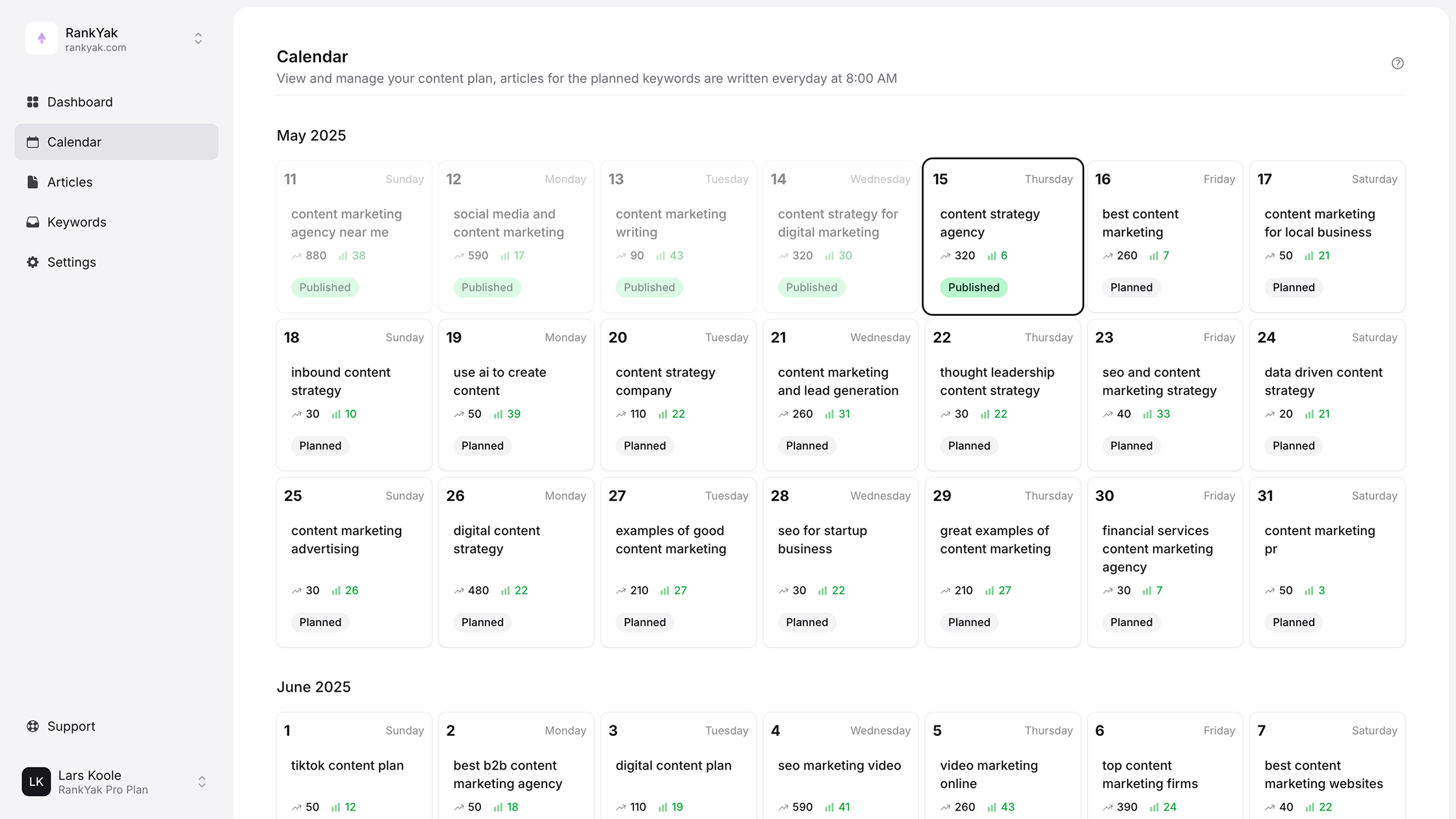
With your assignments mapped, you can build a realistic 30-day execution schedule that sequences quick wins before larger builds, the same way an automated publishing schedule decides which keyword gets written on which date. Start with your existing page updates in week one and two because they require less production effort and can show movement in search results faster than a brand-new URL. Reserve new page builds for weeks three and four, so you're not front-loading your plan with the heaviest lift.
Updating two underperforming pages before writing anything new often produces faster ranking gains than publishing fresh content on topics where you have no existing authority.
Keep your calendar to four to six items per month at most. Spreading your effort too thin across too many keywords at once means none of them get the attention needed to actually rank. A focused, sequenced plan beats an ambitious one that stalls.
What to do next
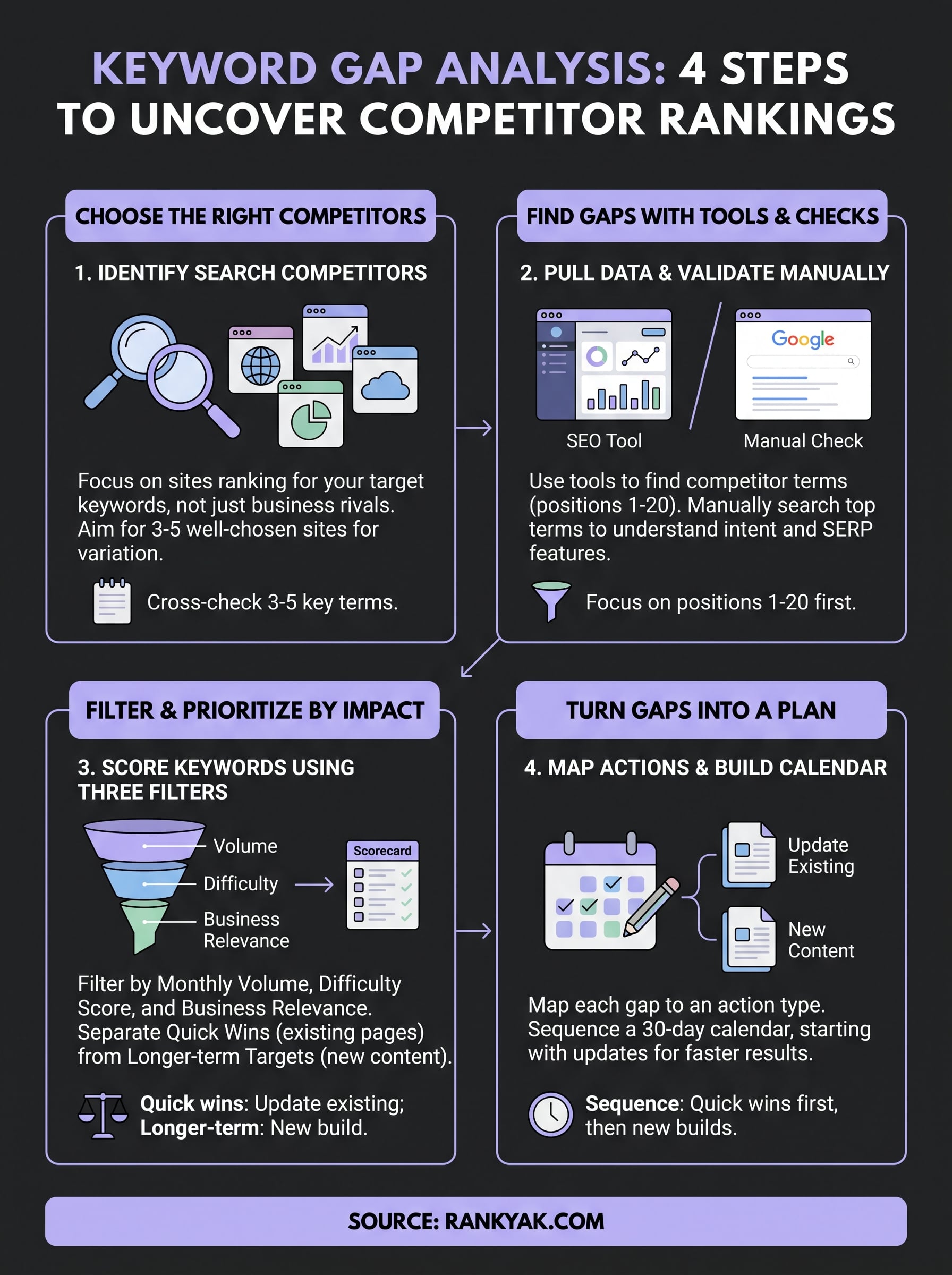
You now have a complete keyword gap analysis process: pick the right competitors, pull ranking data with a tool, filter by volume, difficulty, and business relevance, then assign each gap to either a new page or an update. The work compounds when you execute in sequence, quick wins first, longer builds after, and repeat the analysis every 60 to 90 days as your rankings shift and competitors adjust their content.
The biggest bottleneck most sites hit isn't finding the gaps. It's producing optimized content consistently once they know what to target. Keyword research without execution doesn't move rankings. If you want to close your gaps faster without building out a full content team, see how RankYak writes researched, ready-to-rank SEO articles and publishes them straight to your CMS, so your content plan actually ships on schedule instead of stalling in a backlog.
Allan de Wit is a co-founder of RankYak and has worked in SEO since 2015: inside agencies, alongside them, for clients directly, and in-house on the products being ranked. He came to it as a software engineer building for marketers, which is why the platform is built the way it is. He went on to start companies of his own, two of which were acquired. At RankYak he sets the product direction and owns the features, the quality bar, the design, and the UX.