15 Small Business SEO Tools: Free + Budget-Friendly Picks
Most small businesses don't have a $3,000/month SEO budget, and they shouldn't need one. The right small business SEO tools can help you find keywords, optimize content, track rankings, and build authority without draining your bank account or requiring a dedicated marketing team.
But here's the challenge: there are hundreds of SEO tools out there, and most of them are built for enterprise companies with enterprise price tags. Sorting through them to find what actually works on a small business budget takes time you probably don't have. Some tools overlap, some overpromise, and some charge you for features you'll never touch.
That's exactly why we built RankYak, to automate the heavy lifting of SEO, from keyword research to content publishing, at a price that makes sense for smaller teams. But we also know that no single tool does everything, and your stack might need a few extras depending on your goals and where you are in your SEO journey.
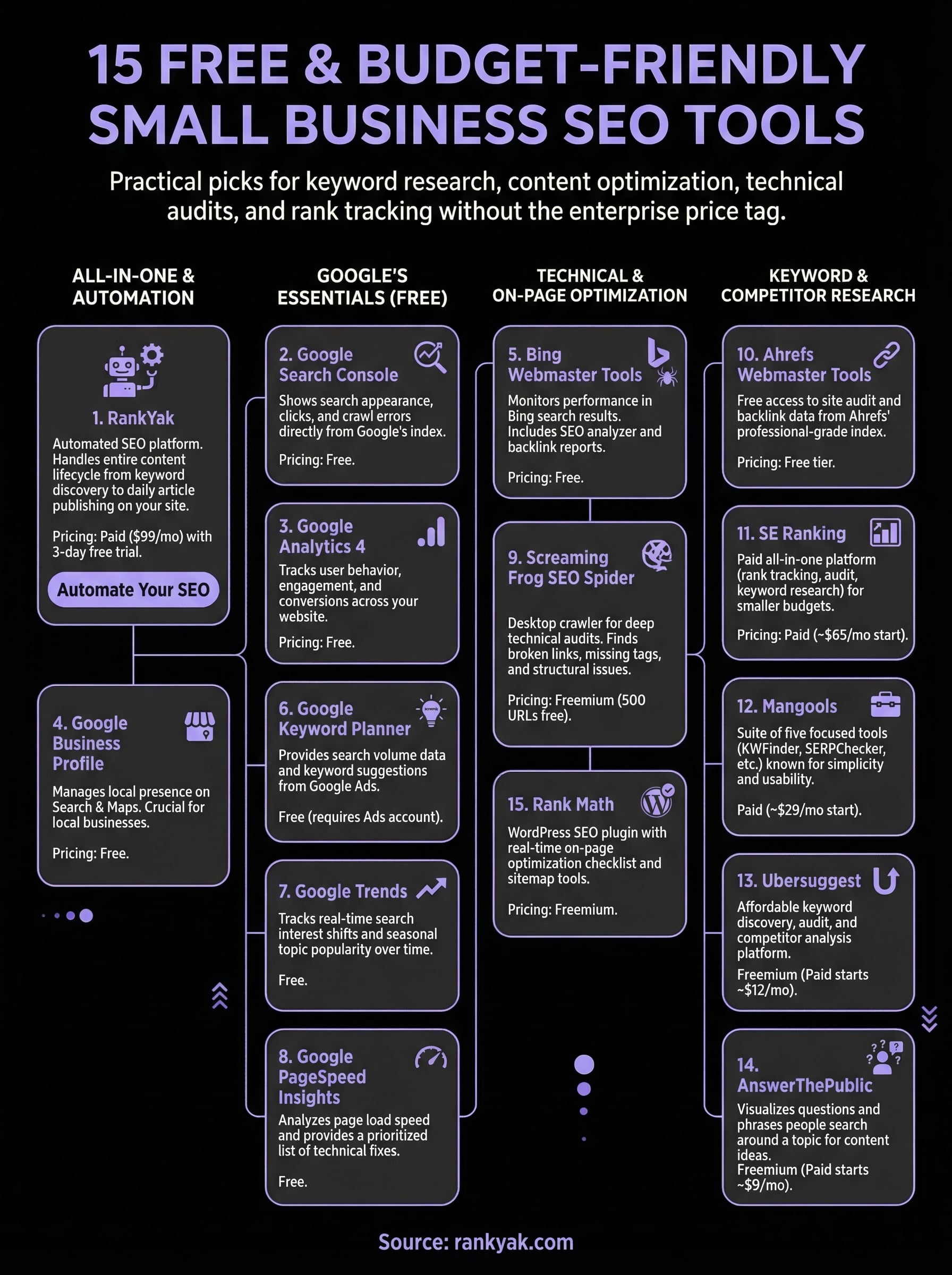
So we put together this list of 15 free and budget-friendly SEO tools that are genuinely useful for small businesses. Each pick was chosen based on practical value and affordability, not brand hype. Let's get into it.
1. RankYak
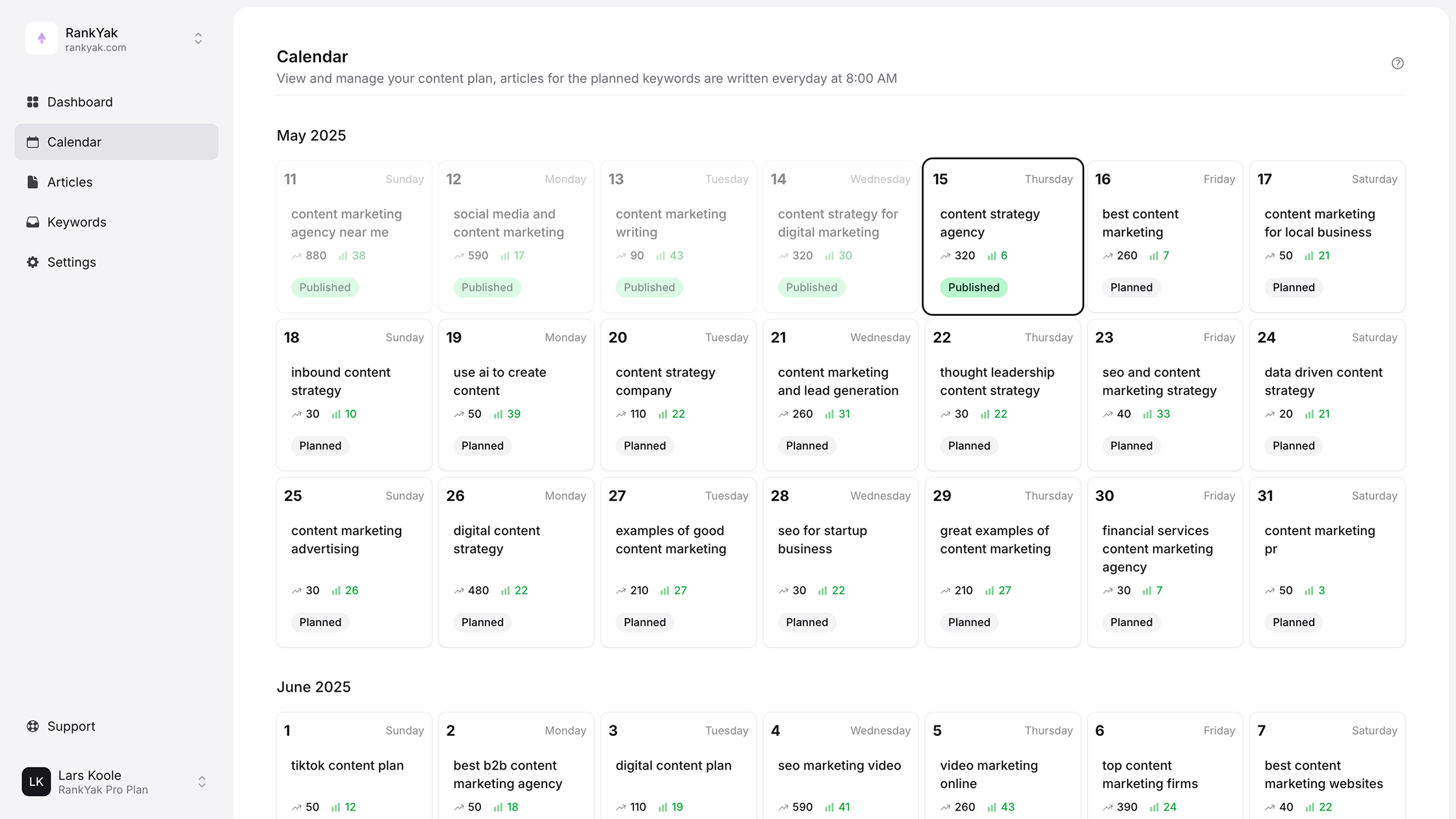
RankYak is an all-in-one SEO automation platform that handles the full content lifecycle for you, from finding keywords to publishing finished articles on your site every single day. It was built specifically for people who want real SEO results without spending hours each week on research, writing, and technical optimization.
What it does
RankYak starts by analyzing your website and niche to identify high-potential keywords you can actually rank for. From there, it builds a daily content plan and writes fully optimized articles, up to 5,000 words each, complete with featured images, internal links, topic clusters, and proper structure. The platform then publishes directly to your CMS, whether that's WordPress, Shopify, Webflow, or Wix, so you never have to copy-paste anything manually.
If you're trying to build organic traffic consistently, the biggest challenge isn't knowing what to do, it's finding the time to do it every single day. RankYak removes that barrier.
Articles are built using competitor research, search intent analysis, and Google's E-E-A-T guidelines, so the output is designed to rank rather than just fill a word count. The platform also optimizes content for visibility in AI chat platforms like ChatGPT and Perplexity, which is becoming an increasingly important traffic channel for small businesses.
Best fit for
RankYak works best for small to medium-sized business owners, content marketers, and website operators who want consistent SEO growth without hiring an agency or building an in-house team. If you're currently publishing content inconsistently, or not at all, because you simply run out of time, RankYak solves that problem directly. It's also a strong fit for anyone managing multiple client sites, since the platform lets you run each site under one account with its own content plan and keyword strategy.
Among the small business SEO tools in this list, RankYak is the only one that automates the entire process end to end, making it the right pick when your goal is to scale output while cutting manual work.
Pricing
RankYak offers one straightforward plan at $99 per month, which includes every feature: keyword discovery, daily article generation, automatic publishing, backlink exchange, and multi-site management. There are no tiered feature locks or hidden upsells to navigate.
You can also start with a 3-day free trial and cancel anytime if it doesn't fit your current needs. For the scope of what the platform covers, the flat monthly rate is significantly cheaper than hiring a freelance content writer for even a handful of articles.
2. Google Search Console
Google Search Console is a free tool from Google that gives you direct insight into how your site appears in search results. If you only add one tool from this entire list, make it this one.
What it does
Search Console shows you which search queries are bringing users to your site, how many clicks and impressions each page gets, and your average ranking position. You can also use it to set up Search Console to submit sitemaps, monitor indexing coverage, and identify crawl errors that might be blocking Google from reading your pages. The Performance report alone is enough to reshape your entire content strategy.
Google pulls this data directly from its own search index, which means you're working with the most accurate ranking data available anywhere.
Best fit for
This tool fits every small business with a website, regardless of your budget, industry, or technical skill level. Whether you're just launching your site or you've been publishing content for years, Search Console gives you the data you need to make smarter decisions. It's especially useful if you want to identify quick-win pages that rank on page two and just need a content refresh to break into the top results.
Pricing
Google Search Console is completely free, with no premium tier or paid upgrade path. You connect it to your site through Google's verification process, and all features are available to every user at no cost. Among all the small business SEO tools available today, it's one of the few that delivers this level of actionable performance data without charging a cent.
3. Google Analytics 4
Google Analytics 4 (GA4) is Google's free website analytics platform that shows you exactly how visitors interact with your site. While Search Console tells you how people find you in Google, GA4 tells you what they do after they arrive.
What it does
GA4 tracks user behavior across your website, including which pages people visit, how long they stay, where they drop off, and what actions they take, such as form submissions or purchases. It uses an event-based data model that gives you far more granular reporting than older analytics platforms.
You can also set up conversion tracking to measure the specific actions that matter most to your business, whether that's a contact form fill or a product sale. Connecting GA4 to Search Console inside your Google account gives you a combined view of traffic sources and on-site behavior.
Understanding which pages drive the most engagement helps you double down on what's working instead of guessing what content to prioritize next.
Best fit for
GA4 works well for any small business that wants to connect SEO effort to actual business outcomes. If you're investing time in content creation, GA4 helps you measure SEO performance by showing which articles bring in engaged traffic versus which pages have high bounce rates. It pairs naturally with Search Console as part of a core set of small business SEO tools that costs nothing to run.
Pricing
GA4 is completely free for standard use. Google does offer a paid enterprise version called Google Analytics 360, but the free tier covers everything a small business needs, including unlimited reports, audience segmentation, and conversion tracking.
You connect GA4 to your site through a tracking code or Google Tag Manager, and setup takes less than 30 minutes for most sites. Given the depth of data it provides, it is one of the highest-value free tools you can add to your stack.
4. Google Business Profile
Google Business Profile (formerly Google My Business) is a free tool that controls how your business appears in Google Search and Google Maps. If your business serves customers in a specific area, this tool directly affects whether people find you when they search locally.
What it does
Optimizing your Google Business Profile lets you manage your business listing on Google, including your name, address, phone number, hours, photos, and service categories. When someone searches for a business type near them, Google pulls from these listings to populate the local map pack, the block of three businesses that appears at the top of local search results. You can also respond to customer reviews, post updates, and add products or services directly inside the profile. Keeping your listing complete and active sends positive signals to Google's local ranking algorithm.
For local businesses, ranking in the map pack often drives more foot traffic and calls than ranking on page one of organic results.
Best fit for
This tool is essential for any business with a physical location or a defined service area, such as restaurants, contractors, retail stores, medical offices, and home service providers. If your customers are searching phrases like "near me" or "[service] in [city]," your Google Business Profile is one of the most important small business SEO tools you can manage. It won't help purely online businesses much, but for local businesses it is non-negotiable.
Pricing
Google Business Profile is completely free to use. There are no paid tiers, and every feature, including posts, photo uploads, review management, and performance insights, is available at no cost. You simply create or claim your listing through Google's Business Profile platform and verify ownership through a standard verification process.
5. Bing Webmaster Tools
Bing Webmaster Tools is Microsoft's free platform for monitoring your site's performance in Bing search results. Most businesses focus entirely on Google and ignore Bing completely, but Bing still accounts for a meaningful slice of search traffic, especially among desktop users, older demographics, and anyone on a Windows device with default browser settings.
What it does
The platform lets you submit sitemaps, monitor crawl activity, and see which queries are driving traffic from Bing to your site. It includes a built-in keyword research tool, a site scan that surfaces SEO issues, and a backlink report. Microsoft also added an SEO analyzer that delivers page-level recommendations, making it closer to a full auditing tool than a basic verification console.
If you already use Google Search Console, setting up Bing Webmaster Tools takes under 10 minutes and gives you search coverage across a second major engine at zero additional cost.
Best fit for
This tool works well for any small business that wants to cover more than one search engine without adding complexity or cost to their stack. It's especially useful if your target audience skews toward Windows users or corporate environments where Bing is often the default. As part of a broader set of small business SEO tools, it fills a gap most businesses overlook entirely.
Pricing
Bing Webmaster Tools is completely free to use. You verify your site through Microsoft's Bing Webmaster platform and immediately access all features, including the keyword tool, SEO reports, and backlink data, with no paid tier or upgrade required.
6. Google Keyword Planner
Google Keyword Planner is a free keyword research tool built inside Google Ads that pulls search volume data and keyword suggestions directly from Google's own index. You need a Google Ads account to access it, but you don't need to run any paid campaigns.
What it does
Keyword Planner lets you enter a word, phrase, or URL and get back data on monthly search volumes, competition levels, and suggested bid ranges, which is the starting point of step-by-step keyword research. You can filter results by location, language, and date range to focus on terms your specific audience is actually searching. The tool also groups related keywords into themes, which helps you spot content gaps and topic clusters worth targeting, and you can group a keyword list into clusters afterwards to decide how many articles it is worth.
Because the data comes directly from Google, it is one of the most reliable free sources for understanding actual keyword demand.
Here are a few ways small businesses typically use it:
- Validate demand before writing a new piece of content
- Find long-tail variations of a primary keyword
- Identify seasonal trends in search volume
Best fit for
Keyword Planner is a strong starting point for any small business that needs keyword data without paying for a premium tool. It works especially well when you're building an initial content strategy or checking whether a topic is worth pursuing. Because it comes from Google directly, it pairs naturally with Search Console and GA4 in your core free stack.
Pricing
Google Keyword Planner is completely free. You access it through a Google Ads account, which costs nothing to create even if you never run a single ad. Every core feature, including keyword suggestions, search volume estimates, and location filtering, is available at no charge, making it one of the most practical small business SEO tools you can add to your workflow today.
7. Google Trends
Search interest shifts constantly, and Google Trends gives you a free way to track exactly how those shifts unfold over time. Rather than reporting exact search volumes, it uses a relative index from 0 to 100 to show how popular a term is compared to its own peak, which makes it especially useful for spotting momentum before a topic hits its ceiling.
What it does
Using Google Trends for keyword research lets you enter a keyword and pull up a historical graph of search interest across any custom time range. You can filter results by country, region, or category, and compare up to five terms at once to see how they perform against each other. The tool also surfaces related queries and breakout topics, giving you a direct feed of growing search interest that you can turn into timely content ideas.
Timing your content around a rising trend means you publish when interest is climbing, not after it has already peaked and started to drop.
Best fit for
This tool works best for small businesses in seasonal or trend-driven industries like retail, food and beverage, home improvement, or fitness. If your products or services follow predictable demand cycles, Google Trends helps you build a content calendar that matches real search behavior rather than guesswork. Among the free small business SEO tools in this list, it is one of the few that gives you a time-based view of keyword demand instead of a static snapshot.
Pricing
Google Trends is completely free and requires no account to access the core features. You can go directly to trends.google.com and start exploring data right away. Every feature, including regional breakdowns, comparison charts, and related query reports, is available to all users at no cost, with no paid upgrade path.
8. Google PageSpeed Insights
Page speed is a confirmed Google ranking factor, and slow-loading pages hurt both your search rankings and your visitor experience at the same time. Google PageSpeed Insights is a free diagnostic tool that analyzes how fast your pages load and gives you a specific, prioritized list of fixes to improve performance on both mobile and desktop.
What it does
PageSpeed Insights runs your URL through Google's Lighthouse performance engine and scores your page from 0 to 100 for both mobile and desktop environments. The report breaks down issues like unoptimized images, render-blocking resources, and slow server response times, with each item explained and ranked by its potential impact on load speed. Rather than leaving you with a raw number, the tool walks you through exactly what to fix and why.
A page that scores below 50 on mobile is likely losing visitors before they even see your content, which directly undermines every other SEO effort you make.
Best fit for
This tool fits any small business website owner who wants to understand what is slowing their site down. It is especially valuable if your site relies heavily on large images, third-party scripts, or page builder plugins, which are common culprits behind poor performance. Among the small business SEO tools in this list, PageSpeed Insights is one of the most practical ways to surface technical problems that quietly hold back your rankings without obvious warning signs.
Pricing
Google PageSpeed Insights is completely free to use with no account required. You simply paste a URL into the tool at pagespeed.web.dev and receive a full report instantly. Every feature, including the Core Web Vitals assessment, field data, and lab diagnostics, is available to all users at no cost.
9. Screaming Frog SEO Spider
Screaming Frog SEO Spider is a desktop-based crawling tool that scans your entire website the same way Google's bots do, surfacing technical SEO issues that are invisible until they start actively hurting your rankings. It runs on your own computer rather than in a browser, which makes it faster and more thorough than most web-based audit platforms.
What it does
The tool crawls every URL on your site and returns a detailed breakdown of technical problems, including broken links on a page, duplicate content, missing meta descriptions, redirect chains, and pages blocked from indexing. You can pull data on page titles, header structures, response codes, and canonical tags across your entire site in a single crawl pass. For small businesses that have been publishing content for years without a formal audit, a Screaming Frog crawl often uncovers a backlog of fixable issues quietly dragging down rankings.
Fixing broken internal links and redirect chains can improve how Google crawls your site and distributes authority without requiring a single new piece of content.
Best fit for
Screaming Frog works best for small business owners and marketers who want to run a thorough audit with a technical SEO audit tool without paying for an enterprise-level platform. Among the small business SEO tools in this list, it is one of the most reliable options for surfacing structural problems that simpler tools miss entirely.
Pricing
The free version lets you crawl up to 500 URLs, which covers most small business sites at no cost. If your site is larger, the paid license costs £259 per year (roughly $325 USD) and removes the crawl cap while adding Google Analytics integration and scheduled crawls.
10. Ahrefs Webmaster Tools
Ahrefs is one of the most respected names in the SEO industry, and its free Webmaster Tools tier gives you direct access to a subset of that platform's core capabilities without paying for a full subscription. For small businesses that want professional-grade backlink and site audit data, this is one of the strongest free options available.
What it does
Ahrefs Webmaster Tools connects to your verified website and delivers two primary functions: a site audit tool and a backlink report. The site audit crawls your pages and flags technical issues like broken links, slow pages, missing tags, and crawlability problems, all scored by severity. The backlink report shows you which domains are linking to your site, the quality of those links, and how your referring domain count changes over time.
Knowing which sites link to you and which links are broken gives you a clear action list for improving your site's authority without any guesswork.
Best fit for
This tool is a strong addition for small business owners who want credible backlink data without committing to a paid plan. Among the small business SEO tools in this list, Ahrefs Webmaster Tools stands out because it brings enterprise-level link intelligence to a free tier that most competitors simply don't match. It works especially well if you suspect your backlink profile has gaps or toxic links worth investigating.
Pricing
The Webmaster Tools tier is completely free for verified site owners. Paid Ahrefs plans start at $129 per month, which unlocks keyword research, competitor analysis, and deeper reporting, but the free tier alone delivers significant value for link and technical auditing (here is how RankYak compares with Ahrefs).
11. SE Ranking
SE Ranking is a paid all-in-one SEO platform that delivers a wide range of capabilities, including rank tracking, site audits, keyword research, and competitor analysis, all inside a single dashboard. It sits in the mid-market space and is priced with smaller teams and budgets in mind, making it one of the more accessible full-featured platforms available.
What it does
SE Ranking covers the core functions most small businesses need in one place. Its rank tracker monitors your keyword positions daily across Google and Bing, so you always know where your pages stand. The site audit tool crawls your site and flags technical problems by severity, while the keyword research module pulls search volume, difficulty scores, and related keyword suggestions for any term you want to target. You also get a competitor analysis feature that shows which keywords rival sites rank for, which can sharpen your own content strategy significantly.
Having rank tracking, auditing, and keyword research inside one platform saves you from juggling three separate tools and paying for each individually.
Best fit for
SE Ranking works well for small business owners who want a single paid tool that covers most of their SEO needs without requiring enterprise-level spending. Among the small business SEO tools in this list, it is a strong pick if you want to move beyond free tools and invest in something more structured without jumping straight to the higher price points of platforms like Ahrefs or Semrush, and it is worth seeing how SE Ranking stacks up against RankYak first.
Pricing
SE Ranking's plans start at approximately $65 per month when billed annually, with pricing scaling based on the number of keywords you track and the number of projects you manage. A free trial is available so you can test the platform before committing.
12. Mangools
Mangools is a suite of five focused SEO tools packaged together under one subscription, covering keyword research, rank tracking, backlink analysis, SERP analysis, and competitor research. The platform is built around simplicity and usability, which makes it a natural fit for small business owners who want capable tools without a steep learning curve.
What it does
The platform gives you access to five dedicated tools: KWFinder for keyword research, SERPChecker for analyzing the competition behind any query, SERPWatcher for daily rank tracking, LinkMiner for backlink exploration, and SiteProfiler for domain authority and competitor research. KWFinder is particularly strong because it surfaces long-tail keywords with low competition scores that are realistically achievable for smaller sites, and it holds up well against the other top keyword research tools. You enter a seed keyword or a competitor's domain and get back a filtered list of terms sorted by difficulty, search volume, and trend data.
KWFinder's difficulty scores are based on real backlink data rather than vague estimates, which gives you a more accurate picture of what it actually takes to rank for a given term.
Best fit for
Mangools works well for small business owners and content marketers who want keyword research and rank tracking without paying for a tool that buries those features under a bloated interface. Among the small business SEO tools in this list, it is one of the cleaner options if your primary need is finding keywords you can realistically rank for and then monitoring your progress over time.
Pricing
Plans start at approximately $29 per month when billed annually, making it one of the more affordable paid options in this category. A 10-day free trial is available, giving you enough time to test KWFinder and the rank tracker before you decide to commit to a subscription.
13. Ubersuggest
Ubersuggest is a keyword research and SEO audit platform created by marketing strategist Neil Patel. It covers keyword discovery, competitor analysis, content ideas, and site audits inside a single interface, and its pricing structure makes it one of the more accessible paid options among small business SEO tools.
What it does
Ubersuggest lets you enter a keyword or a competitor's domain and pulls back search volume, keyword difficulty scores, and content suggestions based on what is already performing well in search results. The site audit tool scans your pages for technical issues and organizes problems by priority, so you know what to fix first rather than working through a random list. You also get a traffic analyzer that estimates how much organic traffic a competitor is getting and which keywords are driving it, which helps you spot gaps in your own content strategy.
Seeing which keywords send traffic to a competing site gives you a practical shortlist of terms worth targeting without spending hours on manual research.
Best fit for
Ubersuggest works well for small business owners and solo marketers who want keyword and competitor data without committing to a higher-cost platform. It fits naturally into an early-stage SEO workflow where you need to identify target keywords, audit your site, and understand what competitors are doing, all without switching between multiple tools.
Pricing
Ubersuggest offers a limited free tier that gives you a few searches per day before hitting a paywall. Paid plans start at $12 per month when billed annually, which makes it one of the most budget-friendly paid options in this list. A seven-day free trial is also available before you commit.
14. AnswerThePublic
AnswerThePublic is a keyword research tool built around surfacing the questions, comparisons, and phrases that real people type into search engines. Rather than showing raw volume numbers, it maps out how your audience thinks and talks about a topic, which makes it a practical generator of content ideas grounded in actual user intent.
What it does
AnswerThePublic takes a seed keyword you enter and returns a structured set of related questions organized by search modifiers like who, what, where, when, why, and how. It also surfaces comparison queries and preposition-based phrases that reveal exactly how people frame their needs before they click anything. The resulting list gives you a ready-made outline of content angles worth covering, from FAQ sections to full article topics, and you can turn a seed subject into pillars and supporting articles from there.
Answering the specific questions your audience is already asking in search is one of the most direct ways to rank for informational queries without fighting over high-competition head terms.
Best fit for
This tool works well for content marketers and small business owners who need a steady stream of topic ideas built around genuine audience questions. Among the small business SEO tools in this list, AnswerThePublic stands out if you write blog posts, FAQ pages, or educational content and want those pieces to match real search behavior.
It pairs naturally with Google Keyword Planner or Mangools to add volume data on top of the question-based ideas it surfaces, giving you both the topic angles and the demand numbers you need to prioritize your content calendar.
Pricing
AnswerThePublic offers a limited free tier that allows a small number of searches per day before restricting access. Paid plans start at approximately $9 per month when billed annually, making it one of the most affordable specialized research tools in this category.
15. Rank Math
Rank Math is a WordPress SEO plugin that handles on-page optimization directly inside your content editor, so you can review and improve every page before it ever goes live. The plugin gives you a structured checklist that scores your content against proven SEO factors, removing the guesswork from on-page work entirely.
What it does
The tool integrates into your WordPress dashboard and provides real-time feedback as you write or edit any page. It checks elements like your focus keyword placement, meta title and description length, heading structure, image alt text, and internal linking, essentially walking you through an on-page SEO checklist as you write. The plugin also generates and submits your XML sitemap automatically, handles redirects, and adds schema markup to your pages without requiring you to touch any code.
Getting schema markup and on-page signals right from the start means your pages enter Google's index already optimized rather than needing fixes after the fact.
Best fit for
This plugin is built specifically for WordPress users, which makes it a natural fit for any small business running its site on that platform. Among the small business SEO tools in this list, it stands out as the most practical option for anyone who wants on-page guidance built directly into their existing publishing workflow without adding a separate dashboard to manage.
Pricing
The free version is available through the WordPress plugin directory and covers the core on-page optimization features most small businesses need day to day. A paid Pro plan starts at $6.99 per month when billed annually, which unlocks advanced schema options, keyword rank tracking, and Google Analytics integration directly inside the plugin itself.
What to do next
You now have a solid overview of 15 small business SEO tools that cover every core function, from keyword research and rank tracking to technical audits and on-page optimization. The free tools in this list, especially Google Search Console, GA4, and Google Business Profile, should be your first installs if you haven't set them up yet.
From there, your next move depends on where your biggest gap is. If you need keyword and competitor data on a budget, Mangools or SE Ranking give you the most for your money. If technical issues are holding your site back, Screaming Frog or Ahrefs Webmaster Tools will surface them fast.
But if your core problem is that you simply aren't publishing enough content consistently, no audit tool will fix that. RankYak automates your entire content operation, from keyword discovery to daily article publishing, so your site keeps growing without requiring your time every week. See what RankYak costs per month, start your free trial, and find out what consistent SEO output actually looks like.
Lars Koole is a co-founder of RankYak and has worked in SEO since 2021, on the side where a strategy has to become a live page: inside agencies, alongside them, for clients directly, and in-house on the products being ranked. He is a software engineer by trade, which is how that page gets built. Before RankYak he founded companies of his own, two of which were acquired. At RankYak he owns the engineering and everything AI, and works out the solution and the implementation of each new feature.