White Label Link Building Services: A Reseller Guide
Link building is one of the hardest SEO services to scale. It's labor-intensive, relationship-driven, and nearly impossible to do well without dedicated resources. That's exactly why white label link building services have become a go-to solution for agencies that want to offer backlink acquisition without building the infrastructure from scratch.
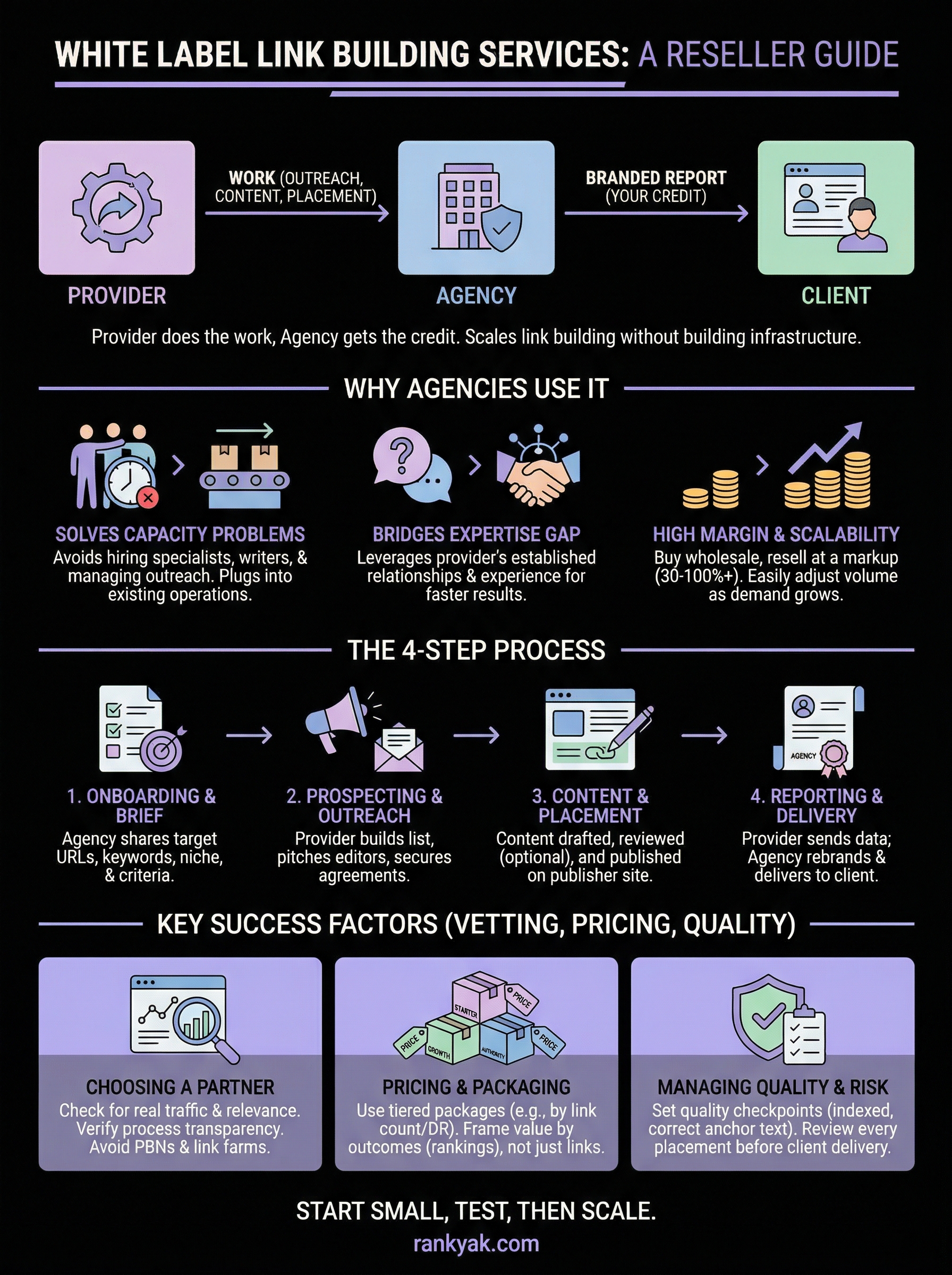
The concept is straightforward: a specialized provider does the outreach, secures the placements, and delivers the results, all under your brand. Your clients never see the partner behind the curtain. You keep the margin, the relationship, and the credit. But choosing the wrong provider can torch your reputation fast, so understanding how these services actually work matters before you sign anything.
If you've asked yourself "what are white label backlinks?" the answer is simple, and it starts with the basics of SEO backlinks: white label backlinks are links acquired by a third-party provider and delivered to you without any branding that reveals the provider's identity. You resell those placements to your clients as if your agency secured them directly. The term "white label" refers to the unbranded nature of the deliverable, not the link type itself. The links can be guest posts, niche edits, resource page placements, or any other legitimate acquisition method, as long as they arrive under your brand umbrella.
This guide breaks down what white label link building is, how to evaluate providers, what pricing looks like, and where the common pitfalls are. Whether you're an agency owner exploring outsourced fulfillment or a consultant looking to expand your service offering, you'll walk away with a clear framework for making this model work. At RankYak, we help businesses automate their SEO, from keyword research to content publishing to automated backlink building, so we know firsthand how critical quality links are to ranking success.
Why agencies use white label link building
Most agencies don't outsource link building because they lack confidence in their SEO knowledge. They do it because building links at scale requires infrastructure that most agencies don't have: dedicated outreach staff, established publisher relationships, guest post writers, and months of runway before results show up. White label arrangements solve that problem by letting you plug into an existing operation rather than building one from scratch. You offer the service, the provider handles the execution, and your clients see a polished deliverable under your brand.
The economics make this model particularly attractive. Link building is one of the highest-margin services an agency can offer when it's outsourced well, but it's also one of the most resource-intensive to run internally. That tension is exactly why so many agencies reach for white label link building services as their fulfillment solution.
Operating as a link building reseller through one of the white label SEO reseller programs also lowers the barrier to entry for agencies that are just starting to add SEO to their service menu. Instead of spending months hiring and training an outreach team, you can begin offering backlink services almost immediately by partnering with one of the established white label SEO service providers. For agencies looking for affordable options for white label link building, many affordable link building providers offer entry-level packages that let you test the model with a small number of clients before committing to higher volumes.
The capacity problem with in-house link building
Running outreach in-house is expensive and slow to get going. You need to hire specialists, train them on prospecting, build contact lists, draft outreach sequences, and then wait weeks or months for placements to materialize. For most agencies, that's not a realistic timeline when clients expect to see movement within the first few billing cycles.
When your team is already stretched thin on strategy and client reporting, piling manual link outreach on top almost always leads to corner-cutting or delayed deliverables.
Even teams with solid SEO experience find that link building becomes the first bottleneck as client volume grows. Here's what running it in-house actually requires:
- A dedicated outreach specialist or two
- A content writer to produce guest post drafts
- A vetted database of publisher sites by niche
- Software for tracking campaigns and managing follow-up sequences
- Months of relationship-building before placements become predictable
Most agencies find that list uncomfortable when they compare it to the cost of a white label partner.
The expertise and relationship gap
Link building success depends heavily on who you already know. Providers with years of outreach experience have contact lists, editor trust, and a placement history that gets their emails opened and answered. Starting from zero means a steep ramp-up period with high rejection rates before you land placements worth delivering to clients.
Your clients don't care about your internal growing pains. They care about whether their domain authority is climbing and whether they're ranking for the keywords that matter to their business. When you work with a white label partner that already has publisher relationships built in, you deliver faster results without waiting for your team to build the same credibility from scratch.
What makes a good backlink network for white-label SEO comes down to diversity and legitimacy. A strong provider maintains relationships across a wide range of niches and site types, avoiding over-reliance on a small cluster of domains. That diversity means your clients get links from topically varied but relevant sources, which is exactly what search engines reward.
Margin and scalability
White label arrangements give you direct control over your pricing. You buy links at the provider's wholesale rate and resell them at your agency's markup, keeping the difference. That margin can be substantial, often ranging from 30% to over 100% depending on how you package and position the service.
Scaling the service is straightforward once the provider relationship is stable. If a client wants to double their monthly link volume, you adjust the order. There's no scrambling to hire or retrain staff. Your agency can grow this service line as fast as client demand grows, without adding fixed costs to your overhead. That's a meaningful advantage for any agency trying to stay lean while expanding its service menu.
Many providers offer structured link building reseller packages that bundle a set number of placements at predefined domain rating thresholds, and comparing link building packages with pricing shows how those bundles are usually built. These packages make it easy to map your provider costs directly to your client pricing tiers. Some providers also include niche edit placements alongside guest posts in their reseller packages, giving you more flexibility in how you fulfill client campaigns. A niche edit reseller program, where links are placed within existing published content on authoritative sites, can be especially useful for clients who need faster turnaround times since the content is already indexed.
How white label link building works step by step
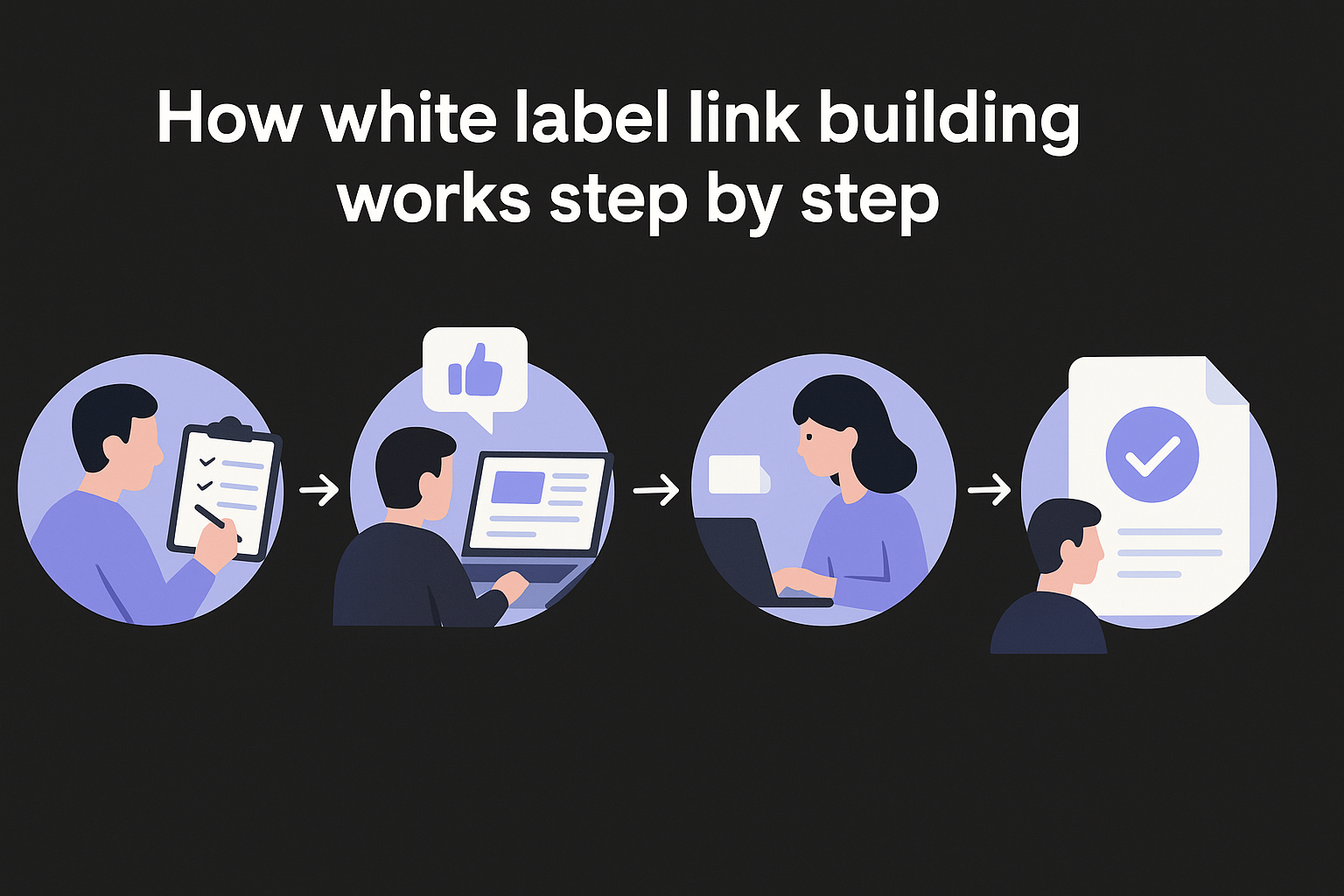
Understanding the mechanics helps you set realistic expectations with clients and catch problems before they become complaints. Most white label link building services follow a predictable workflow, from initial brief to final deliverable, and knowing each step tells you exactly where to apply oversight so nothing falls through the cracks. Whether you're acting as a link building reseller for a single client or managing a portfolio of ten, the process stays largely the same.
Onboarding and campaign brief
Your engagement starts with a detailed brief. You share target URLs, anchor text preferences, domain authority minimums, and niche context so the provider can source placements that actually fit. A thorough brief prevents mismatched links and limits revision cycles. Here's what a solid brief typically covers:
- Target page URLs and primary keywords for each
- Minimum domain rating or domain authority threshold
- Niche and topical relevance requirements
- Preferred, acceptable, and excluded anchor text variations
- Any brand voice notes or editorial restrictions
If you're targeting white label high authority backlinks (typically DR 50+), make that threshold explicit in the brief. High-authority placements cost more and take longer to secure, so setting that expectation upfront prevents scope confusion later.
Prospecting and outreach
Once the brief is locked in, the provider's team builds a list of publisher sites that match your criteria and starts pitching editors and site owners, much like dedicated blogger outreach service providers do. This is where their existing publisher relationships matter most, because established contacts respond faster and convert at far higher rates than cold pitches to unknown sites.
The strength of a provider's publisher network is the single biggest factor separating link campaigns that move rankings from ones that burn your client's budget.
Outreach confirmation can take several weeks, so building that timeline into your client communications from day one prevents unnecessary pressure on the provider and keeps your client relationship smooth.
Content creation and link placement
When a publisher agrees to a placement, the provider drafts an article or guest post that fits the publisher's editorial standards while naturally embedding your client's target link, the same fulfillment model used by guest post link building providers. You'll typically review the draft before it publishes, giving you a direct checkpoint to catch anything off-brand, inaccurate, or out of tone before it goes live on a third-party site.
Some providers also offer niche edit placements as part of their fulfillment. In these cases, the provider identifies an existing, already-indexed article on a relevant site and negotiates the insertion of your client's link into that content. Niche edits skip the content creation step entirely, which often means faster placement turnaround. However, you have less control over the surrounding context, so reviewing the live page after the edit goes in is critical.
Reporting and delivery
After the link goes live, the provider sends a report showing the live URL, domain metrics, and anchor text used for each placement secured. Reformatting that report under your agency's branding takes minimal time, and automating white label SEO reports means your client receives a polished deliverable with your logo on the cover. The provider's name never appears anywhere in what your client sees, which keeps the white label arrangement clean and professional throughout the engagement.
White label backlink tracking is a step many agencies overlook after initial delivery, but it's essential for long-term campaign integrity. Links can be removed, pages can be deindexed, and domain metrics can shift over time. Setting up a recurring check, whether monthly or quarterly, to verify that placed links are still live and indexed protects your client from paying for backlinks that no longer exist. Many providers offer white label backlink building tracking dashboards or spreadsheets that you can access with your own branding, letting you monitor placement status without revealing the provider to your clients. If your provider doesn't offer built-in tracking, use a third-party backlink monitoring tool and flag any dropped links for replacement.
How to choose a white label link building partner
Picking the wrong partner is the fastest way to damage client relationships you've spent years building. White label link building services vary dramatically in quality, transparency, and link practices, so comparing the link building services worth paying for and vetting a provider before you commit to a contract protects both your agency and your clients. You need to look beyond the sales pitch, review how the top link building agencies present their work, and ask for concrete evidence of how a provider actually operates.
What to look for in link quality
The most important signal is the quality of the sites where a provider places links. Ask for sample placements before you sign anything, then check each site yourself. Look at real traffic using objective signals, verify that the site publishes content consistently, and confirm the content is topically relevant to your clients' niches. A provider that hesitates to share samples or sends you a list of sites with no organic traffic is telling you everything you need to know about their standards.
Providers who place links on private blog networks or link farms will cost you far more than their fee when Google penalizes your client's site.
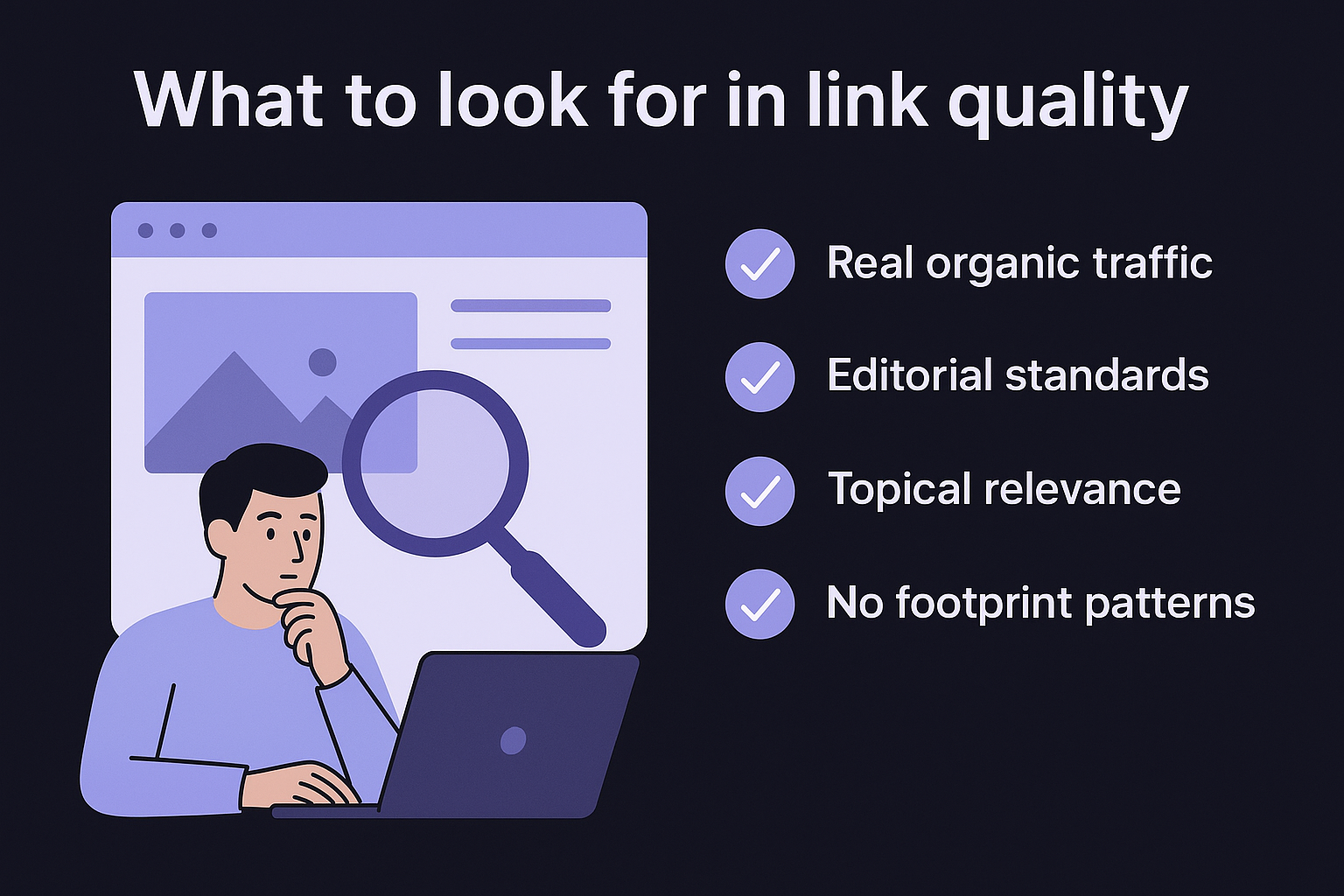
Here's what to verify on any sample placement a provider sends you:
- Real organic traffic, not just a high domain rating number
- Editorial standards that match legitimate, independently-run publications
- Content written by actual authors, not clearly spun or low-effort filler
- Topical relevance between the linking site and your client's target page
- No footprint patterns like identical site layouts or suspicious link profiles across placements
When evaluating the most reliable sources for white-label backlinks, prioritize providers using white hat link building tactics, whose placements appear on sites with genuine editorial processes: real editors, published contributor guidelines, and a history of content that serves an actual audience. The most reliable white label backlink sources are sites that would exist and attract readers whether or not they accepted guest contributions.
How to evaluate their process and communication
A reliable provider runs a structured process and communicates clearly at each stage of a campaign. Ask them to walk you through their typical timeline, how they handle rejected outreach, and what happens when a client's brief requires highly niche-specific placements. That conversation alone reveals whether they have a repeatable system or improvise their way through each order.
Request a sample report to see exactly what your clients would receive after you reformat it under your brand. If the data is thin, the metrics don't align with what you'd promise clients, or the formatting looks rushed, that's a clear sign the provider isn't built to support a professional reseller relationship. Before committing to volume orders, run a small test campaign so you can evaluate real results against what they promised during the sales process.
Watch for these red flags during the vetting process:
- Guaranteed placements on specific high-authority domains before outreach begins (legitimate providers can't promise exact sites in advance)
- Prices that are dramatically lower than the market average, which usually means PBN links or recycled placements
- Unwillingness to share their outreach methodology or explain how they source publisher sites
- No process for replacing dropped or deindexed links
- Vague answers when asked about anchor text distribution and link velocity controls
How to price and package link building for clients
Pricing link building correctly protects your margin without making clients hesitant to invest. Most agencies structure their markup between 40% and 100% over their provider's wholesale rate, depending on how the service is positioned and how much supporting work they wrap around the core deliverable, which is why it helps to study white label SEO package pricing before setting your own. When you use white label link building services, your cost per link is fixed by the provider, so your pricing strategy directly determines how profitable each client relationship becomes.
The agencies that price too low often do so out of fear of losing clients, but underpricing signals low confidence in the value you actually deliver.
Building a tiered package structure
Packaging link building into defined tiers makes the buying decision straightforward for clients and keeps your own operations predictable month to month. A simple three-tier structure works well because it gives clients a clear entry point and a natural upgrade path as their results build momentum. Here is how a basic tier structure might look:
| Tier | Monthly Links | Suggested DR Minimum | Suggested Retail Price |
|---|---|---|---|
| Starter | 3 links | DR 30+ | $750/month |
| Growth | 6 links | DR 40+ | $1,400/month |
| Authority | 10 links | DR 50+ | $2,200/month |
Adjust these numbers based on your actual provider costs and the going market rates in your agency's niche. The goal is to price high enough to sustain quality and leave room for the reporting and client communication work that makes the service feel premium, without collapsing your margin on volume.
When structuring your link building reseller packages, consider whether to include a mix of placement types. Some agencies bundle guest posts and niche edits together within a single tier, giving clients a more diverse backlink profile. Others offer niche edits as an add-on at a lower per-link cost, which provides an affordable entry point for clients testing link building for the first time. Either approach works as long as the pricing reflects your actual provider costs and leaves a healthy margin.
Framing value in client conversations
Clients rarely think about link building in terms of link count. They think in terms of ranking improvements and revenue impact, which means your packaging should lead with outcomes rather than mechanics. Instead of selling "five DR40 links per month," position the package as a monthly authority-building program designed to move target pages up in competitive search results.
Adding supporting deliverables like monthly ranking snapshots or organic traffic trend summaries strengthens the perceived value of each tier without adding significant cost to your fulfillment. That combination of outcome-focused framing and tangible reporting keeps clients renewing and reduces the friction that comes up during price justification conversations at review time.
How to manage quality, risk, and reporting
Outsourcing link building means you're responsible for results you didn't directly produce. Quality control and risk management need to be built into your process from the start, not treated as something to address only when a client raises a complaint. Every placement your provider delivers carries your agency's reputation, so treating oversight as a routine part of the engagement protects both your clients and your business.
Setting quality checkpoints
Before you approve any link for client delivery, verify each placement against the criteria you set in the original brief. Check that the live URL is indexed, confirm the anchor text matches what was agreed, and validate that the linking page has real traffic and editorial content that reads like it was written for an actual audience. Running this check on every placement takes less time than managing a client dispute over a low-quality link, and it catches provider errors before they reach your client's domain.
Build a simple review checklist you run through with each report:
- Live URL is indexed in Google
- Anchor text matches agreed variations
- Linking page has relevant, editorial content
- Domain metrics meet the minimum thresholds set in the brief
- No obvious footprint patterns or suspicious link neighborhoods
Protecting against link-related risk
Link-based penalties are rare when you work with reputable white label link building services, but they're not impossible. The risk rises sharply when providers use private blog networks, over-optimized anchor text distributions, or sites that exist primarily to sell links. Ask your provider directly how they handle anchor text diversity and what percentage of their placements come from sites with genuine editorial standards versus paid post arrangements. That conversation surfaces problems before they show up in your client's Google Search Console data.
If a provider can't clearly explain how they avoid manipulative link patterns, treat that as a disqualifying answer.
Anchor text ratio management is one of the most overlooked risk factors. A natural backlink profile includes a mix of branded anchors, naked URLs, generic terms, and exact-match keyword anchors. If your provider is building links with the same exact-match anchor text repeatedly, that profile will look artificial to Google regardless of how high the domain ratings are. Set an anchor text distribution target in your brief and verify it in every delivery report.
Delivering reports your clients trust
White-labeled reporting closes the loop on every campaign and gives clients something concrete to review at billing time. Take the raw delivery report from your provider, add your agency's branding, and include a short written summary explaining what each placement contributes to the client's broader SEO goals. That summary doesn't need to be long, but it shifts the report from a data dump into SEO reports clients actually understand and can use to evaluate progress and justify continued investment.
Beyond the monthly delivery report, maintaining an ongoing white label backlink tracking system gives your clients visibility into their full link portfolio over time. A cumulative tracker that shows every link placed across all campaign months, along with current index status and domain metrics, demonstrates compounding value in a way that a single monthly report cannot. This type of ongoing tracking also makes it easy to identify and flag any placements that have been removed, giving you the information you need to request replacements from your provider before your client notices the gap.
Next steps for offering link building
You now have the framework to evaluate, price, and manage white label link building services without flying blind. The model works when you treat it like a real service line: vet your provider thoroughly, set clear quality checkpoints, and wrap the deliverables in reporting that helps clients understand what they're getting and why it matters.
Start small. Run a test campaign with one or two clients before you roll link building out across your full roster. That gives you a clean read on your provider's quality and timeline before your reputation is fully on the line. Once you're confident in the output, fold link building into your standard packages and let the margin compound.
If you want a platform that handles the content side of SEO with the same level of automation you're getting from your link building partner, see how RankYak runs SEO for every client site and where it fits your workflow.
Lars Koole is a co-founder of RankYak and has worked in SEO since 2021, on the side where a strategy has to become a live page: inside agencies, alongside them, for clients directly, and in-house on the products being ranked. He is a software engineer by trade, which is how that page gets built. Before RankYak he founded companies of his own, two of which were acquired. At RankYak he owns the engineering and everything AI, and works out the solution and the implementation of each new feature.