Keyword Density Checker
Enter a URL, or paste a draft, and this reads the page's visible text and reports its one-, two-, and three-word phrase frequency. Add the keyword you are targeting and it also reports where that phrase sits: in a heading, in the opening, or only in the body.
What the phrase tables are for
The single-word table tells you what a page is about. The two- and three-word tables tell you what it is trying to rank for. That second reading is the useful one, and it is the reason to run this on a competitor's page before you write your own: the repeated phrases on a page that already ranks are a fair map of the query space it covers.
When you run it on your own draft, you are looking for two failures. The first is a target phrase at zero, which usually means the page was written before the keyword was chosen and never revisited. The second is a phrase above 3%, which almost always reads as repetitive out loud even when it looked fine on the page.
Neither is fixed by editing the number. A phrase at zero is fixed by writing a heading that answers the query directly, and a phrase at 5% is fixed by replacing most of its occurrences with pronouns and natural variations, which is what a person would have written in the first place.
How the density figure is defined
Density here is the number of times a phrase occurs divided by the total word count of the text, stated as a percentage. A phrase appearing 17 times in a 1,000-word page reads 1.7%, and it reads 1.7% whether the phrase is one word or three. Every row in every table is on that one scale, which is what lets you compare a single word against a three-word phrase without doing arithmetic in your head.
The other definition in circulation counts the words a phrase occupies rather than the times it occurs, so the same three-word phrase reads 5.1%. That figure is not wrong, but it climbs three times faster than a single word does, and the thresholds published alongside density advice were all calibrated on single keywords. Read against them, a long phrase reaches "over-optimized" while occurring less often than a single word nobody would question. The occurrence figure is the one that survives comparison, so it is the one this tool reports.
Two rules shape the counting. Phrases made entirely of stop words are dropped, because a table topped by "of the" describes no page. Phrases never run across a blank line, because the last word of a heading and the first word of the paragraph under it are never read together, and counting them would list phrases that appear nowhere on the page.
Placement beats frequency
Enter a target keyword and the report adds where that phrase sits. A phrase in a heading is a page that declares its subject. A phrase in the first 100 words is a page that answers the query before the reader scrolls. A phrase that only appears further down is a page that gets there eventually, which is the common shape of a draft written before its keyword was chosen.
Fix placement first and the density figure usually settles on its own. Fix the density figure first and you have written the same sentence four more times.
From phrases to a plan
A density report describes one page. The harder question is which pages to have at all, and that is a clustering problem: the variations Google answers with the same results belong on one page, and the ones it answers differently need their own. The keyword clustering tool does that grouping on a list you paste.
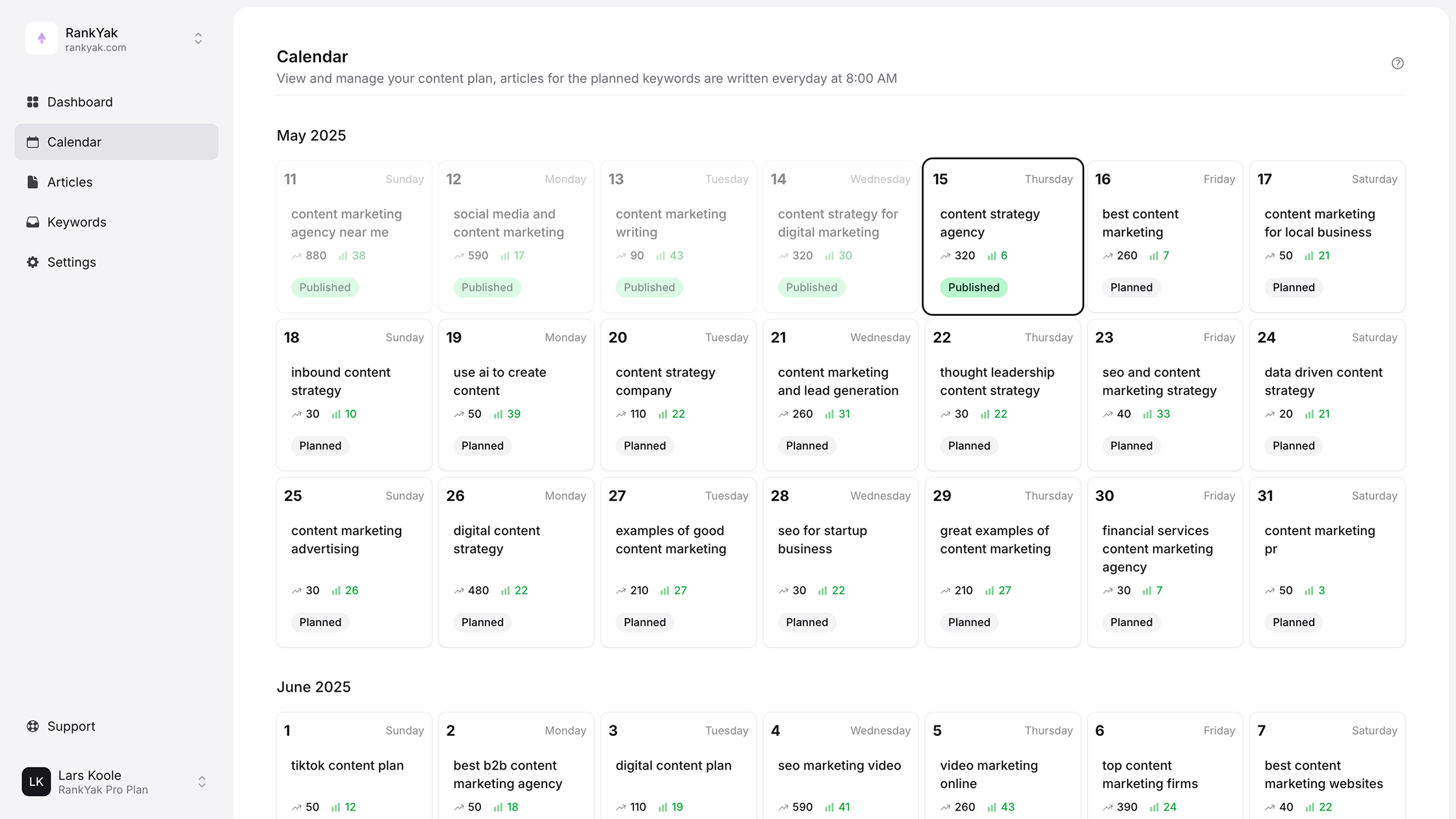
RankYak runs the whole loop for the sites it manages: it researches the keywords, groups them into clusters, and writes and publishes an article per cluster on a schedule. If you would rather the phrase tables never needed checking, that is the product.
Frequently Asked Questions
There is no target worth hitting. Keyword density was a ranking factor two decades ago and has not been one for a long time; Google reads a page for meaning rather than counting a phrase. The figure is still useful in one direction: a density above roughly 3% usually reads as repetitive to a human, and above 5% it reads as stuffing. Treat the number as a warning light, not a dial to tune.
The number of times a phrase appears, divided by the total number of words in the text. A phrase used 17 times in a 1,000-word page sits at 1.7%, and it sits at 1.7% whether the phrase is one word or three.
Leaving the length of the phrase out of the figure is what makes the three tables comparable. Counting a three-word phrase by the 51 words it occupies puts it at 5.1%, three times higher than a single word repeated exactly as often, and the thresholds every piece of density advice is written against were calibrated on single keywords. A phrase that occurs less often than another should not be the one that reads as stuffed.
In the heading, in the opening, and wherever else the sentence wanted it anyway. Enter a target keyword and the tool reports each of those separately: how many times it appears in a heading, whether it appears in the first 100 words, and how often it appears in the body. Placement is the part of a density report worth acting on, because a page that states its query once in the heading beats a page that repeats it fifteen times in the middle.
The tool reads the page's visible text, so it covers headings and body copy. The title tag and the meta description are markup rather than text, and the meta tag checker reads those.
Phrases made entirely of stop words such as "the", "of", and "and" are excluded, because a report topped by "the" tells you nothing about the page. A phrase that merely contains a stop word is kept, so "best of both worlds" still appears.
Yes. Keyword stuffing is named explicitly in Google's spam policies, and a page that repeats a phrase unnaturally can be demoted or, in bad cases, removed. The more common outcome is quieter: the page reads badly, people leave, and it never earns the engagement that would have lifted it.
Use it once in the heading, once in the opening paragraph, and wherever else it genuinely fits. Google does not need an exact match to understand a page, but a page targeting a query that never states it is usually a page written before the target was chosen. Fix the heading first; that is where it matters most.
Yes, enter their URL and the tool fetches the page and analyzes its readable text. That is often more useful than checking your own: the two- and three-word phrase tables show which specific queries a ranking page is built around, which tells you what your version has to cover to compete.
Related tools
Score any text or URL on Flesch-Kincaid and four other formulas, and see the sentences dragging the grade up.
Count words, characters, sentences, and reading time, in your own text or on any published page.
Paste a keyword list and group it into the clusters a single article can rank for, each with a suggested target.
Get Google and ChatGPT traffic on autopilot.
Start today and generate your first article within 15 minutes.