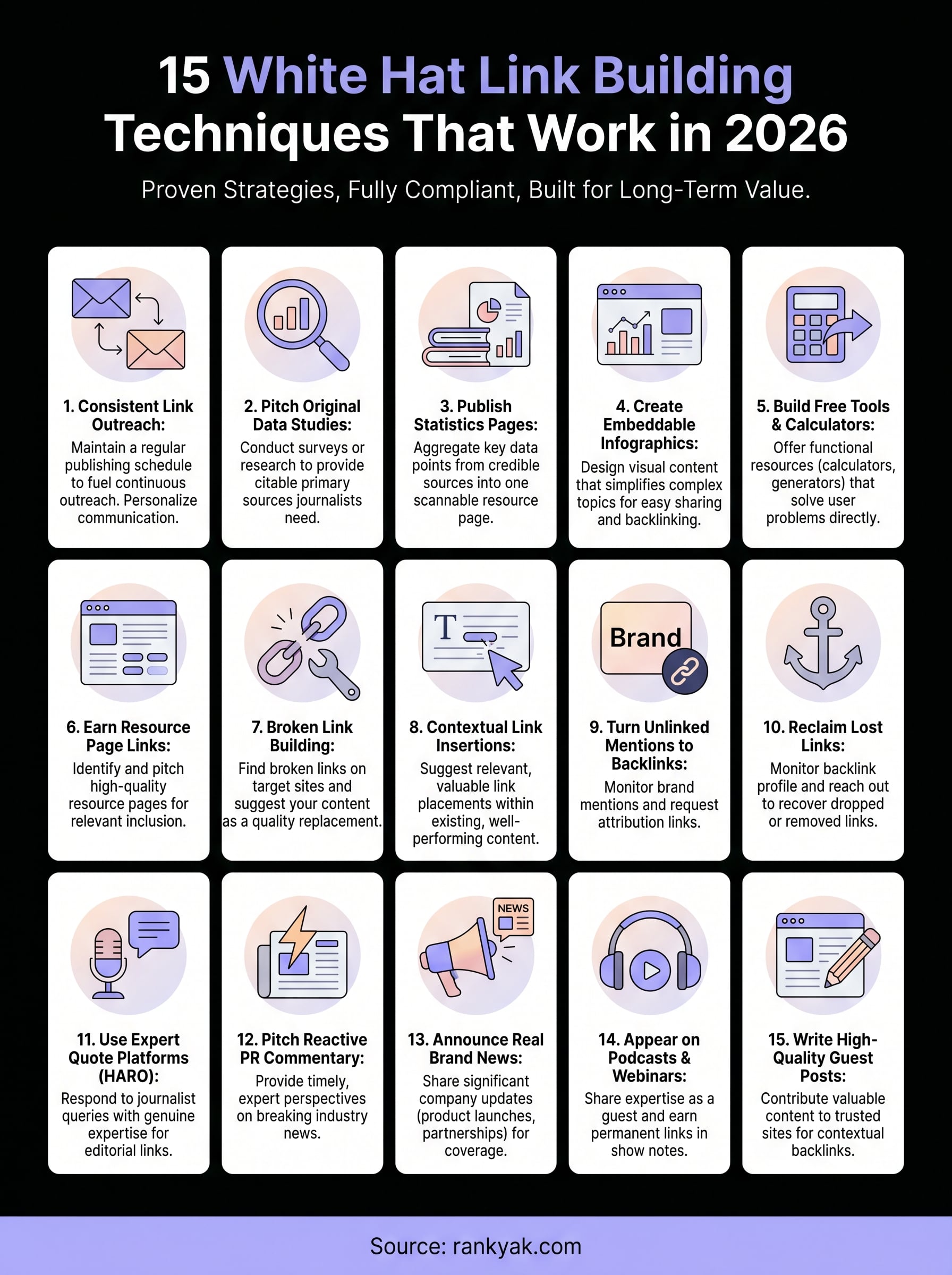
15 White Hat Link Building Techniques That Work in 2026
Backlinks still matter, a lot. Google's algorithm has evolved significantly, but one thing hasn't changed: links from other reputable sites remain one of the strongest ranking signals. The problem is that white hat link building techniques require real effort, real relationships, and a real strategy. There are no shortcuts that don't eventually bite you back. And with Google's spam detection getting sharper every year, cutting corners isn't just risky, it's pointless.
If you've been burned by shady link schemes or you're new to earning backlinks and just starting to build your site's authority, this guide is for you. Every technique here is fully compliant with Google's guidelines and focused on earning links the right way. These are methods that hold up under algorithm updates instead of crumbling because of them. At RankYak, we handle the content side of SEO on autopilot, from keyword research to daily publishing, but even the best content needs strong backlinks to reach its full ranking potential.
Below, you'll find 15 proven link building strategies you can put to work right now, alongside our shorter list of white hat tactics that actually work. Each one includes practical steps so you can start building a backlink profile that actually moves the needle. No fluff, no gray-area tactics, just methods that work in 2026 and beyond.
1. Use RankYak to run consistent link outreach
Link outreach fails most often because it's inconsistent. You research prospects one week, draft emails the next, then the pipeline stalls when other priorities take over. RankYak keeps your content engine running every single day, which means you always have a fresh, well-optimized article to use as an outreach asset. A regular publishing schedule gives your link building campaign the fuel it needs to stay active.
Why it works
Consistency is the strongest predictor of outreach success. When you publish new, authoritative content on a predictable schedule, you always have a concrete reason to contact relevant sites. Editors and bloggers respond far better to outreach tied to a specific, recently published piece than to a vague "check out my website" message.
The sites that build backlinks fastest are the ones publishing frequently enough to give their outreach team a new asset every week.
How to do it
Start by letting RankYak handle your daily article creation and publishing automatically, then build a simple outreach workflow around that content calendar. Each time a new article goes live, identify three to five sites that cover related topics and send a short, personalized email pointing to the piece. Keep your process repeatable so outreach becomes a habit, not a sprint.
What to automate and what to keep manual
You can automate content creation, keyword research, and publishing using RankYak. Keep the actual email writing manual. Personalized outreach consistently outperforms bulk templates, and a two-sentence email that references something specific about the recipient's site will always beat a mass send. Automate the input, humanize the output.
Outreach angles that stay white hat
The safest white hat link building techniques focus on genuine value exchange. Pitch your content as a resource that helps the linking site's audience, not as a favor they owe you. Frame every email around what the reader gains from clicking the link, not what you gain from earning it.
Quality checks and compliance
Before sending any outreach email, confirm the target site has real organic traffic and genuine editorial standards. Avoid directories, link farms, or any site that exists primarily to sell links. Google's spam policies are explicit: manipulative link schemes violate their guidelines and can trigger manual penalties that are difficult to recover from.
2. Pitch original data studies
Original research is one of the most reliable white hat link building techniques because it gives other sites something they can't get anywhere else: a citable primary source. When you publish data no one else has, journalists, bloggers, and industry writers link to you automatically because citing your study adds credibility to their own content.

Why it works
Other sites need data to back up their claims. Original research fills that gap and positions your site as an authoritative reference in your niche. A single data study can earn dozens of links over months, often without any active outreach at all.
The sites that earn the most editorial links are almost always the ones producing original data no one else has.
How to do it
Run a short survey using a tool like Google Forms, collect at least 100 responses, and publish a dedicated article presenting your findings. Include clear charts, a methodology section, and a concise summary of key takeaways. Structure the page so a journalist can pull a stat and quote it in under 30 seconds.
How to find a story in your data
Look for surprising contrasts or counterintuitive findings inside your results. "Most marketers do X" is forgettable. "74% of marketers say X, but only 12% actually measure it" is a story editors will use.
Who to pitch and how to package assets
Target industry publications and niche newsletters whose audiences match your data. Send a two-paragraph email with your top three findings, a link to the full study, and a downloadable chart ready to embed.
Quality checks and compliance
Publish your full methodology transparently, including sample size, collection dates, and any limitations. Vague or undisclosed methods destroy credibility and reduce the chance that serious publications will cite your work.
3. Publish statistics pages with citation intent
A statistics page aggregates key data points from multiple credible sources on one topic. When journalists need a number fast, they search for pages exactly like this, and every citation they pull turns into a backlink. This makes statistics pages one of the most passive white hat link building techniques available.
Why it works
Writers under deadline need quick, citable data they can use without conducting their own research. A well-structured stats page puts your site directly in that path, earning links from publications you may never have reached through cold outreach.
How to do it
Choose one focused topic and gather 20 to 40 verified statistics from primary sources such as government reports or academic studies. Label each stat clearly with its source and year, and keep the layout clean and scannable so a writer can grab what they need in seconds.
How to choose topics journalists cite
Target topics that appear regularly in news cycles within your niche. If reporters write about a subject every month, they need fresh stats every month. Google Trends helps you confirm that a topic has consistent editorial demand before you invest time building the page.
The best statistics pages cover topics journalists return to repeatedly, not once-a-year stories.
How to keep stats fresh without fluff
Revisit your page at least once a year and replace outdated figures with new primary source data. A shorter page with current, accurate numbers will always outperform a bloated page full of stale statistics.
Quality checks and compliance
Link every statistic directly to its original primary source, not a secondary article. Google's helpful content guidelines reward pages that demonstrate genuine expertise, and unverified numbers damage both your credibility and your rankings.
4. Create infographics other sites want to embed
An infographic distills complex information into a visually digestible format that other sites actively want to share. When you build one around a topic your audience already searches for, you create a natural magnet for embed links that other content creators place on their own pages.

Why it works
Bloggers and newsletter writers constantly need visual content to break up long articles. An embeddable infographic solves that problem for them while earning you a backlink every time someone uses it. This makes infographics one of the most scalable white hat link building techniques for sites that publish regularly.
How to do it
Focus on a specific, narrow topic within your niche rather than trying to visualize everything at once. Keep the design clean and include your site's URL visibly at the bottom so every embed carries attribution back to your page.
Tools built into platforms like Canva or Adobe Express let you produce professional layouts without a dedicated design team, which keeps production costs low enough to make this tactic repeatable.
What makes an infographic link-worthy in 2026
Sites embed infographics that save their readers time and make a complex point immediately clear. Avoid decorative charts that only repeat what text already says. The strongest performers show step-by-step processes, comparisons, or data visualizations that would take several paragraphs to explain in writing.
An infographic earns links when it replaces a difficult explanation, not when it simply decorates a page.
How to pitch bloggers and newsletters
Send a short, direct email with a thumbnail preview and an embed code ready to paste, or hand the job to a blogger outreach service. Frame your pitch around the benefit to their audience, not the backlink you want.
Quality checks and compliance
Verify every statistic shown in the graphic against its primary source before publishing. Infographics spread quickly, and inaccurate data attached to your brand is difficult to correct once it circulates.
5. Build free tools and calculators
Free tools are among the most durable white hat link building techniques you can build into your strategy. Unlike a blog post someone reads once and forgets, a useful calculator or generator keeps drawing traffic and links long after you publish it.
Why it works
When another site links to a tool, they're pointing their audience toward something functional and immediately useful. That utility makes the link feel like a recommendation rather than a promotion, which means editors and bloggers include it willingly without you having to apply much pressure.
How to do it
Start by identifying one specific calculation or decision your audience faces regularly, the way our own free SEO tools each solve a single check. Build the simplest version that solves that problem completely, host it on a dedicated page, and write a short explanation of how to use it. Keep the interface clean so visitors get results fast.
The best free tools solve a real problem in under 60 seconds, which is why other sites link to them without being asked.
What tools earn links in your niche
Look for repetitive manual tasks your audience currently handles with spreadsheets or guesswork. ROI calculators, pricing estimators, readability checkers, and budget planners all earn links consistently because they replace tedious manual work with an instant answer.
How to promote without spamming
Share your tool with communities and forums where your target audience is already active. Mention it only when it genuinely answers a question someone has posted, and let the tool's usefulness drive organic sharing from there.
Quality checks and compliance
Test your tool across multiple browsers and devices before launching. A broken calculator frustrates visitors and kills any chance of earning links, so confirm the output is accurate and consistent every time before you promote it anywhere.
6. Earn resource page links
Resource pages exist on thousands of sites specifically to curate the best external links on a given topic, and getting listed on them follows a repeatable process. When you get your page listed on one, you earn a link that sits in front of every visitor that page attracts. This makes resource page outreach one of the most efficient white hat link building techniques in a consistent SEO strategy.
Why it works
Resource page editors have already done the hard work of building a destination for relevant, high-quality links. They want to keep that page useful, which means they welcome genuinely helpful additions. You're not asking for a favor; you're helping them do their job better.
How to do it
Search for resource pages using queries like "best resources" + [your topic] or "useful links" + [your niche]. Once you find a strong candidate, confirm the page is actively maintained and has real traffic before you invest time in outreach. Then send a short, specific email explaining exactly what your page covers and why it fits.
How to find resource pages that still matter
Prioritize pages that link out to multiple authoritative sources and carry clear editorial intent. A resource page that hasn't been updated in three years or links to dead URLs signals neglect and won't send meaningful traffic or link equity your way.
The most valuable resource pages are the ones that editors return to regularly because their audience keeps asking where to learn more.
How to suggest the right placement on the page
When you pitch, name the specific section where your link belongs. Editors respond faster when you've already mapped out the fit, because it reduces the mental effort of deciding where to place it.
Quality checks and compliance
Never pitch a resource page with a thin or under-developed page on your end. Your linked content should be comprehensive and clearly relevant to the page's theme, or the editor will decline and stop engaging with your outreach entirely.
7. Replace broken links with better resources
Broken link building is one of the most straightforward white hat link building techniques because it creates an immediate win for both sides. You help a site owner fix a problem they probably don't know they have, and you earn a relevant backlink in return.
Why it works
Site owners hate broken links because they create a poor user experience and signal neglect to search engines. When you identify one and offer a high-quality replacement, you're solving a real problem rather than making a request, which makes editors far more receptive to your outreach.
You convert a site's liability into your backlink opportunity, which is why this tactic earns one of the highest response rates in link building.
How to do it
Use a crawling tool like Screaming Frog, or a free broken link checker, to scan pages in your niche and flag any external links returning a 404 error. Then check whether you have a page on your site that covers the same topic the broken link was originally pointing to. If you do, you have your outreach angle.
How to find broken links at scale
Focus your crawling on resource pages, link roundups, and long-form guides in your niche because these formats tend to carry the most external links and therefore produce the most broken link opportunities per page crawled.
How to write a helpful broken-link email
Keep your email short and specific: name the exact URL containing the broken link, identify which link is broken, and suggest your replacement page clearly. Editors respond faster when you remove all guesswork from the fix.
Quality checks and compliance
Your replacement page must genuinely match the original content's topic and intent. Submitting an unrelated page as a substitute damages your credibility and signals that your outreach is link-focused rather than value-focused.
8. Ask for contextual link insertions
Contextual link insertion is one of the more direct white hat link building techniques: you reach out to a site that already has a relevant published page and ask them to add your link within existing body content. This skips the need to create new content together and focuses on earning a placement in a live, indexed page that already ranks.
Why it works
Editors update existing content regularly to keep it accurate and useful. A well-timed, relevant suggestion fits directly into that workflow, making your request easy to act on without a significant time commitment from them.
How to do it
Find published articles in your niche that cover topics closely related to a specific page on your site. Send a short email naming the exact paragraph where your link fits and explain in one sentence why it adds value to their readers.
How to pick pages where your link adds value
Target pages where your content genuinely expands on a point the author has already made. A link that fills a real information gap reads naturally, while a forced or loosely related placement stands out as self-serving and gets declined.
The strongest insertion requests point to a clear gap in existing content, not just a vague topic overlap.
How to suggest copy that reads naturally
Write a short suggested anchor text and surrounding sentence for the editor to use or adapt. Reducing their editing effort increases the chance they act on your request the same day.
Quality checks and compliance
Confirm the target site has real editorial standards and genuine organic traffic. Google treats paid link insertions as manipulative link schemes, so keep every placement earned through value rather than payment.
9. Turn unlinked mentions into backlinks
When someone writes about your brand, your product, or your content without linking back to your site, you've already earned the editorial credibility but missed the link. Converting those unlinked mentions into actual backlinks is one of the lowest-effort white hat link building techniques because the hard work is already done, and it fits neatly into a wider off-page SEO plan.
Why it works
The site has already decided you're worth mentioning, which means they have no reason to resist your request. You're asking for a minor edit, not a decision from scratch. This tactic earns high acceptance rates because you're pointing to an obvious, easy improvement.
Converting an existing mention into a link is the warmest outreach you can run in any link building campaign.
How to do it
Set up Google Alerts for your brand name, product names, and key contributors on your team. When an alert surfaces a mention without a link, note the page URL and author contact before reaching out the same day.
How to find unlinked mentions reliably
Search Google for your brand name in quotes with your domain excluded, using a query like "YourBrand" -site:yourdomain.com. This surfaces pages that reference you without a link, giving you a fresh prospect list to revisit each week.
What to say so it feels like a quick fix, not a favor
Frame your email as a helpful heads-up, not a request. A single sentence like: "I noticed you mentioned us recently. Here's the direct URL if you'd like to link it for your readers." Keep your message brief and specific so acting on it takes the editor under a minute.
Quality checks and compliance
Confirm the mentioning page has genuine organic traffic and clear editorial relevance before spending time on outreach. Pursuing mentions on low-quality sites delivers no real SEO value and can weaken your overall backlink profile.
10. Reclaim lost links
Links you've already earned can disappear without warning. Site redesigns, content migrations, and CMS updates all cause previously live backlinks to drop off, taking the link equity they carried with them. Reclaiming lost links is one of the most overlooked white hat link building techniques because it targets links you already had a right to keep.
Why it works
Lost link reclamation delivers results faster than cold outreach because the relationship already exists. The site linked to you once, which means they found your content credible. You're restoring something that should still be there, not negotiating from zero.
Reclaiming a lost link is always faster than earning a new one because the editorial decision was already made in your favor.
How to do it
Use Google Search Console or one of the tools built for tracking backlinks to monitor your backlink profile regularly. Export your link data monthly and compare it against previous exports to catch sudden drops from specific referring domains.
Why links disappear and how to diagnose fast
The most common causes are 404 errors on the linking page, content rewrites that removed your URL, and domain migrations where redirects weren't set up correctly. Check the linking page directly to confirm which scenario applies before you write your outreach email.
How to request a restoration without friction
Keep your email short and factual: name the page that previously linked to you, share a screenshot or archived URL as proof, and include your direct link so the editor can add it back in under a minute.
Quality checks and compliance
Only pursue links from sites with genuine editorial traffic. If a referring domain has dropped in quality since the original link went live, removing it from your target list protects your overall backlink profile.
11. Use expert quote platforms like HARO
Expert quote platforms connect journalists with sources they need for their articles, giving you a direct path to earn editorial links from publications you'd never reach through cold outreach. This makes platforms like HARO one of the most legitimate white hat link building techniques available.
Why it works
Journalists using these platforms are already looking for quotes, which means they're pre-qualified leads. When they use your response, they almost always link back to your site as part of standard attribution practice, giving you a high-quality editorial backlink with no negotiation required.
How to do it
Sign up for HARO or a similar platform, then monitor daily email digests for queries that match your niche. Respond only to requests where you have genuine expertise to contribute, and prioritize queries from well-known publications over obscure blogs.
How to respond so journalists use your quote
Speed matters here, so lead with your most quotable sentence rather than a lengthy introduction. Keep your response under 200 words, include a specific statistic or concrete example if you have one, and close with a one-line bio that establishes your credibility immediately.
The quotes that get picked are the ones that require zero editing, so write for publication, not for conversation.
How to build an internal expert pipeline
If your team includes multiple people with relevant credentials or experience, set up a shared system where anyone can respond to relevant queries. Rotating contributors diversifies your attribution and builds authority across multiple names associated with your brand.
Quality checks and compliance
Verify that every publication you're quoted in has real editorial standards and genuine organic traffic before counting the link as an asset. A placement on a low-traffic site with no real audience adds minimal value to your backlink profile.
12. Pitch reactive PR commentary
Reactive PR commentary means responding to breaking news in your industry with a timely expert perspective journalists can use in their coverage. When you position yourself as a credible source on current events, reporters come to you instead of the other way around.
Why it works
Journalists covering fast-moving stories need expert sources fast. If you deliver a sharp, credible take within hours of a news event, you give them exactly what they need to finish their piece. That urgency creates a direct path to earn high-authority editorial links from publications that standard cold outreach rarely reaches, which is exactly how digital PR earns authority backlinks.
How to do it
Build a short list of journalists and editors who regularly cover your niche, and track their recent bylines. When a relevant story breaks, send a brief pitch within a few hours. Lead with your quote or angle immediately so the journalist can assess its value in seconds, not minutes.
How to monitor news and move fast
Set up Google Alerts and RSS feeds for the core keywords that define your industry, and check them at least twice daily. A pitch sent 48 hours after the story peaks rarely earns a response, so speed is the entire advantage of this tactic.
Journalists covering your niche are far more likely to quote you while they're still actively writing the piece.
How to offer a quote, angle, or mini-analysis
Give the journalist two or three usable options: a direct quote, a supporting data point, and a brief contrarian angle. This versatility increases the chance that at least one element makes it into the final article without requiring the editor to rewrite anything.
Quality checks and compliance
Only pitch stories where you have genuine expertise and a defensible point of view. Reactive PR is one of the most legitimate white hat link building techniques available, but overstating your knowledge destroys your credibility with journalists who remember every source they've used before.
13. Announce real brand news
When your business does something genuinely notable, publishing a press release or a targeted media pitch gives journalists a concrete reason to cover you. This is one of the most underused white hat link building techniques because most site owners assume they have nothing newsworthy to share.
Why it works
Journalists need story angles, not advertisements. A factual announcement about a product launch, a partnership, or a funding round gives them a ready-made hook. Coverage translates directly into editorial backlinks from publications that would otherwise ignore cold outreach entirely.
How to do it
Write a concise, factual press release that answers who, what, when, and why in the first paragraph. Send it directly to journalists who cover your niche, and include a high-resolution image or supporting data they can use without requesting additional assets.
The cleaner and more complete your announcement, the faster a journalist can publish it with attribution back to your site.
What counts as newsworthy
Product launches, strategic partnerships, original research releases, company milestones, and executive appointments all clear the editorial bar at most publications. Avoid pitching routine updates or minor internal changes as news, because editors will stop opening your emails if they learn to expect filler.
How to build a targeted media list
Identify journalists by name who have recently covered similar announcements in your industry. A targeted list of 20 relevant contacts beats a generic list of 200 email addresses every time.
Quality checks and compliance
Confirm every fact in your release is verifiable and accurate before distributing. False or inflated claims damage your credibility permanently with the journalists you need to build long-term relationships with.
14. Appear on podcasts and webinars
Podcast and webinar appearances give you a direct way to share genuine expertise with an engaged audience while earning a permanent link in the show notes. This makes guest appearances one of the most natural white hat link building techniques in any authority-building strategy.
Why it works
Podcast hosts need credible guests who improve their show, and linking to guest resources in show notes is standard practice. Every episode you appear on creates a dofollow backlink that stays indexed long after the recording goes live.
How to do it
Find shows in your niche and submit a guest pitch through the host's contact page. Prepare a short bio and two or three specific topic ideas that demonstrate clear value for their audience before you reach out.
How to find shows that publish dofollow show notes
Search your niche keywords on major podcast platforms, then check each show's website for published episode pages with external links. Prioritize shows that consistently include resource links in their show notes rather than those that publish only transcripts with no outbound links.
A podcast appearance earns a link that stays live for years, often with no follow-up required on your end.
How to pitch topics hosts want right now
Lead your pitch with a specific episode title and a one-paragraph summary explaining why their audience needs this topic today. Reference a recent episode to show you actually listen to the show before pitching.
Quality checks and compliance
Confirm each show's website has real organic traffic and genuine editorial credibility before investing prep time. A guest spot on a low-traffic show with no show notes page delivers no measurable backlink value.
15. Write high-quality guest posts
Guest posting remains one of the most effective white hat link building techniques when you choose the right sites and write content their audience genuinely finds useful. A well-placed guest post earns a contextual backlink from a trusted domain while putting your brand in front of a new readership at the same time, and guest posting for quality links rewards careful site selection.
Why it works
Editors accept guest posts because quality external contributors improve their content library without adding to their internal workload. Your link ends up inside real editorial content, which carries significantly more weight with Google than directory listings or sidebar placements.
How to do it
Study the top-performing articles on your target site before you pitch. Then send a specific topic idea with a short outline rather than a generic offer to contribute, which makes it far easier for the editor to say yes immediately.
How to vet sites so you avoid guest post farms
Check each site's organic traffic and editorial standards before investing writing time. Sites that publish dozens of guest posts weekly with no clear editorial review are guest post farms, and links from them add no measurable SEO value to your backlink profile.
A single link from a well-vetted, niche-relevant publication will consistently outperform ten links from low-quality guest post networks.
How to place links naturally in the content
Add your link where it directly supports a specific point you're already making in the article. Editors cut links that feel self-serving, so write your surrounding copy so the link reads as a natural next step for the reader rather than an interruption.
Quality checks and compliance
Confirm the host site has genuine editorial standards before you submit. Google treats guest posts as legitimate only when the content delivers real value to readers, not when it exists primarily to pass link equity between sites.
Put these techniques to work
Every white hat link building technique on this list works, but only if you execute consistently. The sites that build the strongest backlink profiles aren't the ones with the cleverest tactics; they're the ones that show up every week with fresh content, relevant outreach, and a clear value proposition for the sites they contact.
Start with two or three techniques that fit your current resources and build from there. Broken link outreach and unlinked mention reclamation are strong starting points because they require less content investment than original research or free tools. Once your pipeline is running, layer in data studies and guest posts to diversify your link sources over time.
Consistent publishing is the foundation everything else depends on. If you want to keep your content calendar full without burning hours every week, put your content on autopilot with RankYak and let the platform handle daily article creation automatically.
Allan de Wit is a co-founder of RankYak and has worked in SEO since 2015: inside agencies, alongside them, for clients directly, and in-house on the products being ranked. He came to it as a software engineer building for marketers, which is why the platform is built the way it is. He went on to start companies of his own, two of which were acquired. At RankYak he sets the product direction and owns the features, the quality bar, the design, and the UX.