Digital PR Link Building: How To Earn Authority Backlinks
Getting backlinks through cold outreach emails and guest post requests has become a grind that rarely pays off. Webmasters ignore generic pitches, and Google's algorithms have gotten better at spotting low-quality link schemes. Digital PR link building offers a different approach, one that earns links by creating content and stories that journalists, bloggers, and industry publications actually want to share. Instead of begging for links, you're giving people a reason to link to you naturally.
The difference matters more than most SEO guides let on. Traditional link building often feels transactional and spammy. Digital PR flips the script by focusing on newsworthy content, data-driven stories, and genuine media relationships. When done right, a single digital PR campaign can generate dozens of high-authority backlinks from sites that would never respond to a standard outreach email.
At RankYak, we automate the content side of SEO, but we also know that backlinks remain a critical ranking factor that content alone can't solve. This guide breaks down exactly how digital PR link building works, the strategies that consistently earn authority backlinks, and how to decide whether to handle it in-house or hire a link building agency.
What digital PR link building is and why it works
So what is digital PR link building? Digital PR link building is the practice of earning backlinks by creating newsworthy content, data, or stories that journalists, bloggers, and online publishers choose to cite and link to in their articles. Unlike traditional link building where you manually reach out asking for links, digital PR focuses on building relationships with media contacts and offering them something valuable enough that they naturally want to reference your brand or research. You're essentially becoming a source for stories rather than chasing individual link placements.
The core mechanism is simple: you create an asset (a study, survey, press release, expert commentary, or unique data set), pitch it to relevant journalists and publications, and when they cover your story, they link back to your site as the source. One successful digital PR campaign can result in dozens of high-authority PR backlinks from news sites, industry publications, and respected blogs that would typically ignore standard outreach attempts. These links carry more weight because they come from editorial decisions rather than reciprocal arrangements or paid placements.
How digital PR differs from traditional link building
Traditional link building typically involves finding websites with relevant content, then reaching out to request a link insertion, guest post opportunity, or resource page addition. You're often interrupting someone's day with a pitch that benefits you more than them. Response rates have dropped as inboxes fill with generic templates and webmasters grow skeptical of link schemes that violate Google's spam policies.
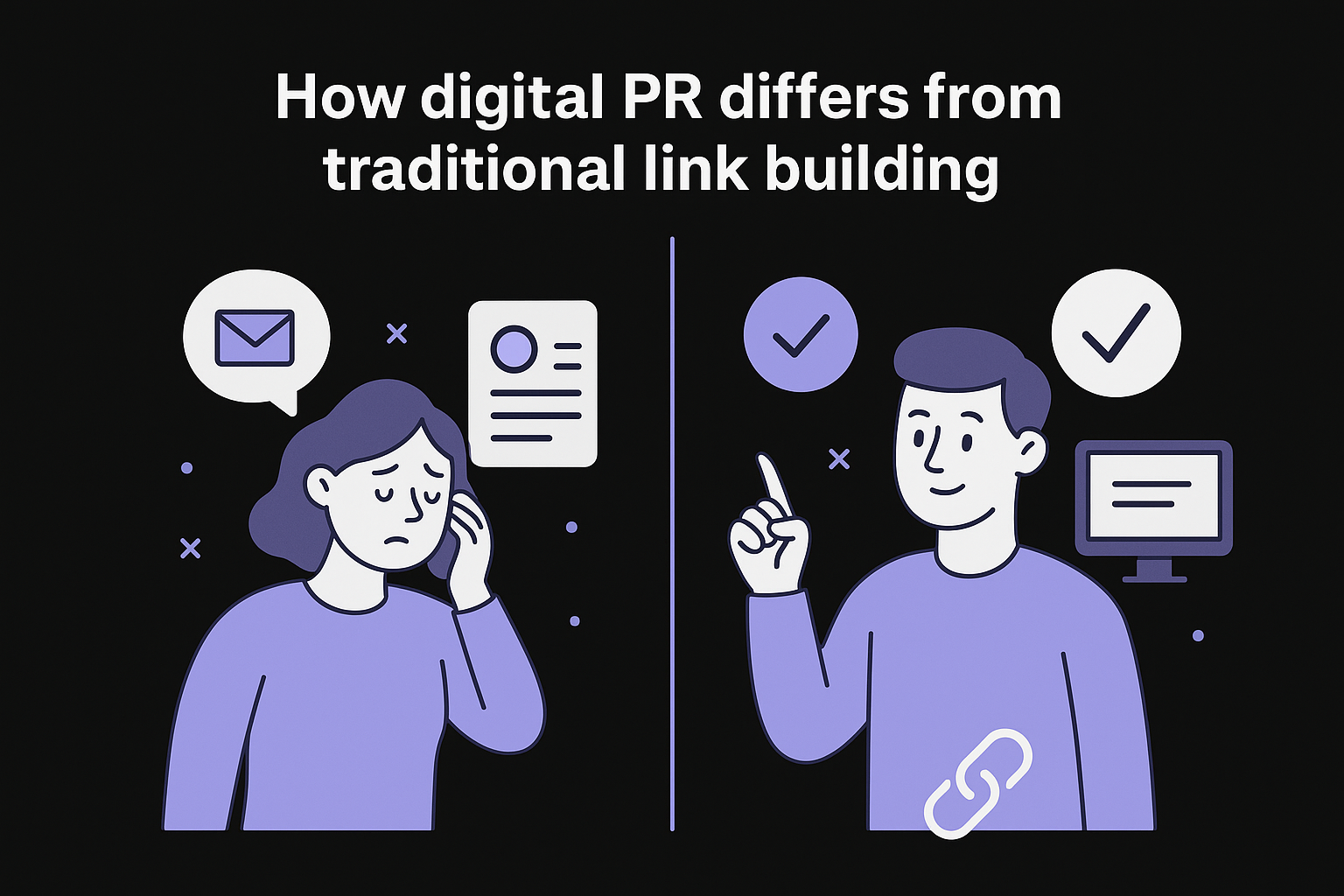
Digital PR reverses the dynamic by making you the story. You're not asking for a favor; you're offering exclusive information, expert insights, or original research that helps journalists do their job better. The resulting link appears in editorial content surrounded by context that signals genuine relevance to search engines. This editorial context matters because Google's algorithms evaluate not just the link itself, but the surrounding content and the authority of the linking domain. Both strategies have a place in a strong off-page SEO strategy and branding plan, but PR link building tends to earn placements that traditional tactics simply can't reach.
Traditional outreach gets ignored because it asks for something. Digital PR succeeds because it offers something worth citing.
Why journalists and publishers link to digital PR campaigns
Journalists work under constant deadline pressure to produce stories that attract readers and provide value. They need credible sources, fresh data, and expert perspectives to make their articles authoritative. When you provide that through a well-crafted campaign, you solve a real problem for them. Your research becomes their evidence, your expert quote becomes their source, and your data visualization becomes their supporting graphic.
Publishers also face pressure to create content that performs in search and social. Original data and unique insights perform better than rehashed information because they give readers something they can't find elsewhere. When your digital PR asset offers exclusivity or a new angle on a trending topic, publications compete to cover it first, and they're motivated to link back properly and credit your brand as the source. The same principle applies when pitching bloggers, finding the right blogger for link building and PR digital outreach means identifying writers who already cover your topic and would genuinely benefit from your data.
The SEO value of earned media coverage
How does digital PR build search authority and links? Search engines treat links from established news sites and industry publications differently than links from random blogs or directories. These high-authority domains pass significant ranking power because Google recognizes them as trusted sources. A single link from a major news outlet can carry more weight than dozens of links from smaller, less authoritative sites.
Beyond direct SEO benefits, digital PR creates a compounding effect that traditional link building can't match. When major publications cover your story, smaller blogs and industry sites often pick it up and add their own commentary. Secondary coverage multiplies your backlink profile without additional outreach effort. These links also tend to be more durable because they're embedded in published articles that remain live for years.
The traffic from these placements matters too. Referral visitors from news sites and industry publications typically show higher engagement metrics than visitors from other sources. They arrive with context about your brand from a trusted source, which means they're more likely to convert into customers, subscribers, or repeat visitors.
Step 1. Set PR goals and choose a linkable angle
You can't execute an effective digital PR link building campaign without knowing exactly what you want to achieve and what story you're going to tell. Most failed campaigns happen because people skip this planning phase and jump straight into creating content that nobody cares about.
Define what success looks like for your campaign
Start by deciding what you want from your PR outreach beyond just backlinks. Yes, digital PR backlinks are the primary goal, but successful campaigns often generate brand awareness, traffic spikes, and leads as secondary benefits. Write down specific targets like "earn 20+ backlinks from domain authority 50+ sites" or "get coverage in three industry publications our target customers read." Concrete numbers give you a way to evaluate whether your campaign worked.
Your goals should also consider timing and relevance to your business. If you're launching a new product next quarter, your PR campaign might focus on industry trends that naturally tie back to your offering. If you're a SaaS company trying to establish thought leadership, you might target commentary opportunities that position your team as experts. Different goals require different digital PR link building strategies.
Find an angle journalists actually care about
Journalists receive hundreds of pitches every week, and most go straight to the trash because they lack a compelling news hook. Your angle needs to answer "Why would my readers care about this right now?" Newsworthy angles typically fall into categories that media outlets consistently cover: original data and research, trend analysis, expert predictions, reaction to current events, or human interest stories with broader implications.
The best PR angles connect your expertise to topics journalists are already writing about.
Look at what major publications in your industry covered in the past month. Identify recurring themes, controversial topics, or data gaps in their coverage. Your angle should feel timely rather than evergreen, because journalists prioritize stories that align with current reader interests.
Common linkable angles that consistently earn coverage include:
- Original survey data revealing surprising statistics about industry trends or consumer behavior
- Expert analysis of recent news events, policy changes, or market shifts
- Proprietary research that challenges conventional wisdom or confirms emerging patterns
- Newsjacking that ties your expertise to breaking news or viral topics
- Press releases announcing original research findings, product launches with data hooks, or industry partnerships that provide a natural reason for publications to build backlinks with press releases
- Localized data that helps regional publications cover national stories with local context
Pick one angle per campaign and commit to it fully rather than trying to appeal to everyone at once.
Step 2. Build a PR asset journalists can cite
Once you've locked down your angle, you need to create something concrete that journalists can reference, link to, and base their stories around. Your PR asset serves as the foundation for every pitch you send. You're building original research, data, or expert commentary packaged specifically for journalists who need credible sources to cite.
Survey your audience or analyze existing data
The most powerful assets for PR link building come from original research that reveals something new about your industry. You can run surveys through tools like Google Forms or Typeform to collect data from your customers, email subscribers, or targeted audiences. Ask questions that uncover surprising behaviors, opinions, or trends rather than confirming what everyone already knows. A survey showing that 67% of small business owners still manage SEO manually carries more weight than generic best practices advice.
If you don't have access to a large audience for surveys, analyze data you already possess from your business operations or customer base. Your sales data might reveal seasonal patterns nobody else has documented. Proprietary insights from your own operations give you an angle competitors can't replicate, which makes your asset more valuable to journalists looking for exclusive stories.
Create visual assets that tell the story
Journalists love data they can quickly understand and share. Turn your research into charts, graphs, or infographics that visualize key findings in a scannable format. Tools like Canva or Google Sheets can produce clean, professional visuals that publications will embed in their articles. Each visual should highlight one specific insight rather than cramming multiple data points into a confusing mess.
High-quality images increase the chances that publications will feature your content prominently. Make sure every visual includes your brand name or logo subtly in the corner, so even if the image gets shared without proper attribution, readers can trace it back to you.
Journalists work on tight deadlines. The easier you make their job, the more likely they'll use your asset.
Package your findings with this format
Structure your PR asset so journalists can extract quotes, statistics, and takeaways without digging through paragraphs of fluff. Use this proven format that publications consistently cite:

Executive Summary Section:
- Lead with the single most newsworthy finding
- State the sample size and methodology in one sentence
- List 3-5 key statistics that tell the story
Key Findings Section:
- Break data into themed subsections with clear headings
- Include specific percentages and numbers for every claim
Methodology Section:
- Explain who you surveyed and how you collected data
- Specify dates and sample size
About Section:
- Brief description of your company and why you conducted this research
- Contact information for media inquiries
- High-resolution versions of all charts and graphics
Step 3. Find the right outlets and contacts
Having a solid PR asset means nothing if you pitch it to the wrong people. You need to target journalists and publications that actively cover your industry, write about topics related to your angle, and reach the audience you want to influence. Most failed campaigns happen because people spray generic pitches to irrelevant contacts rather than building a focused list of media outlets that would genuinely benefit from featuring your research.
Identify publications that cover your topic
Start by searching Google for articles similar to the story you're planning to pitch. Use search queries that combine your topic with publication types like "industry trends report" or "consumer behavior study." Look at which publications covered similar research in the past six months, because those outlets have proven they'll write about your type of content. Track the domain authority of each publication using tools like Moz or Ahrefs to prioritize outlets that will pass meaningful link equity.
Pay attention to publication tier and audience alignment rather than just chasing the biggest names. A feature in a mid-sized industry publication often delivers better results than a brief mention in a massive general news site.
Target journalists who have already written about your topic rather than cold pitching random reporters.
Find the right journalists and their contact details
Once you've identified target publications, locate the specific journalists who cover your beat. Read recent articles from each outlet and note which reporters write about your industry. Check their Twitter bios, LinkedIn profiles, or author pages for preferred contact methods.
Build your contact list using this approach:
- Search the publication's staff directory for beat reporters covering your industry
- Review bylines on recent relevant articles to find active contributors
- Use Twitter Advanced Search with queries like "from:@journalistname topic keywords"
- Check journalist databases like Muck Rack or Cision if you have access
- Verify email addresses using formats like [email protected]
Organize your outreach targets
Create a spreadsheet tracking each contact with columns for journalist name, publication, email address, Twitter handle, recent articles, and pitch status. Segment your list into priority tiers based on domain authority and audience fit. Pitch your top-tier targets first, because if a major publication runs your story, smaller outlets often follow with their own coverage. Space out your outreach over a few days rather than blasting everyone simultaneously.
Step 4. Pitch, follow up, and secure coverage
Your pitch email determines whether a journalist reads your research or deletes it without a second thought. You need to craft messages that grab attention immediately and make it obvious why your asset matters to their readers. Most campaigns fail here because people either write generic pitches that sound like spam or give up after one email with no response.
Write a pitch email that gets opened
Start with a subject line that references the journalist's recent work or highlights your most newsworthy finding. Avoid generic phrases like "Story idea for you." Instead, try "Data for your article on [topic]" or "New research: [surprising statistic]."

Keep your pitch under 150 words and structure it with this exact format:
Subject: [Specific reference to their coverage or newsworthy stat]

Hi [First Name],

I saw your recent piece on [specific article title].
Your coverage of [topic] got me thinking about new data
we just compiled.

We surveyed [number] [audience] and found [most
newsworthy stat that contradicts common assumptions
or reveals a trend].

The full research includes [2-3 other interesting
findings], and I can send over charts, methodology,
and the complete dataset if it's useful for an
upcoming story.

Happy to answer any questions or provide expert
commentary from our [role].

Best,
[Your Name]
[Title]
[Direct Phone]
This format works because it respects their time and makes the value proposition clear in seconds.
The best pitch emails feel like you're helping a journalist meet their deadline, not asking for a favor.
Time your follow-ups strategically
Wait three business days after your initial pitch before sending a follow-up email. Your follow-up should add new information rather than just asking "Did you see my last email?" Reference a related story that just published, share one additional data point, or mention increased interest from other outlets.
Send a maximum of two follow-ups spaced a week apart. If you don't hear back after three touchpoints, move on to other contacts rather than becoming a nuisance. Some journalists bookmark interesting pitches for future stories, so even non-responses can turn into coverage months later.
Handle responses and secure the link
When a journalist replies with interest, respond within two hours if possible with everything they requested plus additional supporting materials. Make yourself available immediately because journalists work on tight deadlines and will move to another source if you're slow to respond.
Once an article publishes, check that it includes a proper backlink to your research page rather than just a brand mention. If the link is missing, send a polite email thanking them for the coverage and asking if they could add a link to help readers access the full data. Most journalists will add it without hesitation.
Step 5. Measure impact and keep links high quality
You've secured coverage, but your work isn't finished until you track which links actually went live and verify they're helping your SEO. Many journalists mention your research without linking, or their editors strip links during the publishing process. You need to monitor every placement, ensure links point to the right pages, and measure the actual traffic and ranking impact from your digital PR link building efforts. This tracking reveals which types of campaigns work best and helps you justify the investment to stakeholders.
Track which links actually materialized
Set up Google Alerts for your brand name and campaign keywords to get notified when publications mention your research. Use backlink monitoring tools like Google Search Console or Ahrefs to track new referring domains pointing to your research page. Compare the list of journalists who responded against the actual links you received.
Create a tracking spreadsheet with these columns:
| Publication | Journalist | Pitch Date | Response Date | Publish Date | Link Status | Domain Authority | Article URL |
|---|---|---|---|---|---|---|---|
| Industry Weekly | Jane Smith | 2026-02-10 | 2026-02-12 | 2026-02-15 | Live | 62 | [URL] |
| Tech News | Bob Jones | 2026-02-10 | No response | N/A | N/A | 48 | N/A |
This data helps you identify patterns in which types of outlets convert from pitch to published link most reliably.
Monitor link quality and fix issues
Check every published link to confirm it points to your research landing page rather than your homepage and uses relevant anchor text. Links buried in image captions or author bios carry less SEO weight than contextual links within article body text. If a publication mentions your research without linking, send a polite email asking them to add the link so readers can access the full data.
Track not just the quantity of links but whether they're placed in editorial content that Google values.
Watch for links that disappear after publication due to site migrations, content updates, or editorial changes. Set quarterly reminders to verify your most valuable links remain live.
Calculate ROI from your PR campaign
Measure the traffic spike from each major publication's coverage using UTM parameters in your research page URL. Compare organic traffic and keyword rankings before and after your campaign to quantify the SEO impact with the right metrics. Track how many of these referral visitors converted into email subscribers, product trials, or sales to justify the campaign cost beyond just backlink metrics.
Calculate your cost per link by dividing total campaign expenses (time, tools, any paid promotion) by the number of domain authority 40+ backlinks you secured. This metric helps you compare digital PR link building against other link acquisition methods and optimize future campaigns.
Bring it all together
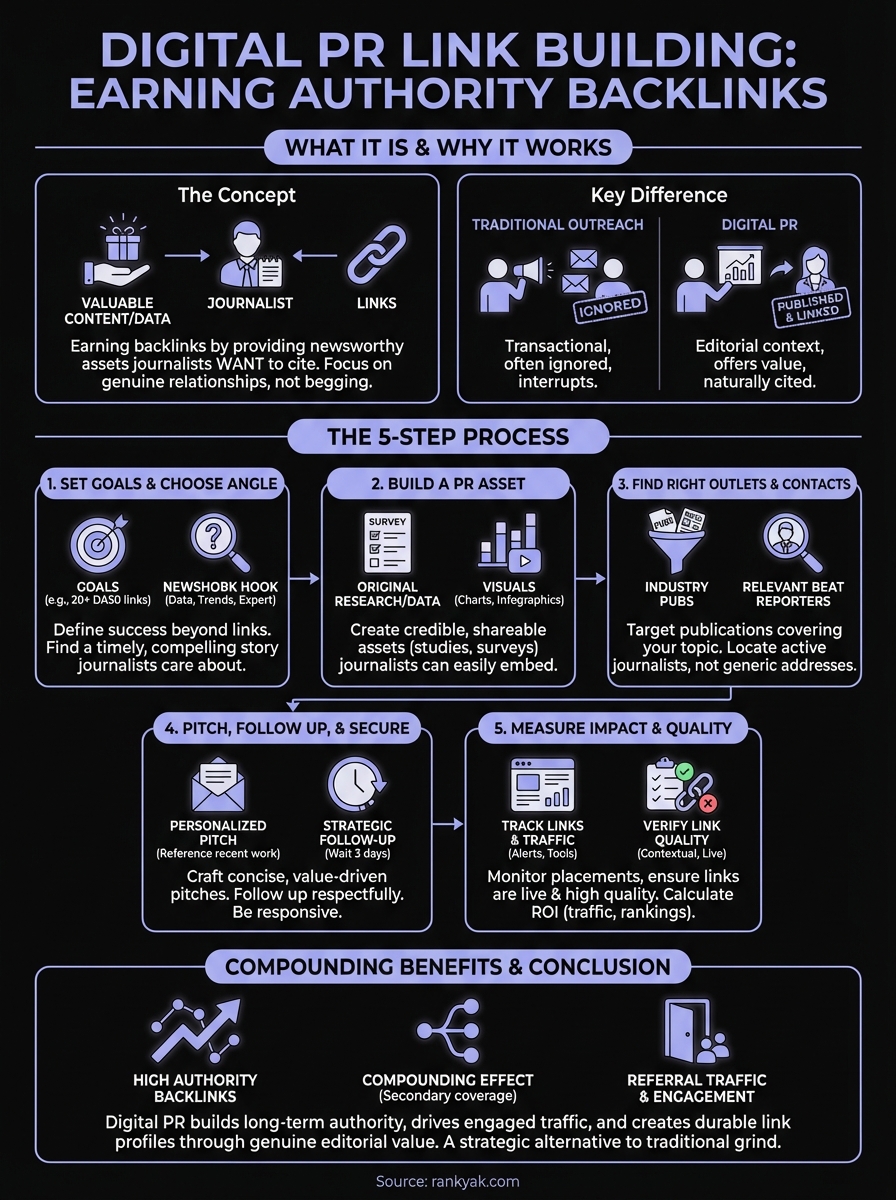
Digital PR link building requires more planning and relationship-building than traditional outreach, but the results speak for themselves. You've learned how to identify newsworthy angles, create assets journalists actually want to cite, find the right media contacts, craft pitches that get responses, and measure your campaign's impact. Each successful placement compounds your authority in Google's eyes while traditional link building tactics become less effective every year.
The challenge is that PR campaigns take time away from content creation, which remains essential for ranking in search results. While you're building media relationships and pitching journalists, your competitors are publishing new articles and capturing keywords you should own. RankYak handles the content side automatically, generating SEO-optimized articles every day so your site continues growing while you focus on high-value link building activities. You get consistent content output plus the strategic bandwidth to execute PR campaigns that actually move the needle.
Allan de Wit is a co-founder of RankYak and has worked in SEO since 2015: inside agencies, alongside them, for clients directly, and in-house on the products being ranked. He came to it as a software engineer building for marketers, which is why the platform is built the way it is. He went on to start companies of his own, two of which were acquired. At RankYak he sets the product direction and owns the features, the quality bar, the design, and the UX.