
What Are Topic Clusters? SEO Benefits, Examples & Steps

Publishing dozens of blog posts without a clear structure is like filling a library with books but never organizing them into sections. Search engines struggle to understand what your site is actually about, and readers bounce between loosely related pages without finding depth. That's the core problem topic clusters solve, they give your content a connected architecture that signals expertise to both Google and AI platforms like ChatGPT and Perplexity.
A topic cluster groups related content around a single pillar page, linking supporting articles back to it. This creates a web of internal links that helps search engines crawl your site efficiently and recognize your authority on a subject. The result? Higher rankings across multiple keywords, not just one. Sites that use this strategy consistently see compounding organic traffic because each new piece of content strengthens the entire cluster.
In this guide, you'll learn exactly what topic clusters are, how they differ from traditional keyword-by-keyword publishing, and why they've become essential for modern SEO. We'll walk through real examples, break down the components, and give you a step-by-step process to build your own. At RankYak, topic clusters are baked into how our platform plans and publishes daily SEO content, because automated keyword discovery and content planning only work when there's a strategic structure behind every article. Let's get into it.
What a topic cluster includes
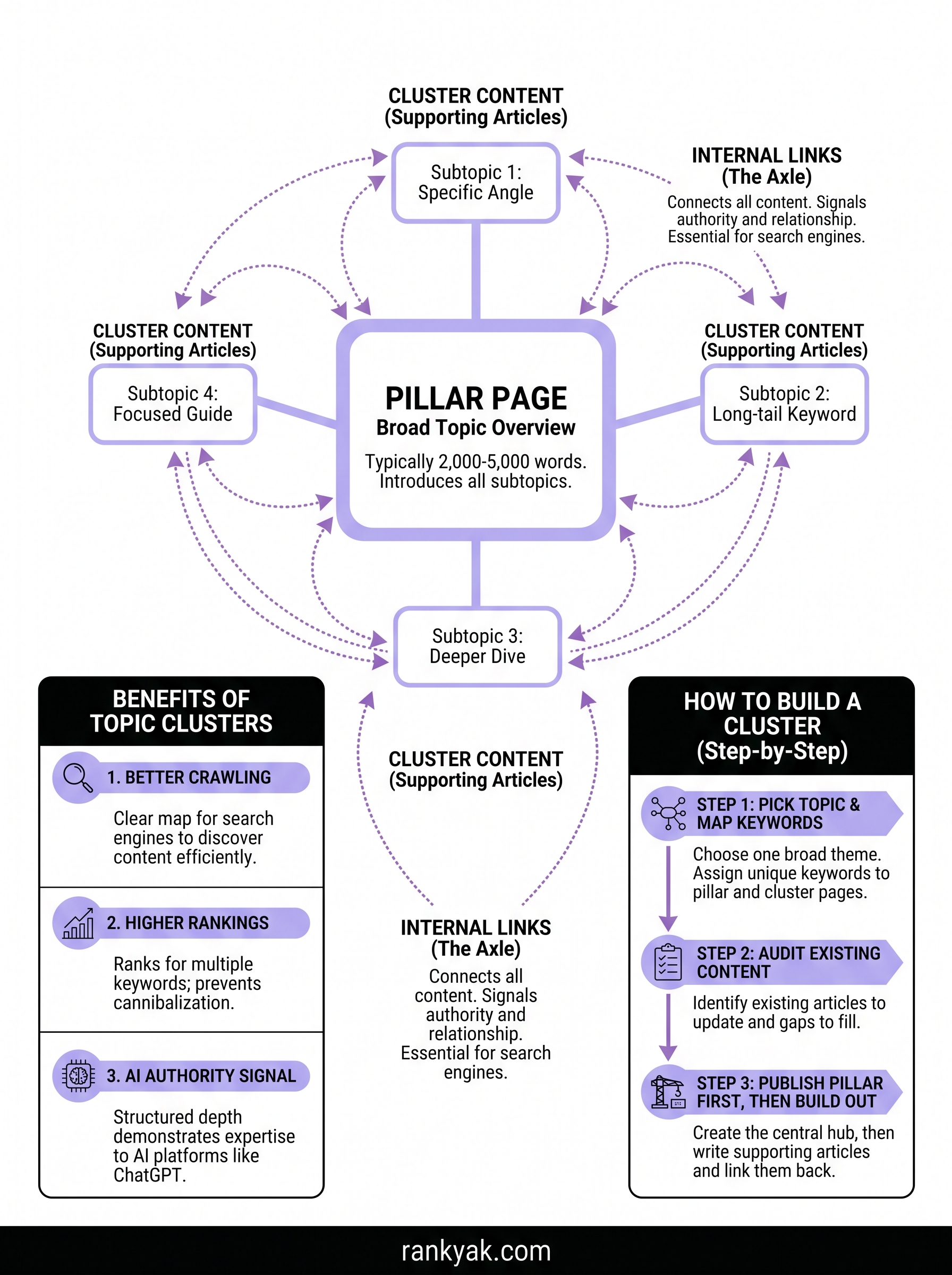
When people ask what are topic clusters, they're usually surprised to find that the concept has just three core components: a pillar page, cluster content, and internal links. Each piece plays a specific role, and removing any one of them breaks the system. Think of it as a wheel: the pillar page is the hub, the cluster articles are the spokes, and the internal links are the axle that holds everything together.
The pillar page
The pillar page is the broadest, most comprehensive piece of content in the cluster. It covers a topic at a high level, meaning it introduces every major subtopic without going too deep on any single one. For example, if your cluster is about email marketing, your pillar page might cover strategy, segmentation, automation, and analytics at a summary level, with each section pointing to a dedicated cluster article that digs deeper.
A pillar page isn't just a long article. It's a structural hub that signals to search engines your site has genuine authority over an entire subject area.
Your pillar page should target a broad, high-volume keyword and be long enough to give readers a thorough overview of the subject. Typical pillar pages run between 2,000 and 5,000 words. They aren't meant to answer every question in exhaustive detail; they're meant to orient the reader and route them to deeper content. The page also receives internal links back from every supporting article in the cluster, which continuously feeds it SEO authority over time.
Cluster content (supporting pages)
Cluster content consists of individual articles that each target one specific subtopic related to the pillar. Where the pillar page introduces email segmentation briefly, a cluster article covers it fully: what it is, how to do it, and what mistakes to avoid. Each cluster article is tightly scoped, which lets it rank for long-tail keywords that the pillar page can't realistically target on its own.
The number of cluster articles you need depends on how broad your topic is. A narrow niche might need only five supporting articles, while a competitive, wide topic might require twenty or more. What matters most is that each article covers one distinct angle without heavily overlapping other pages in the cluster. Overlap creates keyword cannibalization, where multiple pages compete against each other in search results instead of reinforcing the overall cluster.
Internal links
Internal links are what transform a collection of separate articles into an actual cluster. Without them, your pillar page and cluster articles are just isolated content. With them, you're telling search engines exactly how your content relates and which page carries the most authority. Every cluster article should link back to the pillar page using anchor text that reflects the pillar's main keyword.

Linking should also flow sideways between cluster articles when it makes sense contextually. If a reader finishes your article on email segmentation and there's a natural connection to your article on email automation, link between them directly. This keeps readers engaged longer, reduces bounce rates, and gives search engines more context about how your content functions as a unified body of work. The structure doesn't need to be complicated, but it does need to be intentional and consistent across every piece you publish.
Why topic clusters help SEO
Understanding what are topic clusters is only half the picture. The other half is knowing why Google and other search platforms reward this structure specifically. The short answer is that topic clusters solve three problems at once: crawlability, keyword coverage, and perceived authority. Each of those factors influences your rankings directly, and they compound on each other the longer you publish within a structured cluster.
Google crawls and understands your site better
Search engines discover and evaluate your content by following links. When your content sits in isolated pages with few internal links, Google has to guess how your articles relate to each other. With a cluster structure, you remove that guesswork. The pillar page acts as a clear entry point, and the internal links between articles create a logical map that crawlers can follow efficiently.
A well-linked cluster tells Google not just that you cover a topic, but that you cover it completely, which is a key signal for topical authority.
This matters because Google doesn't just rank individual pages, it evaluates entire sites. When your internal link structure consistently points back to a pillar page, you concentrate link equity in one place rather than scattering it across dozens of disconnected posts. That concentrated authority helps the pillar page climb rankings and pulls supporting articles up with it.
You rank for more keywords with less effort
A single article can only realistically target one or two primary keywords before it loses focus. A cluster of ten articles can target thirty or forty distinct keywords, all tied to the same core subject. Each supporting article captures long-tail search queries that would never fit naturally into a single comprehensive post.
This structure also reduces keyword cannibalization. When each article covers a clearly defined subtopic, your pages stop competing against each other and start working as a team. Google can confidently send different searchers to different pages within your cluster depending on exactly what they searched for.
AI platforms reward depth and structure
Search is no longer just Google. ChatGPT, Perplexity, and Gemini increasingly pull answers from sites they recognize as authoritative on a topic. A cluster demonstrates that authority clearly because your site contains multiple interconnected pieces that cover a subject from multiple angles. That breadth and depth signal is exactly what AI-driven platforms look for when deciding which sources to surface in their responses.
How to build a topic cluster step by step
Building a topic cluster doesn't require a complete site overhaul. You can start with one core topic, build it out systematically, and then repeat the process across other subjects. The key is doing things in the right order so that your pillar page and cluster articles reinforce each other from day one rather than sitting disconnected until you go back and fix them later.
Step 1: Pick your core topic and map your keywords
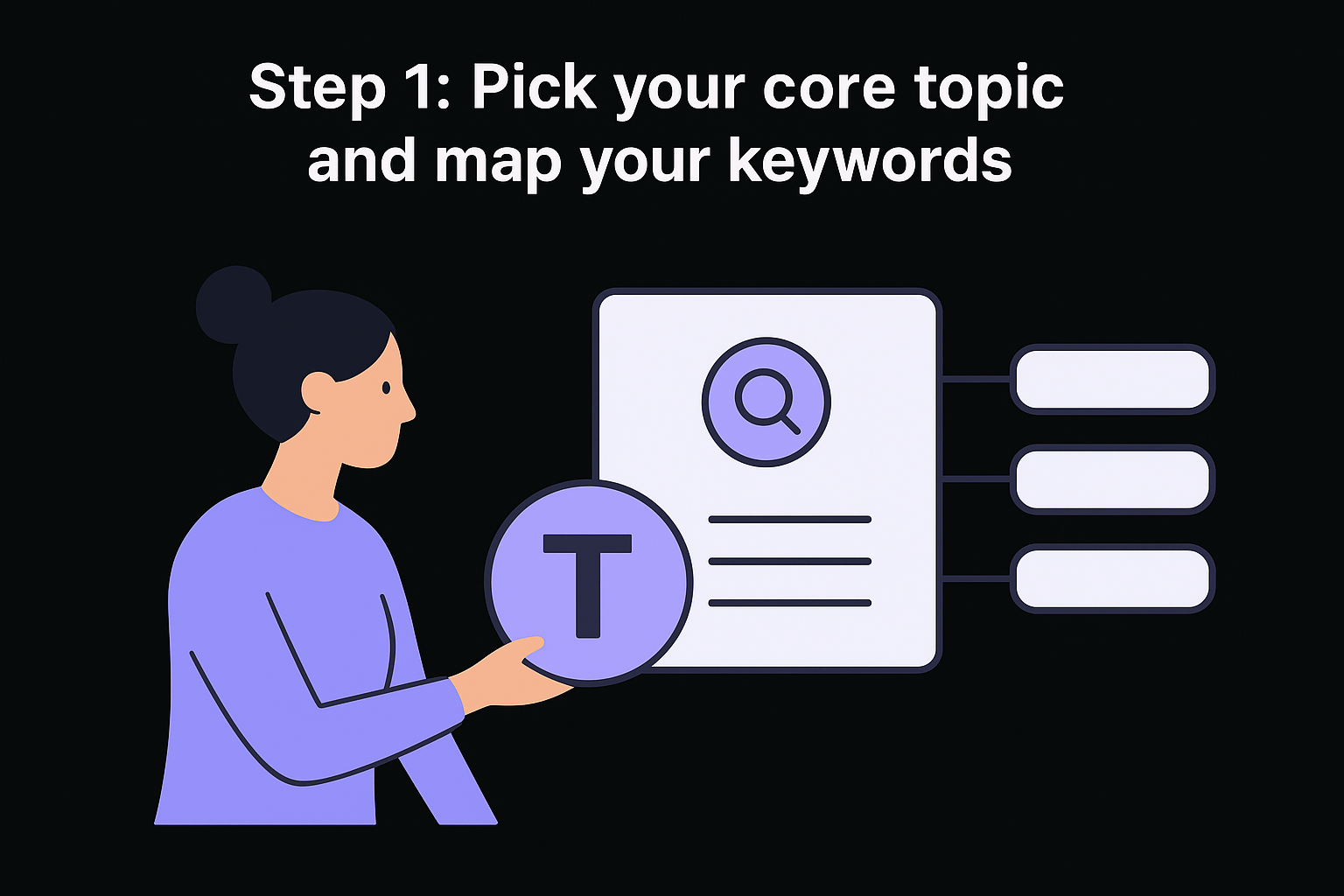
Start by choosing one broad subject your business genuinely covers. This isn't your pillar keyword yet; it's the theme that will hold your entire cluster together. Once you have it, research the specific keywords your audience searches for within that theme. Your pillar page targets a broad, high-volume phrase. Each cluster article targets a distinct long-tail variation tied to the same subject.
If you understand what are topic clusters at this point, you'll recognize that keyword overlap between cluster articles is the main problem to prevent before you write anything. Assign each keyword to exactly one URL upfront. A simple spreadsheet with three columns works fine:
- Target keyword (the phrase the page will rank for)
- Page type (pillar or cluster)
- Status (existing, needs update, or net new)
Map each keyword to exactly one URL before you write a single word. This prevents cannibalization before it starts.
Step 2: Audit what you already have
Before creating new content, check whether existing articles already cover any of your planned cluster topics. If they do, update and optimize those pieces rather than publishing duplicates. Assign each existing article to its place in the cluster, identify gaps, and then build a focused list of articles you still need to create. This step saves real time and prevents your new cluster from competing against content you've already published.
Many site owners discover they already have 40 to 60 percent of a cluster in place; it just lacks the pillar page and internal links that would make the structure visible to search engines.
Step 3: Publish your pillar page first, then build outward
Write and publish your pillar page before any cluster articles. This gives you a live URL to link back to from every supporting piece you create afterward. Publishing cluster articles without a live pillar page means every internal link you want to add requires going back to edit already-published content, which slows your workflow and increases the chance you'll miss connections across the cluster.
How to link and structure cluster pages
Once you understand what are topic clusters, you quickly realize that the linking structure is where most people either make or break the entire strategy. Getting your internal links right means every article you publish actively pushes authority toward your pillar page rather than distributing it randomly across your site. The structure itself is straightforward, but the details matter more than most site owners expect.
Anchor text and link placement
Every cluster article should link back to your pillar page using descriptive anchor text that reflects the pillar's main keyword. Avoid generic phrases like "click here" or "read more." Instead, use anchor text that describes exactly what the pillar page covers, such as "complete guide to email marketing" or "email marketing strategy." This tells search engines precisely what your pillar page is about and reinforces its topical relevance each time a new cluster article links to it.
Place these links within the body of the article, not just in a sidebar or footer. Contextual links carry significantly more weight because Google interprets them as an editorial endorsement rather than a navigational shortcut. Aim for one clear link back to the pillar per cluster article, and add sideways links to related cluster pages whenever the context supports it naturally.
Contextual internal links placed within the body text pass more link equity than navigation links placed in headers, footers, or sidebars.
Managing link equity across the cluster
Your pillar page should receive the most internal links of any page in the cluster. This concentrates authority where you need it most and signals to search engines that the pillar is the primary resource on your chosen subject. Cluster articles, by contrast, link to each other sparingly, only when one article directly relates to another and the connection adds genuine value for the reader.
One practical rule to follow: every cluster article should have at least one internal link going out (to the pillar or a closely related cluster page) and at least one coming in from another page in the same cluster. This bidirectional linking ensures no page sits as a dead end in your structure. When you publish new content, revisit older cluster articles and add links to the new page where they fit naturally. Keeping your cluster growing as a connected system is what separates a working SEO strategy from a folder full of disconnected posts.
Topic cluster examples and common pitfalls
One of the best ways to fully grasp what are topic clusters is to see them applied to a real business. The concept clicks faster when you map it to a niche you recognize, and the most common mistakes become obvious once you understand exactly what breaks a cluster's effectiveness.
Real-world cluster examples
A fitness coaching website might build a cluster around "strength training for beginners." The pillar page covers the full topic: equipment, programming, nutrition, and recovery. Supporting cluster articles then go deeper on each angle, targeting keywords like "how many sets for beginners," "best compound lifts for beginners," and "how much protein do beginners need." Each article links back to the pillar, and the pillar links out to each supporting page.
A cluster works best when every supporting article covers a topic that the pillar page introduces but cannot fully explore on its own.
For a B2B software company, the same model applies. If the pillar page targets "project management best practices," cluster articles cover subtopics like "how to run a sprint retrospective," "project status report templates," and "common project management mistakes." Readers who land on any one of those articles find a clear path back to the broader pillar and from there to other relevant pages in the cluster.
Common pitfalls to avoid
Several mistakes consistently undercut cluster performance, and most of them come down to poor planning before writing starts. The most common problem is building cluster articles without a live pillar page. When you publish supporting content first, your internal links have nowhere to point, which means you delay the authority-building effect the entire structure is designed to create.
Writing cluster articles that overlap in scope is the second major pitfall. If two articles in your cluster target nearly identical keywords or cover the same subtopic from the same angle, they compete against each other rather than reinforcing the pillar. Assign one angle to one URL and stay consistent with that decision. Treating internal links as optional is the third mistake site owners make most frequently. You can publish every cluster article in the right order and still undercut your results by skipping the links that connect each piece back to the pillar and across related supporting pages.
Next steps for your content strategy
Now that you understand what are topic clusters and how each component works together, the next move is to apply this structure to your own site. Start with one core topic you already have some content around, audit what exists, identify your gaps, and build your pillar page before anything else. Resist the urge to plan ten clusters at once. One well-executed cluster with strong internal linking will do more for your rankings than ten loosely connected groups with missing links and overlapping articles.
Consistent execution is where most sites fall short. Planning a cluster is straightforward, but publishing supporting content daily, keeping links updated, and expanding clusters over time takes real discipline. If you want the structure handled automatically without sacrificing quality, see how RankYak builds and scales topic clusters for you. Your content strategy works harder when the architecture behind it is built to compound.

Get Google and ChatGPT traffic on autopilot.
Start today and generate your first article within 15 minutes.
SEO revenue calculator
How much revenue is your website leaving on the table?
Take a quick quiz and see exactly how much organic revenue you're missing out on, along with personalized tips to fix it.
-
4 questions, under 1 minute
-
See traffic and revenue potential
-
No email required
Free · takes 1 minute · no signup needed
Question 1 of 4
Question 2 of 4
Question 3 of 4
Question 4 of 4
Your SEO growth potential
Extra visitors / month
after 6-12 months of consistent publishing
Revenue potential / year
at your niche's avg. conversion rate
Articles needed (12 mo)
to reach this traffic level
ROI with RankYak
at $99/mo ($1,188/year)
To hit that number, you'd need to:
- Build a topical authority strategy for your niche
- Research keywords & map out a full topical cluster
- Write, edit & publish an article every single day
- Build backlinks to the articles you publish
RankYak handles all of this automatically, every day.
* Estimates based on industry averages. Results vary by niche, competition, and domain authority. Most SEO results become visible after 3-6 months of consistent publishing.