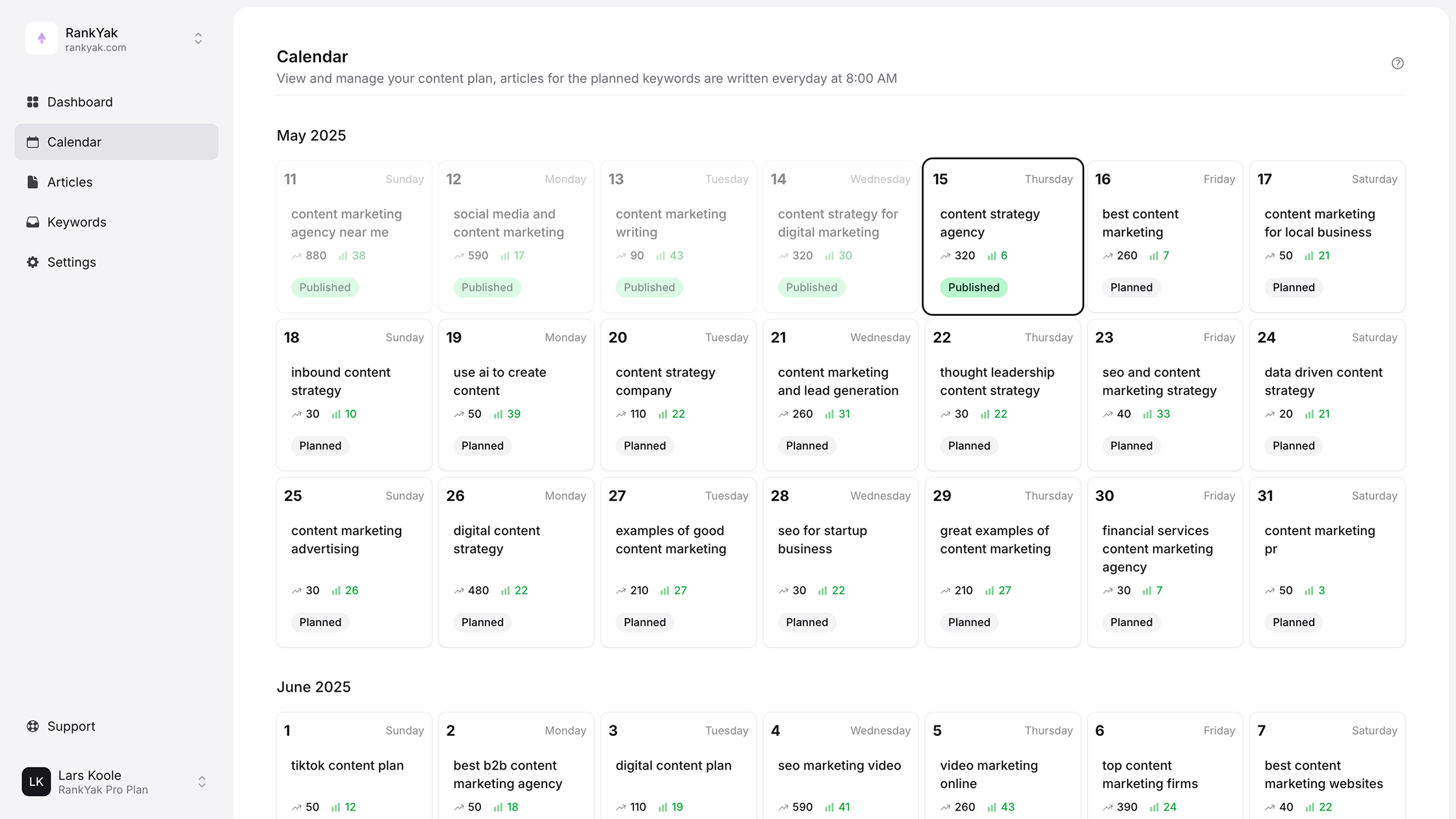
The blog runs on the same process RankYak sells.
Every article on rankyak.com is chosen by research, written against the pages that rank, cited to its sources, signed by a founder, and refreshed when the research changes. This page states the process, so a reader knows what stands behind an article before trusting it.
A company that sells SEO automation has one honest way to write a blog: run it on the product. That is what happens here. The articles on rankyak.com are not a separate marketing operation with its own writers and its own rules. They come out of the same process that plans, writes, and maintains the content on every customer's site, and they are held to the same standard.
How an article comes to exist
An article starts with a keyword, not with an idea for a post. The research that plans a customer's month plans this blog too: what people search for, how strong the pages already ranking are, and whether RankYak has something real to say on the subject. A topic that fails that test does not get written, however tempting it looks.
Once a keyword earns its place, the article is researched against the pages that rank for it, drawn from named sources that are cited in the text, and written in the RankYak voice with links to the pages it builds on. Then it publishes under the name of one of the two founders, Allan de Wit or Lars Koole. That name is not decoration. It is the person who stands behind the article: for what it claims, for what it cites, and for fixing it when it is wrong. Between them the founders have worked in SEO since 2015, inside agencies, alongside agencies, for clients directly, and in-house on the products being ranked, and that is the experience an article is measured against.
What happens after it publishes
Publishing is the middle of an article's life, not the end. When the research behind a keyword moves, the article is refreshed on the same URL and shows the date it was updated. When two articles end up competing for the same search, the weaker one is folded into the stronger and its address redirects permanently. The date on an article means its content was checked on that day.
If something is wrong, a fact, a dead source, a claim that has gone stale, it is corrected on the page and the updated date moves with it. The contact page reaches the founder whose name is on the article. The methodology describes the same process from the customer's side.
Get Google and ChatGPT traffic on autopilot.
Start today and generate your first article within 15 minutes.