Keyword Clustering Tool
Paste a keyword list and this groups it into the clusters a single article can rank for, naming the primary keyword and the search intent behind each one. What comes back is a content plan rather than a list.
Your clusters appear here. Each one names the page it would become, the keyword that page should target, the search intent behind it, and every keyword it covers. Copy the set or export it as CSV when you are done.
One cluster, one article
The rule that makes clustering worth doing is that a cluster maps to exactly one page. Not one page per keyword, and not one page per topic, but one page per group of keywords a single answer satisfies. Get that mapping right and the rest of the content plan follows from it: each cluster becomes an article, the primary keyword becomes the title, and the cluster size tells you roughly how much demand the article is competing for.
The mapping also tells you what not to write. Two keywords that landed in the same cluster are not two briefs, and writing them as two articles produces exactly the cannibalization that consolidation projects exist to undo. If you already have both pages, the answer is usually to merge them and redirect one.
Where a cluster comes back with a single keyword, that is a real answer rather than a failure. Some queries genuinely need their own page, and a plan that forces everything into groups of five ends up with pages trying to serve intents that have nothing to do with each other.
From clusters to published articles
A cluster list is the input to the work rather than the work. The next step is a brief per cluster, and the content brief generator takes a primary keyword and returns the intent, the outline, and the entities the page has to cover. If you are starting from a subject rather than a keyword list, the topical map generator works the other way round.
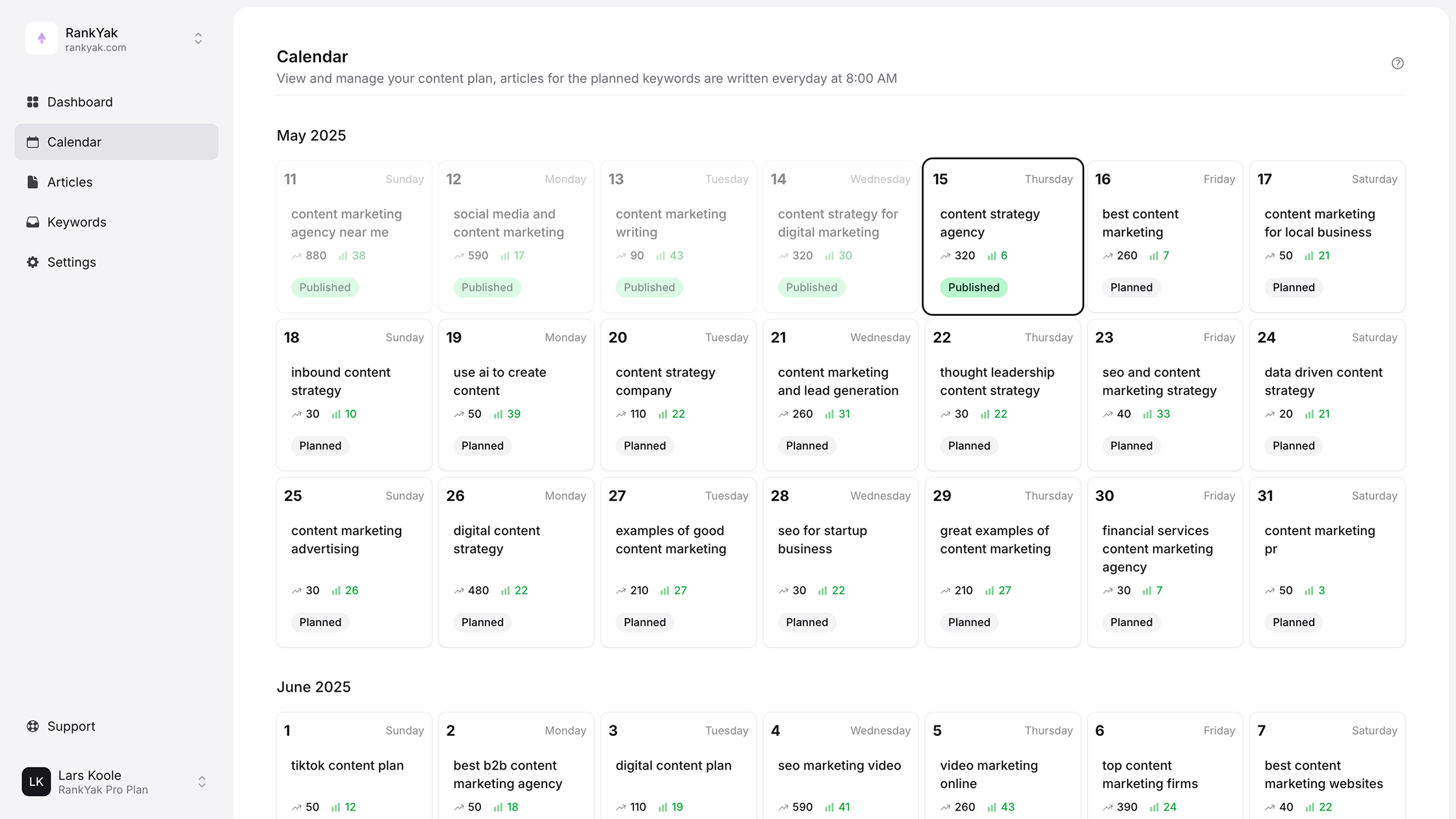
RankYak runs this loop continuously on the sites it manages. It researches the keywords, clusters them, plans an article per cluster, writes it, and publishes it to the site on a schedule. The clustering you just ran by hand is one step of what it does every month without being asked.
Frequently Asked Questions
Grouping a keyword list so that every keyword in a group could be answered by one page. "seo tools", "seo software", and "tools for seo" are one page; "seo tools for agencies" is usually another, because the searcher expects agency-specific content. Clustering is what turns a list of a thousand keywords into a plan of eighty articles.
Because you would be competing against yourself. Several thin pages targeting variations of the same query split the links and the relevance between them, and Google picks one to rank, usually not the one you would have chosen. That is keyword cannibalization, and consolidating those pages into one is a common way to recover traffic without writing anything new.
It groups by what the searcher wants rather than by how similar the words look. Two keywords cluster when a person typing either would be satisfied by the same page, which is why intent splits a cluster even when the wording is close: "buy running shoes" and "how to choose running shoes" share three words and need two entirely different pages.
SERP overlap clustering compares the actual results Google returns for each keyword and groups the ones that share ranking pages. It is the more precise method and it needs live SERP data for every keyword, which is why the tools that do it charge for it. This groups by intent and meaning instead, which gets you most of the way for free and is enough to plan content against.
Up to 50 per run, one per line or comma-separated. Duplicates are removed before clustering. A longer list is run in batches, and the clusters come back cleaner that way, because a batch whose keywords already sit on one topic gives the grouping less to guess at.
It is the one the page should target: the phrasing a searcher is most likely to type, which is usually the shortest natural form rather than the longest. Use it in the title, the H1, and the URL. The rest of the cluster should appear naturally in the body, and mostly will, without being placed deliberately.
Related tools
Turn one seed topic into a full topical map of pillars and supporting articles, ready to publish against.
Turn a target keyword into a writer-ready brief: intent, the heading and meta tags, the outline, and the entities to cover.
Analyze one-, two-, and three-word phrase frequency on any URL, and see where you have over-optimized.
Get Google and ChatGPT traffic on autopilot.
Start today and generate your first article within 15 minutes.