Content Brief Generator
Enter a target keyword and this returns the brief a writer needs: the intent behind the query, the angle worth taking, a realistic length, the heading and the meta tags to publish it with, the outline, the entities the page has to mention, and the questions it has to answer.
- Search intent. What the searcher wants, which decides the shape of the page.
- The angle. The approach that gets past what already ranks.
- Heading and metadata. The H1, the SEO title, and the meta description, each written for its own job.
- The outline. Every section in order, with a line on what it should cover.
- Entities and questions. What the page has to mention and what it has to answer.
- Internal links. The kinds of page on your site this one should link to.
A brief takes about twenty seconds to write. Copy it as Markdown when it lands and hand it to whoever drafts the article.
Briefing at volume
One brief takes a few minutes to write by hand and is not worth automating. Forty briefs a month across a dozen client sites is a different job, and it is the point at which briefing quietly becomes the bottleneck: the writers are available, the keywords are chosen, and the work waits on someone deciding what each article should contain.
Copy each brief as Markdown and it drops straight into whatever the writer works from. Pair it with the keyword clustering tool to decide which keywords deserve a brief at all, and check the finished draft with the heading analyzer to confirm the outline survived the writing.
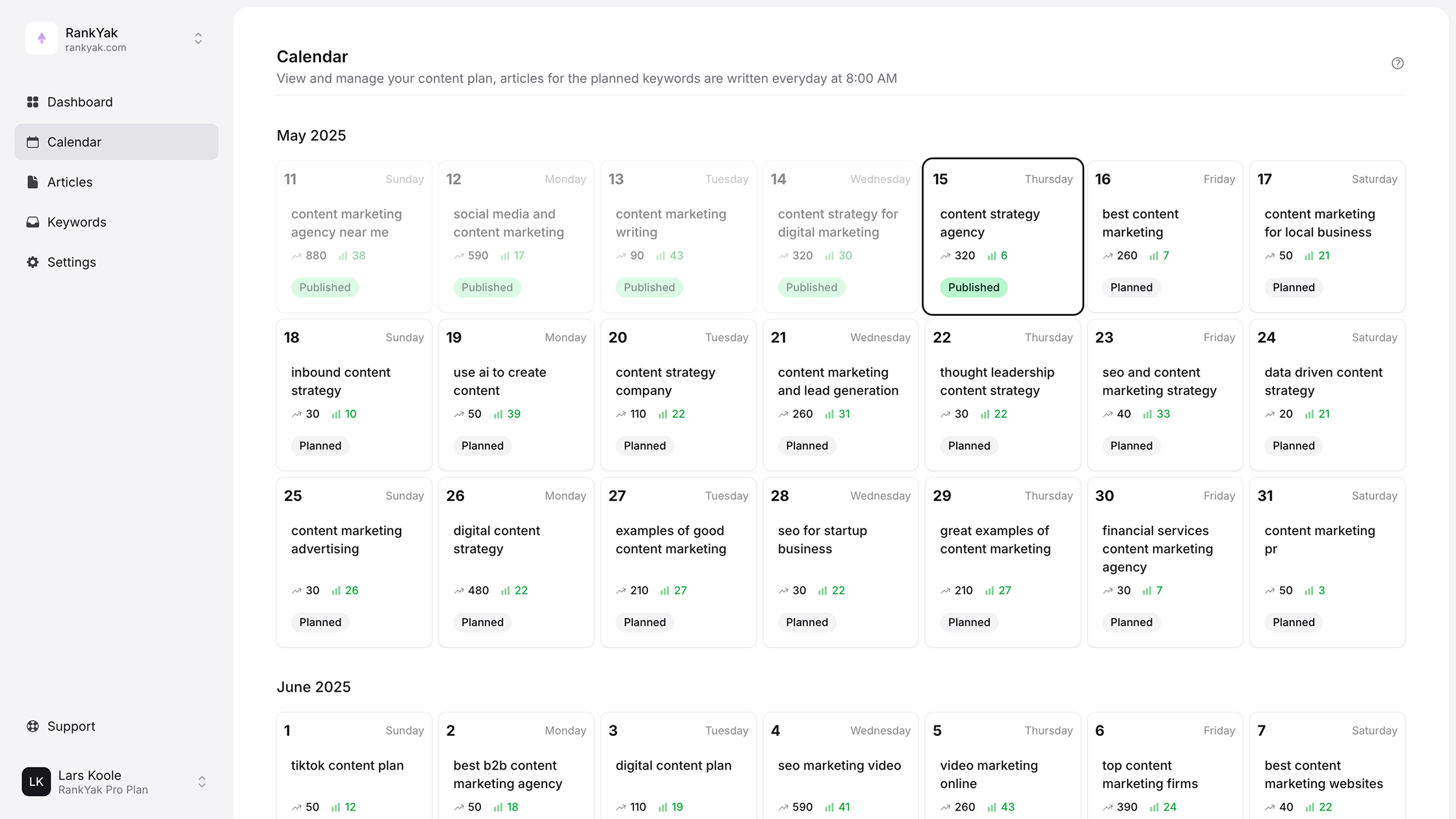
RankYak removes the step entirely for the sites it runs. It researches the keywords, decides what to write, briefs itself, writes the article, and publishes it. If briefing at volume is the part that is slowing you down, that is the problem the product exists to solve.
Frequently Asked Questions
The document a writer works from before drafting: what the searcher wants, the angle the page should take, roughly how long it needs to be, the heading and the meta tags it publishes with, the outline, the entities to cover, and the questions to answer. A good brief is what separates an article that ranks from one that reads well and does nothing.
Because they are two different lines doing two different jobs. The heading is the H1 the page carries once it is published, so it has room to say what the page actually covers. The SEO title is the title tag, which is what Google shows in its results, and it gets cut off past roughly 60 characters. Where the heading is short the two often match; where it is not, writing one line for both leaves you with either a thin heading or a truncated search result.
Because intent determines everything else. Someone searching "best crm for agencies" wants a comparison with a recommendation; someone searching "what is a crm" wants a definition. Write the wrong one and no amount of quality rescues it, because the page is answering a question nobody asked.
The specific things a credible page on a subject mentions: named concepts, standards, methods, metrics, and roles. They matter because search engines assess whether a page covers a subject by what it references, and a page that omits the entities its competitors all cover reads as thin however many words it has.
Treat it as a starting structure. The order and the coverage are usually right; the phrasing of each heading is worth rewriting in your own voice. What you should not do is drop sections because they are inconvenient, since those are usually the ones your competitors cover and you do not.
Not directly. It works from the query rather than from live SERP data, which means it gets the intent and the structure right without telling you what any specific competitor did. Read the top three results yourself before writing; that step is quick and it is where the differentiating angle usually comes from.
Related tools
Turn one seed topic into a full topical map of pillars and supporting articles, ready to publish against.
Paste a keyword list and group it into the clusters a single article can rank for, each with a suggested target.
Pull the heading outline from any URL and find the missing H1s, skipped levels, and empty headings.
Get Google and ChatGPT traffic on autopilot.
Start today and generate your first article within 15 minutes.