
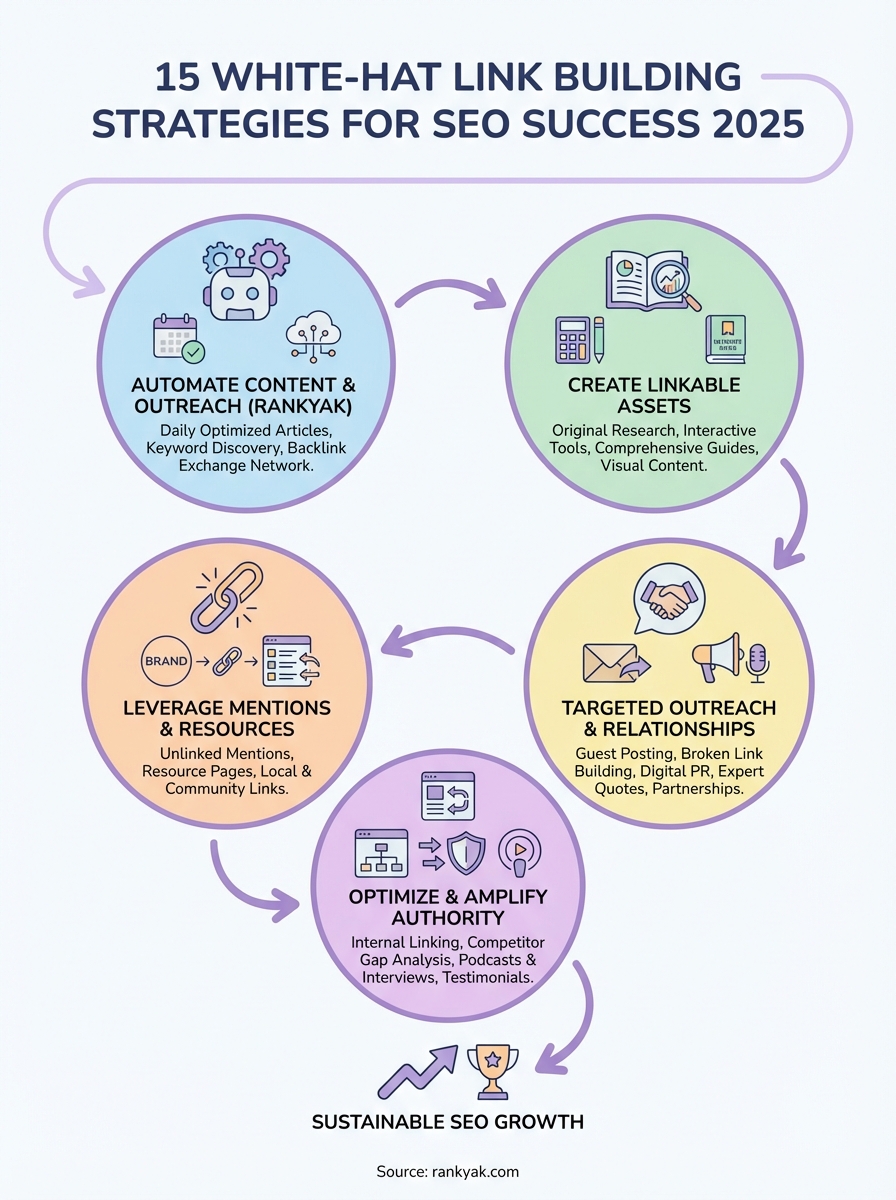
15 White-Hat Link Building Strategies for SEO Success 2025

You know backlinks matter for SEO. But actually getting them? That's where most businesses hit a wall. Manual outreach eats up hours with little to show for it. Guest post pitches go unanswered. Tactics you read about online turn out to be outdated or borderline spammy. Meanwhile, your competitors keep climbing the rankings while your content sits buried on page three.
This guide walks you through 15 proven white-hat link building strategies that actually work right now. Each strategy includes step-by-step instructions, real examples, and templates you can use immediately. You'll learn how to automate parts of the process without sacrificing quality, find opportunities your competitors miss, and build relationships that result in high-quality backlinks. Whether you're just starting with link building or looking to scale your existing efforts, these strategies will help you earn the backlinks your site needs to rank higher and drive more organic traffic.
1. Use RankYak for scalable link building
Most link building strategies fail because they can't scale. You spend weeks creating one piece of content, then more weeks reaching out to sites that might link to it. RankYak changes this equation by automating both content creation and the foundation for link earning. The platform generates daily SEO-optimized articles that naturally attract backlinks while also connecting you with relevant sites in your niche for backlink exchanges. Instead of choosing between quality and quantity, you get both.
How RankYak automates content and link outreach
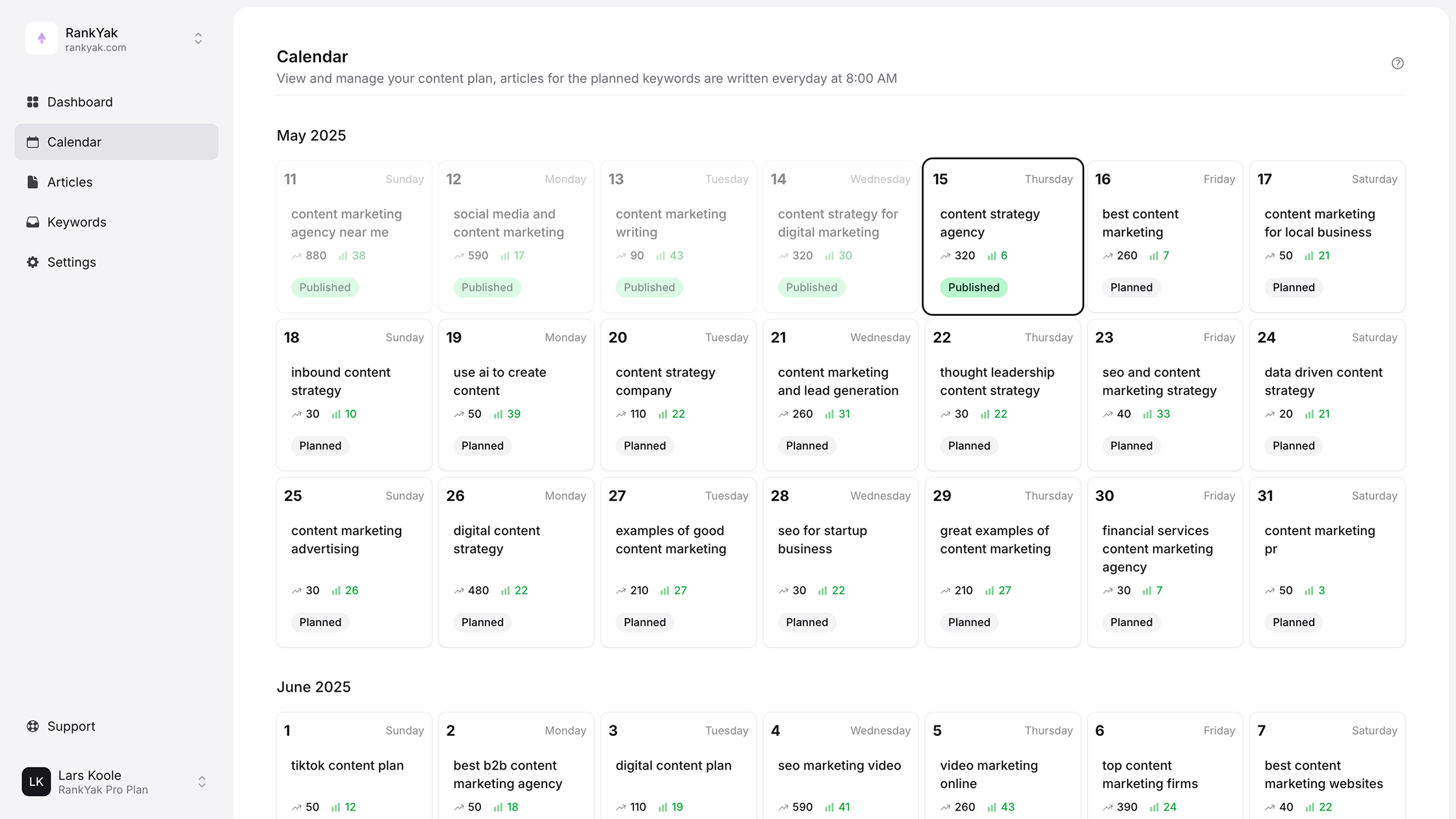
RankYak handles the entire content production pipeline that makes link building possible. The system discovers high-potential keywords based on your niche, creates a content plan targeting those keywords, and writes fully optimized articles that rank in search results. Each article includes proper structure, internal links, and citations that make other sites want to reference your content. The backlink exchange feature connects you with other quality websites in your industry, creating opportunities for mutual linking that search engines reward. You publish content consistently while building relationships that lead to natural backlinks.
The combination of consistent content and automated networking means you earn links while you sleep, not just when you have time for manual outreach.
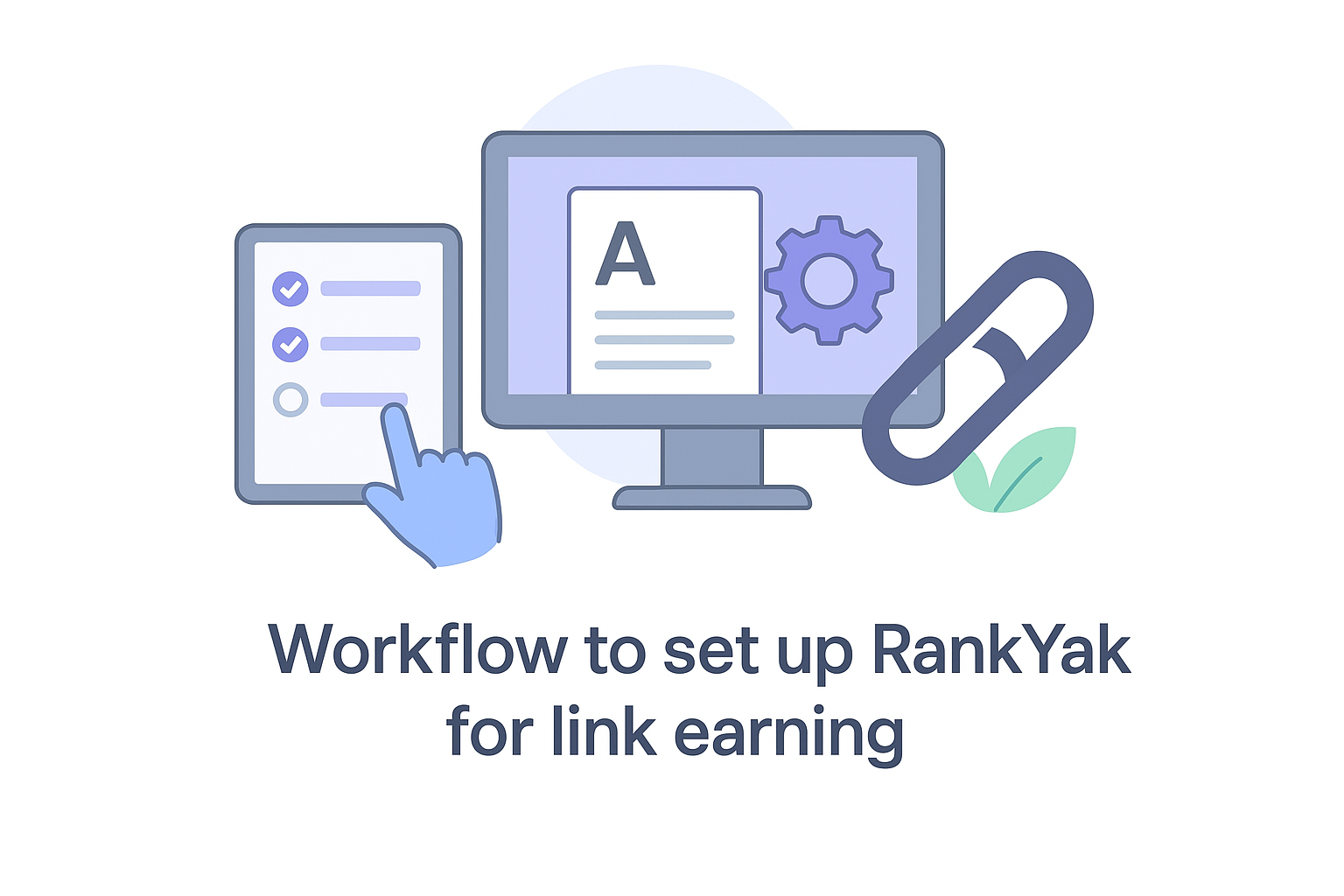
Workflow to set up RankYak for link earning
Start by connecting your website to RankYak and letting the platform analyze your niche. The system will generate keyword recommendations and build a content calendar targeting terms your audience actually searches for. Review the proposed topics and approve them, then let RankYak write and publish articles automatically to your site. Join the backlink exchange network by adding your site details and the types of links you're seeking. Monitor which articles gain traction in search results, then use those high-performing pieces as anchor content for outreach. Check your dashboard regularly to see new backlink opportunities and accept exchanges that fit your strategy.
Best practices to combine RankYak with manual outreach
Use RankYak's automated content as your foundation, but layer manual tactics on top for maximum results. When the platform publishes a particularly strong article, create a targeted outreach list of sites that would benefit from linking to it. Reference your consistent publishing schedule in pitches to show you're a reliable content creator, not a one-off contributor. Track which content types earn the most organic backlinks through RankYak, then double down on those formats in your manual campaigns. The automation handles volume while your personal outreach targets your highest-value link opportunities.
2. Create linkable assets that earn backlinks
Linkable assets are content pieces specifically designed to attract backlinks naturally. Unlike regular blog posts, these resources solve problems so comprehensively that other creators reference them as sources without you asking. When you publish an original industry report, an interactive tool, or a detailed how-to guide, you create something journalists, bloggers, and content marketers need to cite. This strategy transforms your content from forgettable to essential, turning passive link building strategies into active magnets for quality backlinks.
Types of linkable assets that work in 2025
Original research and data studies consistently earn the most backlinks because they provide information no one else has. Survey your customers, analyze industry trends, or compile statistics from public sources into a single comprehensive report. Interactive tools like calculators, templates, and generators solve specific problems while naturally encouraging links from tutorial writers and review sites. Ultimate guides that cover a topic more thoroughly than any competitor become the default reference in your niche. Visual content including infographics, charts, and data visualizations help other creators illustrate their points while crediting your source.
When you publish data or tools that make other people's content better, they link to you without prompting.
How to research topics for linkable assets
Start by analyzing what already earns links in your industry using backlink analysis tools to see which content types competitors attract. Search for your target keywords on Google and examine the articles ranking in positions one through ten, noting which external sources they cite most frequently. Look for information gaps where existing resources fall short, outdated statistics that need refreshing, or complex topics that lack beginner guides. Check forums, social media groups, and question sites to identify problems your audience repeatedly asks about but struggles to find good answers for.
Promotion checklist to get your first backlinks
Build a list of sites that linked to similar content by checking backlinks to competing assets before you publish. Create a brief outreach email template explaining how your resource improves on what currently exists and why their audience would benefit. Share your asset across social channels and relevant communities immediately after launch to build initial momentum. Email your existing network and anyone you interviewed or cited in the piece, making it easy for them to share. Follow up with non-responders after one week, and track which outreach angles work best so you can refine your approach for the next asset.
3. Guest posting on relevant authority sites
Guest posting remains one of the most effective link building strategies when done correctly. The key is targeting sites your audience already trusts and contributing content that genuinely helps their readers. Modern guest posting focuses on building relationships and providing value, not stuffing author bios with keyword-rich links. You earn backlinks by becoming a recognized voice in your niche, which means writing fewer, better articles for sites that matter instead of churning out generic posts for anyone who accepts them.
What modern white hat guest posting looks like
Today's successful guest posts read like regular editorial content, not thinly veiled advertisements for your business. You write about topics the host site's audience cares about, incorporating your expertise naturally without pushing your product or service. The backlink typically appears in your author bio or as a contextual reference when it genuinely adds value to the discussion. Focus on sites where your target customers already spend time reading, learning, or solving problems. Quality publications review submissions carefully and often require revisions, which signals you're pursuing legitimate opportunities rather than link farms.
When editors treat your submission like real content that needs to meet their standards, you know you're building links the right way.
How to build a shortlist of guest post targets
Start by searching phrases like "write for us" plus your industry keywords to find sites actively accepting contributors. Check where your competitors and industry leaders contribute by reviewing their author profiles and backlink sources. Evaluate each potential target by reading their existing guest posts to understand tone, length expectations, and topic preferences. Create a spreadsheet ranking sites by domain authority, audience overlap, and editorial standards. Prioritize publications that feature author bios with dofollow links and maintain consistent publishing schedules.
Pitch templates and follow up cadence
Your initial pitch should introduce yourself briefly, explain why you're qualified to write for their audience, and propose three specific topic ideas with working headlines. Keep the email under 150 words and demonstrate you've actually read their site by referencing a recent article. Follow up exactly one week after your first email if you receive no response, and send one final check-in after another week before moving on. When an editor accepts your pitch, deliver the draft on time and respond quickly to revision requests to build a relationship that leads to additional guest posting opportunities.

4. Broken link building the smart way
Broken link building works because you solve a problem while asking for a backlink. When you find a dead link on a website pointing to content that no longer exists, you can offer your similar resource as a replacement. Site owners appreciate this approach because broken links hurt their user experience and SEO, making them more receptive to your outreach. Unlike cold pitches for guest posts, you provide immediate value by alerting them to an issue they need to fix anyway.
Finding broken link opportunities in your niche
Start by identifying resource pages and link roundups in your industry since these pages contain dozens of outbound links that may break over time. Use browser extensions that check for 404 errors as you browse competitor sites and industry directories. Focus on pages that rank well in search results because these sites have authority worth pursuing. Look for recently deleted content or rebranded companies in your niche, then find pages that still link to those old URLs. Check your own competitors' backlink profiles for broken links pointing to content similar to what you publish.
Crafting outreach emails site owners welcome
Your email should alert them to the specific broken link by including the exact URL of their page and the dead link you found. Explain how the broken link affects their readers and briefly describe your content as a potential replacement without being pushy. Keep the message under 100 words and focus on helping them first, mentioning your resource second. Personalize each email by referencing something specific about their site to prove you actually read it.
When you lead with solving their problem instead of asking for something, site owners respond positively to your outreach.
Scaling broken link building without spam
Create a content inventory matching common broken link topics in your niche so you have relevant replacements ready before you start outreach. Build relationships with site owners even when you don't have an immediate ask, making future broken link pitches feel natural. Track which types of pages respond best to your outreach and focus your efforts there instead of contacting every broken link you find. Limit yourself to one follow-up email per prospect to avoid crossing into spam territory while still maximizing response rates.
5. Digital PR and newsworthy content
Digital PR transforms your link building strategies by creating stories that journalists and bloggers want to cover naturally. Instead of asking for backlinks directly, you generate newsworthy content that earns media mentions and links as a byproduct of legitimate coverage. This approach builds your brand while acquiring high-authority backlinks from publications that rarely accept traditional pitches. When you give reporters something genuinely interesting to write about, they link to your site as the primary source of the story, creating powerful signals that improve your search rankings and credibility.
What counts as a newsworthy angle for link building
Your story needs to offer something journalists can't find elsewhere to justify coverage in competitive publications. Original research studies, industry surveys with surprising findings, and expert analysis of breaking news in your niche all qualify as newsworthy angles. Timely content tied to current events, seasonal trends, or upcoming holidays makes your pitch more relevant when it lands in an editor's inbox. Controversial opinions backed by data, predictions about industry changes, or unique case studies showing unexpected results give reporters angles their competitors lack.
When you create stories that help journalists do their jobs better, they reward you with coverage and backlinks.
Planning and pitching a digital PR campaign
Start by defining your story angle and gathering supporting data, visuals, or expert quotes before you contact anyone. Build a targeted media list of publications that cover your industry and have published similar stories recently. Write a concise pitch email with a compelling subject line, a one-paragraph story summary, and key data points that prove your angle matters. Time your outreach for Tuesday through Thursday mornings when journalists actively plan upcoming content. Personalize each pitch by referencing recent articles the reporter wrote to show you read their work.
Measuring links and brand impact from PR
Track every media mention and backlink your campaign generates using monitoring tools that alert you when publications cover your story. Calculate the domain authority of sites linking to you to understand the SEO value you've earned beyond just link volume. Measure referral traffic from each mention to identify which publications drive actual visitors to your site, not just links. Monitor brand search volume increases after your campaign launches to gauge awareness lift that compounds over time.
6. Answer journalist requests for expert quotes
Journalists constantly search for expert sources to quote in their articles, and every quote typically includes a backlink to your website. Platforms connect reporters with industry experts, creating opportunities to earn high-authority links from major publications. You provide valuable insights that improve their stories while securing editorial backlinks from trusted media outlets. This approach works because journalists need credible sources under tight deadlines, making them more likely to use your contributions and link back to you.
Where to find journalist and blogger requests
Connectively (formerly HARO) remains the largest platform where journalists post daily requests for expert commentary across hundreds of topics. You receive email digests three times per day containing dozens of opportunities to contribute quotes in your industry. Search the requests using keywords related to your expertise and respond only to queries where you can provide genuine value. Set up alerts for specific topics so relevant opportunities reach your inbox automatically instead of requiring you to check constantly.
How to write responses that get quoted and linked
Your response should directly answer the journalist's question in two to three concise paragraphs without marketing fluff or self-promotion. Include specific data, examples, or insights that make your quote more quotable than generic advice other experts might provide. Add your credentials, company name, and website URL in your email signature exactly as you want them to appear in the published article.
When you give journalists exactly what they need without making them work for it, they choose your quote over dozens of others.
Routines to turn media requests into a habit
Block 15 minutes each morning to scan new journalist requests before your workday starts, when fresh opportunities still have few responses. Create response templates for common question types in your niche to speed up your replies while maintaining quality. Track which types of requests lead to published links and focus your efforts on those categories going forward.
7. Win links from resource and links pages
Resource pages exist specifically to link out to helpful content in a particular niche, making them perfect targets for white-hat link building strategies. These curated lists solve problems by directing readers to the best tools, guides, and resources on specific topics. When you earn a spot on a quality resource page, you gain a contextually relevant backlink from a site that already filters and recommends content to your target audience. Unlike pitching individual articles, resource pages often accept multiple submissions over time as curators maintain and update their lists with fresh additions.
How to uncover resource pages in your industry
Search Google using phrases like "helpful resources" plus your industry keywords or "links" combined with your niche terms to find curated lists. Look for pages with titles containing words like "resources," "links," "tools," or "further reading" that indicate the page's purpose is collecting external references. Check what resource pages your competitors appear on by analyzing their backlink profiles for pages containing dozens of outbound links. Universities, industry associations, and government sites often maintain resource directories that accept submissions from quality businesses in relevant fields.
Qualifying pages so you only pursue quality links
Evaluate each resource page by checking how many outbound links it contains and whether they point to legitimate sites rather than spam domains. Verify the page receives organic traffic and ranks for relevant keywords instead of existing solely to exchange links. Review when the curator last updated the page since abandoned resource lists provide little SEO value even if you earn a spot. Confirm the page's topic aligns closely with your content so the link makes contextual sense to both visitors and search engines.
Outreach scripts that win a spot on resource lists
Your email should reference the specific resource page by URL and explain how your content fills a gap in their current list. Describe what makes your resource unique or more comprehensive than similar links they already feature. Keep your pitch under 100 words and acknowledge their curation efforts before suggesting your addition. Include the exact anchor text and URL you recommend to make adding your link effortless for the page owner.
When you demonstrate genuine familiarity with their resource page and explain exactly how you improve it, curators welcome your suggestion instead of ignoring it.
8. Turn unlinked brand mentions into links
Someone writes about your company, product, or founder without linking to your site. These unlinked mentions represent easy backlink opportunities because the author already knows your brand exists and considered it worth discussing. You simply ask them to add a link where they mentioned you, converting passive references into active SEO value with minimal effort. This approach works exceptionally well as one of the simplest link building strategies since you're not requesting new content creation or convincing anyone your brand deserves attention.
How to discover unlinked mentions of your brand
Set up Google Alerts for your brand name, product names, and key executives to receive email notifications whenever someone publishes new content mentioning you. Search Google directly using your brand name in quotes minus your domain to find pages that reference you without linking back. Check social media platforms where industry discussions happen since conversations often lead to blog posts and articles that forget attribution. Monitor competitor mentions to discover publications covering your industry that might also discuss your business.
Prioritizing which mentions to turn into backlinks
Focus first on mentions from high-authority domains since these links provide the most SEO impact and referral traffic potential. Target articles published recently because authors actively maintain fresh content and respond to requests more readily than for older archived pieces. Choose mentions where adding your link genuinely helps readers learn more rather than forcing links into contexts where they feel unnatural.
When you prioritize quality mentions over volume, you build relationships with influential sites instead of annoying everyone with requests.
Email scripts to convert mentions into links
Thank the author for mentioning your brand and explain specifically where they referenced you in their article. Ask politely if they could add a hyperlink to your site for readers who want additional information about your company or product. Keep your email under 75 words and make it effortless for them to comply by providing the exact URL and suggested anchor text.
9. Close backlink gaps with competitor data
Your competitors already solved half your link building problem by identifying which sites link to content like yours. Backlink gap analysis reveals websites that link to multiple competitors but ignore your site, creating a clear roadmap of opportunities you're missing. These sites already demonstrate interest in your niche and willingness to link to similar content, making them far more receptive to outreach than cold prospects. Instead of guessing which sites might link to you, you target domains with proven track records of supporting businesses exactly like yours.
How to run a backlink gap analysis
Enter your domain and three to five competitor URLs into a backlink analysis tool to generate a comprehensive comparison of link profiles. Filter the results to show only domains that link to at least two competitors but have zero links pointing to your site. Export this list and sort by domain authority to prioritize sites with the most SEO impact first. Review each domain manually to confirm they publish content relevant to your niche rather than blindly pursuing every gap you discover.
Choosing which competitor links to replicate
Focus on backlinks from resource pages, guest posts, and editorial mentions that you can reasonably replicate with similar content or outreach. Ignore links competitors earned through partnerships, sponsorships, or relationships you can't duplicate without the same investment. Look for recently published links since these sites actively update their content and remain responsive to new opportunities. Target gaps where you have existing content superior to what your competitor provided, making your pitch stronger than theirs.
When you only pursue backlinks you can genuinely earn through better content or relationships, your success rate multiplies while your effort decreases.
Outreach angles that beat what competitors offered
Research what your competitor provided to earn each link, then craft pitches explaining how your content improves on their contribution. Offer updated statistics, additional examples, or more comprehensive coverage that makes replacing their link worthwhile. Position yourself as a supplementary resource rather than a replacement when appropriate, since some sites prefer adding multiple quality sources instead of swapping links. Mention specific elements of their site you admire before suggesting your addition to build rapport with the site owner.
10. Build links through partnerships
Strategic partnerships create natural opportunities for high-quality backlinks without typical outreach friction. When you collaborate with complementary businesses in your industry, link exchanges become a byproduct of genuine relationships rather than transactional requests. These partnerships provide mutual value beyond just SEO, including shared audiences, co-created content, and joint marketing efforts that make backlinks feel organic to both parties and search engines. Unlike cold outreach where you ask strangers for links, partnerships establish trust first and generate links as you work together on projects that benefit both businesses.
Partnership types that naturally include backlinks
Vendor and supplier relationships offer straightforward link opportunities when companies feature client success stories or maintain partner directories on their websites. Technology integrations between complementary software tools typically result in co-marketing pages listing integration partners with backlinks to each participant. Joint research projects or industry reports create authoritative content that both partners promote and link to from their respective sites. Co-hosted webinars, events, or educational content naturally include links in promotional materials, registration pages, and follow-up resources shared with attendees.
How to pitch win win collaborations
Your partnership pitch should identify specific mutual benefits that extend beyond link exchanges to demonstrate genuine business value. Research potential partners to understand their audience, goals, and recent initiatives so you can propose collaborations that align with their strategy. Start conversations by offering something valuable first, such as promoting their content, providing expertise, or connecting them with your network. Frame link exchanges as natural outcomes of working together rather than the primary goal of your partnership.
When you lead with solving problems together instead of asking for favors, partnerships become link building strategies that scale through relationships.
Systems to track partner links over time
Create a spreadsheet documenting each partnership with columns for partner name, agreement date, link URLs, and traffic metrics from those referrals. Set quarterly reminders to verify that partner links remain active and reach out if any break or get removed during website updates. Monitor changes in partner website authority and traffic to assess which relationships provide the most SEO and referral value over time.
11. Get links from testimonials and reviews
Writing testimonials for products and services you genuinely use creates one of the easiest white-hat link building strategies available. Companies actively seek customer testimonials to build social proof and credibility, making them receptive to publishing your feedback with a backlink to your site. You provide valuable content that helps them convert prospects while earning a contextual link from their testimonials page. This approach requires no cold outreach or complicated pitches since businesses want testimonials and naturally include attribution links to thank contributors.
Why testimonials are an easy white hat link source
Businesses need testimonials more than you need their backlinks, creating a power dynamic favoring your request. Most companies maintain dedicated testimonials or case studies pages specifically designed to showcase customer success stories with attribution. Your testimonial helps them overcome buyer objections and build trust with potential customers, making it mutually beneficial content they want to display prominently. Unlike guest posts that require significant time investment, you can write effective testimonials in minutes based on your actual experience with their product or service.
How to write testimonials that sites want to publish
Focus your testimonial on specific results or improvements you achieved rather than generic praise that could describe any product. Include measurable outcomes, time frames, or concrete examples that make your testimonial credible and persuasive for their audience. Keep it between 75 and 150 words so it fits easily on their testimonials page without overwhelming readers. Mention the problem you faced before using their product to create a narrative arc that resonates with prospects in similar situations.
When you write testimonials that help companies sell rather than just compliment them, they publish your feedback prominently with your preferred link.
Tracking and refreshing testimonial links
Document each testimonial you submit in a spreadsheet with columns for company name, submission date, and link status to monitor which opportunities convert to published backlinks. Check quarterly whether your testimonials remain active since website redesigns often remove older testimonials or restructure pages in ways that break your links. Reach out to update testimonials with fresh results or new perspectives after using their product longer, giving them reasons to keep your link prominent.
12. Leverage podcasts webinars and interviews
Appearing as a guest on podcasts, webinars, and interviews generates multiple backlinks while establishing your industry authority and credibility. Most hosts include links to your website in show notes, on their episodes page, and across social media promotion of your appearance. These link building strategies work because you provide valuable content to their audience while the host naturally credits you with attribution links. Unlike traditional outreach where you ask for links, podcast and webinar appearances create reciprocal value that makes linking automatic and expected.
Finding shows and hosts who feature your expertise
Search podcast directories and YouTube channels covering topics in your niche by entering industry keywords plus terms like "interview" or "expert." Review recent episode descriptions to identify shows that regularly feature guests rather than solo hosts who rarely bring on outside voices. Check which podcasts your competitors and industry leaders have appeared on since these hosts likely seek additional experts with similar expertise. Subscribe to shows you want to target so you understand their interview style, typical guest profiles, and audience expectations before pitching yourself.
How to pitch yourself as a valuable guest
Your pitch should propose three specific topics you can discuss that align with recent episodes while offering fresh perspectives their audience hasn't heard. Explain your unique qualifications briefly, including relevant credentials, experiences, or results that make you worth featuring. Keep your initial email under 100 words and demonstrate familiarity with their show by mentioning a recent episode you enjoyed.
When you pitch topics that solve problems for their audience instead of promoting yourself, hosts respond positively to your request.
Turning each appearance into multiple backlinks
Request links in both the episode show notes and your guest bio on their main website before you record. Share the published episode across your channels and tag the host to encourage additional promotion that may include more links. Repurpose your appearance by creating blog posts, social content, and email newsletters that link back to the original interview, multiplying its backlink value.
13. Use local link building to boost authority
Local link building targets websites and organizations in your geographic area to build authority that helps you rank in both local and national search results. These link building strategies work particularly well for businesses with physical locations or service areas because local sites naturally want to promote community businesses and resources. You earn backlinks from chambers of commerce, local news outlets, community organizations, and regional directories that signal geographic relevance to search engines while connecting you with customers in your area.
Local link sources like chambers and associations
Join your local chamber of commerce and industry-specific associations that maintain member directories with website links on their platforms. Submit your business to city and regional directories managed by local government websites, tourism boards, and economic development organizations. Sponsor local sports teams, school events, or nonprofit initiatives that acknowledge supporters with backlinks on their websites. Universities and community colleges often maintain local business resource pages for students seeking internships, services, or partnerships that provide valuable educational domain links.
How to earn links from local media and events
Contact local newspapers and online news sites with story ideas about your business achievements, community involvement, or unique expertise that appeals to regional readers. Host or sponsor community events like workshops, fundraisers, or educational seminars that local event calendars and media outlets naturally cover and link to when promoting activities. Partner with other local businesses on collaborative projects or initiatives that generate press coverage mentioning all participants with attribution links.
Blending local and national link strategies
Start with local links to build your initial authority and trust signals before expanding outreach to national publications and industry sites. Use local media coverage as social proof in national pitches by mentioning your regional press features to demonstrate credibility and newsworthiness. Target national sites with local angles by offering insights about regional trends, local case studies, or geographic variations of industry topics that make your expertise relevant beyond your immediate area.
When you establish local authority first, national sites view you as a credible source rooted in real community impact rather than another generic business seeking attention.
14. Earn links from communities and Q and A
Online communities and question-and-answer platforms create opportunities to earn backlinks naturally through consistent participation and valuable contributions. Sites like Reddit, industry forums, and niche Q&A platforms reward members who help others solve problems with trust and eventual links. This approach works as one of the most sustainable link building strategies because you build genuine relationships before anyone considers linking to your site. You earn credibility first by answering questions, sharing insights, and participating in discussions that matter to your target audience.
Choosing communities that your audience trusts
Identify communities where your potential customers actively seek advice and share experiences related to your industry or niche. Focus on platforms with established moderation and quality standards rather than spammy forums that allow promotional content without restriction. Research which communities your competitors participate in by searching their brand names across forums, Reddit, and specialized platforms. Evaluate each community's activity level by checking how frequently new discussions appear and how many members engage with posted content.
How to provide value without looking spammy
Answer questions thoroughly with specific, actionable advice that solves problems without mentioning your business or products initially. Include your website link only when it genuinely adds value to your response rather than forcing attribution into every contribution. Build your reputation by consistently helping others over weeks or months before sharing your own resources. Wait until community members ask for recommendations or until your content directly answers a question before including backlinks to your site.
When you establish yourself as a helpful expert first, communities welcome your resources instead of flagging them as spam.
Turning community relationships into organic links
Participate in discussions where people naturally ask for tool recommendations, resources, or solutions that match what your website provides. Create genuinely helpful content on your site that answers common community questions comprehensively, making it easy for members to reference your resources. Track which types of community contributions lead to organic mentions and links, then focus your participation on those high-value discussion topics.
15. Strengthen authority with internal links
Internal links distribute authority throughout your site while helping search engines understand your content relationships. While external backlinks remain crucial for SEO, strategic internal linking amplifies the value of every backlink you earn. You control internal links completely, making them one of the most underutilized link building strategies that require no outreach or approvals. Every piece of content you publish creates new opportunities to strengthen existing pages through contextual connections that guide visitors and search engine crawlers to your most important resources.
Why internal links matter as much as backlinks
Search engines use internal links to discover new pages, understand topical relationships, and distribute page authority across your domain. When you earn a backlink to one page, internal links from that page pass authority to connected content throughout your site. Your navigation structure, footer links, and in-content references create a web of signals that reinforces which pages matter most to your business. Strategic internal linking ensures authority flows to pages you want to rank rather than getting trapped on isolated posts that rarely connect to your conversion paths.
When you build internal links systematically, you multiply the SEO impact of every external backlink you earn through other strategies.
Internal linking frameworks that scale with content
Create topic clusters by linking related content around pillar pages that comprehensively cover broad subjects in your niche. Add contextual internal links within your content whenever you reference concepts explained elsewhere on your site, using descriptive anchor text that signals relevance. Link from newer content back to established pages that already rank well to boost their authority and maintain their positions in search results. Review your top-performing pages quarterly and add internal links to newer content that deserves more visibility and traffic.
Tools and processes to keep links updated
Use site crawling software to identify orphaned pages that receive no internal links and content with excessive links that dilute their value. Set monthly reminders to review your latest published content and retroactively add links from older relevant posts that could direct readers to your new resources. Create a simple spreadsheet tracking your most valuable landing pages and the internal links pointing to them, ensuring critical conversion paths receive consistent link support as your site grows.
Final thoughts
Link building strategies work when you combine consistency with quality. You now have 15 proven white-hat tactics that earn real backlinks from authoritative sites without risking penalties or wasting time on outdated approaches. The strategies that succeed in 2025 focus on creating genuine value and building relationships instead of gaming algorithms or buying shortcuts that hurt your rankings long-term.
Start with RankYak to automate your content foundation and backlink opportunities while you layer manual tactics on top. Consistent publishing combined with strategic outreach generates compound results over months, not overnight wins. Pick three strategies from this guide that match your resources and audience, then execute them thoroughly before adding more to your process.
Your competitors keep climbing rankings because they treat link building as an ongoing system rather than a one-time project. Try RankYak free for 3 days and start building that automated content foundation today.

Get Google and ChatGPT traffic on autopilot.
Start today and generate your first article within 15 minutes.
SEO revenue calculator
How much revenue is your website leaving on the table?
Take a quick quiz and see exactly how much organic revenue you're missing out on, along with personalized tips to fix it.
-
4 questions, under 1 minute
-
See traffic and revenue potential
-
No email required
Free · takes 1 minute · no signup needed
Question 1 of 4
Question 2 of 4
Question 3 of 4
Question 4 of 4
Your SEO growth potential
Extra visitors / month
after 6-12 months of consistent publishing
Revenue potential / year
at your niche's avg. conversion rate
Articles needed (12 mo)
to reach this traffic level
ROI with RankYak
at $99/mo ($1,188/year)
To hit that number, you'd need to:
- Build a topical authority strategy for your niche
- Research keywords & map out a full topical cluster
- Write, edit & publish an article every single day
- Build backlinks to the articles you publish
RankYak handles all of this automatically, every day.
* Estimates based on industry averages. Results vary by niche, competition, and domain authority. Most SEO results become visible after 3-6 months of consistent publishing.