How to Create SEO Strategy That Ranks in 2026: Checklist
Most guides on how to create SEO strategy read like they were written in 2019 and lightly updated with a new date. The problem? SEO in 2026 looks nothing like it did even two years ago. Google's ranking systems have gotten sharper, AI-powered search is reshaping how people find answers, and the bar for content that actually ranks keeps climbing. If your strategy still revolves around stuffing keywords into blog posts and hoping for the best, you're already behind.
What works now is a clear, repeatable system, one that connects keyword research, content creation, technical optimization, and authority building into a single cohesive plan. That's exactly the kind of framework we built RankYak around: automating these moving pieces so businesses can grow organic traffic without burning hundreds of hours on manual SEO tasks.
This guide walks you through every step of building an SEO strategy from scratch, no fluff, no filler. You'll get a practical checklist you can start executing today, whether you're doing it yourself or letting automation handle the heavy lifting. Let's get into it.
What an SEO strategy looks like in 2026
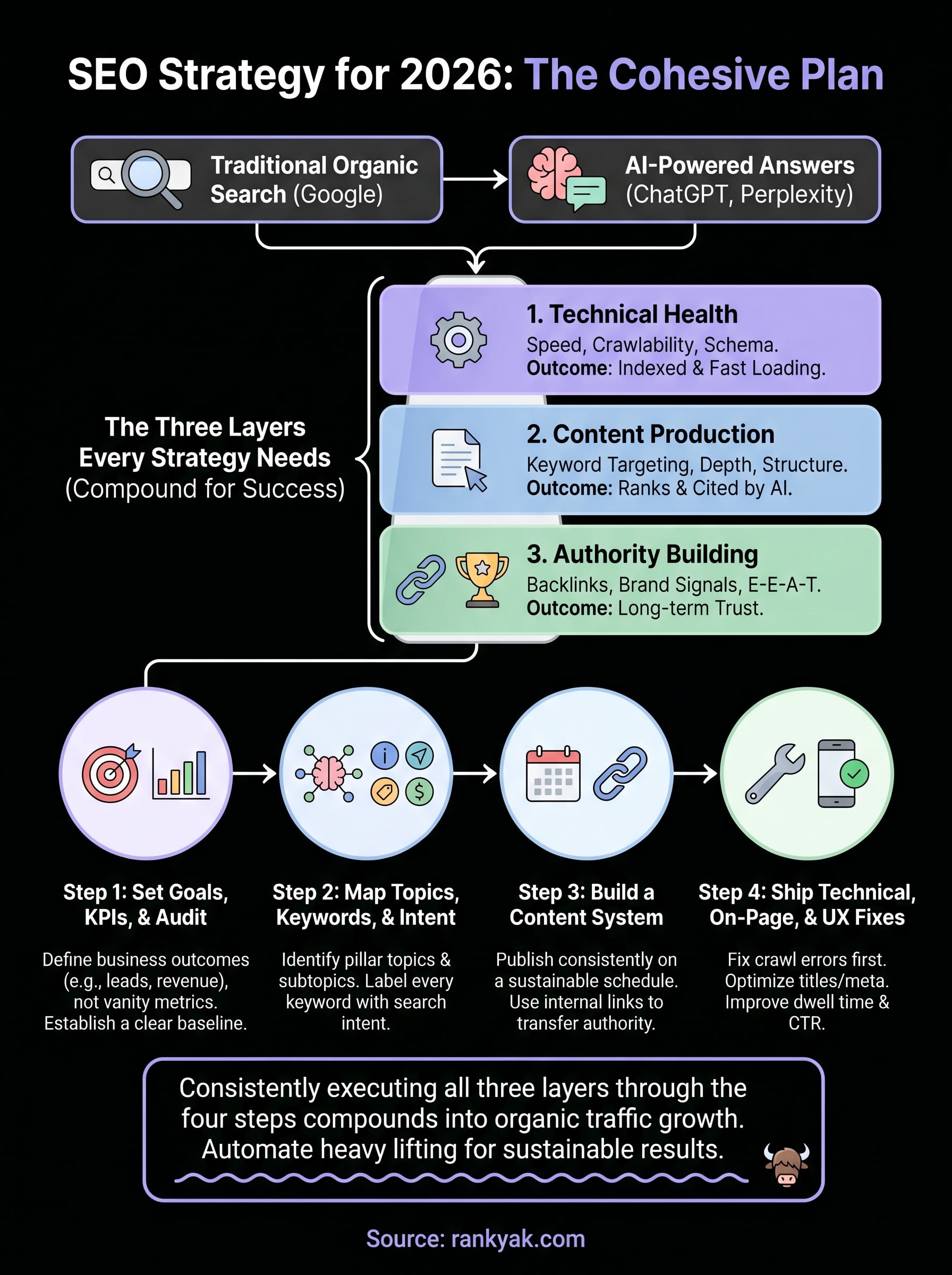
SEO in 2026 runs on two parallel tracks: traditional organic search on Google and AI-generated answers on platforms like ChatGPT, Perplexity, and Google's AI Overviews. When you figure out how to create SEO strategy today, you need to account for both. A page that ranks on page one of Google can also appear inside an AI answer, doubling your visibility. But weak content gets excluded from both channels at the same time.
The brands showing up in AI-generated answers aren't gaming a system - they've built real topical authority through consistent, well-structured content.
How Google's Ranking Systems Changed
Google's core ranking systems now weigh E-E-A-T signals (experience, expertise, authoritativeness, and trust) more heavily than keyword density or raw link counts. That shift accelerated significantly over the past two years. What this means practically is that thin, generic content won't hold a position for long, even if it temporarily ranks. Google's helpful content guidelines make this explicit: content should serve people first, with genuine depth and accuracy.
Your strategy needs to reflect this reality. Each piece of content you publish should answer a specific question completely, link to credible sources, and demonstrate real expertise. Topic clusters, where a pillar page covers a broad subject and supporting articles go deep on subtopics, have become the standard architecture for building topical authority systematically. Without this structure, individual pages compete against each other rather than reinforcing your site's overall authority.
What AI Search Requires
AI search engines pull answers from content that is clear, factual, and well-organized. They favor pages with explicit headings, concise answers near the top, and strong source credibility. If your content buries the main point deep in the article or uses vague language, it won't get cited by an AI model regardless of how it performs on traditional search.
The practical implication is that formatting and structure now carry real ranking weight. Use descriptive H2 and H3 headings. Put your most important answer within the first few paragraphs. Back up claims with data or links to authoritative sources. This approach lifts both Google rankings and AI visibility at the same time, so the effort compounds rather than splits.
The Three Layers Every Strategy Needs
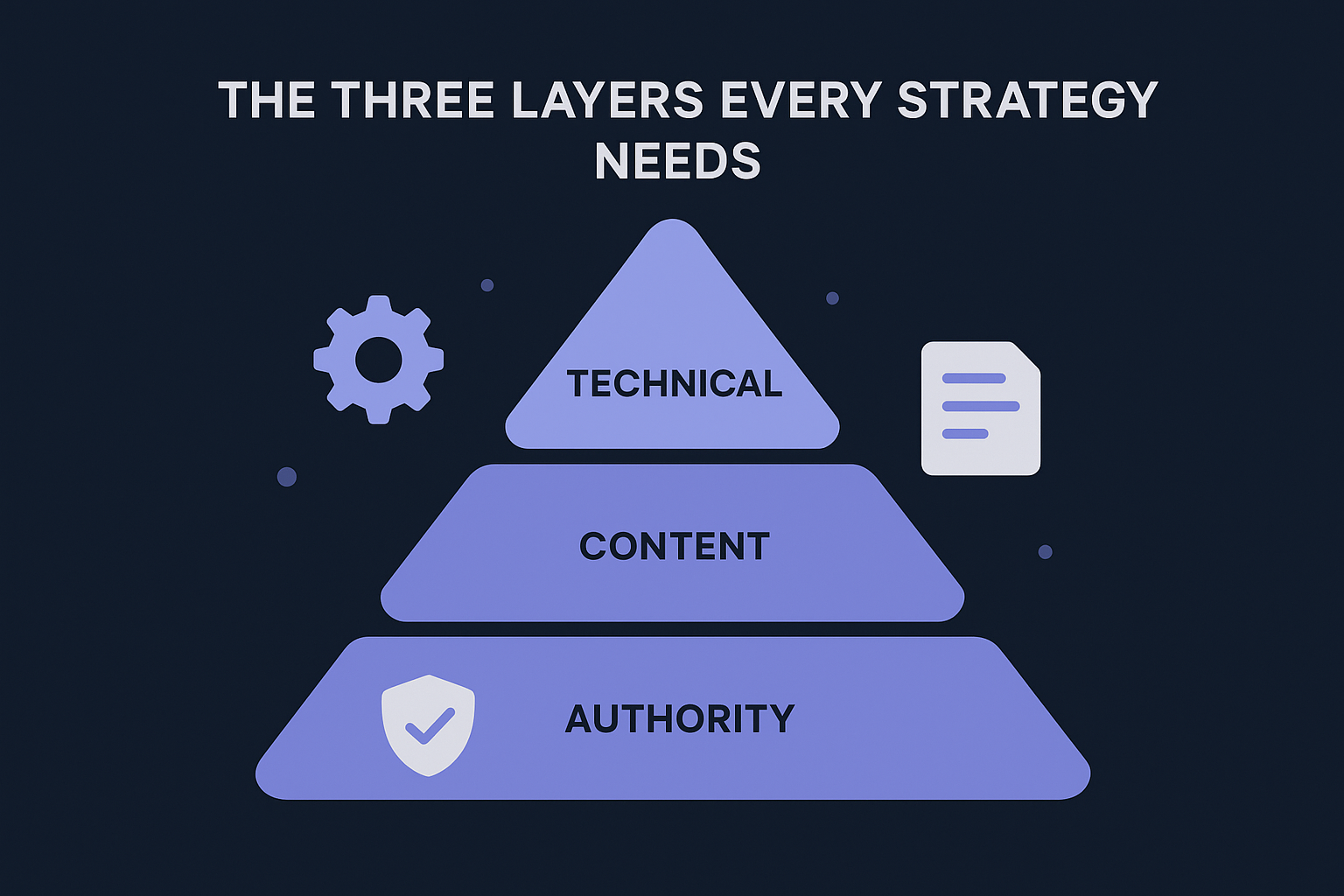
A modern SEO strategy operates on three layers: technical health, content production, and authority building. Technical health covers site speed, crawlability, mobile performance, and JSON-LD structured data. Content production means publishing consistently on topics your audience is actively searching for. Authority building involves earning backlinks and brand signals that communicate trust to both Google and AI systems.
| Layer | Core Focus | Primary Outcome |
|---|---|---|
| Technical | Speed, crawlability, schema markup | Pages get indexed and loaded fast |
| Content | Keyword targeting, depth, structure | Pages rank and get cited by AI |
| Authority | Backlinks, brand signals, E-E-A-T | Domain earns long-term trust |
Most sites that plateau have two of these layers working but neglect the third. Backlink building gets skipped because it's slow and difficult to scale, even though off-page SEO tactics are what earn long-term trust. Technical debt piles up when teams focus only on publishing new content. A strong strategy treats all three as non-negotiable priorities running in parallel, not sequentially.
Step 1. Set goals, KPIs, and a baseline audit
Before you touch a single keyword or publish a single article, you need to know what success looks like and where you're starting from. Skipping this step is how most teams end up six months into a strategy with no idea if it's working. When you learn how to create SEO strategy that actually holds up, this foundation is what makes everything measurable and repeatable.
Define your goals and KPIs
Your SEO goals should connect directly to business outcomes, not vanity metrics, so decide early how you will measure SEO performance. More traffic is not a goal. A 40% increase in organic leads from product pages over 12 months is a goal. Start with your core business objective, then work backward to the SEO metrics that predict it.
Use this framework to set your KPIs:
| Business Goal | Primary KPI | Secondary KPI |
|---|---|---|
| More leads | Organic form submissions | Rankings for intent-driven terms |
| More revenue | Organic-attributed revenue | Click-through rate on product pages |
| Brand awareness | Organic impressions | New users from organic search |
| Authority building | Referring domains | Pages ranking in top 10 |
Set a 90-day target for each KPI so you have a short feedback loop before committing to a full-year roadmap.
Run a baseline audit
You cannot measure progress without a clear starting point. Pull data from Google Search Console before you change anything on your site. Record your current impressions, clicks, average position, and the pages driving the most organic traffic right now.
Run through this baseline audit checklist, drawn from a fuller SEO audit checklist:
- Total indexed pages vs. pages with actual organic clicks
- Top 10 pages by organic clicks, including current keywords and positions
- Average Core Web Vitals scores across your key page templates
- Mobile usability errors flagged inside Search Console
- Current referring domain count and your top linking pages
- Any manual actions or security issues active in Search Console
Once you have this data logged, you have a real benchmark to compare against at 30, 60, and 90 days. Without it, every decision you make rests on assumptions rather than evidence, and assumptions don't compound into rankings.
Step 2. Map topics, keywords, and search intent
Keyword research without a topic map is just a list of words. When you're working out how to create SEO strategy that holds its rankings, building a topical map is the step that turns scattered keywords into a structure that builds authority over time. Start by identifying the core themes your business needs to own, then use step-by-step keyword research to find the specific keywords that live inside those themes.
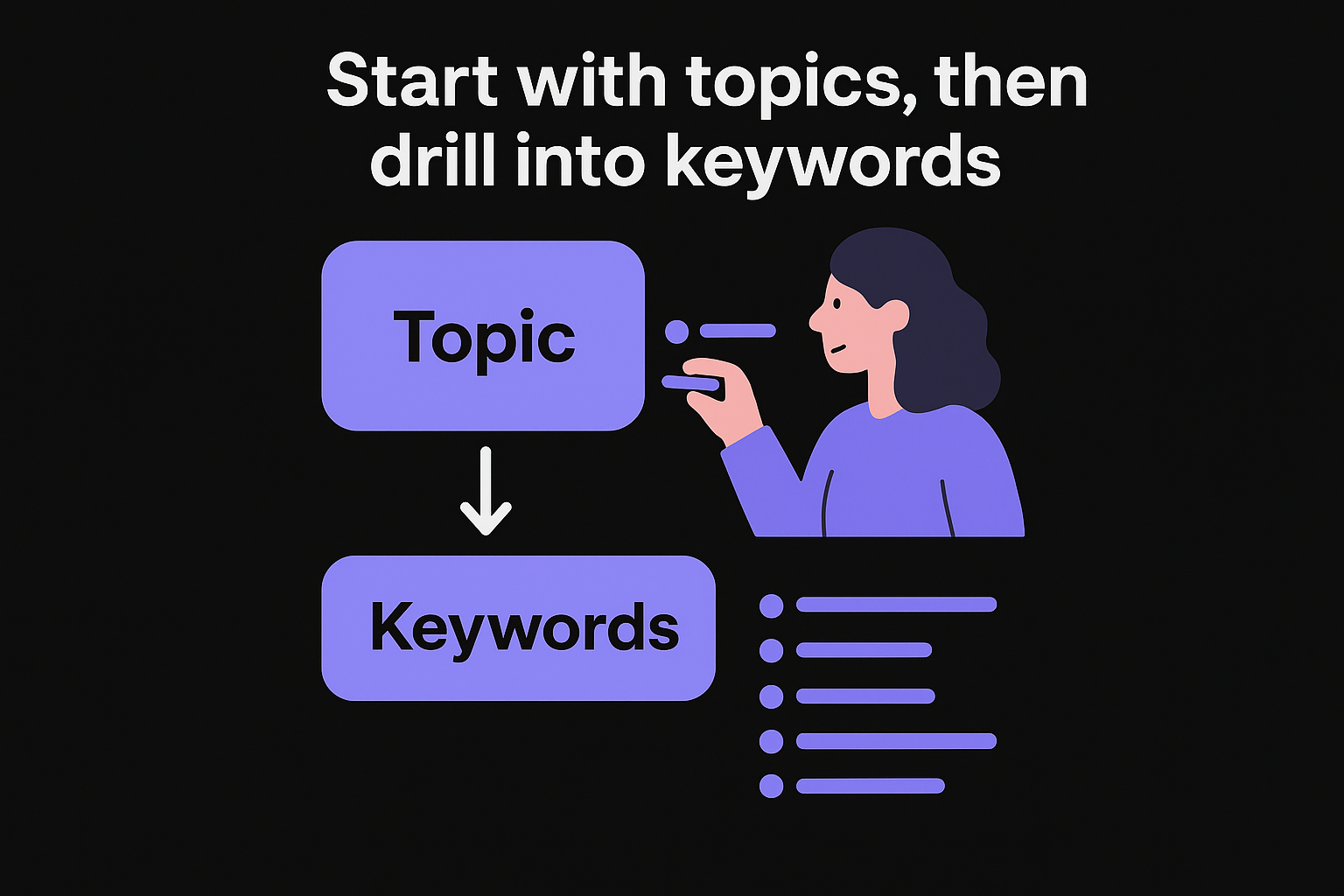
Start with topics, then drill into keywords
Pick three to five broad topic areas that match your product or service. Each topic becomes a pillar page that targets a high-volume, competitive keyword. Under each pillar, you identify supporting subtopics that target long-tail, lower-competition keywords with clear search demand. This content pillar strategy tells Google that your site covers a subject in depth, which builds topical authority faster than publishing disconnected articles.
A single pillar page paired with eight to ten supporting articles will outperform twenty unrelated posts targeting random keywords.
For a project management software company, the topic map might look like this:
| Pillar Topic | Example Pillar Keyword | Supporting Subtopic Example |
|---|---|---|
| Project planning | project planning software | how to create a project timeline |
| Team collaboration | team collaboration tools | how to run a remote standup meeting |
| Task management | task management system | how to prioritize tasks at work |
Match every keyword to a search intent
Every keyword you add to your plan needs a clear intent label before you write a single word. Google's search results tell you exactly what intent a keyword carries: look at the top five results and ask yourself whether they are blog posts, product pages, comparison pages, or video results. That format is your content format signal.
Use these four intent categories to label each keyword in your plan:
- Informational: the user wants to learn something (how-to guides, explainers)
- Navigational: the user is looking for a specific brand or site
- Commercial: the user is comparing options before buying (best X for Y)
- Transactional: the user is ready to act (buy, sign up, download)
Publishing the wrong content format for a keyword's intent is one of the fastest ways to rank on page three indefinitely, regardless of how well-structured the article is.
Step 3. Build a content system that compounds
Keyword research gives you a map, but consistent publishing is what makes the map pay off. One article a month won't build topical authority. A content system, where you publish on a reliable schedule, link pieces together deliberately, and refresh older content before it decays, is how you turn individual articles into compounding organic traffic over time. This step is where most sites either separate themselves from competitors or fall back to mediocrity.
Publish on a schedule your site can sustain
When you figure out how to create SEO strategy that scales, publishing frequency matters more than most people admit. Google rewards consistent signals of site activity. A site publishing three well-structured articles per week will outpace a site publishing one poorly-planned article per month, assuming quality stays high across both. The key word is sustainable: set a pace you can maintain for 12 months, not a sprint you'll drop after six weeks.
The best publishing frequency is the one you can hold without sacrificing the quality that earns rankings.
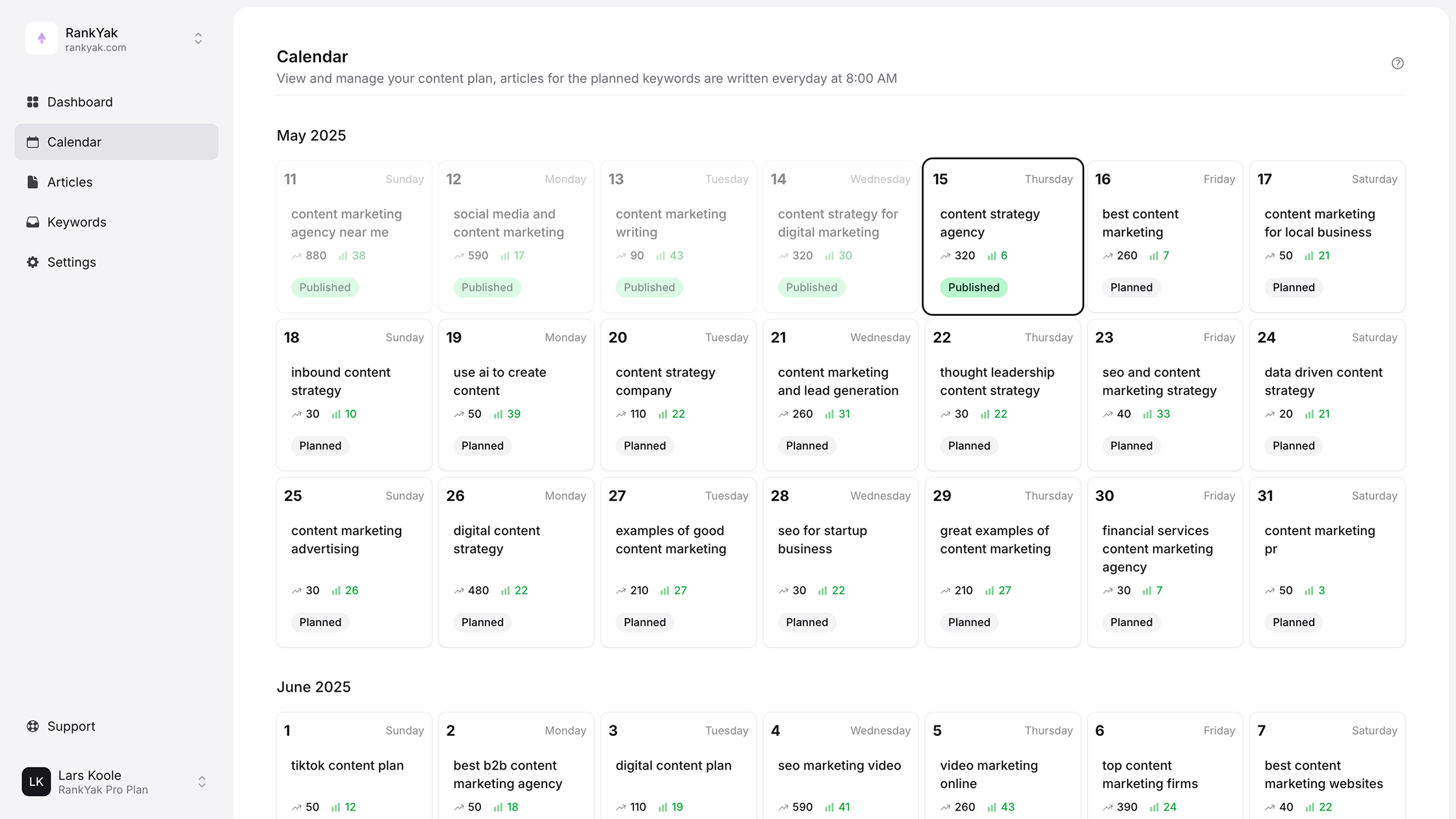
Use this template to map your monthly content output against your topic pillars, or let an automated content plan schedule it for you:
| Week | Content Type | Target Keyword | Pillar Topic |
|---|---|---|---|
| Week 1 | Pillar page | [broad head term] | Topic A |
| Week 2 | Supporting article | [long-tail subtopic] | Topic A |
| Week 3 | Supporting article | [long-tail subtopic] | Topic A |
| Week 4 | Supporting article | [long-tail subtopic] | Topic B |
Use internal links to transfer authority
Every new article you publish should link to at least two to three existing pages on your site, and at least one existing page should link back to it. This internal linking practice tells Google how your content relates to itself, accelerating topical authority signals across the entire cluster. Without deliberate internal linking, your pillar pages won't receive the authority signals they need to rank for competitive head terms.
Audit your internal links every 90 days. Pull your top 10 ranking pages from Google Search Console and check whether each one links out to relevant supporting articles and receives links from them. Fix gaps before they erode the authority you've built.
Step 4. Ship technical, on-page, and UX fixes
Technical fixes rarely get the attention they deserve in most "how to create seo strategy" conversations, but they're often the fastest wins available. Crawl issues, slow load times, and broken internal links hold back pages that would otherwise rank. Before you invest another hour into new content, work through the fixes in this step so your existing pages can reach their actual ranking potential.
Fix your core technical issues first
Google needs to crawl, index, and serve your pages correctly before content quality matters at all, which is exactly what a practical technical SEO checklist covers. Pull your crawl report from Google Search Console, then work through this checklist in order:
- Indexing errors: Fix any "Excluded" pages that should be indexed, especially pillar and product pages
- Core Web Vitals failures: Address Largest Contentful Paint (LCP) above 2.5 seconds and Cumulative Layout Shift (CLS) above 0.1 first
- Broken internal links: Replace or remove any 404s inside your internal link structure
- Missing XML sitemap: Submit a clean sitemap through Search Console so Google discovers new content faster
- Duplicate content: Add canonical tags to pages sharing the same or very similar content
Fixing one critical crawl error can unlock ranking movement faster than publishing ten new articles.
Optimize on-page elements for every target keyword
Title tags and meta descriptions are the first elements Google reads when evaluating page relevance. Every page targeting a specific keyword needs a unique title tag under 60 characters that includes the target keyword near the front, and a Google result preview shows whether it fits before you publish. Use this template for each page you optimize:
| Element | Template | Example |
|---|---|---|
| Title tag | [Target Keyword] + [Benefit or Modifier] | How to Create SEO Strategy: 2026 Checklist |
| Meta description | [Specific promise, under 155 characters] | Build an SEO strategy that ranks with this step-by-step checklist. |
| H1 | Match title intent, vary the phrasing | Build an SEO Strategy That Actually Ranks in 2026 |
Improve UX signals that affect rankings
Dwell time and click-through rate are behavioral signals Google uses to validate whether a page satisfies the searcher. A page that loads fast but buries its main point sends readers back to search results immediately. Keep your most valuable content above the fold, use short paragraphs, and add a clear table of contents on any page exceeding 1,000 words to reduce bounce rate and hold attention long enough to trigger positive ranking signals.
Wrap-up and next steps
Building an SEO strategy that holds in 2026 comes down to four connected steps: set measurable goals and a baseline, map keywords to search intent, publish on a sustainable schedule, and fix the technical issues blocking your existing pages. Every step in this guide feeds the next. Skip one, and the entire system underperforms.
The hardest part of figuring out how to create SEO strategy is not understanding the framework. It's executing consistently over months without letting production slow down. That's where most sites lose ground, not from bad strategy, but from inconsistent follow-through. RankYak handles that gap by automating keyword discovery, daily article creation, and publishing across your CMS so your content plan runs without constant manual input.
If you want organic traffic that grows while you focus on your business, let RankYak run your SEO strategy on autopilot with a free 3-day trial and let the system do the heavy lifting.
Lars Koole is a co-founder of RankYak and has worked in SEO since 2021, on the side where a strategy has to become a live page: inside agencies, alongside them, for clients directly, and in-house on the products being ranked. He is a software engineer by trade, which is how that page gets built. Before RankYak he founded companies of his own, two of which were acquired. At RankYak he owns the engineering and everything AI, and works out the solution and the implementation of each new feature.