SaaS SEO Strategy: A Step-By-Step Framework for Growth
Most SaaS companies treat SEO like a side project, a few blog posts here, some keyword stuffing there, and then frustration when nothing ranks. The problem isn't effort. It's the lack of a structured SaaS SEO strategy built around how buyers actually search, evaluate, and choose software. SaaS search behavior is unique: longer sales cycles, high-intent comparison queries, and content needs that span every stage of the funnel.
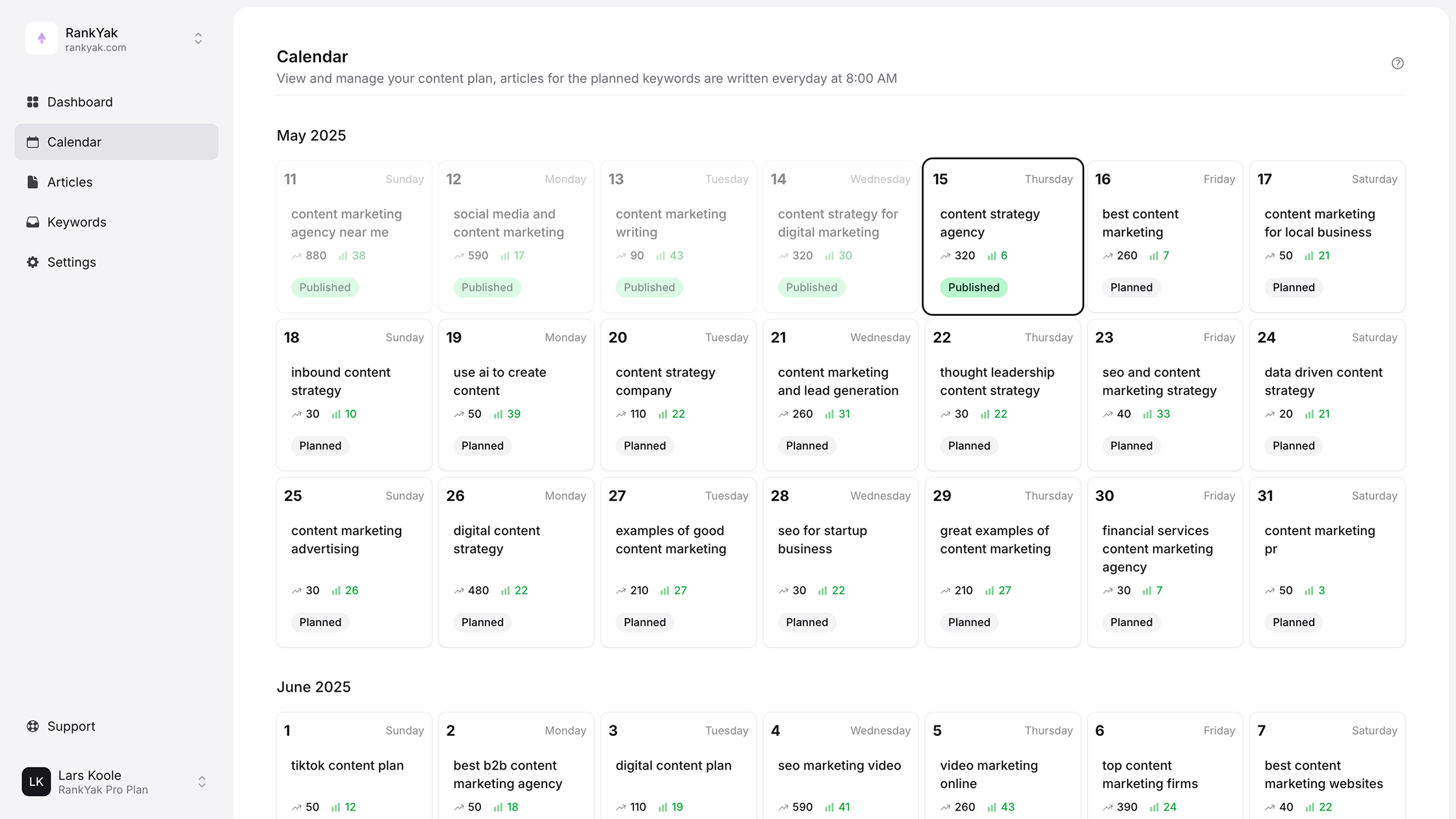
Getting this right means more than just "doing content marketing." It means mapping keywords to buyer stages, building topic authority, and publishing consistently enough to compound results over time. That's exactly the kind of execution we built RankYak to automate, from keyword discovery to daily publishing, because we know firsthand how resource-intensive a proper SaaS SEO engine really is.
This guide breaks down a complete, step-by-step framework for building an SEO strategy that drives real organic growth for your SaaS business. You'll walk away with a clear playbook covering keyword research, content planning, on-page optimization, technical foundations, link building, and measurement. No theory dumps, just the practical structure you need to start ranking and acquiring customers through search.
What a SaaS SEO strategy must do
A generic SEO strategy optimizes for rankings and traffic. A SaaS SEO strategy does something harder: it ties every piece of search content directly to revenue-driving actions, whether that's a free trial signup, a demo request, or a product activation. Most SaaS companies pour effort into blog posts that attract broad audiences but never convert. You need a framework where every page earns its place by moving someone closer to becoming a paying customer.
The structure of your strategy also needs to account for something most content marketing advice ignores: SaaS buyers research extensively before they ever talk to sales. They compare tools, read reviews, search for alternatives, and look for tutorials. Your SEO program needs to show up at every one of those research moments, not just at the top of the funnel.
Drive signups, not just traffic
The first job of a SaaS SEO program is to connect organic search directly to business outcomes. That means you set conversion goals that go beyond ranking position or monthly visitors. For each content type you produce, define the action you want the reader to take: start a trial, book a demo, or visit a pricing page. Without this alignment, you'll end up building an audience that reads your blog and never touches your product.
Every page you publish needs a clear next step that pulls the reader toward your product, even if that step is just visiting a relevant feature page.
A practical way to enforce this is to attach a specific, relevant call-to-action to every page based on its topic. A post about "email automation for ecommerce" should link to your email automation feature, not your homepage. Map your CTAs to content topics before you write anything, so conversion is built into the structure from the start.
Cover every stage of the buyer funnel
Your keyword strategy needs to span awareness, consideration, and decision stages, because SaaS buyers rarely search once and buy immediately. At awareness, they search around problems: "why is my churn rate high." At consideration, they compare solutions: "best customer success software." At decision, they evaluate you specifically: "YourTool vs CompetitorTool" or "YourTool pricing."
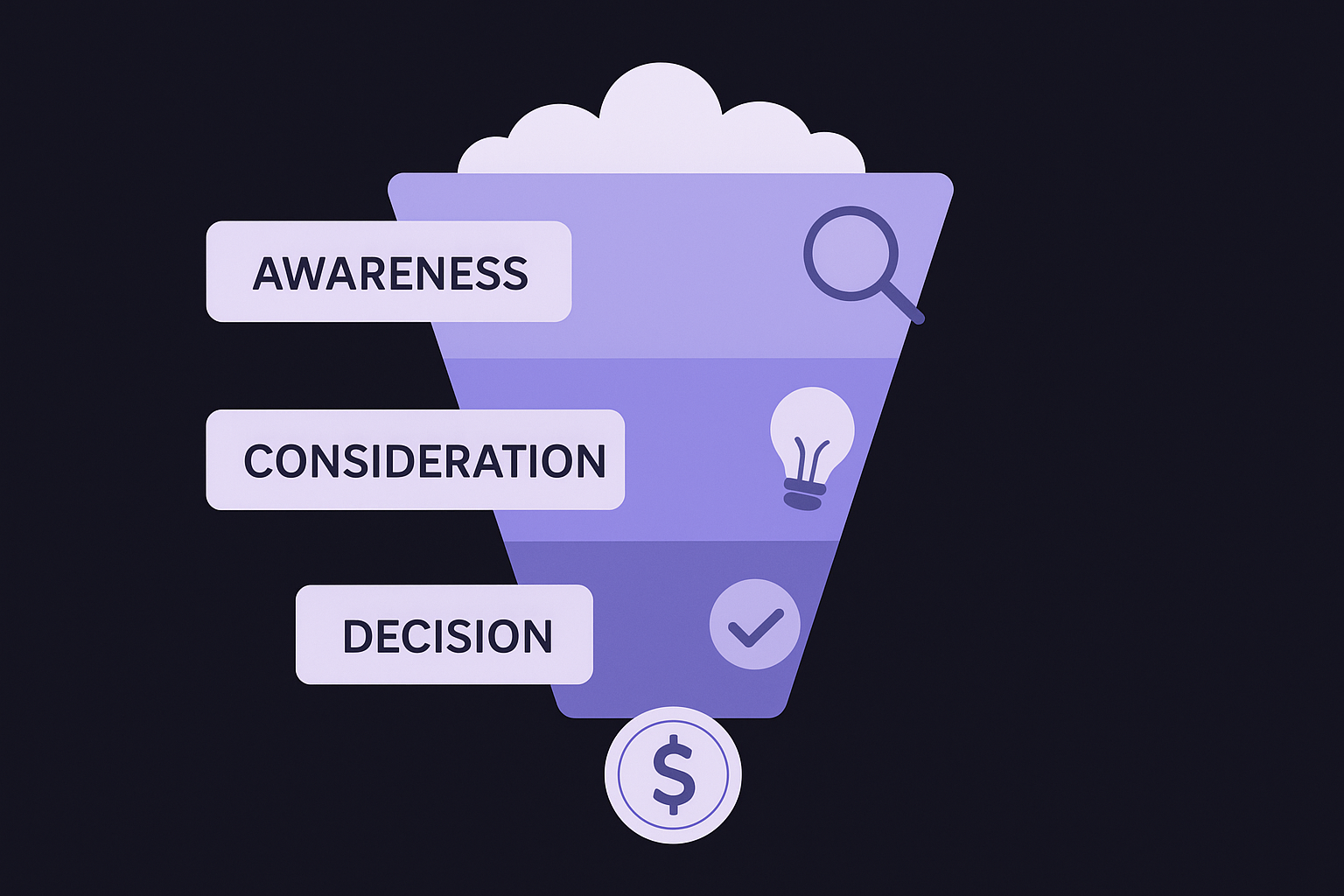
Building content across all three stages keeps you visible throughout the entire research journey, not just when someone first discovers a problem. Use this breakdown to organize your keyword list:
| Funnel Stage | Example Query Type | Primary Goal |
|---|---|---|
| Awareness | "how to reduce SaaS churn" | Build trust, capture early interest |
| Consideration | "best SaaS analytics tools" | Position your product as a strong option |
| Decision | "YourTool vs Competitor" | Convert informed buyers |
Build compounding topical authority
Search engines reward sites that cover a topic comprehensively, which is how topical authority gets built, not sites that publish one strong post and stop. The way you build this authority is through topic clusters: a central pillar page that covers a broad subject, supported by cluster pages that go deep on related subtopics. Each cluster page links back to the pillar, and the pillar links out to cluster pages, creating a tight web of relevance.
For a SaaS product, your pillar pages typically align with core use cases or product categories, and a map of pillars and supporting articles makes that alignment obvious before you write anything. If you sell project management software, a pillar might be "project management for remote teams," with clusters covering time tracking, task assignment, and async communication. Over time, this structure signals to search engines that your site is the authoritative resource in your space, which compounds your ability to rank across the entire cluster rather than just individual pages.
Step 1. Align SEO with your SaaS business model
Before you touch a keyword tool or brief a writer, you need to ground your SaaS SEO strategy in the specific economics of your business. SaaS companies succeed with SEO when they target the right accounts, not just the highest search volumes. If your product serves mid-market finance teams, ranking for a keyword driven by freelancers wastes your entire content budget. Alignment starts with knowing who you're actually trying to attract and filtering every SEO decision through that lens.
Define your ICP before you target any keyword
Your ideal customer profile shapes every part of your keyword strategy. Before building any content plan, write out the specific characteristics of the customer who creates the most revenue for your business: their industry, company size, job title, and the core problem they're trying to solve. Then map that profile to how they search.
The keywords your ICP uses are often different from the keywords your product team thinks they use, so validate with real data, not assumptions.
Use this ICP-to-keyword template as your starting point:
| ICP Attribute | Example | Keyword Signal |
|---|---|---|
| Industry | B2B SaaS | "SaaS churn reduction" |
| Job title | Head of Customer Success | "customer success playbook" |
| Company size | 50-500 employees | "scalable onboarding software" |
| Core problem | High churn rate | "why customers cancel subscriptions" |
Fill this in before you run any keyword research. It keeps your content pipeline focused on buyers, not browsers.
Connect your SEO metrics to revenue
Most SaaS teams track rankings and traffic, then wonder why neither number shows up in the board meeting. You fix this by building a reporting layer that connects organic search activity to pipeline metrics like trial signups, demo requests, and activated accounts. Set up conversion tracking in Google Analytics 4 so every organic session that leads to a signup gets attributed correctly, and decide up front how you will track SEO performance month to month.
Your core measurement framework should include three numbers: organic-attributed signups per month, trial-to-paid conversion rate from organic traffic, and revenue influenced by organic sessions. When you track these, you stop optimizing for clicks that go nowhere and start making content decisions based on what actually drives customers into your product. That shift in measurement changes which pages you build, which topics you prioritize, and how you evaluate whether your SEO investment is working.
Step 2. Build your technical SEO foundation
Technical SEO is the floor your entire SaaS SEO strategy sits on. If search engines can't crawl, render, or index your pages correctly, none of your keyword research or content work will produce results. Before you invest a single hour in content creation, run a full technical SEO audit step by step to confirm your site gives Google clean, unobstructed access to every page that matters.
Audit crawlability and indexing
Your first move is identifying what Google can and can't access on your site. Open Google Search Console and check the Indexing report to surface pages that are excluded, noindexed, or returning errors. A properly configured robots.txt file tells crawlers which paths to skip, while your XML sitemap tells them which pages to prioritize.
Here's a minimal, correct robots.txt for a typical SaaS site, and you can build a valid robots.txt for your own paths in a couple of minutes:
User-agent: *
Disallow: /admin/
Disallow: /checkout/
Disallow: /account/
Disallow: /api/
Allow: /

Sitemap: https://yoursite.com/sitemap.xml
Block paths with zero SEO value like admin panels, checkout flows, and user dashboards so your crawl budget concentrates on revenue-driving pages.
Once your robots.txt is clean, validate your XML sitemap and submit it in Google Search Console under the Sitemaps tab. Confirm that every high-value page, including feature pages, landing pages, and blog posts, returns a 200 HTTP status code and carries no accidental noindex tag. A single misplaced noindex on a pillar page can wipe out months of work.
Fix Core Web Vitals
Core Web Vitals are Google's page experience signals, and they directly affect how your pages compete in search results. The three metrics you need to pass are Largest Contentful Paint (LCP), which measures how fast your main content loads; Cumulative Layout Shift (CLS), which measures visual stability; and Interaction to Next Paint (INP), which measures how quickly your page responds to user input.
Check your scores in Google Search Console under the Experience section, or run individual pages through PageSpeed Insights. For most SaaS sites, the fastest gains come from three changes: converting images to WebP format, enabling browser caching at the server level, and deferring non-critical JavaScript. If your product marketing site runs on a JavaScript-heavy framework like React or Vue, confirm that server-side rendering or static site generation is active so Google receives fully rendered HTML rather than an empty page shell that bots can't read.
Step 3. Fix site structure and internal linking
Your site structure determines how search engines and visitors navigate your content. A flat, logical architecture makes it easy for Google to discover every page quickly, while a tangled hierarchy buries important pages under layers of unnecessary clicks. In any strong SaaS SEO strategy, your site architecture also signals topic relevance: pages sitting closer to the root domain tend to carry more authority and get crawled more frequently than deep, poorly linked pages.
Design a flat URL hierarchy
Most SaaS sites suffer from URL depth problems. If a visitor clicks five times from your homepage to reach a core feature page, that page sits too deep for search engines to treat as important. A flat hierarchy keeps every significant page within three clicks of the homepage, which is what good site architecture for SEO does: it concentrates crawl budget on the pages that actually drive trials and signups.
Structure your URLs so they communicate the topic clearly: /blog/category/post-title works far better than /blog/?p=1234 for both crawlers and readers.
Build your top-level structure around four primary buckets:
- Product pages: /features/, /pricing/, /integrations/
- Solution pages: /solutions/use-case/ or /for/industry/
- Content hub: /blog/category/post-title
- Comparison pages: /compare/competitor-name
This structure keeps related pages grouped logically, reinforces your topic clusters, and supports crawl budget optimization by preventing crawl budget from leaking into orphaned or redundant pages.
Use internal links to pass authority
Internal linking is how page authority flows across your site. When your high-traffic blog posts link to feature pages, they transfer ranking power directly to the pages where conversions happen. Most SaaS teams treat internal links as an afterthought, but a deliberate internal linking plan is one of the highest-leverage wins available without touching your content strategy at all.
Each piece of content you publish should include three to five internal links: at least one pointing to a related pillar page, one pointing to a relevant feature or solution page, and one pointing to a related cluster article. Use descriptive anchor text that matches the target page's primary keyword. Link to your onboarding feature page using anchor text like "automated onboarding workflows" rather than vague phrases like "learn more."
Audit your existing content for internal link gaps using Google Search Console's Pages report combined with a site crawl. Any page with zero internal links pointing to it is effectively invisible to your site's authority flow and needs a connection added immediately.
Step 4. Map the buyer journey to search intent
Understanding search intent is what separates a SaaS SEO strategy that drives signups from one that just drives pageviews. Every search query carries an intent signal, and that signal tells you exactly where the searcher sits in the buying process. When you align your content format and message to that intent, you stop publishing pages that rank but fail to convert.
Match query types to funnel stages
Search intent falls into three practical categories for SaaS, out of the broader types of keywords in SEO: informational, commercial, and transactional. Informational queries signal a buyer identifying a problem. Commercial queries signal a buyer evaluating options. Transactional queries signal a buyer ready to act. Each type demands a different content approach, and mixing them up is one of the most common reasons SaaS content underperforms despite strong rankings.
The searcher's intent, not your product's features, should drive every content decision you make.
Use this mapping table to categorize your target keywords before you write a single word:
| Intent Type | Example Query | Buyer Stage | Goal |
|---|---|---|---|
| Informational | "how to reduce customer churn" | Awareness | Educate, build trust |
| Commercial | "best churn analytics software" | Consideration | Position your product |
| Transactional | "YourTool free trial" | Decision | Drive direct action |
Assign content types to each intent
Once you categorize your keywords by intent, assign a specific content format to each category. Informational keywords deserve educational long-form guides, tutorials, or explainer posts that answer the question completely and end with a soft CTA pointing to a relevant feature page. Commercial keywords need comparison articles, use case pages, or roundup posts where your product appears in context alongside alternatives, giving you a real shot at converting informed buyers.
Transactional keywords need your highest-conversion pages: dedicated landing pages, free trial signup flows, and demo request pages with minimal friction and a single clear action. Avoid sending transactional traffic to blog posts. When someone searches "YourTool pricing," send them to your pricing page, not an article about pricing strategy. Here is a simple assignment template you can use for every keyword before it enters production:
Keyword: [target keyword]
Intent type: [informational / commercial / transactional]
Content format: [guide / comparison / landing page]
Target CTA: [read related post / start trial / book demo]
Primary internal link: [feature page / pillar page / pricing]
Fill this out for every keyword before it enters your content production queue, and each page will arrive with a clear purpose built in before anyone writes the first word.
Step 5. Build a keyword universe you can win
Most SaaS keyword lists grow from curiosity rather than strategy. You search for obvious terms, pull whatever has high volume, and end up with a list that reads like a competitor's homepage. A stronger approach builds a keyword universe by filtering every term through two criteria: can your site realistically rank for it, and does it attract people who would actually pay for your product? That combination is what a focused SaaS SEO strategy demands at the research stage.
Your keyword list is only as strong as the filters you apply to it, so build the filter before you build the list.
Prioritize by difficulty and business fit
Every keyword you consider needs to pass two tests before it earns a spot in your plan. The first test is keyword difficulty: compare your site's current domain authority against the sites ranking on page one. If every result comes from enterprise publications with thousands of backlinks and your site is six months old, skip that keyword and find low difficulty keywords instead. The second test is business relevance: assign each keyword a score from one to three based on how directly it connects to your product's core value.
Use this scoring template to evaluate every keyword before it enters your pipeline:
Keyword: [target keyword]
Monthly search volume: [number]
Keyword difficulty (0-100): [score]
Business fit (1=low, 2=medium, 3=high): [score]
Funnel stage: [awareness / consideration / decision]
Verdict: [include / exclude / revisit when DA grows]
Target keywords with difficulty scores your site can compete with now, then add a "revisit" column for high-difficulty terms you plan to chase in six to twelve months as your authority grows.
Group keywords into topic clusters
Once you filter your list, organize remaining keywords into clusters built around a central theme rather than treating each keyword as an isolated target, or group a keyword list into clusters automatically. Each cluster needs one pillar keyword that anchors a comprehensive page, plus three to eight related keywords that feed supporting articles. This structure signals topical depth to search engines and prevents your pages from competing against each other for the same queries.
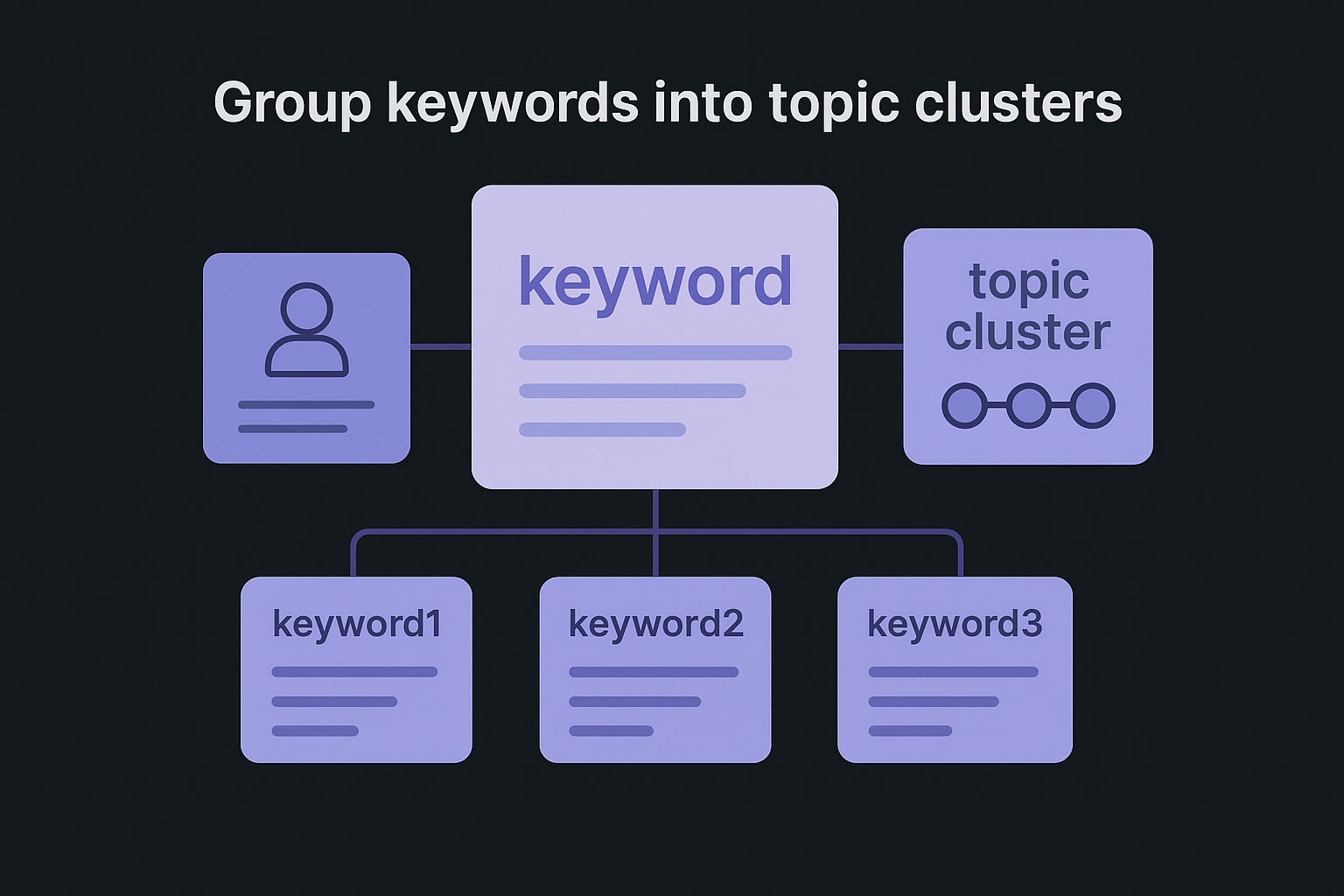
A practical way to cluster is to sort your keyword list by shared noun phrases. Keywords containing "customer onboarding" cluster together. Keywords containing "SaaS pricing" form their own group. Run through your full list this way, and your content calendar will organize itself naturally around topics that reinforce each other rather than a random collection of individual posts.
Step 6. Create pages that convert
Ranking is only half the job. A well-ranked page that fails to convert wastes every link you built and every piece of content you published to get there. Your SaaS SEO strategy needs landing pages and feature pages that pull organic visitors toward a clear action, whether that's starting a trial or booking a demo. Publishing great content without building pages designed for conversion is the fastest way to generate traffic that never touches your product.
Structure your landing pages for action
Your highest-converting pages share a common structure. Lead with the problem your buyer is experiencing, not with your product's feature list. Visitors arriving from organic search already know they have a problem; your page needs to confirm you understand it within the first two sentences. Follow that with a direct explanation of how your product solves it, then a CTA above the fold before the reader scrolls anywhere.

Every element above the fold should serve one purpose: moving the visitor toward your primary CTA, nothing else.
Use this template for any feature or solution landing page:
[H1] - Outcome-focused headline (what the user achieves)
[Subheadline] - One sentence on how you deliver that outcome
[Primary CTA] - Trial, demo, or signup button above the fold
[Problem section] - 2-3 sentences describing the specific pain
[Solution section] - Feature explanation tied directly to pain points
[Social proof] - Testimonials, logos, or case study snippet
[Secondary CTA] - Repeat the primary action at the bottom
Remove friction from the conversion path
Friction kills conversions more reliably than weak copy does. Every extra form field, every unnecessary redirect, and every ambiguous CTA reduces the percentage of organic visitors who complete the desired action. Audit each page by counting the number of steps between a visitor landing and finishing the action you want them to take.
For trial signups, the ideal form asks for email only on the first step and collects billing and profile information after activation. For demo requests, reduce your form to name, work email, and company size. Anything beyond that adds drop-off without adding meaningful lead qualification at this stage. Run structured A/B tests on your CTAs, testing one variable at a time, such as button copy, button color, or placement, to identify which combination drives the most completions against your current baseline before rolling out any change site-wide.
Step 7. Publish content that earns rankings
Publishing consistently separates SaaS companies that build compounding organic traffic from those stuck refreshing the same stale rankings. Your content quality determines whether a page earns a top position, and your publishing frequency determines how fast your site accumulates the topical authority that sustains those positions. Both matter, and your SaaS SEO strategy needs a clear system for producing content that checks both boxes every time.
Write for search intent first, readers second
Before you write anything, confirm exactly what the top-ranking pages deliver for your target keyword. Open a private browser window, search the keyword, and read the top three results carefully. Note the format they use, the subheadings they cover, and the approximate depth of each article. That analysis tells you the minimum bar you need to clear, not copy, but meet and surpass on depth, clarity, and usefulness.
Matching search intent is not optional. If the top results are listicles and you publish a 3,000-word narrative guide, Google will deprioritize your page regardless of its quality.
Use this writer-ready content brief template before writing any piece:
Keyword: [target keyword]
Search intent: [informational / commercial / transactional]
Format of top results: [guide / listicle / comparison / landing page]
Required subheadings (from top results): [list them]
Minimum word depth: [estimated from top results]
Unique angle: [what you cover that competitors miss]
Primary CTA: [trial / demo / feature page]
Internal links to include: [3-5 specific pages]
Fill out this brief for every article before production begins, and your writers will have a clear target rather than guessing at structure or scope.
Maintain a publishing cadence that compounds
Sporadic publishing produces sporadic results. Search engines reward sites that publish consistently because regular, fresh content signals an active and authoritative source worth surfacing. Set a fixed weekly publishing schedule you can actually maintain, whether that is one article a week or five, and hold to it without gaps, or publish against a rolling schedule you never have to maintain.
Track your publishing cadence inside a simple content calendar that records the keyword, publish date, live URL, and ranking status for every piece. Review this calendar monthly to identify which topics are gaining traction fastest and double down on those clusters by scheduling two to three follow-up articles in the same theme. Consistency over time is what turns individual articles into a ranking asset that grows even when you stop actively promoting it.
Step 8. Earn authority with links and PR
Backlinks remain one of the strongest ranking signals in any SaaS SEO strategy. When authoritative sites link to your pages, they transfer trust and relevance that your content alone cannot generate. Building that authority requires two parallel tracks: direct outreach to acquire links from specific sites and digital PR to earn editorial mentions at scale. Run both consistently, and your domain's ability to compete for high-difficulty keywords grows month over month.
Build links through targeted outreach
Your starting point is identifying pages on other sites that already link to content similar to yours. Use Google Search to find relevant resource pages by searching inurl:resources "SaaS tools" or intitle:"best tools" "project management" and replacing the category with your product's core use case. These pages actively maintain link lists, making them far more receptive to outreach than cold pitches to editorial writers, which is why a resource page link building guide is worth following closely.
The best outreach emails are short, specific, and make the value exchange obvious to the recipient in under ten seconds.
Once you identify target pages, send a concise outreach email using this template:
Subject: Resource suggestion for [page title]

Hi [First Name],

I found your [page title] page while researching [topic].
You link to [existing linked resource], and I thought you might
also find our [your content title] useful for your readers.

It covers [one sentence on what it adds that the existing resource misses].

Here's the link: [your URL]

Happy to return the favor if you have content I can share with
our audience.

[Your name]
[Title, Company]
Send this to ten to fifteen targeted contacts per week rather than blasting hundreds of low-quality prospects. A smaller, relevant list consistently outperforms high-volume spray-and-pray outreach in link acquisition.
Use digital PR to earn editorial links
Digital PR campaigns that earn links target journalists, newsletter writers, and industry publications by giving them original data or expert commentary worth citing. The fastest way to generate this material is through original research: survey your existing customers about a trend in your market, compile the results into a short report, and pitch the findings to publications that cover your industry.
Your pitch email should lead with the data point, not your company. Journalists link to sources because the information serves their readers, not because you asked nicely. Package your research as a downloadable PDF hosted on your site, and every publication that cites it links directly to your domain, building editorial authority that paid placements cannot replicate.
Step 9. Measure, iterate, and refresh content
Publishing content is not the final step in a SaaS SEO strategy. Measuring what each page actually delivers and responding to what you find is what determines whether your organic growth compounds or stalls. Most SaaS teams check rankings occasionally and call that reporting. A measurement system that drives action looks at ranking movement, organic conversions, and content decay together, then feeds those findings directly back into your publishing queue.
Track the metrics that signal real progress
Your reporting needs to connect three data layers: search performance in Google Search Console, conversion activity in Google Analytics 4, and ranking trends from a keyword tracking tool. Review these on a fixed monthly schedule rather than reacting to daily fluctuations. Set up a simple tracking sheet that records each page's key numbers in one place so trends become visible over time.
A page that ranks seventh and converts at three percent outperforms a page that ranks first and converts at zero, so never optimize for position alone.
Use this monthly tracking template for every high-priority page:
Page URL: [url]
Target keyword: [keyword]
Current ranking position: [position]
Impressions (last 30 days): [number]
Clicks (last 30 days): [number]
CTR: [percentage]
Organic conversions (trial / demo): [number]
Month-over-month ranking change: [+/- positions]
Action required: [refresh / promote / leave / retire]
Fill this out for your top twenty to thirty pages each month, and patterns in which content types earn the most conversions will surface within two to three review cycles.
Refresh content before it loses ground
Content decay is predictable. Any page more than twelve months old starts to lose ranking ground as fresher content enters the results and competitors update their existing pages. You do not need to rewrite the full article to recover lost ground. Identify pages that have dropped three or more positions since their peak, or let an audit find the pages losing ground for you, then update the sections that have become outdated, add new examples, expand thin sections, and confirm all internal links still point to relevant live pages.
Prioritize your refresh queue by revenue impact. Start with the pages driving the most organic trial signups from the previous quarter, because recovering one high-converting page often produces more measurable growth than publishing five new articles on topics with unproven conversion rates. Run your full refresh cycle quarterly so no high-value page sits untouched for more than six months.
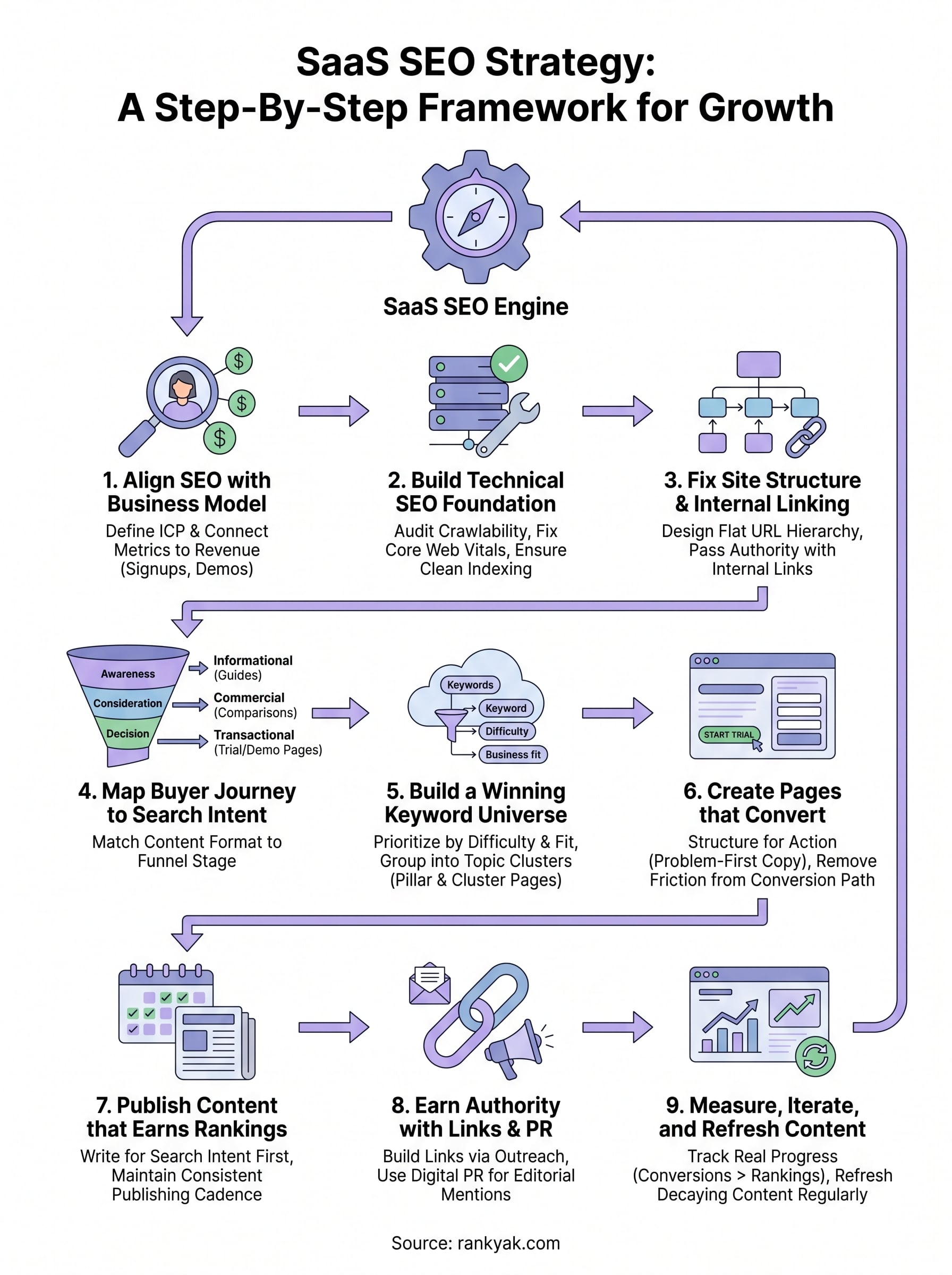
Bring it all together
A complete SaaS SEO strategy is not a single tactic but a system where every layer reinforces the next. Your technical foundation makes your content crawlable. Your site structure passes authority where it matters. Your keyword clusters and intent mapping ensure every page targets a buyer at the right moment, not just a search bot looking for a match. Link building and digital PR amplify the pages that already convert, and your monthly measurement cycle keeps the whole engine moving forward rather than drifting.
Start with the step where your current program is weakest, fix it fully, then move to the next. Skipping steps creates gaps that undermine the layers you build on top. If executing this system consistently feels like more bandwidth than your team has, see SEO built for SaaS companies: RankYak automates the entire content pipeline from keyword discovery to daily publishing, so you can scale organic growth without scaling your headcount to match.
Lars Koole is a co-founder of RankYak and has worked in SEO since 2021, on the side where a strategy has to become a live page: inside agencies, alongside them, for clients directly, and in-house on the products being ranked. He is a software engineer by trade, which is how that page gets built. Before RankYak he founded companies of his own, two of which were acquired. At RankYak he owns the engineering and everything AI, and works out the solution and the implementation of each new feature.