What Is an SEO Strategy? Framework, Examples, and Steps
If you've ever asked what is an SEO strategy, you're already ahead of most website owners who skip straight to publishing content and hope for the best. An SEO strategy is a structured plan for improving your website's visibility in search engines, it covers everything from keyword research and content creation to technical optimization and link building. Without one, you're essentially throwing darts in the dark and wondering why nothing sticks.
The difference between websites that consistently pull in organic traffic and those stuck on page five often comes down to one thing: a clear, repeatable framework. Not a list of random tactics. Not a one-time audit. A strategy ties your business goals to specific actions that compound over time, giving search engines (and now AI platforms like ChatGPT and Gemini) clear signals about what your site is about and why it matters.
The challenge? Building and executing that strategy takes serious time, keyword discovery, content planning, writing, publishing, backlink outreach, and most small teams don't have enough hours in the day. That's exactly the problem we built RankYak to solve: automating the core SEO workflow so you can focus on running your business while your organic traffic grows on autopilot.
This article breaks down what an SEO strategy actually includes, walks through a practical framework you can follow, and gives you real examples and steps to build one from scratch. Whether you're starting fresh or reworking an existing approach, you'll leave with a clear path forward and the knowledge to decide which parts to handle yourself, and which to let automation take off your plate.
Why an SEO strategy matters in 2026
Understanding what is an SEO strategy is one thing; grasping why it matters right now is another. In 2026, the search environment looks fundamentally different from just a few years ago. Google now displays AI-generated overviews at the top of many results pages, which means a large share of users read an answer without ever clicking through to a website. If your content doesn't meet a high bar for quality, structure, and authority, you're invisible before the click even happens. A deliberate strategy is no longer optional; it's the baseline for staying in the game.
The search landscape has changed faster than most realize
Google has rolled out several significant algorithm updates in recent years, all focused on rewarding experience, expertise, authoritativeness, and trustworthiness (E-E-A-T). Sites that relied on high content volume with little depth have seen traffic drop sharply. Meanwhile, sites with well-organized content strategies, clear topical authority, and strong technical foundations are pulling ahead in the rankings. The bar for what counts as "helpful content" is higher than it has ever been, and only a structured plan lets you meet that bar reliably and repeatedly.
A content plan built around real search intent, proper structure, and demonstrated expertise is what separates websites that grow organically from ones that stagnate.
AI platforms have become a discovery channel
Search behavior no longer lives entirely on Google. Platforms like ChatGPT, Gemini, and Perplexity now answer millions of questions daily, and they pull information directly from web content to do it. If your site lacks the authority signals and structured content those systems look for, you won't appear in those answers either. Your SEO strategy needs to account for both traditional search and AI-driven discovery simultaneously, because ignoring one means leaving a growing share of potential visitors on the table.
Competition for organic clicks is tighter than ever
Organic search results still drive the majority of web traffic, but the competition for those clicks has intensified across nearly every industry. More businesses are publishing content, running technical SEO audits, and building backlinks than ever before. Without a clear framework for how you prioritize keywords, structure content, and earn authority, you end up competing on the same crowded terms as everyone else in your niche, and losing. A strong strategy tells you exactly where the gaps are, which topics your site can realistically rank for, and which actions will move the needle fastest.
The cost of having no plan compounds over time
Many small businesses try to skip strategy and publish content reactively, writing about whatever seems relevant in the moment. The short-term time savings turn into long-term traffic problems. Without internal linking, topic clusters, or keyword intent alignment, individual pages don't reinforce each other. Google can't tell what your site is actually authoritative about, so it doesn't rank any of your pages confidently. Over months, you end up with a scattered library of content that produces minimal organic traffic despite significant effort. A strategy prevents this by connecting every piece of content to a clear business goal and a measurable ranking outcome from the start.
Starting with a solid framework and following it consistently is what allows you to build compounding SEO momentum rather than starting from zero every time you publish something new.
The framework: pillars and moving parts
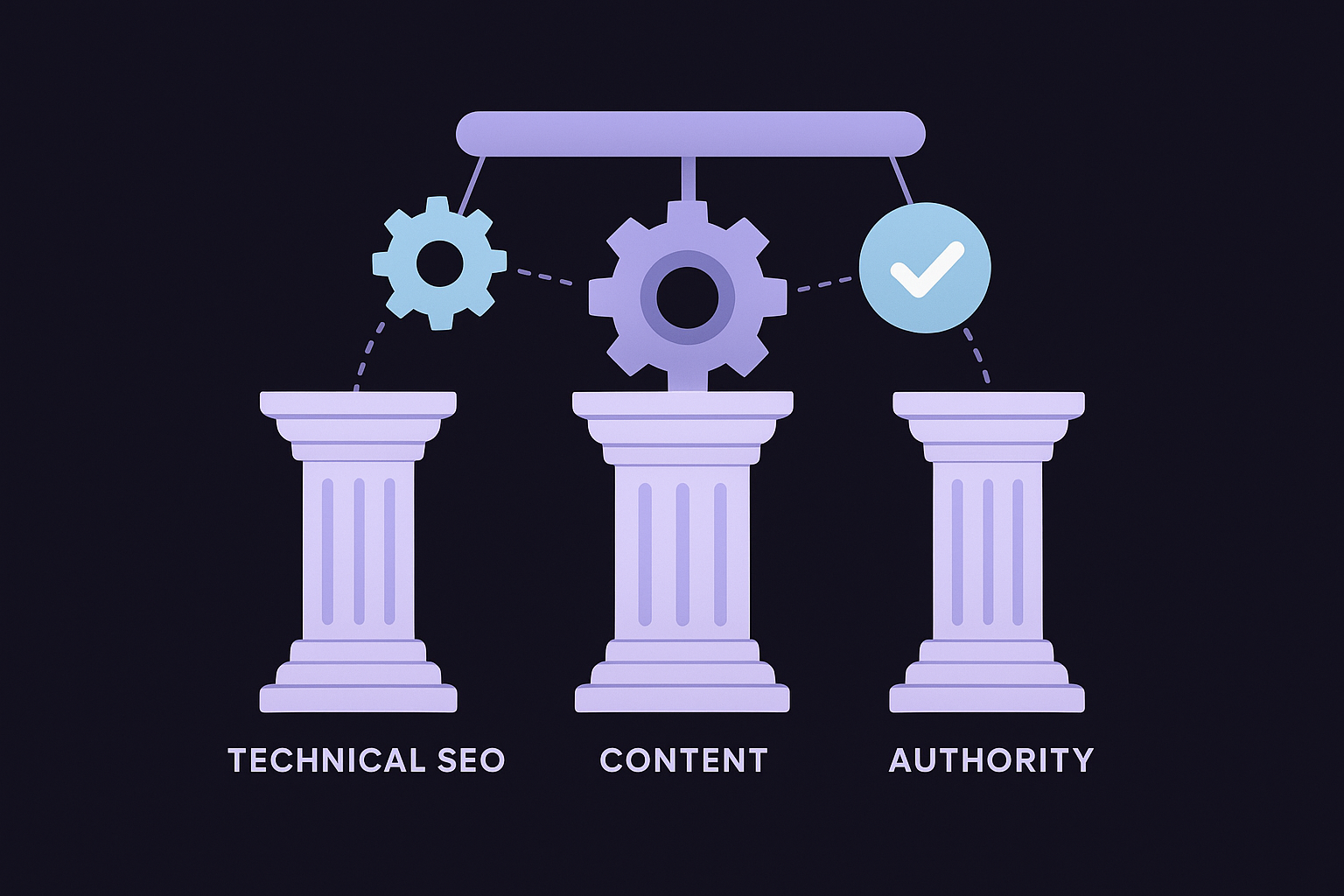
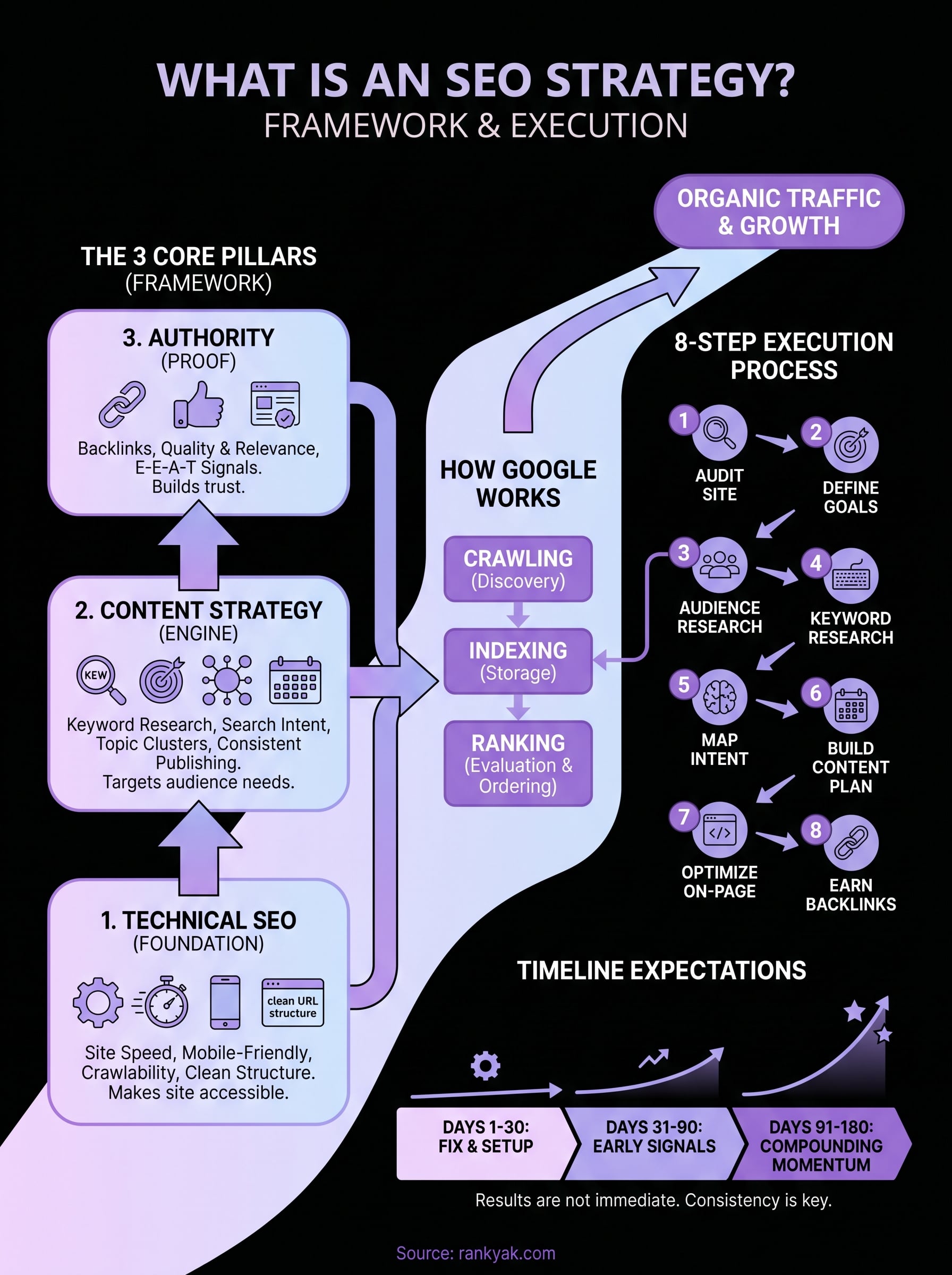
When you think about what is an SEO strategy at its core, picture three interconnected pillars: technical SEO, content, and authority. Each one supports the others. Strong content with no technical foundation won't rank consistently. A technically perfect site with no content has nothing to rank. And even great content on a solid site struggles without external authority signals pointing to it. Understanding how these three pillars connect is the first step toward building a plan that actually produces measurable results over time.
Technical SEO: the foundation
Technical SEO covers everything that makes your site accessible and understandable to search engines, and what technical SEO includes goes deeper than most site owners expect. This includes site speed, mobile usability, crawlability, clean URL structures, proper use of canonical tags, and structured data markup. If search engines can't efficiently crawl and index your pages, no amount of well-written content will move your rankings. Think of technical SEO as the foundation: fix the structural problems first, and every other effort you layer on top gets amplified.
A site that loads quickly, uses clean architecture, and has no crawl errors gives every piece of content you publish a much better shot at ranking.
Content strategy: the engine
Your content strategy is where keyword research, search intent, and topical authority come together. You need to identify the terms your target audience actually searches for, then create content that matches what those searchers are trying to accomplish, whether that's learning something, comparing options, or making a purchase decision. Publishing consistently around a set of closely related topics builds topical authority, signaling to search engines that your site is a reliable and comprehensive source on a given subject. Without a structured content plan, your site ends up with scattered pages that don't reinforce each other and rarely build ranking momentum.
Authority: the proof
Authority comes primarily from backlinks, which are links from other websites pointing to yours. When credible sites link to your content, search engines treat that as a vote of confidence in your site's relevance and trustworthiness. Building authority is not just about quantity; the quality and topical relevance of linking domains matters far more than sheer link count. A handful of links from respected, niche-relevant websites consistently outperforms hundreds of low-quality directory links. Your authority-building efforts reinforce both your technical foundation and your content strategy, completing the loop and driving the compounding growth that separates high-performing sites from the rest.
How Google finds, indexes, and ranks your site
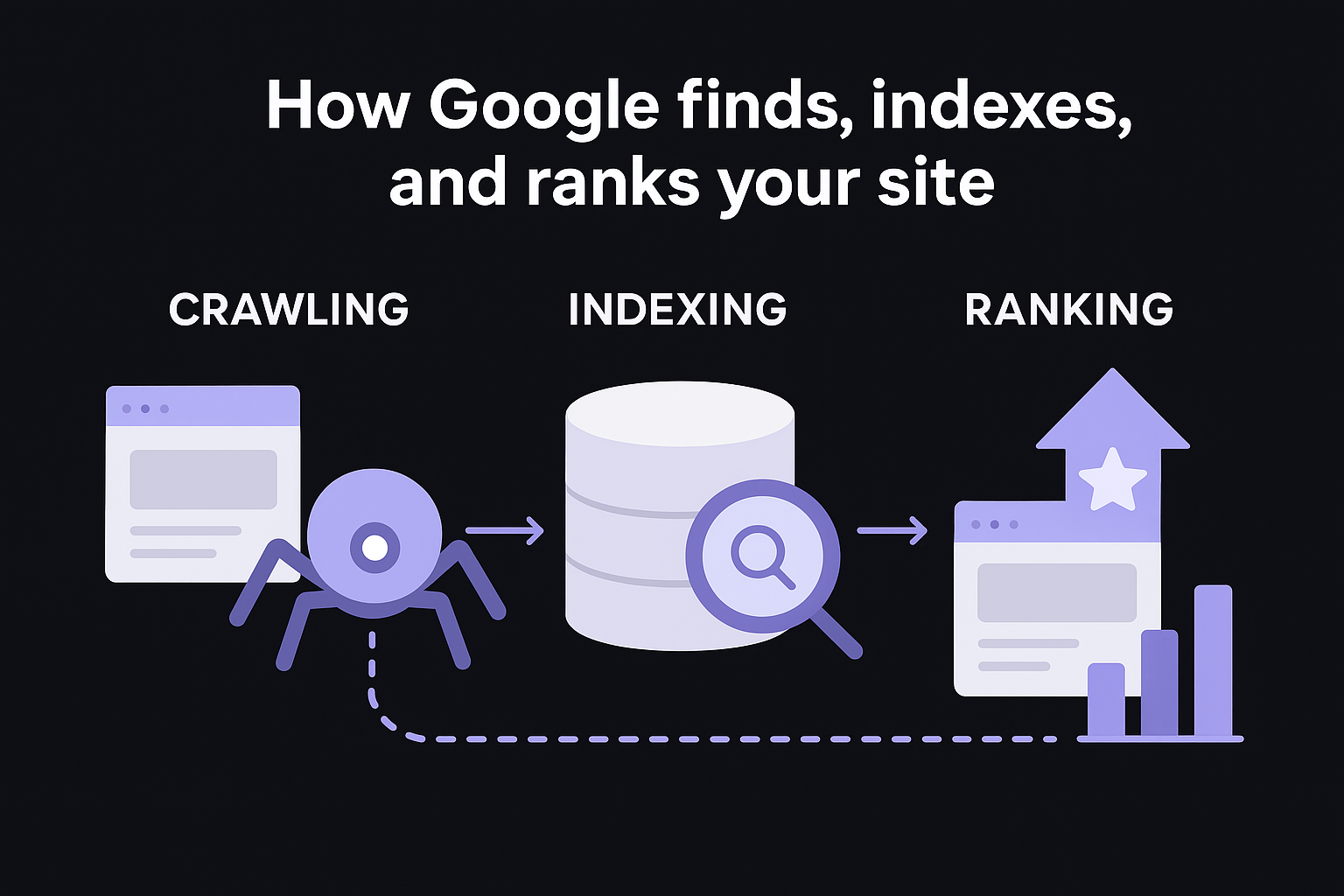
Before you can build what is an SEO strategy worth following, you need to understand the three-step process Google uses to evaluate every page on the web: crawling, indexing, and ranking. These aren't interchangeable terms. Each stage is a distinct gate your content must pass through before it can ever appear in search results. Skip any one of them, and the rest of your strategy collapses regardless of how good your content is.
Crawling: how Google discovers your pages
Google uses automated programs called crawlers (also known as Googlebot) to continuously scan the web, following links from page to page to find new and updated content. If your pages aren't linked internally or don't appear in a submitted XML sitemap, crawlers may never find them at all. You can check how Googlebot interacts with your site through Google Search Console, which shows crawl stats, errors, and coverage issues that need fixing.
A page that crawlers can't reach is a page that will never rank, no matter how well it's written.
Your site's robots.txt file and internal linking structure directly control what crawlers can and can't access. If you accidentally block important pages through misconfigured directives, those pages drop out of the process entirely. Audit your crawl budget and crawlability regularly, especially after site migrations or major structural changes.
Indexing: what gets stored and why
Once Googlebot crawls a page, Google decides whether to store it in its index, which is the massive database it draws from when serving search results, and a crawling and indexing checklist helps you confirm nothing is blocking that step. Not every crawled page gets indexed. Pages with thin content, duplicate content, or noindex tags are often excluded. Google also evaluates whether a page adds enough unique value to be worth including. This is why publishing comprehensive, well-structured content on specific topics matters far more than producing large volumes of short, overlapping posts.
Ranking: how Google decides the order
Ranking is where the real competition happens. Google applies hundreds of signals to determine which indexed pages deserve the top positions for a given query. These signals include relevance (does the page match search intent?), authority (do credible sites link to it?), user experience signals (is the page fast, mobile-friendly, and easy to navigate?), and E-E-A-T indicators like clear authorship and sourced information. No single signal dominates; Google weighs the full picture every time a user types a query. Your strategy needs to address all three stages consistently to generate reliable organic traffic growth.
How to build an SEO strategy in 8 steps
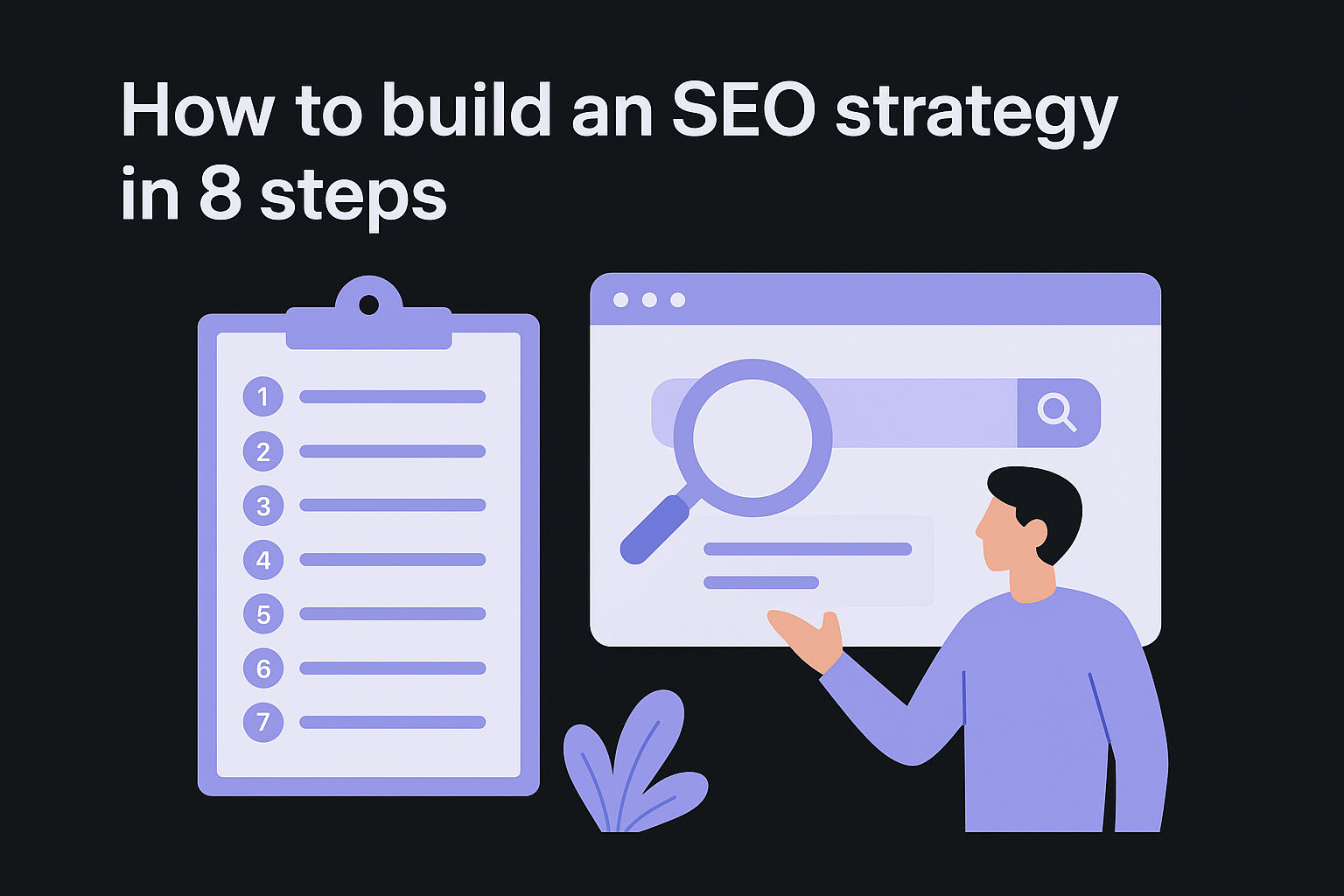
Now that you understand what is an SEO strategy and how Google evaluates your site, you need a concrete sequence of actions to build one. The eight steps below move from foundation to execution, each building on the last, the same sequence behind an SEO strategy that actually works. Skipping early steps creates gaps that cost you rankings later, so work through them in order before circling back to refine anything.
- Audit your current site for technical issues, crawl errors, and indexing gaps.
- Define your business goals and connect them to specific search outcomes.
- Research your target audience to understand what they search for and why.
- Conduct keyword research to identify high-potential, realistic terms for your site.
- Map keywords to search intent so each page targets the right type of query.
- Build a content plan with a consistent publishing schedule around topic clusters.
- Optimize on-page elements including titles, headings, meta descriptions, and internal links.
- Earn backlinks through outreach, partnerships, and content worth citing.
Start with the audit and goals before touching content
Your technical audit and goal-setting are the two steps most teams skip in their rush to publish content, which is why an automated site audit that finds and fixes weak pages is worth running first. Without a clean technical foundation, new pages you publish may never get indexed properly. Without clear goals, you can't measure whether your strategy is working or prioritize which keywords deserve your attention first. Use Google Search Console to identify crawl errors, coverage issues, and which queries already send traffic to your site before you write a single new word.
Fixing technical problems before scaling content ensures every page you publish lands on a solid foundation rather than disappearing into an unindexed void.
Treat keyword mapping and content planning as one connected workflow
Keyword research and content planning work best when you run them together, not as separate tasks separated by weeks, and finding the keywords you can realistically win is where that combined workflow starts. Once you identify your target terms, immediately map each one to a specific page type, a blog post, a product page, or a landing page, based on the search intent behind the query. This prevents the common mistake of researching dozens of keywords and then stalling on what to actually produce.
Grouping related keywords into topic clusters lets you build topical authority faster than publishing isolated pages on disconnected subjects. Each piece reinforces the others, and Google can confidently understand what your site covers in depth. This connected approach turns a list of keywords into a content strategy that compounds over time rather than producing a scattered library that ranks for nothing.
SEO strategy examples for common business types
Knowing what is an SEO strategy in theory is useful, but seeing how it looks in practice across different business types makes it far easier to apply. The core pillars stay the same, but the specific tactics, keyword priorities, and content formats shift significantly depending on what you sell and who you're trying to reach. The examples below show you how those differences play out across four common business types.
Local service businesses
If you run a local business, like a plumber, dentist, or law firm, your strategy centers on local search visibility and Google Maps rankings. Your priority keywords combine your service with your city or neighborhood, such as "emergency plumber Austin" or "family dentist near downtown Chicago." You need a fully optimized Google Business Profile with accurate hours, categories, and regular photo updates. Location-specific landing pages for each area you serve let you capture searches across multiple neighborhoods without cannibalizing a single page's rankings.
Consistent name, address, and phone number (NAP) information across your website and business directories is one of the strongest local ranking signals you can control directly.
E-commerce stores
For e-commerce businesses, an ecommerce SEO plan splits across product pages, category pages, and supporting content. Product pages target transactional queries from buyers who already know what they want. Category pages go after broader, higher-volume terms that capture comparison shoppers. Supporting blog content, like buying guides and how-to articles, pulls in informational traffic from people who don't know your product yet but fit your customer profile. Structured data markup for products, prices, and reviews helps Google display rich results that stand out in the search results and drive higher click-through rates, and you can generate valid JSON-LD for product markup in a couple of minutes.
SaaS and software companies
Software companies compete heavily in informational and comparison-stage searches. A SaaS SEO framework needs to cover problem-aware queries like "how to manage client onboarding" and direct comparison queries like "tool A vs tool B." Building out a library of guides, tutorials, and use-case pages around your product category establishes the topical authority that pushes your site above less focused competitors. Integration pages targeting terms like "your tool + platform name" also convert well because they capture high-intent visitors ready to evaluate solutions.
Content publishers and media sites
Publishers grow by building deep topic clusters that cover every angle of a subject. The goal is to become the single most useful destination for a reader interested in a specific area. Every article links to related pieces, distributes authority across the site, and signals to Google that your domain covers the topic comprehensively. Ad revenue, sponsorships, and affiliate income all scale directly with traffic volume, so consistent daily publishing around well-researched keywords is the core engine of this model.
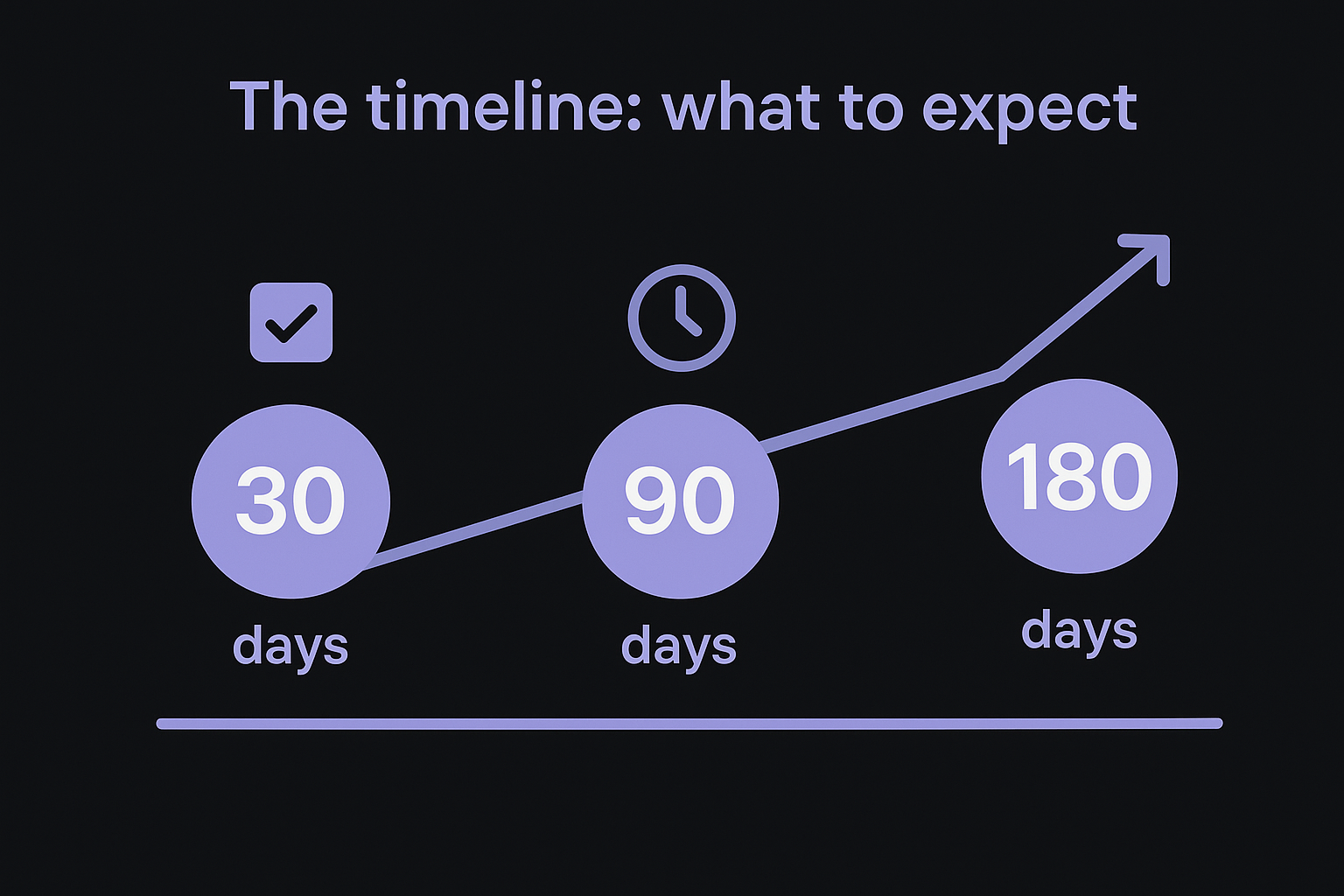
The timeline: what to expect in 30, 90, 180 days
One of the most common frustrations with what is an SEO strategy in practice is that results don't arrive immediately. Search engines need time to crawl, index, and evaluate your site's changes before rewarding them with higher rankings. Setting realistic milestones from the start keeps you from abandoning a working strategy too early, which is one of the most expensive mistakes you can make in organic growth.
The first 30 days: fix, set up, and publish
Your first month is almost entirely about laying the foundation rather than chasing rankings. Fix the technical issues your audit surfaced, set up Google Search Console if it isn't already running, and publish your first cluster of well-targeted content. You won't see significant ranking movement yet, and that's expected. What you should see is Google beginning to crawl and index your new pages, which you can confirm directly in Search Console's coverage report. Early wins in this phase come from resolving crawl errors and establishing a consistent publishing cadence, not from traffic numbers.
The work you do in the first 30 days determines whether the next five months produce compounding results or a flat line.
Days 31 to 90: early signals start appearing
By the end of month three, Google has had enough time to evaluate your initial content and you'll start to see early keyword rankings appear, often in positions 15 to 40 before any significant movement higher. Your internal linking structure begins connecting pages, passing authority between related pieces, and strengthening topical signals. Traffic at this stage is usually modest, but the trend line matters more than the raw numbers. Pages targeting long-tail, lower-competition keywords often break into the top ten first, giving you measurable proof that the strategy is working and helping you refine your content approach for the next phase.
Days 91 to 180: compounding momentum builds
The six-month mark is where consistent execution starts to pay off visibly. Pages that ranked in the middle positions begin climbing toward the top five, especially if you've been actively earning backlinks and updating older content with fresh data and improved structure. Organic traffic volume typically shows its steepest growth curve in this window because multiple pages are now ranking simultaneously, reinforcing each other's authority. The sites that reach this point with strong results are the ones that treated months one and two as investment phases rather than expecting shortcuts to compress the timeline.
Metrics and reporting that prove ROI
When you understand what is an SEO strategy from end to end, you also understand that measuring it correctly is just as important as executing it. Tracking the right metrics tells you whether your efforts are producing real business value or just vanity numbers that look good in a slide deck. Without a clear reporting structure, you can't identify what's working, what needs adjustment, or when to double down on a specific content cluster.
Organic traffic and keyword rankings
Organic traffic is the most direct measure of whether your SEO strategy is working, and you can track it for free through Google Search Console and Google Analytics. Search Console shows which queries drive impressions and clicks to your site, while Analytics reveals what those visitors do after they land. Together, they give you a full picture of discovery and behavior.
Keyword rankings tell you where your content sits in the search results for your target terms, but treat them as leading indicators rather than the final goal when you track SEO performance with reports. A page moving from position 20 to position 8 is making real progress even before it drives substantial traffic. Track rankings weekly for your primary cluster keywords and monthly for the broader set, so you catch meaningful trends without getting distracted by day-to-day fluctuations that mean nothing on their own.
Rankings and traffic only matter if they connect to the business outcomes your strategy was built to produce.
Conversion metrics and business impact
Traffic without conversions is just noise, which is why your reporting needs to tie organic visits directly to revenue, leads, or signups depending on your business model. Set up goal tracking in Google Analytics so you can attribute conversions to specific landing pages and organic search sessions. This connection between content performance and business outcomes is what turns SEO from a cost center into a measurable growth channel.
Your cost per acquisition from organic search compares directly against paid channels, and this comparison is often where SEO's return on investment becomes undeniable. A blog post that ranks for three years and consistently converts visitors costs a fraction of running paid ads for the same traffic volume. Build a simple monthly report that captures organic sessions, conversions, and estimated revenue or lead value per page, and you'll have the numbers to justify continued investment in your strategy every single time.
Common SEO strategy mistakes to avoid
Even with a solid understanding of what is an SEO strategy, execution is where most plans fall apart. The same mistakes appear repeatedly across sites of every size, and each one quietly erodes the results you would otherwise see from your investment of time and content. Knowing these pitfalls in advance lets you sidestep them rather than spending months undoing preventable damage.
Targeting keywords without matching search intent
Choosing keywords purely based on search volume without understanding why people search for them is one of the fastest ways to produce content that ranks nowhere. A page targeting "project management software" needs to serve someone evaluating options, not someone looking for a beginner tutorial on task delegation. When your content mismatches the intent behind a query, Google's systems recognize the disconnect and push your page down in favor of results that actually satisfy the searcher, which is why matching content to search intent comes before writing. Always verify the intent behind each keyword before you write a single word by examining what the current top-ranking pages actually cover.
Match the format and depth of your content to what the search results already show, since that's Google's clearest signal about what searchers actually want.
Publishing without a topic cluster structure
Isolated blog posts that don't connect to related content on your site build no lasting authority. Google evaluates your site as a whole to determine which topics you cover with genuine depth and confidence. Publishing individual pages on loosely connected subjects signals a lack of focus, and your rankings reflect that scattered approach.
Building topic clusters, where a pillar page covers a broad subject and supporting pages address specific subtopics, lets every piece of content strengthen every other piece, and a pillar and cluster framework shows how to lay that out. Each internal link transfers authority and reinforces your site's topical signals. Skipping this structure means your pages compete as strangers rather than working together as a coordinated strategy that compounds over time.
Stopping consistent publishing once rankings appear
Ranking on page one does not mean your work is finished. Competitors are constantly publishing new content, earning fresh backlinks, and updating existing pages to stay ahead. Sites that stop publishing once they reach a comfortable ranking position gradually lose ground to more active competitors over the following months.
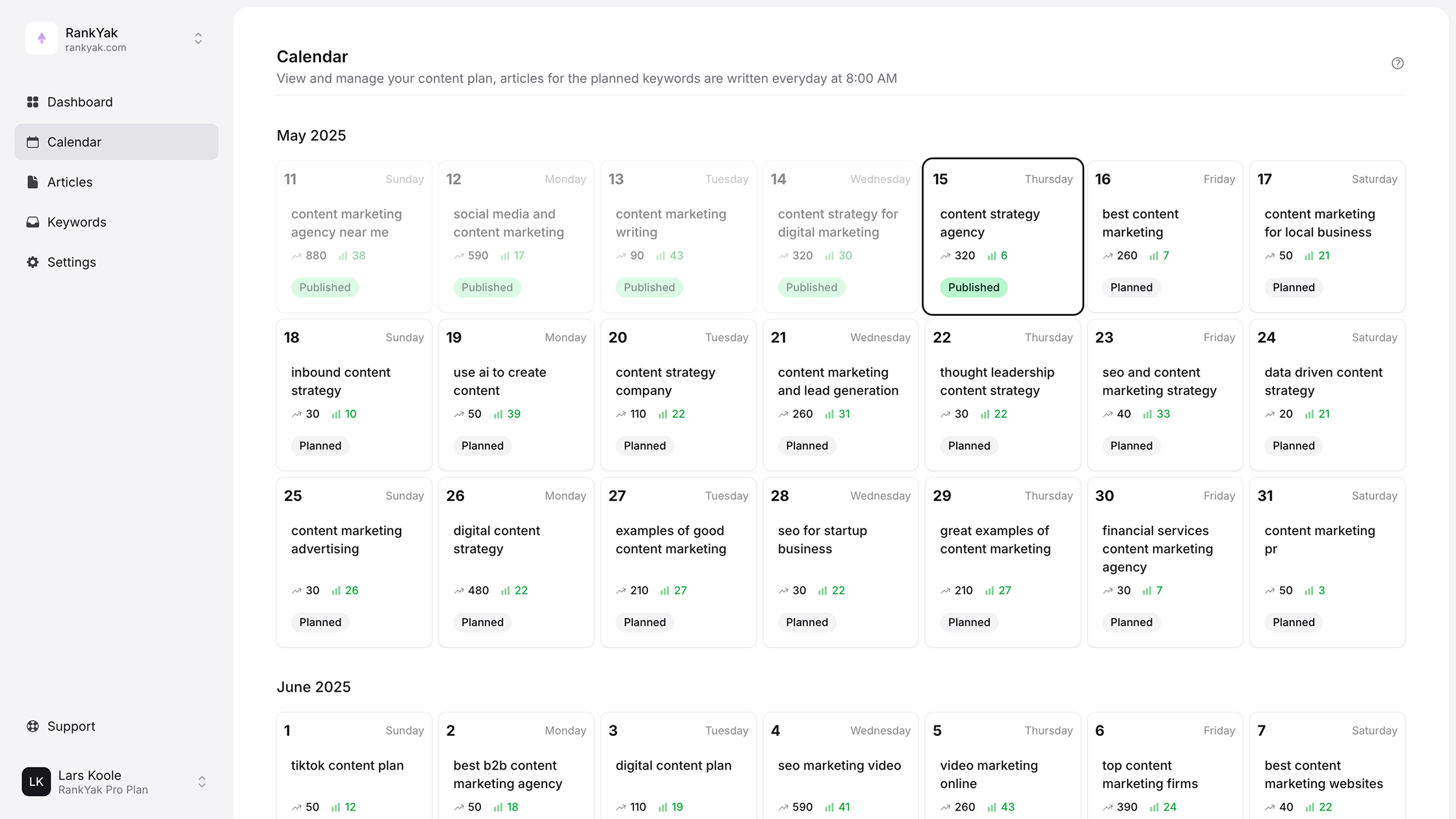
Consistency compounds your results over the long run, which is exactly what a rolling content plan on a calendar is built to protect. Each new page you publish adds another opportunity to rank, another internal link to distribute authority, and another signal to search engines that your site is an active and reliable resource. Treat your publishing schedule as a permanent commitment rather than a campaign with a finish line, and your rankings will hold and grow rather than slowly decay.
Next steps
You now have a complete answer to what is an SEO strategy and a clear path to build one. The framework covers every layer, from technical foundations and keyword research to content clusters, authority building, and measurement. The gap between knowing this and seeing results comes down to consistent execution, and that's where most teams run out of bandwidth before momentum builds.
Keyword discovery, content planning, writing, publishing, and backlink building are all repeatable tasks that eat significant time each week. Automating that workflow is the fastest way to close the gap between your current output and the publishing consistency your strategy requires. RankYak handles the entire content lifecycle on autopilot, from identifying high-potential keywords to writing and publishing fully optimized articles every day, so your site keeps growing while you focus on everything else your business demands.
Start your free trial today and put your SEO strategy on autopilot.
Allan de Wit is a co-founder of RankYak and has worked in SEO since 2015: inside agencies, alongside them, for clients directly, and in-house on the products being ranked. He came to it as a software engineer building for marketers, which is why the platform is built the way it is. He went on to start companies of his own, two of which were acquired. At RankYak he sets the product direction and owns the features, the quality bar, the design, and the UX.