Semrush Long Tail Keywords: How to Find High-Intent Topics
Most businesses chase the same handful of broad, ultra-competitive keywords, and then wonder why their content sits on page three. The real opportunity lives in semrush long tail keywords: those longer, more specific search queries that carry clear buyer intent and far less competition.
Semrush is one of the most popular tools for uncovering long-tail phrases, but knowing which features to use, and how to use them, makes all the difference. The Keyword Magic Tool, Topic Research, and Keyword Gap analysis each surface long-tail opportunities in different ways, and combining them gives you a serious edge over competitors who only skim the surface. The trick is knowing where to look and how to filter the noise.
This guide walks you through the practical steps for finding high-intent long-tail keywords in Semrush, from initial discovery to evaluating which terms are actually worth targeting. You'll learn how to filter by search volume, keyword difficulty, and intent type so every topic you pursue has a realistic shot at ranking, and driving conversions.
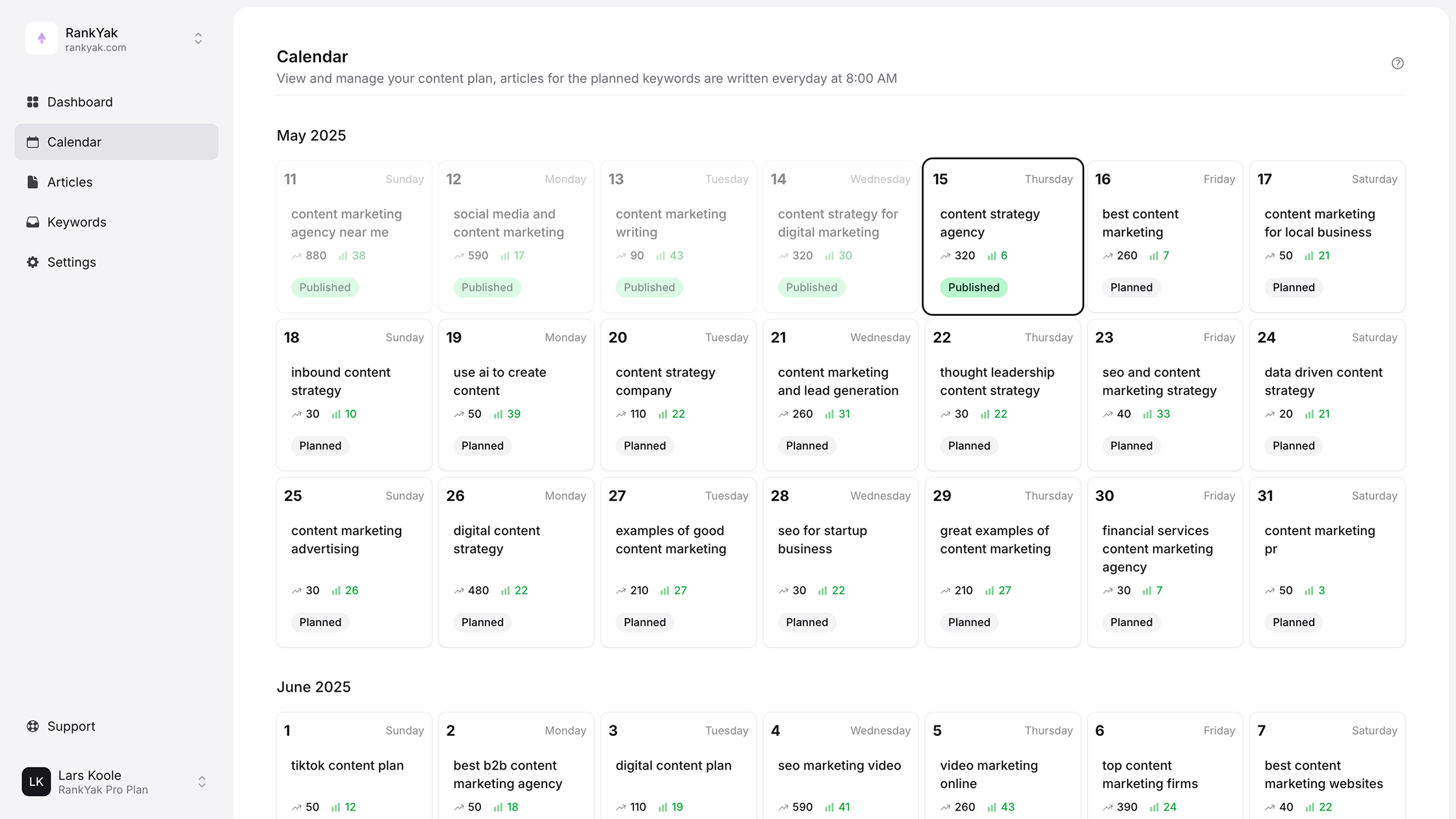
At RankYak, this kind of automated keyword discovery and scoring is exactly what our platform handles daily for businesses that don't have hours to spend inside Semrush. But whether you're doing it manually or on autopilot, understanding the process behind long-tail keyword research is essential to building a content strategy that actually grows organic traffic.
Why long-tail keywords matter in 2026
The search landscape has shifted significantly over the past few years, and 2026 is no exception. Search queries are getting longer and more specific as users grow more comfortable typing conversational, detailed questions into Google, and increasingly into AI platforms like ChatGPT and Perplexity. This shift means that targeting broad, one-or-two-word keywords is not only harder than ever, it's also less effective at attracting people who are ready to act.
AI search has raised the bar for specificity
When people use AI-powered search tools, they tend to type full questions rather than fragments. A user who once searched "project management software" might now type "best project management software for remote teams under 10 people." That longer query reveals far more intent, and it tells you exactly what kind of content you need to produce to match what the person wants. Google's own systems, built around understanding natural language through models like BERT and MUM, are designed to reward content that directly answers specific queries rather than content that broadly covers a topic.
The more specific a query, the more precisely you can match what the searcher actually wants, and that precision directly improves your conversion rate.
Using semrush long tail keywords research as part of your strategy positions you to capture this growing share of high-quality, intent-driven traffic. Long-tail searches now account for the vast majority of all search activity, and as AI chat tools continue to grow in usage, the proportion of specific, detailed queries will only increase.
Lower competition means faster ranking potential
Broad, head keywords like "running shoes" or "email marketing" carry difficulty scores that make ranking nearly impossible for most websites, especially newer ones. A domain without years of built-up authority simply cannot compete with major retailers and established publications for those terms. Long-tail keywords, by contrast, typically carry low difficulty scores below 30, which means a well-written, properly optimized article has a realistic shot at reaching page one within weeks rather than years. Put simply, semrush long-tail keywords are less competitive and easier to rank for, making them the fastest path to measurable organic results.
This reality is especially valuable for small and medium-sized businesses that need results without a massive content budget. Rather than pouring resources into a handful of high-competition terms and waiting indefinitely for traction, you can publish a series of targeted long-tail articles and start accumulating organic traffic across dozens of ranking pages. Each individual page may bring in a modest number of visitors, but those visitors are far more qualified because the specificity of their search tells you they already know what they want. This stronger conversion intent is why long-tail keywords consistently deliver a higher conversion rate than broad terms, visitors arriving through specific queries are closer to a purchasing decision, and your content meets them at exactly the right moment.
Building a content strategy around long-tail terms also strengthens your topical authority, which signals to Google that your site covers a subject in depth. That depth of coverage lifts the ranking potential of every page on your site over time, including the more competitive terms you eventually want to target. A consistent output of long-tail content is the fastest way to build the kind of domain trust that makes every future article easier to rank.
How to find long-tail keywords in Semrush
Semrush gives you several routes into long-tail keyword discovery, and each one surfaces a different layer of opportunity. Starting with the right tool for your goal saves time and gives you a more focused list to work with from the beginning. The three most productive tools for semrush long tail keywords research are the Keyword Magic Tool, the Keyword Gap report, and the Organic Research section.
Start with the Keyword Magic Tool
The Semrush Keyword Magic Tool is your primary starting point. Enter a broad seed term related to your niche, and Semrush returns thousands of related queries organized by topic group. The key move here is applying filters immediately: set keyword difficulty (KD%) to a maximum of 30, and set a minimum search volume of 50. This combination cuts out both the impossibly competitive terms and the queries with so little traffic they are not worth your time.

From there, look at the Questions filter on the left sidebar. Questions tend to be inherently long-tail because users phrase them with full context, such as "how to use email marketing for a small online store." These query types also map cleanly to FAQ sections and featured snippet opportunities, which can accelerate your visibility in both Google and AI-driven search results.
The Questions filter alone can generate dozens of high-intent, low-competition topics that your competitors have likely ignored.
Use Keyword Gap to find what competitors rank for
The keyword gap analysis report compares your domain against up to four competitors and shows you the keywords they rank for that you do not. Filter the results to show only "Missing" or "Weak" keywords, then add a KD% ceiling of 30. What you are left with is a list of proven, rankable terms where there is already demonstrated search demand because a competitor earns traffic from them, but your site has no presence yet. This approach removes guesswork and points you directly toward gaps that are both winnable and commercially relevant to your audience.
How to qualify and prioritize your list
Once you have a raw list of candidates from your semrush long tail keywords research, the next step is cutting it down to terms that are actually worth your time. Raw volume and difficulty scores tell you whether a keyword is accessible, but they do not tell you whether ranking for it will move the needle for your business. You need two more filters before you start writing: search intent and business relevance.
Check intent alignment first
Every keyword carries an implicit expectation about what the searcher wants to find. Semrush labels this as informational, navigational, commercial, or transactional, and you can see the intent tag directly in the Keyword Magic Tool results. Informational keywords like "what is email automation" attract readers who are still learning, while transactional or commercial keywords like "best email automation tool for ecommerce" attract buyers who are close to making a decision. Keywords with strong conversion intent, commercial and transactional queries, should be your priority when you want semrush long-tail keywords that drive revenue, not just page views. Before you add any term to your final list, confirm that you can create content that genuinely satisfies that intent, otherwise your page will see high bounce rates regardless of how well it ranks.
Misaligned intent is one of the most common reasons a well-optimized page fails to convert, even when it reaches page one.
Pay close attention to the SERP preview Semrush shows alongside each keyword. If the top results are all product pages and your site is a blog, or vice versa, that mismatch signals a hard battle. Prioritize terms where the current top results match the type of content you are able to produce, because Google's systems reward pages that best fit what most searchers clearly want.
Score by business relevance
After filtering by intent, rank your remaining keywords by how closely they connect to what your business actually offers. A simple three-tier scoring method works well here:
- Tier 1: Direct product or service connection, strong commercial or transactional intent
- Tier 2: Problem-aware queries where your product is a natural solution
- Tier 3: Broad educational topics with only loose relevance to your offer
Start your content production with Tier 1 and Tier 2 terms because those pages generate traffic that is most likely to convert. Tier 3 topics build authority over time, but they should not crowd out the higher-value targets early in your strategy.
How to map long-tail keywords to content
Once you have a prioritized list of semrush long tail keywords, the next challenge is deciding which keyword belongs on which page and how all those pages connect. Skipping this mapping step leads to keyword cannibalization, where multiple pages compete against each other for the same query, and that splits your ranking potential rather than building it. A clear content map turns your keyword list into a structured plan where every page has a defined purpose and a specific audience it serves.
Match one keyword to one page
Every long-tail keyword you target should anchor a single, dedicated page. That page's title, H1, meta description, and opening paragraph should all reflect the specific query so that both users and search engines immediately understand what the content covers. Trying to target two or three different long-tail terms in a single article dilutes the focus and reduces how precisely you match any one searcher's intent.
One keyword, one page is the simplest rule that most content teams consistently break, and it costs them rankings every time.
Before you create a new page, run a quick search in Semrush's Position Tracking or Site Audit tool to confirm you do not already have an existing page that partially targets the same term. Consolidating thin, overlapping content is often faster than creating something new, and it typically produces stronger results.
Organize keywords into topic clusters
Topic clusters group your individual long-tail pages around a central pillar page that covers a broader subject, and a topical map of pillars and supporting articles is the fastest way to sketch that structure. For example, a pillar page on "email marketing" would link out to cluster pages targeting specific queries like "email marketing for nonprofits" or "how to segment an email list by purchase history." This structure signals to Google that your site covers a subject thoroughly, which lifts the authority of every page in the cluster.
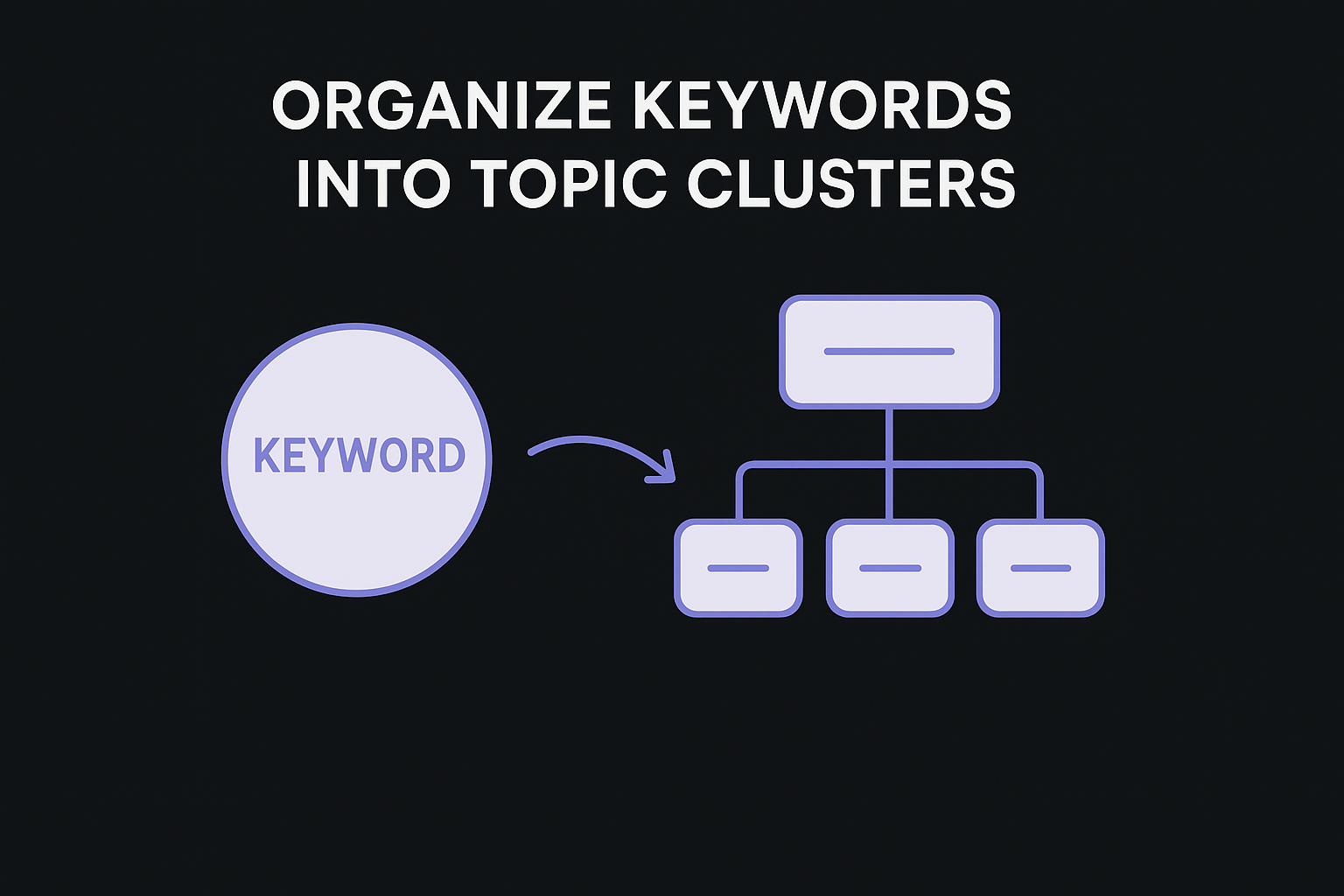
Building these clusters deliberately, rather than publishing pages in isolation, compounds your results over time. Each new long-tail page you add strengthens the pillar, and the pillar passes authority back down to the cluster pages, creating a reinforcing loop that accelerates rankings across your entire content library.
Common pitfalls and quick fixes
Even experienced marketers make predictable mistakes when working through semrush long tail keywords research, and most of these errors are easy to correct once you know what to look for. The three most common traps are targeting keywords with no realistic volume, publishing multiple pages that compete for the same query, and skipping intent verification entirely. Each one quietly undermines the work you put into keyword discovery, so catching them early saves you from publishing content that never gains traction.
Targeting keywords with no realistic traffic
One of the most common mistakes is picking keywords with extremely low monthly search volume, sometimes single digits, because the difficulty score looks attractive. A keyword difficulty of five means nothing if only three people per month search for that term. Set a minimum volume floor of 50 monthly searches in the Keyword Magic Tool filter before you commit to any topic, and treat that number as non-negotiable for any standalone page you plan to build.
A keyword that never gets searched cannot send you traffic no matter how well your page ranks for it.
You can occasionally make exceptions for high-conversion commercial terms tied directly to your product, but those should be clearly justified and tracked separately so you can measure whether they deliver results.
Letting pages compete against each other
Keyword cannibalization happens when two or more pages on your site target overlapping queries, and it splits your ranking signals instead of concentrating them. If you have published content before running your keyword research, use Semrush's Site Audit or Position Tracking, or an audit that detects cannibalization for you, to identify pages that already target similar phrases. When you find overlap, either consolidate the weaker page into the stronger one or adjust the focus of each page so the queries they target no longer compete.
Running a quick cannibalization check before you write is far faster than fixing the problem after both pages are live and indexed. Build this check into your workflow every time you add a new topic to your content calendar, and you will avoid one of the most persistent ranking problems that content teams face.
Next steps
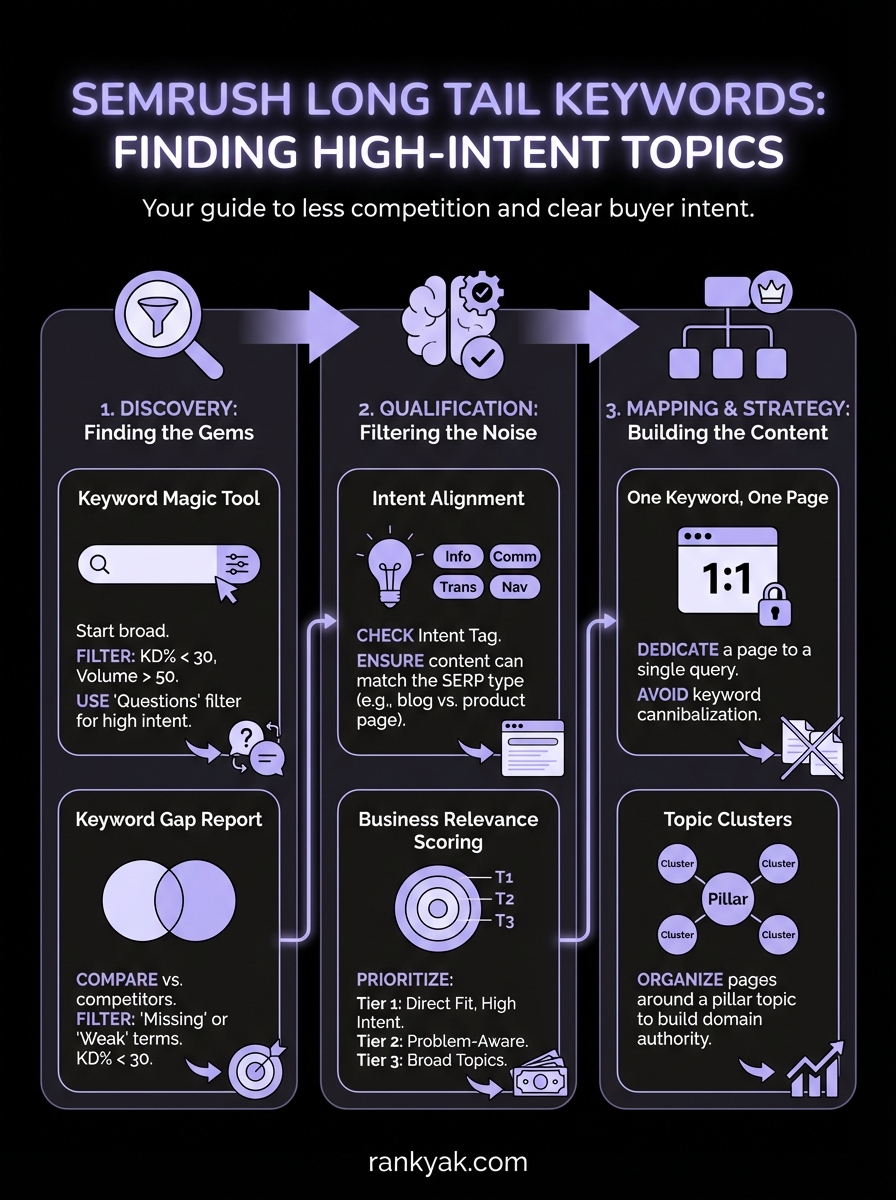
You now have a complete process for turning semrush long tail keywords research into a prioritized, structured content plan. The workflow covers everything from initial discovery in the Keyword Magic Tool to qualifying by intent, mapping to topic clusters, and avoiding the cannibalization traps that quietly kill rankings. Once your content is live, use Semrush's Position Tracking to monitor how your long-tail pages climb over time, so you can spot pages that need a refresh or internal link boost before they stall. The research phase is only as valuable as the publishing consistency you build around it, because a single well-optimized article rarely moves the needle on its own. A steady stream of targeted, high-intent content is what compounds into real organic growth over time.
If running this process manually every week feels like more than your schedule allows, RankYak automates the entire cycle for you, from keyword discovery to content creation and publishing, every single day. You can skip the hours inside Semrush and still get a full pipeline of optimized articles working for your site. See how RankYak turns keyword research into published articles every day, with a free three-day trial.
Lars Koole is a co-founder of RankYak and has worked in SEO since 2021, on the side where a strategy has to become a live page: inside agencies, alongside them, for clients directly, and in-house on the products being ranked. He is a software engineer by trade, which is how that page gets built. Before RankYak he founded companies of his own, two of which were acquired. At RankYak he owns the engineering and everything AI, and works out the solution and the implementation of each new feature.