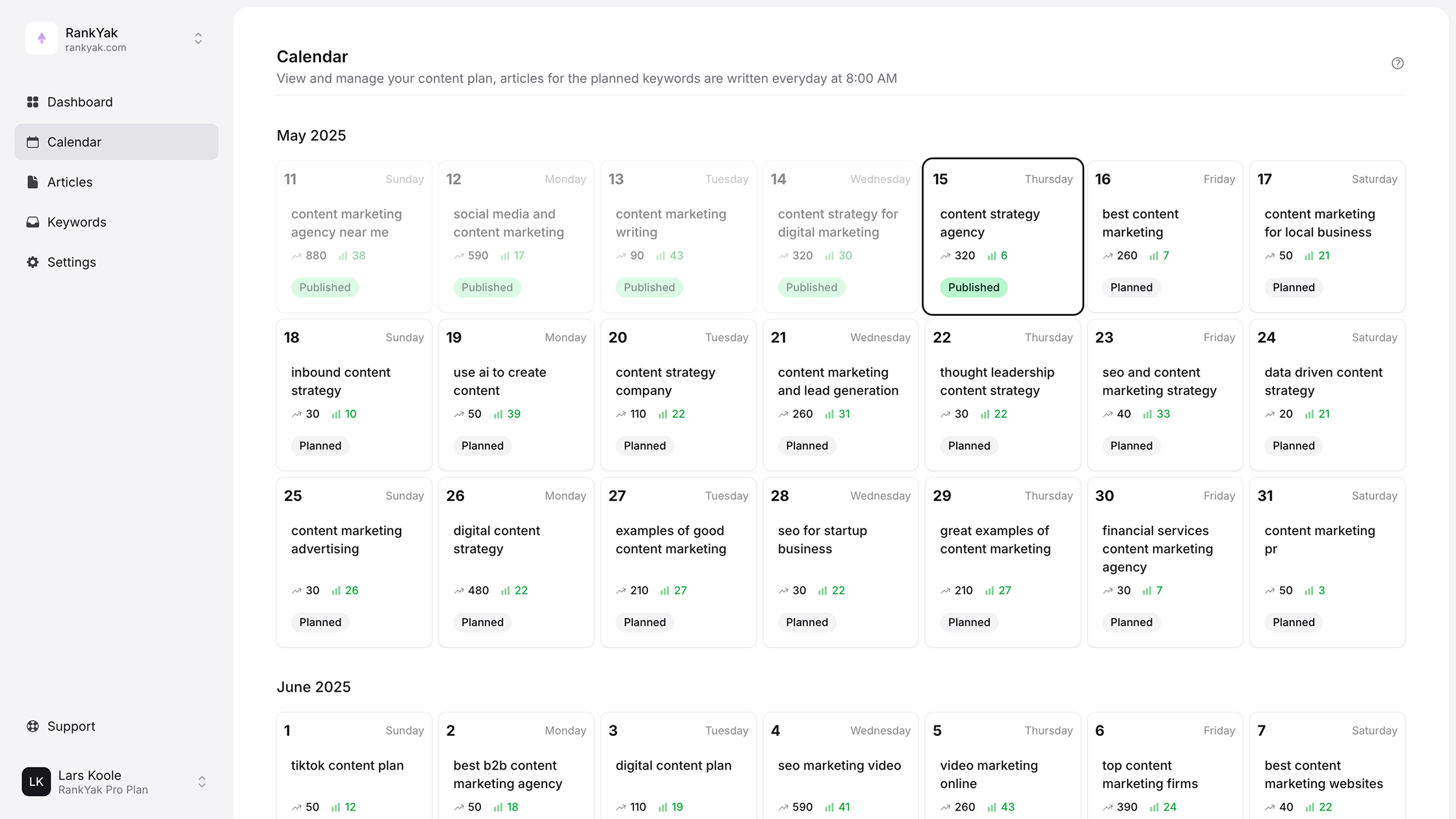
16 Best Keyword Research Tools for Organic Traffic in 2026
You're staring at hundreds of keyword research tools, each promising to unlock your organic traffic potential. Some cost hundreds per month. Others are free but limited. Most leave you wondering if you picked the right one or just burned your budget on features you'll never use. The wrong choice means wasted time analyzing keywords that won't rank and wasted money on subscriptions that don't deliver results.
This guide breaks down the 16 best keyword research tools available in 2026. You'll see what each tool does well, who should use it, and exactly how much it costs. No marketing fluff. No vague promises. Just straight comparisons to help you pick the tool that matches your SEO goals and budget. Whether you need enterprise-level data, a keyword tracking tool to monitor rankings, or the best free keyword research tools to get started, you'll find your answer here.
1. RankYak
RankYak takes a different approach than traditional keyword research tools by automating your entire SEO workflow from discovery to publishing. Instead of just handing you a list of keywords, it analyzes your website, identifies high-potential opportunities, and generates optimized content daily. The platform focuses on keywords that work for both Google search and AI chat platforms like ChatGPT, giving you visibility across multiple channels where your audience searches for answers.
Best features
The smart keyword discovery engine analyzes your niche and automatically surfaces opportunities you might miss with manual research. You don't spend hours filtering through data because RankYak's system evaluates competition, search intent, and ranking potential to prioritize keywords worth targeting. Its automated content plan then maps out which keywords to tackle each day, ensuring your site maintains consistent growth without the planning overhead that bogs down most SEO strategies.
Every article RankYak generates includes full SEO optimization built on competitor research, E-E-A-T signals, and search intent analysis. The platform publishes directly to WordPress, Shopify, Webflow, and other major CMS platforms, eliminating the manual upload step. Its backlink exchange network connects you with relevant sites in your niche, solving the outreach problem that makes link building such a time drain.
"RankYak reduces time spent on SEO tasks by 90% while producing 3x more content that actually ranks."
Who it is for
Small business owners who need organic traffic but lack in-house SEO teams get the most value from RankYak. If you're tired of paying agencies thousands per month or you don't have time to research keywords and write content yourself, this platform handles both. Content marketers managing multiple websites benefit from the multi-site dashboard that tracks each property separately while automating the daily workflow across all of them.
Entrepreneurs launching new sites avoid the months-long ramp-up period because RankYak starts generating and publishing SEO-optimized content from day one. You skip the learning curve of mastering keyword research, content optimization, and link building because the system applies those strategies automatically.
Pricing
RankYak charges $99 per month for one website, which includes all features without tiered limitations or hidden costs. Each site subscription covers unlimited keyword discovery, one daily article (up to 5,000 words), automatic publishing, and access to the backlink network. You can test the platform with a 3-day free trial that you can cancel anytime without answering questions or justifying your decision.
2. Semrush
Semrush stands as one of the most comprehensive platforms in the SEO space, offering far more than basic keyword research. You get access to a massive database of over 25 billion keywords across 130 countries, making it a solid choice if you need global market insights. The platform combines keyword discovery with competitive intelligence, site audits, and rank tracking in one interface.
Best features
The Keyword Magic Tool workflow generates thousands of keyword variations from a single seed term, organized into topic clusters that show you how different queries relate to each other. You can filter by search volume, keyword difficulty, and intent to quickly identify opportunities that match your content strategy. Semrush's competitive analysis reveals which keywords your rivals rank for, giving you a roadmap of gaps you can exploit. The organic research module serves as one of the best features for competitor keyword analysis, letting you reverse-engineer any domain's entire keyword strategy.
"Semrush provides detailed competitor keyword data that shows exactly where your rivals are winning traffic."
Position tracking monitors your rankings daily across devices and locations. The organic research feature breaks down any domain's top pages and their keyword portfolios, so you understand what's driving their traffic before you write a single word.
Who it is for
Marketing agencies managing multiple client accounts rely on Semrush because the white-label reporting and client management features streamline their workflow. In-house SEO teams at growing companies use it when they need enterprise-level data without cobbling together multiple tools. If you're already investing heavily in content, Semrush justifies its cost through depth.
Pricing
Plans start at $139.95 per month for the Pro tier, which limits you to 5 projects and 500 keywords to track. The Guru plan costs $249.95 monthly and removes most restrictions that smaller teams hit quickly. Enterprise pricing requires custom quotes.
3. Ahrefs
Ahrefs built its reputation on backlink analysis but has evolved into one of the most powerful keyword research platforms available. The tool crawls the web constantly, updating its index of over 8 billion pages to give you fresh data on search volumes, keyword difficulty, and ranking opportunities. You get access to a database of 11 billion keywords across 171 countries, making it particularly strong for international SEO campaigns and niche market research.
Best features
The Ahrefs Keywords Explorer shows you metrics that matter: search volume, clicks data, and return rate. Unlike tools that only report search volume, Ahrefs tells you how many actual clicks each keyword generates, accounting for zero-click searches where users find answers directly in search results. This data prevents you from chasing high-volume terms that don't actually send traffic to websites. The Ahrefs organic keywords report displays every keyword a domain ranks for alongside traffic estimates and position history. The accuracy of its organic keywords tracker has made it a benchmark that SEO professionals trust for monitoring competitor visibility and validating their own ranking data.
"Ahrefs shows you not just search volume but actual click potential, revealing which keywords truly drive traffic."
Content Gap analysis identifies keywords your competitors rank for that you don't, creating a clear action plan for content creation, and there's a full walkthrough of how to evaluate keywords in Ahrefs if you want the exact steps. The SERP overview breaks down the top 10 results for any keyword, showing domain rating, backlinks, and traffic estimates so you understand exactly what it takes to compete. Ahrefs also offers API access that lets development teams pull keyword volume, difficulty, and SERP data directly into internal dashboards, which makes it a strong pick if you're specifically searching for the best keyword research API rather than a UI-only tool.
Who it is for
SEO professionals who prioritize link building alongside keyword research find Ahrefs indispensable because it excels at both. Content teams at companies with established websites use it to identify expansion opportunities and track competitor movements. If you care about data accuracy and freshness, Ahrefs consistently ranks at the top.
Pricing
Plans begin at $129 per month for the Lite tier, which includes 500 credits for keyword searches and basic reporting. The Standard plan costs $249 monthly and removes most credit restrictions that active users hit quickly.
4. Google Keyword Planner
Google Keyword Planner gives you keyword data straight from Google's advertising platform, making it one of the most accurate sources for search volume estimates. The tool was designed for Google Ads campaigns but works perfectly for organic SEO research. You get access to Google's actual search data instead of estimates from third-party tools, and it costs nothing to use if you have a Google Ads account. As a free Google keyword analysis tool, it remains one of the most reliable starting points for any SEO campaign.
Best features
The search volume forecasts show you monthly search ranges for any keyword, along with competition levels and suggested bid prices that indicate commercial intent. You can discover new keyword ideas by entering your website URL or a seed term, making it a strong Google keyword traffic tool for estimating demand, and Google generates related queries that people actually search for. The platform groups similar keywords together, helping you identify topic clusters instead of isolated terms.
"Google Keyword Planner provides search data directly from Google's source, eliminating guesswork about actual search volumes."
Historical metrics let you spot seasonal trends and understand how search demand fluctuates throughout the year. You can filter results by location, language, and search network to refine your targeting strategy.
Who it is for
Beginners start here because it's free and doesn't require a learning curve to extract useful data, especially alongside a step-by-step keyword research method for beginners. Small businesses running Google Ads campaigns benefit from using the same tool for both paid and organic keyword strategy. Content creators on tight budgets get reliable search volume data without monthly subscription fees.
Pricing
Google Keyword Planner is completely free when you create a Google Ads account. You don't need to run active campaigns or spend money on ads to access the tool, though Google may show ranges instead of exact numbers until you start advertising.
5. Google Search Console
Google Search Console shows you exactly which keywords already drive traffic to your website, making it one of the most valuable keyword research tools for optimizing existing content. This free platform connects directly to your site and tracks every search query that leads users to your pages. You see real performance data instead of estimates, including impressions, clicks, click-through rates, and average positions for thousands of keywords you might not know you rank for.

Best features
The Performance report reveals your site's actual search performance across every keyword, page, country, and device type. You can filter by date range to spot trends and identify queries where you rank on page two or three, which represent quick wins if you optimize those pages. Google Search Console highlights page-level keyword data that shows which terms drive traffic to specific URLs, helping you understand what content resonates with searchers.
"Google Search Console provides actual performance data from your own site, showing real keywords that already send you traffic."
The Performance report also lets you compare time periods to track ranking improvements or drops. You can export data to spreadsheets for deeper analysis or combine it with other tools in your SEO stack.
Who it is for
Website owners who want to optimize existing content before creating new pages get immediate value from Search Console's data. As a keyword tracking tool, it shows real position data for every query your site appears for, functioning as a free keyword tracker that pulls from Google's own index rather than third-party estimates. Because Google refreshes this data continuously without any manual input, it also works as an automatic keyword tracker for anyone who wants ongoing position monitoring at no cost. SEO teams use it to identify underperforming pages that rank between positions 11-20, where small improvements can unlock significant traffic gains. Content marketers leverage the query data to understand which topics their audience searches for most.
Pricing
Google Search Console is completely free for all users. You just need to verify ownership of your website through DNS records, HTML file upload, or your Google Analytics account.
6. KWFinder
KWFinder focuses on finding low-competition keywords that smaller sites can actually rank for, making it a solid choice among the best keyword research tools for businesses without massive domain authority. The interface strips away complexity and presents data in a clean, visual format that shows you keyword difficulty scores at a glance. You get access to a database covering search volumes across different countries and languages, though it's smaller than enterprise platforms like Semrush or Ahrefs.
Best features
The keyword difficulty metric uses a 1-100 scale that accounts for domain authority and backlink profiles of ranking pages, helping you avoid keywords where you'd waste time competing against giants. KWFinder's location-specific search volume data lets you target local markets instead of relying on broad national averages. The autocomplete feature pulls suggestions from Google's search bar, showing you actual phrases people type into search engines.
"KWFinder excels at identifying low-competition opportunities that give smaller sites realistic ranking chances."
You can analyze SERP results directly in the tool to see exact metrics for competing pages, including their domain authority, page authority, and backlink counts.
Who it is for
New websites and small businesses benefit most from KWFinder's focus on achievable targets. Freelance content writers use it to research keywords for clients without paying enterprise-level prices. If you're building authority in a specific niche, this tool delivers that focus.
Pricing
Plans start at $49 per month for the Mangools Basic tier, which includes 100 keyword lookups daily and covers all five tools in their suite. The Premium plan costs $69 monthly and increases limits to 500 lookups per day.
7. Moz Keyword Explorer
Moz Keyword Explorer combines keyword research with domain authority metrics that have become an industry standard for evaluating ranking potential. The tool provides access to over 1.25 billion keyword suggestions and includes unique metrics like Priority Score that weighs volume, difficulty, and opportunity into a single number. You get data backed by Moz's own web index and clickstream data, which differs from competitors who rely solely on Google's API estimates.
Best features
Moz's Priority Score ranks keywords from 0-100 by combining search volume, organic click-through rate potential, and difficulty into one metric that tells you which terms deserve your attention first. Moz's SERP analysis shows you the Page Authority and Domain Authority of ranking competitors, giving you a realistic view of whether you can compete. The Question Keyword filter surfaces long-tail queries that match informational intent, perfect for content that targets featured snippets.
"Moz Keyword Explorer's Priority Score eliminates guesswork by ranking keywords based on actual opportunity, not just search volume."
Who it is for
Marketing teams that value Moz's authority metrics when building content strategies get the most from this platform. SEO consultants use it to explain ranking difficulty to clients because Domain Authority provides a widely recognized benchmark. Moz's standards appear in countless SEO discussions across the industry.
Pricing
Plans start at $99 per month for the Moz Standard tier, which includes 150 keyword queries monthly and 5 tracked campaigns. The Medium plan costs $179 monthly and expands your query limits to 5,000 per month.
8. Ubersuggest
Ubersuggest delivers keyword research alongside backlink analysis, site audits, and rank tracking in one interface at a fraction of the cost you'd pay for enterprise platforms. Neil Patel built this tool to make SEO accessible to small businesses and solo marketers who can't justify $100+ monthly subscriptions, putting it among the SEO tools under $100 a month. You get access to keyword data across multiple countries with volume estimates, competition metrics, and content ideas pulled from top-ranking pages.
Best features
The keyword suggestions feature generates hundreds of related terms from a single seed keyword, organizing them by volume and competition level so you spot opportunities quickly. Ubersuggest's SEO difficulty score uses a 1-100 scale that shows you whether a keyword is realistically rankable based on your domain's current authority. The content ideas section reveals which articles already rank for your target keywords, including their estimated visits, backlinks, and social shares.
"Ubersuggest combines essential SEO features at a price point that makes the best keyword research tools accessible to businesses of any size."
Who it is for
Freelancers and content creators who need reliable keyword data without enterprise budgets benefit most from Ubersuggest's combination of features and affordability. Small business owners running their own SEO strategy get enough functionality to compete without overwhelming complexity.
Pricing
Plans start at $12 per month for Individual, which includes 150 searches daily and 1 website. The Business plan costs $20 monthly and expands limits to 300 searches per day across 7 websites. Lifetime access options range from $120 to $240 as one-time payments.
9. AnswerThePublic
AnswerThePublic visualizes search queries in a unique format that shows you exactly what questions people ask about any topic. The tool pulls data from Google and Bing autocomplete to generate hundreds of question-based keywords, prepositions, comparisons, and alphabetical suggestions. Instead of presenting data in spreadsheets like most best keyword research tools, it creates visual maps that help you spot content gaps and understand how different queries connect to each other.
Best features
The question wheel visualization organizes keywords by question type (what, why, how, when, where, which, who, are, can, will) so you immediately see the informational queries your audience searches for. This format excels at revealing long-tail opportunities that other long tail keyword tools might bury in massive lists. AnswerThePublic's preposition data shows you phrases like "for," "with," "to," and "versus" that indicate commercial intent or comparison searches.
"AnswerThePublic's visual format reveals question patterns and content gaps that spreadsheet-based tools often hide."
Export options let you download all results as CSV files for analysis in other platforms. The alphabetical view surfaces variations you might miss when focusing only on high-volume terms.
Who it is for
Content strategists planning blog topics and FAQ sections use AnswerThePublic to build comprehensive content that answers every question their audience asks. SEO teams researching featured snippet opportunities benefit because question-based keywords often trigger these SERP features. Writers creating pillar content leverage the tool to ensure they cover all angles of a topic.
Pricing
The free tier allows 3 searches per day without requiring an account. Individual plans start at $99 per month and remove daily search limits while adding comparison and historical data features.
10. Surfer
Surfer combines keyword research with on-page optimization tools that analyze top-ranking content to tell you exactly what to include in your articles. The platform focuses on content optimization by comparing your drafts against competitors and providing specific recommendations for word count, headers, keywords, and images. You get access to keyword data integrated directly with SERP analysis, so you research and optimize content within the same workflow.

Best features
The Content Editor analyzes the top 10 ranking pages for your target keyword and generates a real-time score as you write, showing you how well your content matches ranking patterns. Surfer's SERP Analyzer breaks down competitors' metrics including word count, keyword density, and content structure, giving you a clear blueprint to follow. The Keyword Research tool surfaces related terms organized by relevance and topic clusters, eliminating guesswork about which variations to include.
"Surfer bridges keyword research with content optimization, showing you not just what to write about but exactly how to structure it for rankings."
Who it is for
Content teams creating SEO-optimized articles at scale benefit from Surfer's data-driven approach to writing. Agencies managing multiple client campaigns use it to maintain consistent quality across different niches. Surfer removes the gap between research and execution when you need content guidance built in, though it's worth seeing how Surfer SEO stacks up against RankYak before you commit.
Pricing
Plans start at $99 per month for the Essential tier, which includes 30 content editor uses and basic keyword research. The Scale plan costs $219 monthly and expands limits to 100 articles.
11. AlsoAsked
AlsoAsked scrapes Google's "People Also Ask" boxes to reveal the questions real users trigger when they search for your keywords. The tool maps these questions in a visual tree structure that shows how each query branches into related follow-up questions, giving you a complete picture of your audience's information needs. You discover the exact phrases that appear in Google's expanding question boxes, which often lead to featured snippets and drive significant click-through rates.
Best features
The question tree visualization expands hierarchically to show second and third-level questions that users ask after clicking on initial results. This depth reveals content opportunities that basic keyword tools miss because they only capture top-level queries. AlsoAsked updates its data by scraping Google in real time, ensuring you see current PAA boxes instead of outdated suggestions from static databases, functioning essentially as a keyword scraper dedicated to question data rather than broad search terms.
"AlsoAsked reveals the branching question patterns that guide users deeper into topics, showing you exactly how to structure comprehensive content."
Export options let you download complete question trees as CSV files or images for client reports and writer-ready content briefs. The search comparison feature shows how question patterns differ across locations, helping you tailor content for specific markets.
Who it is for
Content writers building FAQ sections and comprehensive guides use AlsoAsked to ensure they answer every question their audience asks. SEO strategists targeting featured snippets benefit because PAA boxes and snippets often overlap. Teams focused on question-based content put AlsoAsked high on their list.
Pricing
Plans start at $15 per month for the Starter tier, which includes 100 searches. The Professional plan costs $99 monthly and expands limits to 1,000 searches with priority support.
12. LowFruits
LowFruits specializes in finding weak spots in Google's search results where you can rank without massive domain authority or hundreds of backlinks, the same principle behind finding low-competition keywords by hand. The tool scans for keywords where forums, Q&A sites, and other low-authority pages occupy top positions, signaling opportunities for well-written content to outrank them. You get a focused list of targets instead of wading through thousands of competitive terms that would take years to rank for.
Best features
The weak spots analysis identifies keywords where Reddit threads, Quora answers, or outdated forum posts rank in the top 10, showing you exactly where Google lacks quality content. LowFruits' wildcard search lets you discover long-tail variations by inserting asterisks into phrases, revealing specific questions and modifiers that other tools miss. The platform highlights keywords with featured snippet potential and measures SERP strength to help you prioritize targets where your content can actually win positions.
"LowFruits reveals ranking opportunities by finding keywords where weak content already sits in Google's top results."
Who it is for
New website owners building their first content strategy benefit because the tool focuses entirely on achievable wins instead of aspirational keywords. Niche bloggers use it to identify question-based queries where detailed answers can outrank generic forum responses. For sites without established authority, LowFruits provides realistic targets.
Pricing
Plans start at $29 per month for the Standard tier, which includes 3,000 keyword credits and unlimited SERP analysis. The Premium plan costs $49 monthly and expands credits to 10,000 per month.
13. Google Trends
Google Trends tracks keyword popularity over time instead of showing absolute search volumes, making it essential for spotting rising topics with Google Trends before they peak. The tool reveals seasonal patterns and regional interest that help you time your content launches and understand where your audience concentrates geographically. You get access to Google's actual trend data spanning back to 2004, letting you analyze long-term shifts in search behavior that other tools can't match.
Best features
The trend comparison feature lets you plot up to five keywords simultaneously on the same graph, showing you which topics gain or lose momentum relative to each other. Google Trends highlights related queries and related topics that surge alongside your main keyword, revealing emerging subtopics you should cover. The geographic breakdown shows interest by country, state, or city, helping you target content to specific markets where demand concentrates highest.
"Google Trends reveals seasonal patterns and rising topics that help you time content launches before competitors spot the opportunity."
Real-time search data surfaces trending queries from the past 24 hours, perfect for identifying breaking news topics or viral moments to capitalize on quickly.
Who it is for
Content marketers planning editorial calendars in content calendar software use Google Trends to schedule seasonal content months before peak search periods hit. Businesses evaluating new markets leverage the geographic data to identify regions with growing interest in their products. For timing and trend analysis, Google Trends provides data that volume-focused tools miss.
Pricing
Google Trends is completely free for all users without requiring a Google account, though signing in lets you save searches and receive trend alerts.
14. Keywords Everywhere
Keywords Everywhere operates as a browser extension that displays search volume, cost-per-click, and competition data directly in your Google search results. The tool eliminates the need to switch between tabs or platforms by embedding metrics right where you conduct searches. You see keyword data instantly when you type queries into Google, YouTube, Amazon, Bing, or other platforms, making research faster than opening separate tools and copying terms back and forth.
Best features
The inline metrics appear beneath search results and in Google's autocomplete suggestions, showing you volume and CPC data before you click anything. Keywords Everywhere's related keywords widget generates hundreds of suggestions based on your search, pulling data from People Also Search For and autocomplete sources. The bulk upload feature lets you analyze up to 10,000 keywords simultaneously by pasting lists directly into the extension. Because the overlay also works on Bing search results, it doubles as one of the few practical options when you need a Bing organic keyword research tool alongside Google data.
"Keywords Everywhere integrates keyword data directly into your browser workflow, eliminating the constant tool-switching that slows down research."
Browser compatibility spans Chrome, Firefox, and Edge, with data syncing across devices when you sign into your account.
Who it is for
Freelancers conducting quick keyword checks benefit from the streamlined workflow because they research terms without leaving search results. Content teams validating keyword ideas use it to spot volume and competition metrics instantly during competitor research sessions. For researchers who value speed over deep analysis, this extension fits that niche.
Pricing
Plans start at $10 for 100,000 credits, which typically covers several months of moderate use. The $100 tier includes 1 million credits with a 25% volume discount and no expiration date on unused credits.
15. KeySearch
KeySearch combines keyword research, rank tracking, and competitive analysis in a budget-friendly platform that targets solopreneurs and small teams. The tool provides access to millions of keywords with metrics including search volume, trend data, and difficulty scores that help you evaluate opportunities quickly. You get features typically reserved for enterprise platforms at a fraction of the cost, making it a practical choice when you need core SEO functionality without complex dashboards or unused features.
Best features
The keyword difficulty score uses a simple color-coded system that instantly shows whether a term is easy, moderate, or hard to rank for based on competitor analysis. KeySearch's SERP checker reveals detailed metrics for the top 50 ranking pages, including domain authority, page authority, and backlink counts that help you understand what it takes to compete. The YouTube and Amazon keyword research modules expand beyond Google to help you optimize video content and e-commerce listings using the same interface.
"KeySearch delivers enterprise-level keyword metrics at a price point that makes the best keyword research tools accessible to businesses with tight budgets."
Who it is for
Solo bloggers and affiliate marketers benefit from KeySearch's combination of affordability and functionality when building content strategies across multiple niches. Small business owners managing their own SEO campaigns get enough depth to make informed decisions without paying for features they won't use, and it sits comfortably among other small business SEO tools. Content creators targeting platforms beyond Google use the multi-platform research capabilities to optimize across search engines, video, and e-commerce simultaneously.
Pricing
Plans start at $17 per month when billed annually, which includes unlimited keyword searches and basic rank tracking. The monthly option costs $34 without an annual commitment.
16. ChatGPT
ChatGPT functions as an unconventional keyword research tool that generates ideas through conversational prompts instead of database queries. You ask the AI to brainstorm keyword variations, question patterns, or topic clusters based on your niche, and it responds with suggestions drawn from its training data. While it lacks the search volume metrics and competition scores that dedicated SEO platforms provide, ChatGPT excels at expanding your thinking beyond obvious terms and revealing angles you might not consider when staring at spreadsheets.
Best features
The conversational interface lets you refine keyword ideas through back-and-forth dialogue, asking follow-up questions to dig deeper into subtopics or user intent patterns. ChatGPT generates long-tail variations and question-based queries that mirror how real people search, making it useful for content planning when you need fresh perspectives. You can prompt it to organize keywords by search intent, create content outlines, or suggest semantic variations that complement your target terms.
"ChatGPT generates keyword ideas through natural conversation, revealing angles and variations that database tools might miss."
Who it is for
Content strategists brainstorming topic clusters use ChatGPT to explore different angles before validating ideas with volume data from dedicated AI keyword research platforms. Writers experiencing creative blocks leverage it to generate question variations and subtopic ideas that expand thin content into comprehensive guides. For ideation rather than data analysis, ChatGPT serves as a creative starting point.
Pricing
ChatGPT offers a free tier that provides access to GPT-5 with usage limits before it switches to a lighter model. ChatGPT Plus costs $20 per month and includes expanded GPT-5 access, faster response times, and priority availability during high-demand periods.
Final thoughts
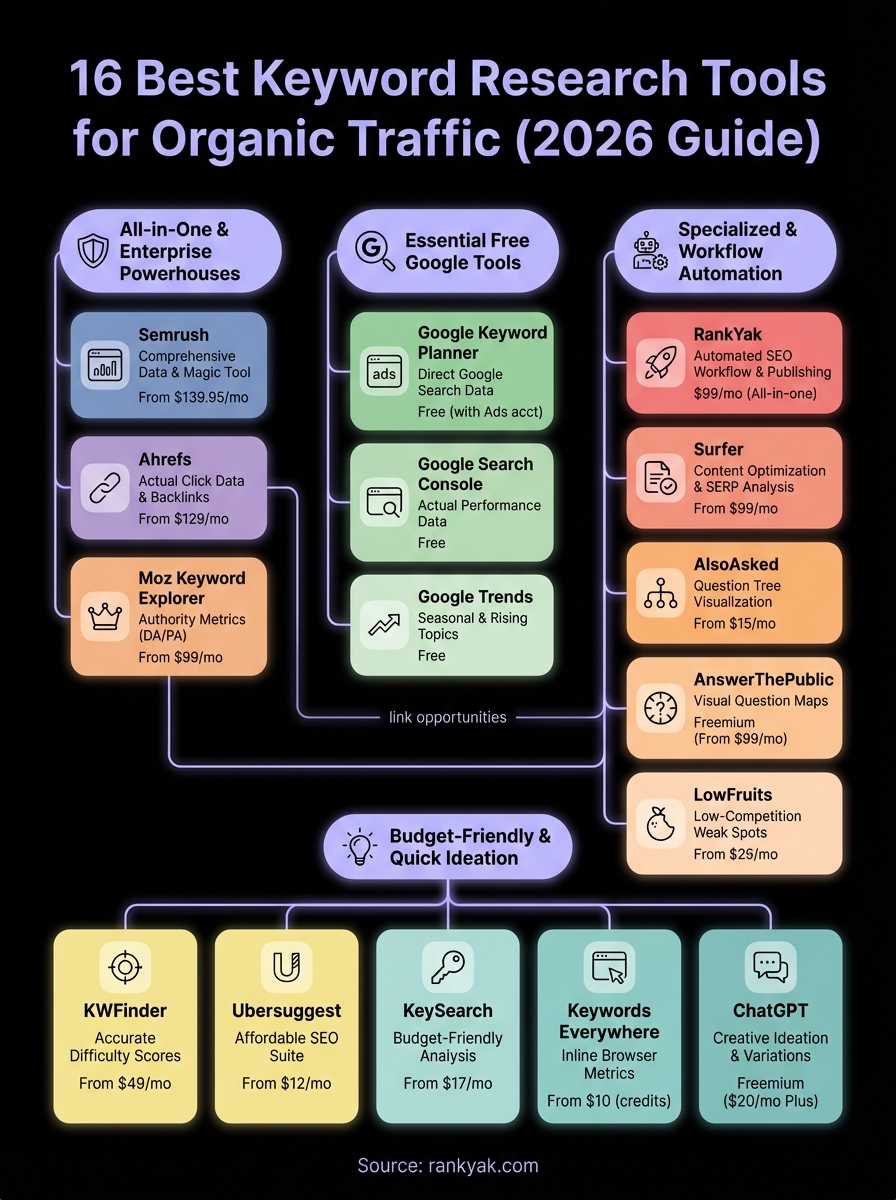
You now have a clear comparison of the best keyword research tools available in 2026, from enterprise platforms to free options. Each tool serves different needs: Semrush and Ahrefs deliver comprehensive data for established teams, Google's free tools provide reliable basics, and specialized platforms like LowFruits and AlsoAsked target specific research angles. Your choice depends on your budget, experience level, and whether you need just keyword data or a complete SEO workflow.
If you're starting out, the best free keyword research tools in 2026, Google Keyword Planner, Google Search Console, and Google Trends, give you reliable data without any subscription. Consider upgrading to a paid keyword ranking platform when you need competitor analysis, keyword tracking at scale, or difficulty scores that free tools don't provide. The best keyword research technique combines multiple tools: use free platforms for baseline data, a dedicated keyword tracker for monitoring positions, and a comprehensive platform for competitor analysis and content planning.
Most tools stop at research and leave you to handle the content creation, optimization, and publishing manually. That's where automation changes the game. RankYak eliminates the gap between finding keywords and ranking for them by handling discovery, writing, and publishing in one platform. Instead of juggling multiple subscriptions and spending hours on manual tasks, you get a complete SEO system that runs on autopilot for $99 per month. See what RankYak costs and start a free trial to watch automated keyword research and content creation drive actual traffic growth.
Lars Koole is a co-founder of RankYak and has worked in SEO since 2021, on the side where a strategy has to become a live page: inside agencies, alongside them, for clients directly, and in-house on the products being ranked. He is a software engineer by trade, which is how that page gets built. Before RankYak he founded companies of his own, two of which were acquired. At RankYak he owns the engineering and everything AI, and works out the solution and the implementation of each new feature.