SpyFu Keyword Research: A Step-by-Step SEO & PPC Guide for 2026
Knowing what keywords your competitors rank for, and how much they spend on ads, gives you a serious advantage. SpyFu keyword research unlocks exactly that, showing you the SEO and PPC strategies your rivals have tested (and paid for) over the years. Instead of guessing which terms to target, you can build campaigns based on proven data from real competitors.
SpyFu has carved out a reputation as one of the go-to tools for competitor keyword intelligence, and it sits alongside the other top keyword research tools for organic traffic. It pulls historical ranking data, ad spend estimates, and keyword overlap reports that help you find gaps in your own strategy. Whether you're running paid campaigns or focused purely on organic growth, the insights here can reshape how you prioritize content. At RankYak, we automate the keyword-to-published-article pipeline, but tools like SpyFu remain valuable for deep competitive analysis before you scale.
This guide walks you through SpyFu's core features step by step, from running your first competitor search to exporting keyword lists for SEO and PPC campaigns.
What SpyFu shows and when to trust it
SpyFu pulls from its database of billions of search results and ad clicks to build profiles of competing domains. When you search a competitor's URL, you get access to their organic keyword rankings, paid search history, ad copy variations, and estimated budget figures. The tool tracks over 15 years of historical data, so you can see which keywords a domain ranked for in 2015 versus today.
Core data points you get from SpyFu
Here's a rundown of the SpyFu key features in 2026 that matter most for keyword research:
- Organic keyword report: Shows which terms a domain ranks for in the top 100 results, along with search volume, ranking position, and estimated monthly clicks. You can filter by position (top 10, top 20, etc.) to focus on keywords where a competitor already has strong visibility.
- Paid keyword report: Reveals which terms they bid on, estimated cost per click, ad position history, and total monthly spend estimates. SpyFu also shows you the exact ad copy variations they've tested.
- Newly ranked keywords daily update: Flags keywords a domain just started ranking for, so you can spot emerging competitor strategies and react before they gain momentum.
- Keyword overlap tool: Highlights terms where two or three competitors rank but you don't, exposing gaps in your current content strategy, which is the same principle behind finding a competitor's best keywords through gap analysis.
- Backlink tracking: Shows which domains link to your competitors most frequently, with anchor text breakdowns and domain authority scores.
- Tagging and grouping: SpyFu tagging lets you label and organize keywords into custom groups directly inside the platform, so you can manage large keyword lists without relying solely on spreadsheets.
- International data: The SpyFu database covers multiple countries including the US, UK, Canada, Germany, Australia, and others, so you can research competitor keywords in regional markets.
These overlaps and newly ranked keyword alerts often represent low-hanging opportunities where you can target proven keywords with existing search demand.
When the numbers hold up (and when they don't)
SpyFu's ranking data refreshes regularly, but it's not real-time. Position tracking can lag by a few days, and some niche queries with low search volume may not appear at all. If you're targeting highly specific long-tail keywords or operating in a brand-new vertical, the SpyFu database might show limited results or SpyFu does not work as well as expected. The tool pulls stronger data for established domains in competitive industries like finance, SaaS, and ecommerce, where there's more search activity to track.
Trust the keyword lists and competitive gaps, but take ad spend estimates as directional rather than exact.
Estimated PPC budgets are calculated based on observed ad frequency and CPC averages, not actual invoices. Use these figures to gauge relative investment levels (who's spending aggressively versus conservatively) rather than precise dollar amounts. Organic ranking data tends to be more reliable because it's based on crawled search results rather than inferred behavior, making spyfu keyword research more dependable on the SEO side than the PPC projections.
Step 1. Set up your research with competitors
You start effective spyfu keyword research by identifying which competitors to analyze, the same opening move in any competitor keyword workflow for SEO and PPC. The tool performs best when you feed it direct competitors who target the same audience and keywords you want to rank for. Focus on 2 to 5 competitors who consistently appear in your target search results, and use those domains as your baseline for comparison.
Identify your top 3 to 5 competitors
Pick competitors who already rank for your core product or service keywords. Open an incognito browser window and search for the main terms your business targets (like "email marketing software" or "organic dog food"). Note which domains appear in positions 1 through 10 consistently. These are your priority competitors because they've proven Google trusts their content for queries you care about.
Avoid comparing yourself to massive brands with entirely different budgets. Look for similar-sized competitors or niche players who operate at a comparable scale.
Focus on competitors who show up repeatedly in your target searches, not just the biggest names in your industry.
Run your first domain comparison
Log into SpyFu and enter your primary competitor's URL in the main search bar. The dashboard loads their organic and paid keyword overview, showing total ranking keywords, estimated monthly traffic, and PPC budget. Click the "Competitors" tab to see which other domains overlap with their keyword profile.
Next, use the "Kombat" tool (SpyFu's comparison feature) to upload your domain plus 2 to 4 competitors. The results show shared keywords, exclusive keywords each domain ranks for, and gaps where competitors rank but you don't. Export this list as a CSV file. You now have a foundation dataset showing exactly where you compete and where opportunities exist.
Step 2. Find SEO keywords you can win
After loading competitor data, you need to filter down to keywords where you actually have a shot at ranking. The goal is to find high-opportunity keywords with decent search volume and ranking difficulty you can realistically overcome.
Filter for ranking difficulty and volume balance
Click into the organic keywords section of any competitor profile and apply filters to narrow the list. Set the difficulty score to a range that matches your domain's current authority (typically 30 to 50 for newer sites, 50 to 70 for established ones), the same logic behind how to find low difficulty keywords. Add a minimum search volume filter of 100 monthly searches to avoid wasting effort on terms nobody types.

Sort the filtered list by ranking difficulty ascending to see easier wins first. Look for keywords where your competitor ranks in positions 4 through 10. These represent terms where they have visibility but haven't fully optimized, giving you room to outrank them with stronger content. Pay special attention to question-based keywords and informational queries, which often have lower difficulty than commercial terms.
Target keywords where competitors rank in positions 4 to 10, not the heavily fortified top 3 spots.
Export keywords with realistic competition
Select 50 to 100 keywords from your filtered list and export them as a CSV file. Cross-reference each keyword with your existing content to identify gaps where you have no page targeting that term. These gaps become your content roadmap for the next 30 to 90 days, turning spyfu keyword research into actual articles and landing pages that compete directly with the domains you analyzed.
Step 3. Steal PPC insights from ads and keywords
SpyFu's paid search data reveals what your competitors spend money on, which tells you what actually converts for them. This SpyFu PPC tutorial section shows you how to skip expensive ad testing by analyzing proven ad strategies competitors have validated with real budgets.
Pull competitor ad copy and test variations
Navigate to the PPC Keywords tab in any competitor's SpyFu profile and sort by estimated monthly budget or ad position. Click on individual keywords to see every ad variation they've run for that term. SpyFu displays the headline, description, display URL, and date range each ad was active. Look for ads that ran for 6 months or longer, which signals they performed well enough to keep spending on.

Copy the top 5 to 10 performing ad variations into a spreadsheet with columns for keyword, headline, description, and landing page URL. Note patterns in their messaging like specific benefits called out, price mentions, or urgency phrases.
Ads that run for months prove they convert, making them safer templates than guessing what messaging works.
Find their most profitable paid keywords
Filter the paid keywords list by highest estimated monthly cost to see where competitors invest the most. Keywords with consistent high spend over multiple months represent terms that generate revenue for them. Export the top 100 paid keywords and cross-reference them against your current PPC campaigns.
Compare cost per click estimates across similar keywords to identify cheaper alternatives with comparable intent. If a competitor pays $12 per click for "project management software" but only $4 for "team collaboration tool," you've found a lower-cost entry point into the same buyer audience.
Step 4. Turn findings into an SEO and PPC plan
Raw keyword data from spyfu keyword research becomes valuable only when you transform it into specific content assignments and campaign structures. Organize findings into two separate execution plans: one for organic content creation and another for paid search campaigns.
Build your SEO content calendar from keyword gaps
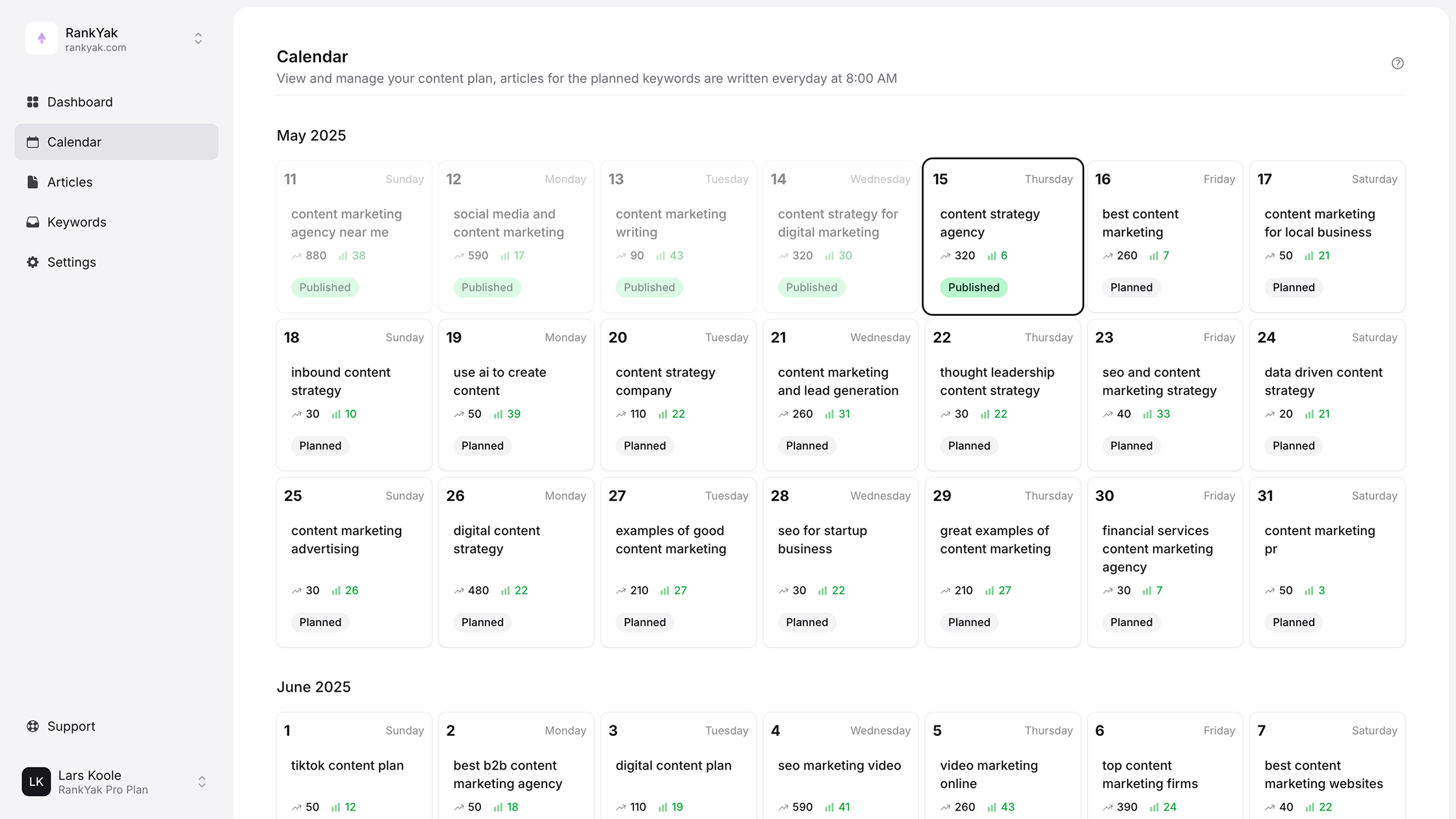
Take the 50 to 100 organic keywords you exported earlier and group them by topic clusters, either by hand or by pasting the export into a free tool that groups keywords into the clusters one article can rank for. Keywords like "email marketing automation," "automated email campaigns," and "email workflow software" all belong under one content pillar. Create a spreadsheet with columns for keyword, search volume, difficulty, target URL, and publish date, or let a rolling content plan decide which keyword gets published on which date. Assign each keyword cluster to a specific month based on difficulty, tackling easier wins first.
Map each keyword to either a new article or an existing page update. For genuine gaps where you have no ranking page, write those as new articles and schedule them across your calendar.
Schedule easier keyword targets first to build quick wins and domain authority before attacking harder terms.
Structure your PPC campaigns by intent clusters
Organize your paid keywords into campaigns based on search intent rather than lumping everything together. Separate informational queries ("what is CRM software") from commercial terms ("buy CRM software online") into different campaigns with distinct budgets and bid strategies.
Create ad groups with 5 to 10 tightly related keywords each. Use the competitor ad copy you analyzed as templates for your own headlines and descriptions, adapting their proven messaging to your brand voice. Set initial bids at 80% of the estimated CPC from SpyFu to test performance without overpaying.
Wrap up and put it to work
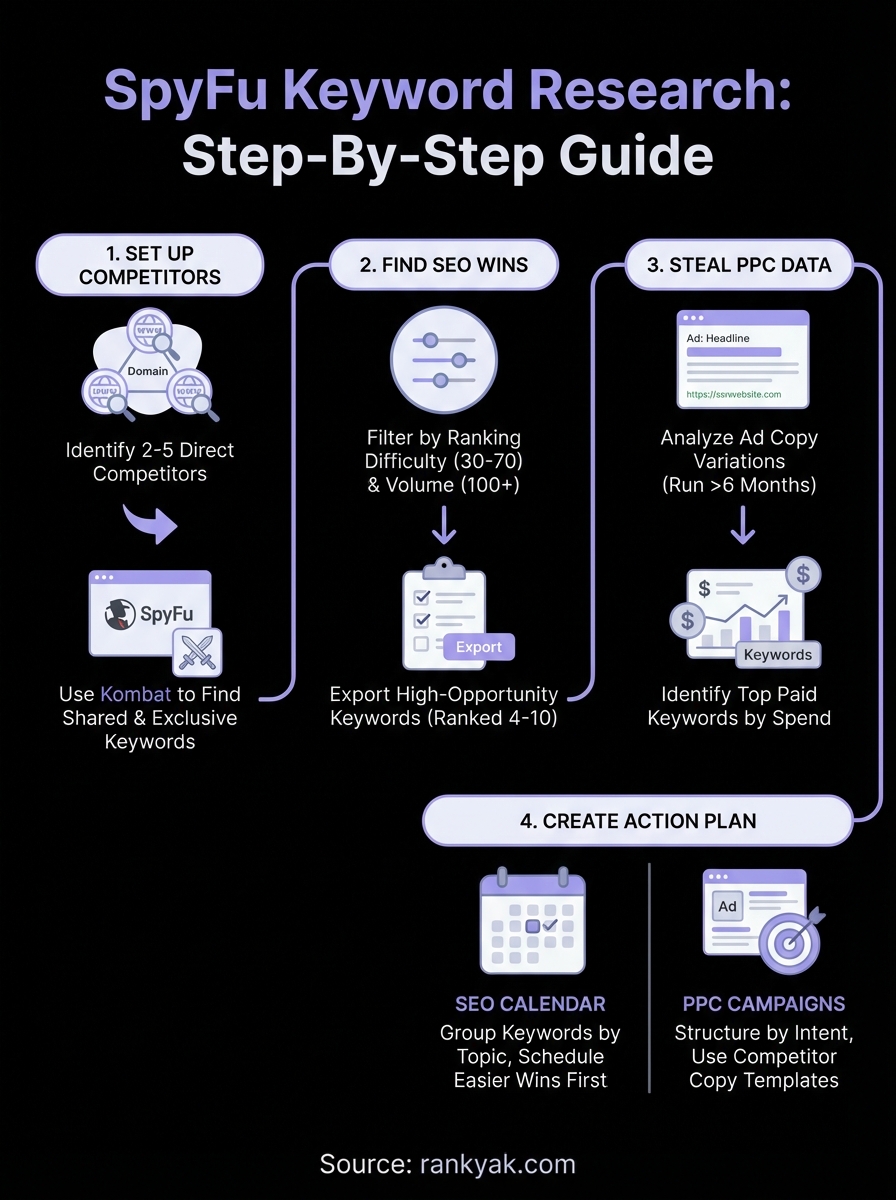
You now have a complete process for extracting competitor intelligence through spyfu keyword research and converting it into campaigns that drive traffic. The four steps (competitor setup, SEO keyword filtering, PPC ad analysis, and execution planning) give you a repeatable system for finding proven keywords your rivals have already validated with time and money. Run this process quarterly to keep your strategy current as competitors shift tactics.
The real bottleneck comes after keyword research when you need to produce optimized content at scale. Writing articles manually for 50+ keywords takes months, which lets competitors claim those rankings first. RankYak researches, writes, and publishes ready-to-rank articles in your brand voice, generating one SEO-optimized piece daily without you writing a word. You focus on strategy while the platform handles production, turning your SpyFu findings into ranking content faster than any manual approach.
Allan de Wit is a co-founder of RankYak and has worked in SEO since 2015: inside agencies, alongside them, for clients directly, and in-house on the products being ranked. He came to it as a software engineer building for marketers, which is why the platform is built the way it is. He went on to start companies of his own, two of which were acquired. At RankYak he sets the product direction and owns the features, the quality bar, the design, and the UX.