Importance of On-Page SEO: Why It Matters for Visibility
You can publish content every single day and still watch it sit on page three of Google. The missing piece isn't volume, it's what happens on the page itself. The importance of on-page SEO comes down to one thing: it's how search engines figure out what your content is about and whether it deserves to rank. Without it, even well-researched articles are essentially invisible.
On-page SEO covers everything you can directly control on your website, from title tags and header structure to internal links and keyword placement. Unlike off-page tactics like backlink building, these are changes you make to your own pages. That means faster implementation, clearer results, and no waiting on third parties. It's also one of the first things Google's crawlers evaluate when deciding where to place your content in search results for a given query.
Still, most businesses either skip on-page optimization entirely or treat it as an afterthought, a quick keyword drop in the title and nothing more. That's a problem, because Google's ranking systems have gotten far more sophisticated. They evaluate search intent, content structure, E-E-A-T signals, and dozens of other on-page factors before deciding if your page earns visibility. Getting this wrong means leaving traffic on the table, no matter how good your writing is.
This guide breaks down exactly why on-page SEO matters, what its core components are, and how to implement them effectively. Whether you're optimizing pages manually or using an automated platform like RankYak, which bakes on-page SEO best practices into every article it generates, understanding these fundamentals will help you make smarter decisions about your content strategy. Let's get into it.
What on-page SEO covers and what it doesn't
On-page SEO is the practice of optimizing individual web pages so search engines can understand their content and relevance to specific queries. It's distinct from other SEO disciplines because every change happens on your own site, giving you direct control over the outcome. Understanding what falls inside and outside this category helps you prioritize your efforts and avoid common misunderstandings about where visibility actually comes from.
What on-page SEO includes
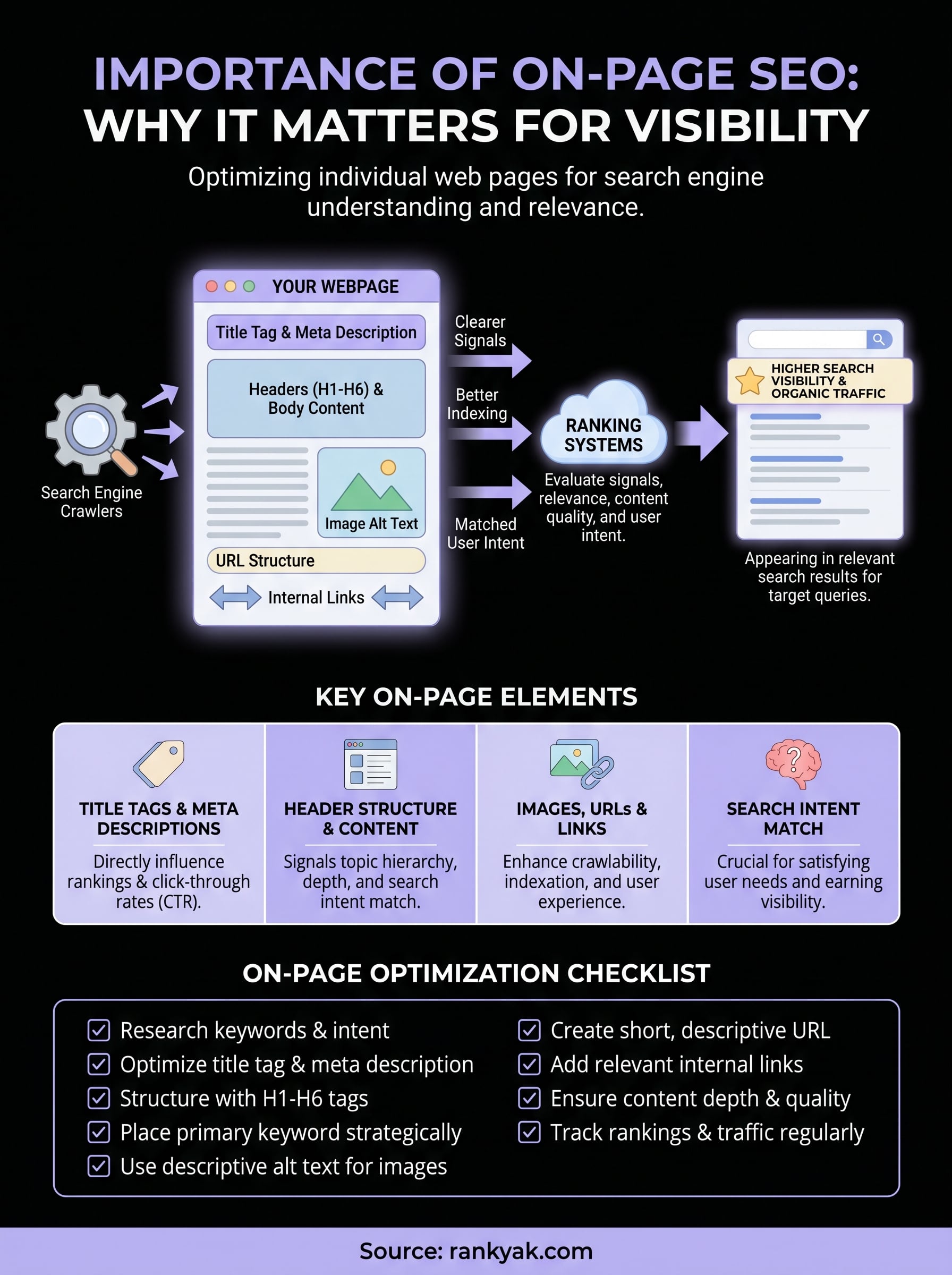
On-page SEO covers every element that lives on the page itself or in its underlying content structure. That includes title tags, meta descriptions, header tags (H1 through H6), body content, keyword placement, image alt text, URL structure, and internal links. Each of these signals tells search engines what the page is about and how it connects to other content on your site. When these elements align with what a searcher is looking for, your page makes a much stronger case for ranking.
The importance of on-page SEO becomes clearest when you realize Google uses these on-page signals to match your content to user queries before it even considers who links to you.
Beyond the technical elements, on-page SEO also includes content quality factors like search intent alignment, topic depth, readability, and E-E-A-T signals. A page can have a perfect title tag and still fail to rank if the body content doesn't satisfy what the searcher actually wants. Google's own guidance makes clear that content needs to demonstrate genuine expertise and fully address the query, which means structure and substance both count. Here's a breakdown of the core on-page elements and what each one does:
| Element | What it does |
|---|---|
| Title tag | Tells search engines and users what the page is about |
| Meta description | Influences click-through rate in search results |
| Header tags | Organizes content and signals topic hierarchy |
| Body content | Demonstrates relevance, depth, and search intent match |
| Image alt text | Helps search engines index visual content |
| URL structure | Reinforces page topic and improves crawlability |
| Internal links | Connects related pages and distributes link equity across your site |
What on-page SEO doesn't include
Off-page SEO and technical SEO are separate disciplines, and it's worth being clear about where on-page SEO ends. Off-page SEO refers to actions taken outside your website, primarily backlink acquisition, brand mentions, and digital PR. You can optimize every element on a page correctly and still need external authority to compete in highly contested niches. These disciplines work together, but they require different strategies and different timelines to show results.
Technical SEO covers server-side factors like site speed, crawlability, mobile responsiveness, structured data, and Core Web Vitals. While some of these touch individual pages, they're driven by infrastructure and code rather than content decisions. If your site has crawl errors, slow load times, or indexing issues, resolving those falls into technical SEO territory, not on-page work. Keeping these categories separate helps you stay focused and prevents you from treating a quick content fix as a substitute for deeper platform-level changes that need their own attention.
Why on-page SEO matters for visibility
Search engines can't read your content the way a person does. They process signals and patterns to determine what a page covers and whether it answers a given query well. On-page SEO gives those systems the structured information they need to make that determination. Without it, your content becomes harder to categorize, which directly reduces your chances of appearing in the right search results. No amount of publishing frequency changes that equation if the fundamental signals are missing.
How search engines use on-page signals
Every time Google crawls a page, it reads title tags, headers, body content, and internal links to build a picture of what the page is about and how well it addresses a topic. These signals feed into ranking systems that evaluate both relevance and helpfulness before placing your content in results. The importance of on-page SEO becomes concrete when you realize that a page with weak signals, even one covering a genuinely valuable topic, will lose ground to a better-structured competitor every time. Google's systems are built to reward pages that make relevance obvious and content depth clear, not pages that bury the point in a wall of generic text.
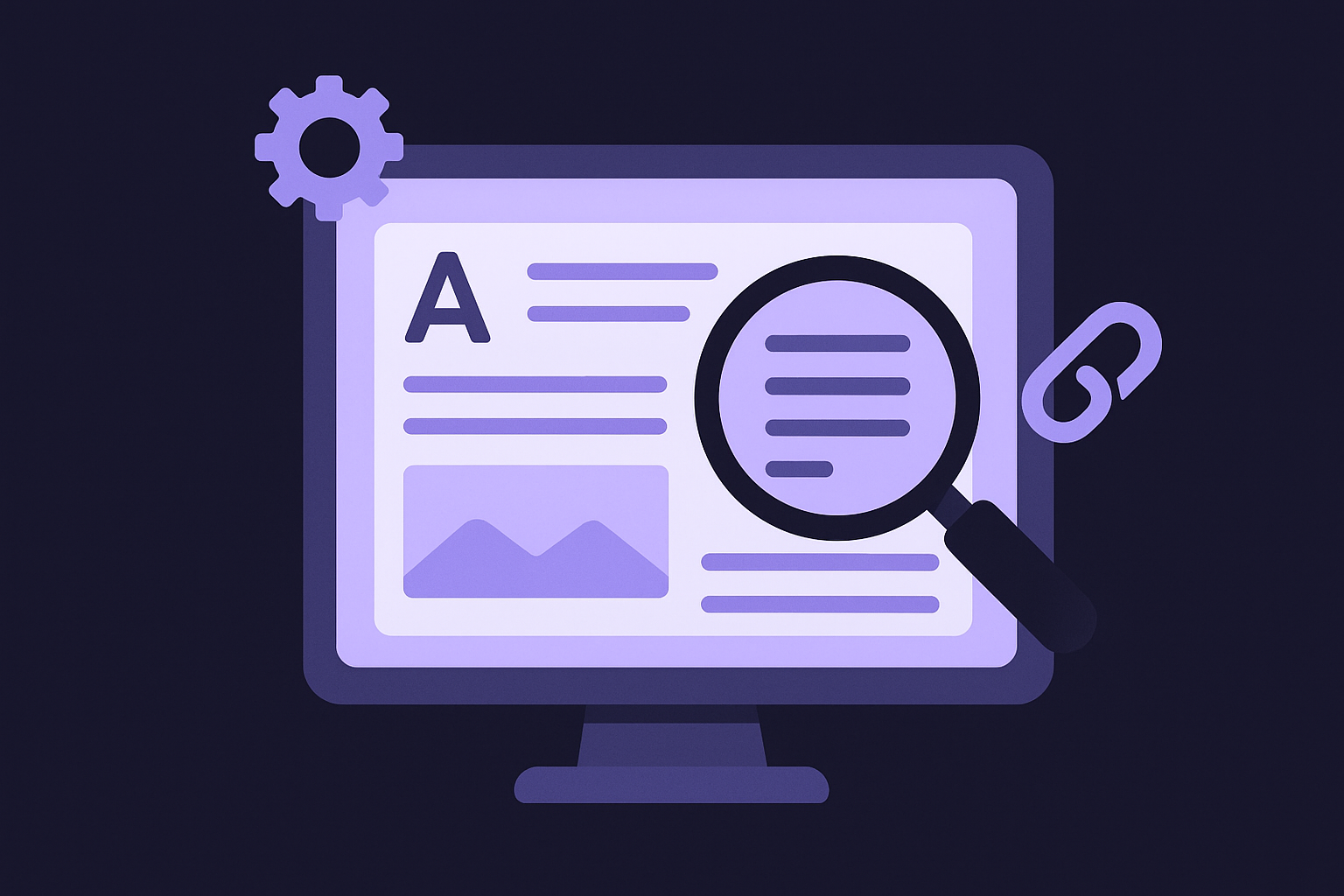
When your on-page signals align with what searchers are actually looking for, your page earns a position in results that unoptimized content never would.
Why intent matching determines whether your page ranks
Search intent is the core reason someone types a query into Google, and it's one of the most critical on-page factors you can optimize for. If your page targets a keyword but the content doesn't match what users actually want, Google will deprioritize it regardless of how well you've handled other technical elements. A page targeting "best project management tools" needs to deliver a comparative breakdown with real recommendations, not a surface-level definition of what project management software does.
Matching intent also affects click-through rate and dwell time, both of which send behavioral signals back to Google about whether your page satisfied the searcher. If users click your result and bounce immediately, that pattern signals a mismatch between your content and their need. Getting the intent right upfront means your on-page work builds momentum over time, creating a track record of satisfied visitors rather than a signal Google learns to penalize.
The on-page elements that affect rankings most
Not all on-page elements carry equal weight. Some have a direct impact on how Google categorizes and ranks your page, while others influence whether users actually click through or stay on your content. Understanding which on-page factors do the most work helps you allocate your time and avoid optimizing low-impact details while neglecting the ones that drive real results. The importance of on-page SEO becomes practical when you know exactly which levers to pull and why each one matters for a specific page.
Title tags and meta descriptions
Your title tag is the single most important on-page element for search rankings. It tells Google the specific topic of your page and appears as the clickable headline in search results. A strong title tag includes your target keyword near the beginning, stays under 60 characters to avoid truncation, and makes a clear promise to the searcher. Vague or keyword-stuffed titles hurt both rankings and click-through rates, so treat each title as a direct answer to what your target audience is searching for.
Meta descriptions don't directly influence rankings, but they shape whether someone clicks your result, which sends behavioral signals Google does pay attention to.
Each meta description you write should expand on the title, deliver a specific value proposition, and include a natural use of your target keyword. Keep it between 140 and 160 characters and write it as a direct pitch to the searcher, not a summary written for the algorithm.
Header structure and content depth
Header tags (H1 through H3) organize your content into a hierarchy that search engines use to understand your topic coverage, and you can pull the full outline of any page to see how yours is built. Your H1 should contain your primary keyword and appear only once per page. Subheadings should introduce distinct subtopics and use related terms and phrases that reinforce the page's overall relevance. A well-structured header hierarchy tells Google you've covered the topic thoroughly, which supports ranking for a wider range of related queries.
Content depth matters just as much as structure. Pages that address the full scope of a topic, including common questions, related concepts, and practical detail, consistently outperform thin content that only scratches the surface. Google's systems reward completeness, so covering a subject end-to-end gives your page a stronger ranking signal than padding word count with repetition.
How to optimize a page with an on-page checklist
Knowing the importance of on-page SEO is one thing; working through it systematically on each page is another. A step-by-step on-page checklist turns abstract best practices into a repeatable process you can apply every time you publish or update content. Instead of relying on memory or intuition, you work through the same set of checkpoints on every page, which makes your results more consistent and gaps far easier to catch before they cost you rankings.
Before you write: keyword and intent research
Start with a clear target before you touch the page. Identify your primary keyword and confirm what type of content currently ranks for it, whether that's a how-to guide, a product comparison, or a definition. This step determines your content format, your header structure, and how much depth you need to cover the topic properly. Getting intent wrong at this stage means the rest of your on-page work won't move the needle, because the content won't match what searchers actually want.
Skipping intent research is the fastest way to produce a fully optimized page that still doesn't rank.
While you write: structural and keyword placement checks
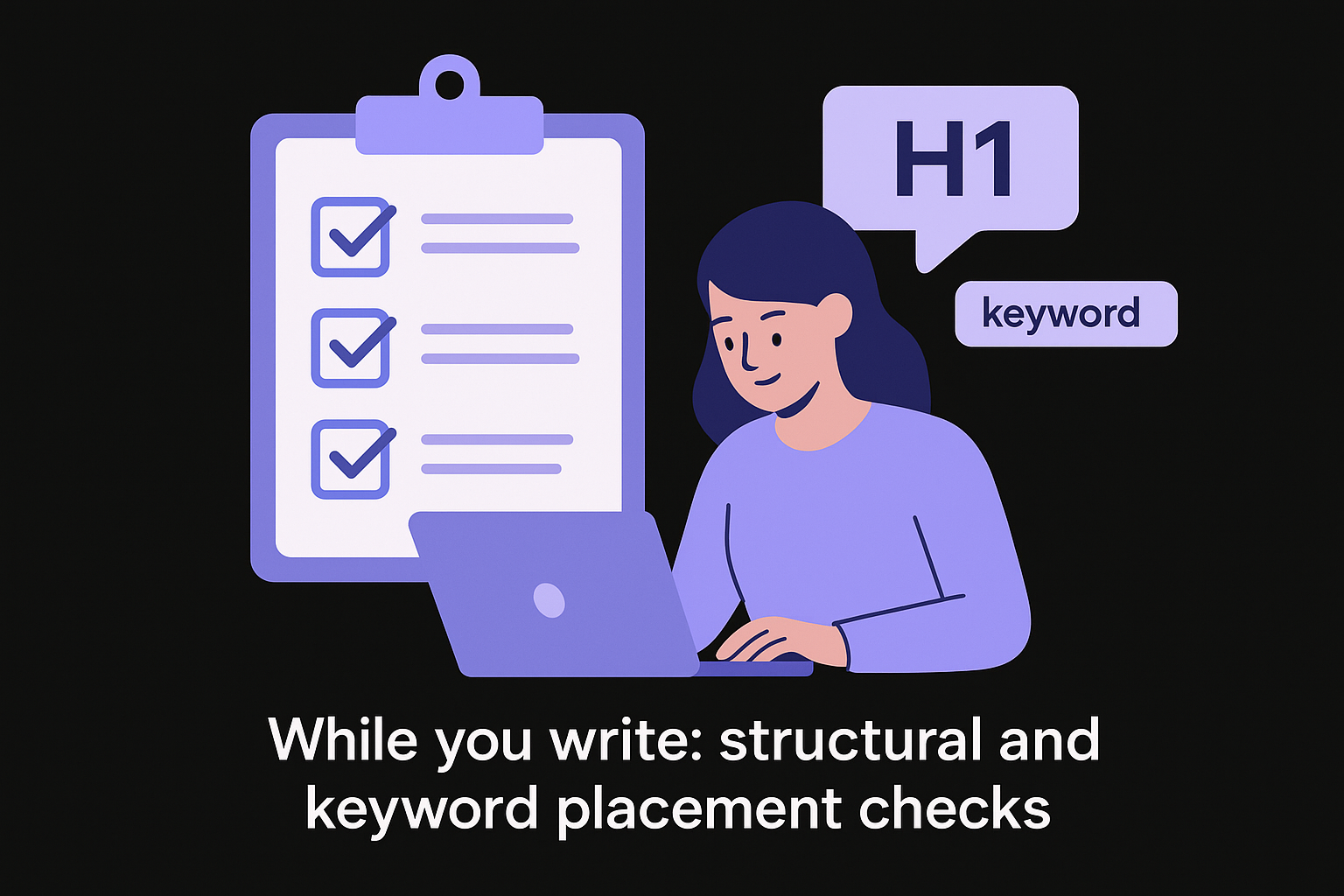
As you build the page, work through the structural elements in sequence. Place your primary keyword in the H1, within the first 100 words of the body, and in at least one subheading. Use related terms and synonyms naturally throughout the content rather than repeating the exact phrase, and check the phrase frequency on the page if you suspect you have overdone it. Keep each section tightly focused on one subtopic, and make sure every header gives a clear signal about what follows it. Your URL should be short, descriptive, and include the target keyword with no unnecessary stop words or filler characters that dilute its relevance signal.
After you write: meta, links, and images
Once the content is complete, address the remaining on-page elements before you publish. Write a title tag under 60 characters with the primary keyword near the front, then see how the result appears in Google before you publish. Draft a meta description between 140 and 160 characters that tells the searcher exactly what they'll find on your page. Add descriptive alt text to every image, and where it fits naturally, include a relevant keyword. Add at least two internal links to related pages on your site to help Google understand your content structure and distribute authority across your most important pages.
How to measure and keep your on-page wins
Optimizing a page is not a one-time event. Rankings shift, competitors update their content, and Google regularly refines how it evaluates on-page signals. Treating your on-page work as an ongoing process rather than a project you complete once means you catch drops early, maintain hard-earned positions, and keep building on the foundation you've already laid. Tracking results also shows you which changes actually moved the needle, so you can repeat what works.
Track rankings and organic traffic
Connect your site to Google Search Console and check it regularly after publishing or updating pages. Look at the queries your pages appear for, the average position, and how click-through rates change over time, since tracking SEO performance is what tells you which changes worked. A page that ranks on page two but earns a high click-through rate often just needs a better title tag or meta description to push it into the top five positions. These small adjustments, informed by real data, tend to deliver faster gains than rewriting entire pages from scratch.
When you can see exactly which queries each page ranks for, you stop guessing and start making changes that move results in a specific direction.
Pair Search Console with Google Analytics to track organic sessions, bounce rate, and engagement time. A page that ranks but loses visitors quickly signals an intent mismatch or a structural problem inside the content itself. Reading both tools together gives you a complete picture of performance rather than just one angle.
Keep pages current with regular audits
The importance of on-page SEO doesn't stop at publication. Set a quarterly review schedule for your top-performing pages and any pages you've optimized in the past six months, or let an audit find the pages losing clicks for you. Check whether your target keyword still matches current search intent, whether competitors have added content that outpaces yours in depth, and whether any internal links point to outdated or removed pages. Small updates to headers, examples, or supporting data can refresh a page's relevance signal without requiring a full rewrite.
Outdated content loses rankings gradually, often before you notice a traffic drop. Building a simple audit habit, even reviewing five pages a month, keeps your on-page work compounding over time instead of slowly eroding.
Next steps
On-page SEO is not complicated, but it does require consistency and deliberate attention to detail. The importance of on-page SEO sits in the fact that every signal you place on a page either helps Google understand your content or creates noise it has to work around. You now have a clear picture of what those signals are, which ones carry the most weight, and how to track whether your changes are actually working. That knowledge only creates results when you put it into action on actual pages.
Your next move is straightforward: pick one underperforming page, run it through the checklist in this guide, and measure what changes over the following weeks. Small, deliberate improvements compound over time into real ranking gains. If you want to skip the manual work entirely and have every article published already optimized from the ground up, let RankYak research, write, and publish your SEO content daily and see how far consistent, on-page-optimized content takes your organic traffic.
Lars Koole is a co-founder of RankYak and has worked in SEO since 2021, on the side where a strategy has to become a live page: inside agencies, alongside them, for clients directly, and in-house on the products being ranked. He is a software engineer by trade, which is how that page gets built. Before RankYak he founded companies of his own, two of which were acquired. At RankYak he owns the engineering and everything AI, and works out the solution and the implementation of each new feature.